ANALYSE – JD Vance, the Shadow Strategist of Trumpian Realpolitik toward Iran
By Angélique Bouchard
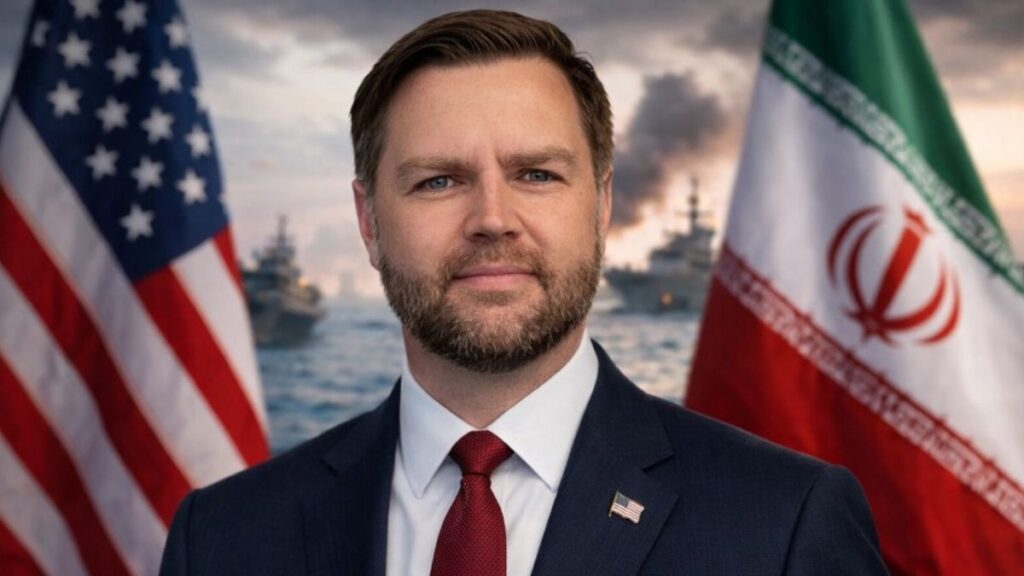
In Budapest, JD Vance has emerged as the leading spokesman for the American strategy toward Iran. Combining military pressure, economic leverage, conditional negotiation, and a display of force, the vice president has articulated an unapologetically realist line now identifiable as a genuine Vance Doctrine 2026.
At 42, JD Vance is no longer a vice president operating in the background. In Hungary, on Wednesday, April 8, 2026, before the Mathias Corvinus Collegium in Budapest, he asserted himself as both the intellectual architect and the most incisive communicator of the U.S. strategy toward Iran. Pragmatic to the point of brutality, faithful to his president’s line while adding a personal touch of his own—including a rare reference to prayer and to “being on God’s side”—Vance embodies the new Republican generation: one that combines overwhelming displays of force with conditional offers of negotiation, never concealing the hard realities of power politics.
From Budapest, the U.S. vice president laid out in detail the « doctrine Vance 2026 », built around the two paths offered to Tehran: normalization or deeper economic and strategic isolation. It is a vision that blends military deterrence, asymmetric economic leverage, and a demand for good faith, in the context of a truce conditioned on the reopening of the Strait of Hormuz.
His statements now form a coherent body of thought: a binary, pedagogical, and implacable vision that places Tehran squarely before its historic responsibilities.
A High-Tension Truce at the Heart of the Persian Gulf
After a month of U.S. military operations codenamed Operation Epic Fury, diplomacy has resumed in a climate of extreme fragility. President Donald Trump agreed, at the last minute on Tuesday evening, to a two-week pause in strikes against Iran, strictly conditioned on the “full, immediate, and safe” reopening of the Strait of Hormuz.
This strategic artery, through which roughly 20 percent of the world’s oil transits, saw its blockage trigger an immediate price surge: gasoline rose above $4 a gallon in the United States for the first time since 2022, with inflationary repercussions already being felt in Europe and Asia.
It was in this highly sensitive geopolitical and energy context that Vice President JD Vance delivered, on Wednesday, April 8 in Budapest, during an address at the Mathias Corvinus Collegium, the most structured and revealing statement to date on the American strategy. His remarks amount to a genuine doctrine—one that can reasonably be described as the Vance Doctrine 2026—organized around the « deux voies » offered to Iran.
Vance in Hungary: “A Fragile Truce” and the Absolute Demand for Good Faith
Before a Hungarian audience, JD Vance did not attempt to hide the precariousness of the current arrangement. “That is why I say this is a fragile truce,” he declared at the outset. He explicitly distinguished between two camps within the Iranian regime: on the one hand, “people who clearly want to come to the negotiating table and work with us to reach a good agreement”; on the other, “people who are lying even about the fragile truce we have already reached.”
The vice president was particularly blunt about the consequences of any breach: “If the Iranians are prepared to work with us in good faith, I think we can reach an agreement. If they lie, if they cheat, if they try to undermine even the fragile truce we have put in place, they will not be happy.”
This insistence on “good faith” is not rhetorical. It is the decisive test of the phase now opening. Vance then recalled the assets available to Washington: “What the president has also shown is that we still have clear military leverage, diplomatic leverage, and perhaps most importantly, extraordinary economic leverage.” The message is unmistakable: Donald Trump has chosen the path of negotiation, but he remains “eager to make progress” and “is not one to mess around.”
The “Vance Doctrine 2026”: The Two Strategic Paths Offered to Tehran
At the core of the vice president’s remarks—notably in his address the previous day, Tuesday, April 7, in Hungary—is the most fully developed formulation yet of the U.S. strategy for 2026: a clear, almost didactic binary vision summed up in « two pathways ».
“There are really two ways this ends,” JD Vance explained. He first offered an unambiguous assessment of U.S. military operations: “The military objectives of the United States have largely been accomplished. There is still some work we would like to do—for example regarding Iran’s capacity to produce weapons—but fundamentally, the military objectives have been met.”
It is on the basis of this acquired military superiority that the two pathways are structured:
Path A – Normalization (“A Normal Country”)
ran decides to break with its past behavior: it stops financing terrorism, ends the destabilization of its neighbors—Israel as well as Arab states—and chooses to integrate fully into “the global system of trade and exchange.”
According to Vance, the consequences would be profoundly positive: “That would mean a lot of better things for them economically. It would mean better things for the peace and security of the world. It would mean a lot of good things for a lot of people all across the planet. That is option A.”
À lire aussi : TRIBUNE – Europe : Les giroflées à cinq pétales de JD Vance
Path B – Isolation and Rising Costs
Conversely, if Tehran “does not come to the table” and remains “committed to terrorism, to terrorizing its neighbors,” then “the economic situation in Iran will continue to be very, very bad. And frankly, it will probably get worse.”
Vance stressed the asymmetry in economic power relations, a central element of the doctrine: “While the Iranians seek to impose maximum economic costs through the Strait of Hormuz, the United States has the capacity to impose far greater economic costs on Iran than Iran can impose on us or on our friends around the world.”
This binary vision embodies an updated version of “peace through strength”: having demonstrated its military resolve through the destruction of ballistic missiles, the annihilation of the Iranian navy, the weakening of terrorist proxies, and a lasting guarantee against the acquisition of nuclear weapons, Washington is now offering an honorable exit while brandishing economic and military leverage that remains only partially used. “We have tools in our toolbox that we have not yet decided to use. The president of the United States can decide to use them, and he will use them if the Iranians do not change their behavior,” Vance warned.
The vice president did not hesitate to describe Iranian actions as “acts of economic terrorism” that obstruct the free flow of gas and oil worldwide. He also confirmed that the United States had already struck military targets on Kharg Island, Iran’s main oil export hub.
On the moral and spiritual plane—a rare dimension in a speech of this level—JD Vance said he was praying that the United States would be “on God’s side” in its determination to prevent Iran from acquiring a nuclear weapon: “We are doing this because we do not want a regime that has committed acts of terrorism to possess the world’s most dangerous weapon. […] I certainly hope God agrees with the decision that Iran should not have a nuclear weapon, but I will continue to pray about it.”
The Vance Doctrine 2026 stands out for its strategic clarity: it avoids the ambiguity of past negotiations, explicitly places responsibility for escalation or de-escalation on Tehran, and tightly links military success, economic pressure, and conditional diplomatic openness.
Pakistan’s Pivotal Role: A Credible Regional Facilitator for the “Islamabad Talks”
Pakistani mediation is the major diplomatic innovation of this phase. Prime Minister Shehbaz Sharif welcomed the “wise gesture” by both sides and invited the American and Iranian delegations to Islamabad as early as Friday, April 10, for what he called “conclusive negotiations.”
Tehran publicly thanked Islamabad and agreed to halt its defensive operations if attacks on its territory ceased. The ceasefire would apply “everywhere,” including Lebanon. By virtue of its geography, its historic ties with Iran, and its longstanding status as a U.S. ally, Pakistan offers a rare and acceptable channel of dialogue for both capitals.
*
* *
Islamabad: A Moment of Truth for the Regional Order and Global Energy Stability
The two-week truce now beginning is therefore not merely a tactical pause. It represents the first real test of the Vance Doctrine 2026: the two pathways are clearly defined, American leverage remains intact, and the Trump administration’s strategic impatience is openly acknowledged.
Everything will now depend on Iranian good faith during the Islamabad talks. The stakes go far beyond the bilateral file: the stability of global energy flows, the credibility of nuclear non-proliferation, the resilience of Western alliances in the face of an already fragile multilateral order, and the capacity of major powers to impose a new form of geopolitical realism.
The world is watching. The coming hours—and the talks in Islamabad—will determine whether Tehran chooses Path A, that of normalization, or whether Washington will once again activate the tools still available in its toolbox.
À lire aussi : ANALYSE – JD Vance, le stratège de l’ombre de la realpolitik trumpienne face à l’Iran
#JDVance,#TrumpDoctrine,#IranCrisis,#Geopolitique,#Realpolitik,#USForeignPolicy,#IranNuclear,#MiddleEastTensions,#StrategieMilitaire,#Diplomatie,#StraitOfHormuz,#OilCrisis,#GeopoliticsAnalysis,#GlobalSecurity,#USIran,#SanctionsEconomiques,#PowerPolitics,#Trump2026,#InternationalRelations,#EnergySecurity,#MilitaryStrategy,#EconomicPressure,#GeopoliticalRisk,#IranDeal,#WarAndPeace,#StrategicDoctrine,#GlobalOrder,#USStrategy,#ConflictAnalysis,#IranSanctions,#EnergyMarkets,#CrisisManagement,#WorldPolitics,#SecurityPolicy,#DefenseStrategy,#GeopoliticalShift,#USLeadership,#IranNegotiations,#StrategicTensions,#GlobalInstability