ANALYSIS – State Aids, Energy Sovereignty and the Nuclear Renaissance: The European Union put to the test by the EDF Case and States Responses
François Souty, PhD, Head of the Economy Section at Le Diplomate média
Executive Summary
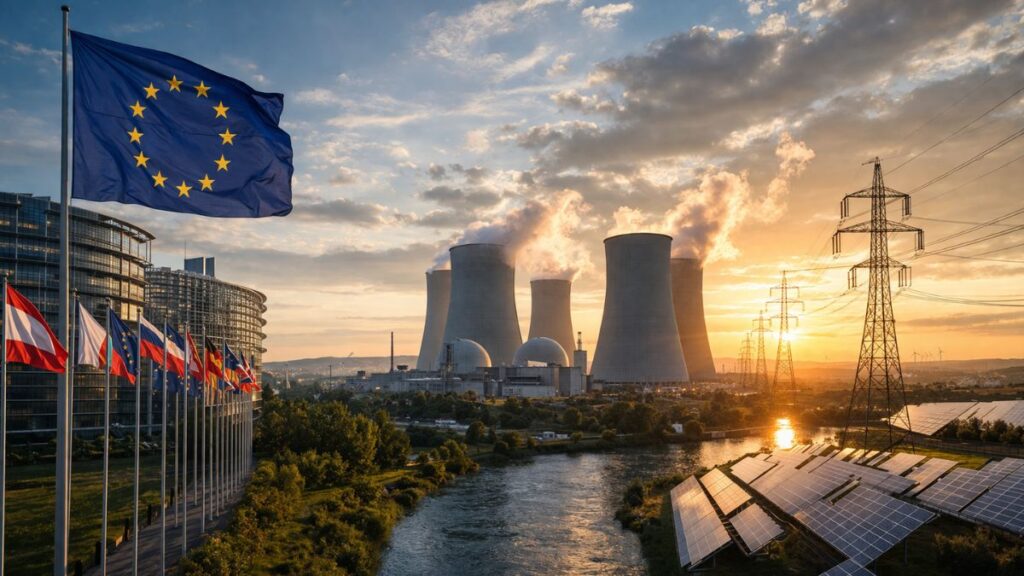
The possible opening of an investigation by the European Commission into the French state’s public support for EDF for the construction of new nuclear reactors raises issues that go beyond the traditional framework of state aid control and European competition policy. It highlights a growing tension between the requirements of the internal market and the imperatives of energy security and sovereignty, in a context of strong geopolitical instability and acceleration of the climate transition.
Faced with the serious risk of significant delays in the implementation of the French nuclear programme, several levers of action can be mobilised. From a legal point of view, France has substantial room for manoeuvre by relying on the exceptions provided for in Article 107 §3 TFEU, in particular those relating to the development of certain economic activities and the achievement of objectives of common interest, such as security of supply and decarbonisation. The qualification of nuclear power as a service of general economic interest is also a structuring axis for framing public compensation mechanisms.
At the same time, the use of the British precedent of Hinkley Point C and the Commission’s recent decision-making practice offers solid arguments in favour of the compatibility of the measures envisaged, in particular if they are designed in a logic of proportionality and limitation of distortions of competition reviewed in the light of geopolitical events.
Beyond the legal register, a proactive political strategy appears to be decisive. It presupposes the creation of broader alliances between Member States in favour of nuclear power, the mobilisation of the European Council and a requalification of the debate at EU level, insisting on the strategic and urgent dimension of energy security.
Finally, controlling the time factor is a central issue: France will have to anticipate the procedure, structure its mechanisms upstream and, if necessary, consider transitional solutions or adaptations to its financing mechanisms in order to limit the delaying effects of an in-depth investigation.
All these actions are part of an integrated approach aimed not at circumventing EU law, but at making full use of its resources in order to reconcile competitive discipline and strategic imperatives. If the search for a rapid consensus with the Commission does not materialise, there will inevitably be other much more aggressive courses of action.
Introduction
The announcement, relayed by the Reuters agency, of the possible opening of an investigation by the European Commission into the support measures envisaged by the French State in favour of EDF for the construction of six new-generation nuclear reactors is part of a context of profound recomposition of the European Union’s energy and industrial priorities.[1] It comes at a time when the balances on which EU competition law has historically been based are under unprecedented strain, resulting both from the deterioration of the geopolitical environment and the acceleration of climate objectives.
The succession of energy crises that have affected the European continent since 2022, particularly as a result of the war in Ukraine, has highlighted the structural vulnerability of Member States to external hydrocarbon supplies.[2] In addition to this fragility, there are persistent uncertainties weighing on global energy markets, in a context marked by recurrent tensions in the Middle East, which are likely to have a lasting impact on the conditions of access to low-cost fossil resources.[3] In this context, securing stable, carbon-free and controlled electricity production now appears to be a strategic imperative, to which the nuclear revival programme undertaken by France intends to respond.
However, this programme involves investments of such a magnitude that they require structuring public support, which may fall within the scope of State aid law.[4] The possible opening of an in-depth investigation by the Commission therefore raises questions about the compatibility of these interventions with the rules of the internal market, in a sector where market failures are particularly pronounced. The precedent of the decision on the Hinkley Point C project, by which the Commission had accepted, subject to conditions, the compatibility of a public support mechanism for British nuclear power, is an essential anchor in this respect,[5] revealing both the possibility of validation and the complexity of the examination procedures.
Beyond the sole question of the legality of the aid envisaged, the current situation highlights a more fundamental tension between, on the one hand, the objective of preserving the conditions of competition and, on the other hand, the need for the Member States to implement industrial and energy policies adapted to contemporary challenges.[6] This tension is all the more obvious as the Union is simultaneously pursuing ambitious objectives for the electrification of uses, in particular through the planned ban on the sale of internal combustion vehicles by 2035,[7] which implies a significant accelerated increase in controllable low-carbon electricity production capacities.
In this context, the analysis of the French case invites us to go beyond a strictly contentious reading of the control of State aid to question the room for manoeuvre available to the Member States in order to reconcile their strategic imperatives with the requirements of EU law. It also leads to a prospective consideration of the various responses — legal, institutional and political — that could be mobilized to prevent or mitigate the potentially delaying effects of an investigation procedure on the implementation of the French nuclear program.[8] The study of the EDF case thus appears to be a privileged field for observing the ongoing recompositions of State aid law, at a time when it is confronted with the rise of the imperatives of energy sovereignty and security of supply, dramatically accentuated by the Ukrainian and Iranian geopolitical contexts.
I. Public support for EDF’s nuclear programme: economic rationality and strategic necessity
The analysis of the public support envisaged in favour of EDF presupposes, first of all, an understanding of its economic and financial determinants, before assessing its strategic significance in the light of the new constraints weighing on European energy systems. This dual perspective – economic and strategic – fully justifies the State’s involvement in the development of the nuclear plants fleet.
A. The economic and financial determinants of support
EDF’s programme to build six new-generation nuclear reactors involves considerable investments, estimated at several tens of billions of euros.[9]In this context, the mobilisation of public support appears to be a sine qua non condition for the economic viability of the project, given the high fixed costs, the long construction times and the financial risks inherent in nuclear projects.[10]
The French government has thus provided financing mechanisms to secure EDF’s cash flow and guarantee the feasibility of projects in a context of volatility in the energy markets.[11] These measures aim to stabilise revenue streams over the long term, limit financial risks and reduce the cost of capital, which is a key factor in the competitiveness of nuclear power in the face of intermittent renewable energy sources and fossil fuels subject to large price fluctuations.[12]
The financial support provided to EDF cannot be understood solely in the light of short-term market economic considerations. It is part of a broader logic of energy and industrial sovereignty, which has become central in the contemporary European context. As Mario Draghi highlighted in his report on European competitiveness, controlling energy costs and supply is a key determinant of the EU’s competitiveness and economic resilience.[13] In an environment marked by increased geopolitical tensions and volatility in energy markets, securing stable and controllable production appears to be an absolute strategic imperative.
In this respect, the use of structuring energy infrastructures, such as the nuclear fleet operated by EDF, is part of a strategy aimed at guaranteeing national energy independence while contributing to the stability of the European electricity system. This approach goes beyond the logic of immediate profitability to be part of a long-term perspective, articulating security of supply, industrial competitiveness and energy transition.
B. The strategic scope of the French nuclear programme
Beyond economic considerations, EDF’s nuclear programme has a major strategic dimension. Europe’s dependence on imported hydrocarbons, accentuated by the war in Ukraine and Iran, and the volatility of world markets, highlights the need to have sovereign and carbon-free energy sources available as quickly as possible on the scale of a few years.[14]
According to the International Energy Agency, energy security remains a central issue in a context of strong geopolitical instability, which justifies increased investment in controllable low-carbon energy sources. Nuclear power offers stable, dispatchable and low-carbon electricity production, directly meeting the requirements of security of supply and the European Union’s climate objectives. Institutional analyses underline that the revival of the French nuclear industry is based on the maintenance and development of critical industrial skills. In particular, the CEA (French Nuclear Energy Commission) highlights the need to preserve a core of internal skills and to strengthen training, in order to guarantee technological mastery and the safety of the facilities.[15]
Anticipating future electricity needs is a major strategic challenge for Europe, particularly in the context of the increasing electrification of uses and the gradual ban on the sale of internal combustion vehicles planned for 2035. This development, provided for by the European regulations on CO₂ emissions from cars and vans,[16] implies a significant increase in electricity demand, reinforcing the relevance of the French and European nuclear program as a tool for energy security and industrial stability.
Analyses by the International Energy Agency (IEA) confirm this finding. The World Energy Outlook 2023 highlights that the transition to low-carbon electricity systems cannot succeed without forward-looking investments in stable and controllable infrastructure, with nuclear power playing a central role in reducing dependence on imported fossil fuels and ensuring continuity of supply[17]. In addition, the Nuclear Power and Secure Energy Transitions[18] report shows that nuclear energy contributes to both decarbonisation and energy security, stabilising the grid and supporting industrial competitiveness in the face of volatile electricity prices.
At the European level, Commission President Ursula von der Leyen, as well as former Italian Prime Minister and former European Central Bank President Mario Draghi unambiguously insist on the need for forward-looking investment in critical infrastructure to reduce the Union’s economic and industrial vulnerabilities.[19] Lack of sufficient planning for strategic energy infrastructure could expose Europe to risks of vital shortages and recurrent industrial crises. Clearly, Vice-President Ribera seems to want to diverge from a new consensus that has been clearly expressed since the explosion of geopolitical risks. Finally, at the risk of repeating itself, the French nuclear programme contributes to energy resilience and cost stability, offering a buffer against fluctuations in hydrocarbon prices and geopolitical crises, in particular tensions around Iran or sanctions against Russia.[20] The integration of these factors into the energy strategy fully justifies the French State’s commitment to securing EDF’s financing and guaranteeing the accelerated completion of the nuclear programme.
II. The imminent opening of an investigation into State aid to EDF: background and legal issues
The prospect of the opening of an investigation by the European Commission in April 2026 into French public support for EDF raises crucial questions about the compatibility of state aid with European law. This section analyses the regulatory context and legal issues related to the possible examination procedure by DG Competition.
A. Legal framework and European precedents
Article 107 of the Treaty on the Functioning of the European Union (TFEU) prohibits in principle any public aid that could distort competition in the internal market.[21] However, exceptions exist, in particular for projects of common or strategic interest for the Union.[22]
In the past, several nuclear projects have been submitted to the Commission for consideration. The Hinkley Point C case in the United Kingdom, which already involved the operator EDF, is an emblematic precedent. The Commission had initially considered that the British aid could constitute a distortion of competition.[23] However, after a thorough assessment, it had authorised the support by recognising the strategic interest and contribution to energy security.[24]
This precedent suggests that the procedure against EDF could be very long and complex, jeopardising the financial balance of the projects. As Francesco Giusti himself notes, generally expressing competition law rather strictly (and therefore rather opposed to developments in nuclear production with an obligation to intervene in view of the colossal volumes of investments amortised over very long periods), investigations into nuclear State aid require a detailed analysis of the costs, financing and strategic contribution to the general interest. This type of investigation can significantly delay the implementation of the project.[25]
B. Challenges and risks for French energy sovereignty
Based on the procedural issues in the aforementioned Hinkley Point C case, the procedure announced by Reuters on aids to EDF[26] could delay the construction of the six reactors by several years, jeopardising France’s ability to meet its energy and climate targets. This situation illustrates the tension between European competition rules and national and European strategic imperatives.
As noted above, the potential lag also poses a risk of increased dependence on imported fossil fuels, whose prices and availability are subject to strong geopolitical influences and fluctuations. In this context, the excessive, even dogmatic, rigidity of the European Commission’s DG Competition in the application of competition rules may contradict the needs of energy security and European industrial sovereignty. Mario Draghi stresses the need to adapt the EU’s competition policy to the challenges of competitiveness, innovation and strategic security, so that the Union can mobilise significant investments and respond to challenges such as the energy transition and industrial sovereignty.[27] Too rigid application of competition rules could limit the EU’s ability to achieve its own objectives. In addition, the procedure could set a precedent for other strategic projects in the European Union, limiting member states’ ability to support critical infrastructure. France must therefore anticipate, with its partners in the EU, legal and political strategies to defend its interests and guarantee the rapid and safe development of the nuclear programme.[28]
III. Growing tension: competition policy and energy sovereignty
Beyond the mere implementation of State aid rules, the present case reveals a deeper tension between the foundations of EU competition law and the emerging requirements of energy and industrial sovereignty. This tension is manifested both in the speeches of European political leaders and in recent institutional positions.
A. A divided Europe but converging towards a new strategic perspective
The European Union has long oscillated on the issue of nuclear power, between Member States that consider it an essential source of low-carbon electricity production and others that distance themselves from it for political or social reasons, or even more vainly artificial ideology. The debate on nuclear energy illustrates this divergence, but there has been a recent convergence towards a growing recognition of the strategic role of the atom for our European energy sovereignty.[29]
In this movement, several European leaders have explicitly expressed their support for nuclear power. Thus, at the International Atomic Energy Agency’s Nuclear Energy Summit in Paris in March 2026, the French President affirmed « civil nuclear power must be at the heart of our strategy to guarantee energy independence in the face of geopolitical uncertainties and soaring hydrocarbon prices ».[30]
In addition, a few days ago in March 2026, the President of the European Commission explicitly recognised the limits of previous choices regarding nuclear power in the Union and stressed the need for the Union to assume a more assertive role in this area: « the reduction in the share of nuclear power in the energy mix was, in my view, a strategic error; We must now mobilise all low-carbon energy sources to ensure our competitiveness and security of supply. »[31]
This evolution of political discourse is also illustrated by the initiative of the European Nuclear Alliance, bringing together several pro-nuclear Member States to promote a European framework favourable to the development of atomic energy.[32] This dynamic shows that, even within a divided Union, the strategic imperative – energy security, industrial competitiveness and climate transition – tends to overlap with the strictly competitive logics that have been followed for decades until now.
B. The structural normative contradiction between competition and energy sovereignty
One of the main tensions arises from the dual logic that governs the European Union: on the one hand, competition law seeks to preserve an efficient internal market that is not distorted by excessive state intervention;[33] on the other hand, Member States, faced with major external challenges, are demanding greater scope to deploy strategic industrial policies, of which the supply of low-cost energy is an essential condition for success.
This contradiction is all the more obvious as imperatives such as the ban on the sale of internal combustion vehicles by 2035 and the acceleration of the electrification of uses require, as already noted, a significant increase in dispatchable and low-carbon electricity production capacities.[34]The mere focus on the internal market without taking into account geopolitical issues can lead to results that are contrary to the Union’s overall objectives.
In this context, some European politicians have explicitly linked support for nuclear power to energy sovereignty and resilience to external shocks. A group of pro-nuclear member states said « nuclear is a competitive solution to meet the growing demand for fossil-free electricity and is a key factor for our collective security of supply ».[35]
This normative tension reflects a deeper transformation of the role of the State and the Union in the management of transnational public goods. The challenge now lies in how the Union reconciles its old competitive framework with new geopolitical challenges as well as new absolute strategic priorities, such as the energy transition or security of supply, without undermining the fundamental principles of the internal market.
IV. Proposals for political action and French strategy in the face of the DG Competition inquiry into EDF Aids: for a bold dynamic geopolitical approach
France, faced with the possible opening of an investigation by the DG Competition into its aid to EDF, must articulate its response around the balance between respect for European law and the preservation of its energy sovereignty. This situation illustrates in an exemplary way the tension between the logic of strict competition and the strategic imperatives of security of supply and decarbonisation, highlighted in the previous section.
A. Legal and institutional actions
Faced with the investigation by the DG Competition into State aid, several legal avenues can be envisaged.
France may initiate prior consultations with the Commission, in accordance with Article 108 TFEU,[36] to clarify the permissible framework for aid to EDF and to anticipate the Commission’s objections. It can also prepare an appeal before the General Court of the European Union, based on the argument that French nuclear policy is an essential strategic investment for energy and industrial independence.[37] This approach is inspired in particular by the experience acquired during the European case law on the Hinkley Point project.[38] This case law sets out the criteria used for the assessment of State aid to strategic infrastructure, but it also illustrates the considerable loss of time of a decade of extremely expensive procedures directly (in terms of procedural costs) and indirectly (in extremely considerable loss of energy production).
At the same time, an enhanced dialogue with the pro-nuclear Member States (Belgium, the Czech Republic, Finland, Hungary, the Netherlands, Romania, Slovakia, Slovenia, Sweden, Spain and France)[39] would make it possible to form a common front to defend nuclear power as a critical infrastructure at European level. This coordinated lobbying includes bilateral and multilateral meetings, as well as joint positions in the EU’s energy councils, and can neutralise the potential influence of the dwindling anti-nuclear states such as Austria and Germany.[40]
Finally, France can anticipate the Commission’s determination on the compatibility of the aid by strengthening EDF’s technical and economic case, including the costs, deadlines and environmental benefits of the new power plants.[41] This makes it possible to demonstrate that the aid is proportionate and necessary to achieve the objectives of energy security and low-carbon transition, without prejudice to the dominant position that will be reproached by DG Competition to EDF on the French market, which is currently still anchored to a European energy market but which could emerge from it if harmful obstacles were to be placed on the development of EDF’s nuclear plan. A legal obstacle could turn into a political crisis for the EU.
B. Strategic actions, geopolitics and political communication
Beyond the legal aspect, a proactive political and diplomatic strategy is indeed essential. The development of French nuclear power plants aims to reduce dependence on fossil fuels, which are highly exposed to geopolitical hazards and hydrocarbon crises.[42] France, with its ten allies, to whom it can try to bring together a dozen others, must therefore mobilize public opinion and European authorities on the vital strategic dimension of nuclear power. The development of the plants aims to reduce dependence on fossil fuels, aggravated by the Ukrainian crisis and the volatility of hydrocarbon markets, while guaranteeing a controlled cost of electricity and a decarbonised energy mix.
The communication should be based on factual and diplomatic elements, citing for example recent statements by European leaders: the French President recalled that « civil nuclear power is a pillar of our energy security and an essential lever in the face of geopolitical crises »[43] and the Hungarian Prime Minister stressed that for his country « Investing in nuclear power is a choice of sovereignty and stability for our industries and our citizens ».[44] These interventions put forward the argument that delaying EDF’s projects would amount to compromising European energy resilience in a way that is very detrimental to our industries, particularly electro-intensive (heavy industries as well as digital economy industries, very high energy consumers).
Proactive policy actions can also complement the system: (1) the dissemination of comparative studies on the costs and deadlines of alternative energies, showing the need to use nuclear energy production to achieve climate and industrial objectives;[45] (2) the facilitation of a European working group of pro-nuclear states, coordinating positions on the compatibility of State aid with the internal market;[46] (3) the mobilisation of European funding to support the energy transition and reduce vulnerability to competitive criticism.[47]
Finally, France can take advantage of the heavy issues currently being followed by Austria, Germany and Spain with the Commission, such as aid for gas infrastructure, renewable energies and strategic industrial projects (see Annex 2). Multilateral coordination around these issues could create levers to negotiate an appeasement of the protests against aid to EDF.[48]
These combined measures should allow France to defend the development of its power plants while respecting the Union’s legal framework, transforming the threat of the DG Competition investigation into an opportunity for strategic leadership on European energy sovereignty.
C. Lessons learned from the British precedent of Hinkley Point for France and EDF
The experience of Hinkley Point C, whose considerable delay in implementation was caused by the action of a Member State (Austria) which mobilized the Commission against the construction of the nuclear complex in question (by EDF already!). In this case, the Commission ended up authorising state aid after a long procedural saga – with confirmation by the CJEU – despite objections from some Member States,[49] showing the importance of a robust case. France could also mobilize support for the European Council of pro-nuclear states — Belgium, the Czech Republic, Finland, Hungary, the Netherlands, Romania, Slovakia, Slovenia, Sweden and Bulgaria — to form a coalition capable of easing the pressure on the Commission of hostile states, including Spain (Ms. Ribera is Spanish), Austria and Germany (Ms. von der Leyen is German).[50]
Despite its happy ending with an authorisation, this case offers several important and topical lessons for France: (1) the duration of the Commission’s procedures can extend over several years when a Member State raises objections. (2) appeals before the General Court of the EU or the CJEU are possible but final decisions can confirm the compatibility of the strategic aid. (3) It is therefore essential to prepare a robust case, legally and economically, while mobilizing, from the outset, diplomatic support from pro-nuclear states to limit the risk of blockages or delays in the timetable of nuclear projects. We must also consider convincing the dozen or so European states that are not opposed to nuclear production and rally them to the cause of European energy sovereignty. These points are illustrated in the box below.
Box
Lessons for France from the delays of the Hinkley Point project and action by a Member State
The Hinkley Point C project in the United Kingdom illustrates the mechanisms and deadlines that can be triggered by a European Commission investigation into state aid:
| Phases | Description | Duration / Impact |
| 1. Initial intervention by a Member State | Austria has formally expressed its concerns about the compatibility of UK state aid for Hinkley Point C with the internal market. It contested the level and terms of guaranteeing electricity prices, considering that this could create a distortion of competition. This action served as a trigger for the Commission’s investigation.[51] | 2012: Opening of the preliminary examination. |
| 2. Investigation by the European Commission | The Commission has opened an in-depth investigation to analyse the legality of the aid and its compatibility with the internal market. The process included consultations with the UK, EDF and other Member States, and the review of economic and environmental impacts.[52] | 20122014: in-depth investigation, analysis and exchanges. |
| 3. Commission Decision | After examining the adjustments proposed and guaranteed by the United Kingdom, the Commission approved support to Hinkley Point C in 2014.[53] This decision was conditional on compliance with the rules of proportionality and transparency. | Final Decision: 2014, approximately 2 years after the initial notification. |
| 4. Challenge before the General Court / CJEU | One Member State has lodged a formal appeal with the General Court of the EU, challenging the Commission’s decision. The General Court confirmed the legality of the aid, recognising that State aid to strategic energy infrastructure can be compatible with the internal market if it complies with the legal conditions[54] | Final decision: 2016, final authorization of the project. |
Conclusion
The hypothesis of an investigation by the European Commission into the support measures envisaged for the benefit of EDF cannot be understood as a mere technical dispute falling within the scope of State aid law. It is part of a broader dynamic of redefining the relationship between competition policy, industrial policy and energy sovereignty within the Union.
The legal framework resulting from Article 107 TFEU, as interpreted by the Commission and the Courts of the European Union, has certainly demonstrated its ability to adapt, in particular in the context of the interminable Hinkley Point C case – that is to say, four years of legal proceedings, which were very disruptive at the industrial level.[55] However, this adaptability remains conditioned by long and complex procedures, which generate uncertainties that are difficult to reconcile with the urgency of the investments required in the energy sector.
At the same time, the evolution of the geopolitical and economic context has led to a revaluation of the role of the State in the structuring of certain strategic sectors, first and foremost nuclear power, because of its capital intensity and its contribution to security of supply. The result is a growing tension between the traditional instruments of competition law and the requirements of an energy policy based on stability, security and decarbonisation, a tension that is all the more marked as the Union pursues ambitious objectives of electrification of uses at the same time.
In this context, the legal and political room for manoeuvre available to France appears to be real, provided that it is mobilised in a coherent and coordinated manner, both within the framework of the instruments of EU law and in that of the institutional relations between the Member States and the Commission. The challenge lies, in the end, less in questioning the control of State aid than in adapting it to the contemporary imperatives of energy sovereignty.
The potential pending case on State aid control relating to support for EDF could thus be a pivotal moment, revealing the limits of the current competition law framework but also the capacity for the development of EU law. Failure to do so would result in a growing mismatch between the strategic objectives pursued by the Union and the legal instruments used to achieve them, to the detriment of the coherence of its action and its position in global energy competition. The lack of a rapid consensus preserving the operational capacity of the nuclear industrial tool, made imperative by the accumulation of geopolitical crises, at the heart of which is energy, could lead – or even force – France to make choices that are much more antagonistic to the European Union.
Appendix 1 – Methodical table of actions to be taken in response to a DG Competition investigation into EDF
| Stage / Category | Objective | Concrete actions | Strategy Notes / Supplements |
| 1. Prior consultations with the Commission | Clarifying the legal framework for aid and limiting the risk of sanctions | – Submit a complete file on the aid envisaged to EDF in accordance with Article 108 TFEU¹ – Argue on the strategic dimension of power plants for energy security | Allows for the preparation of legal defence and the identification of potential objections from the Commission prior to any formal investigation |
| 2. Diplomatic engagement with pro-nuclear states | Creating a common front in favour of nuclear power | – Bilateral and multilateral meetings with Belgium, Czech Republic, Finland, Hungary, Netherlands, Romania, Slovakia, Slovenia, Sweden – Joint statements in EU Energy Councils | Using the political clout of allies to influence the Commission and neutralize opposition from hostile states |
| 3. Strengthening EDF’s technical and economic file | Show the economic and strategic legitimacy of the projects | – Studies on costs, deadlines and carbon impact of new power plants – Comparison with alternatives (intermittent renewable energies, fossil imports) | Arguments to demonstrate that the aid is proportionate and justified by European energy transition objectives |
| 4. Public and diplomatic communication | Influencing European and international public opinion | – Press releases on the importance of nuclear power for energy security- Conferences and articles in specialized media and think tanks- Quotes from favorable European leaders (e.g. French President, Hungarian Prime Minister) | Helps show that the investigation could delay a critical strategic project and induce hostile states to moderate their positions |
| 5. Legal coordination and possible remedies | Prepare formal responses and anticipate litigation | – Preparation of a possible appeal before the General Court of the EU if the Commission decides against it – Relies on case law (e.g. Hinkley Point, judgment T912/19) | Anticipates the duration and constraints of legal proceedings and limits the impact on the project schedule |
| 6. Complementary European and financial actions | Reducing vulnerabilities and maximising the acceptability of aid | – Mobilisation of European funding for energy transition – Creation of a working group of pro-nuclear states to align positions on compatibility with the internal market | Provides additional political and financial coverage, while integrating projects into a European cooperation framework |
| 7. Continuous monitoring and adjustments | Ensure the consistency of the strategy and react to changes | – Regular follow-up of DG Competition communications and Member States’ positions – Adjustment of files and communication according to reactions | Keeps the schedule under control and reduces the risk of unplanned blockages |
Annex 2 – Heavy issues and diplomatic levers in the face of the actions of Austria, Germany and Spain
| Dossier | State(s) at the forefront | Nature of the intervention with the Commission | Strategic leverage for coalition of other states |
| Gas market and fossil infrastructure | Germany, Spain | Challenging certain aid for gas projects and LNG infrastructure | Use pressure to moderate the challenge to EDF aid and recall regulatory coherence on energy aid |
| Energy transition and renewables | Austria, Germany | Monitoring of support schemes for renewables, criticism of subsidies deemed excessive | Highlight nuclear-renewable complementarity and demand a balanced treatment of aid |
| Industrial subsidies and relocations | Germany, Spain | Contestation of aid for strategic industrial projects (chemicals, batteries, automotive) | Propose diplomatic compromises: limit disputes over EDF in exchange for commitments to transparency in industrial aid |
| Strategic Energy Infrastructure | Austria, Germany | Contestation of aid for hydroelectric projects and interconnections | Stress the importance of nuclear infrastructure for energy sovereignty and ask for the suspension of objections to EDF |
| Carbon pricing and ETS | Germany, Spain | Influence on EU ETS revisions that may limit the competitive advantages of some States | Negotiate compromises on the ETS in order to create a favourable climate for the continuation of French nuclear projects |
Sources: European Commission, State Aid Scoreboard, 20252026; European Energy Policy Review, 2025, Key State Interventions in Strategic Energy Projects; Ministry of Energy Transition, France, Strategic Analysis of EU 2026 Dossiers; Reuters, Austria, Germany and Spain push on EU state aid cases, March 2026; European Industrial Alliance, Leveraging state aid negotiations : strategic report, 2025.
[1] Reuters, « EU may investigate French support for EDF nuclear build », dispatch of 10 March 2026, Reuters (online source, accessed 10 March 2026)
[2] European Commission, REPowerEU Plan, COM(2022) 230 final, 18 May 2022; European Council, conclusions of 23-24 March 2023.
[3] International Energy Agency, World Energy Outlook 2023, 2023; IMF, Global Energy Market Developments, 2024.
[4] Art. 107(1) TFEU; CJEU, 21 March 1991, Italy v. Commission, case. C-303/88; CJEU, 24 July 1918. 2003, Altmark, aff. C-280/00.
[5] European Commission, dec. SA.34947, 8 Oct. 2014; Tribunal, 12 July 1918. 2018, aff. T-356/15; CJEU, 22 Sept. 2020, aff. C-594/18 P.
[6] Vestager, M., speech, 2022; Marty, F., « State aid and energy transition », Quarterly Review of European Law (RTDE), 2023, No. 2, p. 215–236.
[7] Regulation (EU) 2023/851 of 19 April 2023.
[8] European Commission, Temporary Crisis and Transition Framework, 2023.
[9] EDF, Financial Presentation and Nuclear Investment Plan, 2025, p. 12.
[10] OECD/NEA, Nuclear Energy Outlook 2023, p. 45; IEA, World Energy Outlook 2023, p. 112.
[11] Ministry of the Economy, Report on the National Energy Strategy, 2025, p. 28.
[12] Nicolaides, P., « Financing Large-Scale Nuclear Projects, » European State Aid Law Quarterly, 21(3), 2022, pp. 307–318; European Commission, State Aid Scoreboard, 2023.
[13] Draghi, M. The Future of European Competitiveness, Brussels, 2024, p. 28-30. V. Also Souty, F., « The European Union, the Draghi report on the future of European competitiveness: what inspiring strategic consequences for France », Le Diplomate Média, 9 December 2025, 17 p.
[14] European Commission, REPowerEU Plan, COM (2022) 230 final; European Council, conclusions of 23-24 March 2023.
[15] International Energy Agency (IEA), Nuclear Power and Secure Energy Transitions, 2022.
[16] European Union, Regulation (EU) 2019/631 of the European Parliament and of the Council of 17 April 2019 on CO₂ emission standards for cars and vans, OJEU L 111, 25.4.2019 and Directive 2009/72/EC of the European Parliament and of the Council of 13 July 2009 on common rules for the internal market in electricity, OJEU L 211, 14.8.2009, art. 7.
[17] International Energy Agency, World Energy Outlook 2023, Paris, 2023. See the Executive Summary at https://www.iea.org/reports/world-energy-outlook-2023/executive-summary
[18] Ibid.
[19] Draghi, M., op. cit. cit. p. 28-30.
[20] OECD/NEA, supra. ; P. Nicolaides, supra, p. 81.
[21] TFEU, Art. 107.
[22] European Commission, Guidelines on regional state aid, 2022, pp. 15–18
[23] European Commission, State Aid SA. 35347 (2014/N), Hinkley Point C, 2014.
[24] European Commission, State Aid SA. 35347 (2014/N), Final Decision, 2014.
[25] Giusti, F., « Nuclear State Aid and Competition Law », European Competition Journal, 2020, p. 112.
[26] See note 1.
[27] See in particular Maulin, Romain, « Innovation: The European Commission publishes the Draghi report which calls for an overhaul of the European Union’s competition policy, with the aim of adapting existing rules to new economic and technological challenges, while strengthening the competitiveness of the Member States », 9 September 2024, Concurrences N° 4-2024, Art. No. 121729, pp. 88-90.
[28] P. Nicolaides, op. cit., p. 83; Lamy, P. (2024). Europe needs a new common energy security strategy. Op-ed/Note published on Pascal Lamy’s website. see https://pascallamy.eu/2024/01/09/leurope-a-besoin-dune-nouvelle-strategie-commune-de-securite-energetique/.
[29] Euronews, Nuclear energy: which European countries support it and which oppose it, 9 Feb. 2026, presenting divergent national positions.
[30] Speech by the President of the French Republic, IAEA Nuclear Energy Summit, Paris, 10 March 2026, Civil nuclear power as a lever for energy independence.
[31] Ursula von der Leyen, Speech at the Nuclear Energy Summit, Paris, 10 March 2026, full text published on World Nuclear News, « Von der Leyen: It was strategic mistake to turn against nuclear », https://www.world-nuclear-news.org/articles/von-der-leyen-it-was-strategic-mistake-to-turn-against-nuclear
[32] European Nuclear Alliance Leaders’ declaration, 21 March 2024.
[33] TFEU, Art. 101109 (principles of competition law and State aid).
[34] Regulation (EU) 2023/851 amending Regulation 2019/631 (2035 internal combustion vehicle ban target); European Commission, Fit for 55, COM(2021) 550 final.
[35] At a conference in Brussels in 2024, eleven member states signed a joint declaration in support of the development of civil nuclear power, calling for « fully unlocking the potential of nuclear » to strengthen energy security, decarbonisation and industrial independence (Euronews, 21 March 2024). The eleven pro-nuclear states, which see nuclear power as a stable and competitive long-term solution, include Belgium, Bulgaria, the Czech Republic, Finland, France, Hungary, the Netherlands, Romania, Slovakia, Slovenia and Sweden (European Nuclear Alliance statement, 4 March 2024). The thirteen « agnostic » states, which have neither a strongly pro-nuclear policy nor an outspoken opposition and may consider the future use of nuclear power, include Italy, Denmark, Luxembourg, Cyprus, Estonia, Ireland, Latvia, Lithuania, Malta, Portugal, Poland, Greece and Croatia (Euronews, 9 Feb. 2026; Reuters, March 10, 2026). Finally, the three staunchly anti-nuclear states, defending this position at the European level, and must be clearly bypassed by a pro-nuclear majority are Germany, Austria and Spain (Euronews, 21 March 2024; Euronews, June 2025). This classification covers all 27 EU Member States; it illustrates the diversity of positions and underlines the strategic issues for France in the face of the Commission’s investigation into State aid to EDF.
[36] Moreau, Pierre, Droit de la concurrence et politique énergétique, LGDJ, Paris, 2024, p. 87102.
[37] Treaty on the Functioning of the European Union (TFEU), Art. 108: Annotated Treaties of the European Union, ed. JeanMarc Thouvenin, 8th ed., Dalloz, Paris, 2023, n° 45 et seq.
[38] Isabelle Durant, « Energy sovereignty and state aid law », Quarterly Review of European Law, 2025, p. 315337.
[39] European Commission, Decision C(2014) 4520 final, State aid SA.35456 (UK – Hinkley Point C), OJEU C 109, 28 April 2015, p. 125; General Court of the EU, 12 July 2018, Bundesrepublik Deutschland v. European Commission, case. T85/15 [15] ECR I0000; CJEU, 22 September 2020, Bundesrepublik Deutschland v. European Commission, case. C594/18 P [18] ECR I0000.
[40] European Nuclear Alliance Leaders‘ Declaration, Brussels, 21 March 2024; Claire Leclerc, « Pro-nuclear states in the European Union », Review of the European Internal Market, Nov. 2025, p. 7892.
[41] Member States opposed to nuclear power: Austria and Germany, in Analyse comparative des politiques énergétique européennes, ed. Sophie Laurent, Presses universitaires de France, Paris, 2025, p. 155179.
[42] See in particular: Energy Regulatory Commission, Evaluation of the complete production costs of historical nuclear electricity, 2023-2025, available at https://www.cre.fr/fileadmin/Documents/Rapports_et_etudes/2025/Rapport_CRE_Couts_du_nucleaire.pdf ;
Court of Auditors, The EPR sector: a new dynamic, persistent risks, 2020 and https://www.vie-publique.fr/catalogue/275616-la-filiere-epr updates ; Directorate-General of the Treasury, The economic challenges of the low-carbon transition, 2024 available at https://www.vie-publique.fr/rapport/296839-cour-des-comptes-filiere-epr-dynamique-nouvelle-risques-persistants?utm_source=chatgpt.com. These analyses converge to highlight that new nuclear projects are characterised by high investment costs, long lead times and a high sensitivity to the cost of capital, which makes their cost-benefit assessment uncertain and dependent on public support mechanisms.
[43] Speech by Emmanuel Macron, President of the French Republic, at the European Energy Council, Strasbourg, 25 June 2025 (official text on the Élysée website).
[44] Statement by Viktor Orbán, Minister-President of the Republic of Hungary, at the European Energy Forum, Budapest, 14 February 2025.
[45] European Commission, Initial Notification SA.35456 (UK – Hinkley Point C), 2012.
[46] European Commission, Initial Notification SA.35456 (UK – Hinkley Point C), 2012.
[47] Pierre Monet & Hélène Perret, « Strategic State Aid and Competition in Energy », Revue du droit de l’énergie, 2026, p. 213245.
[48] General Court of the EU, 12 July 2018, Bundesrepublik Deutschland v. European Commission, case. T85/15.
[49] See note 39.
[50] Macron, E., Declaration on Nuclear Energy, Nuclear Energy Summit (IAEA), Paris (La Seine Musicale), 10 March 2026, full text available on Vie-publique online media: https://www.vie-publique.fr/discours/302404-emmanuel-macron-10032026-energie-nucleaire.and Viktor Orbán, statements by the Minister-President (Prime Minister) of Hungary on Hungarian energy policy and the development of the project Paks nuclear power plant (Paks II), highlighting the role of nuclear power in national energy sovereignty; see in particular Reuters, Hungary presses ahead with Paks nuclear project despite EU tensions, dispatches 2023-2025.
[51] European Commission, State aid SA. 35456 (UK – Hinkley Point C), initial notification 2012, formal intervention by Austria.
[52] European Commission, Preliminary Instruction on Hinkley Point C, 20122014.
[53] European Commission, Decision on the compatibility of aid for Hinkley Point C, C(2014) 4520 final.
[54] General Court of the EU, T85/15, Challenger State v Commission, 2016.
[55] European Commission, Dec. SA.34947 (2013/C), 8 Oct. 2014, United Kingdom – Aid for the Hinkley Point C nuclear power plant, OJEU L 109, 28 Apr. 2015; Tribunal, 12 July 1918. 2018, Austria v. Commission, case. T-356/15; CJEU, 22 Sept. 2020, Austria v. Commission, case. C-594/18 P.
#EUStateAid,#EDF,#NuclearRenaissance,#EnergySovereignty,#EUCompetitionLaw,#EnergySecurity,#EuropeanUnion,#NuclearPolicy,#Decarbonization,#EnergyTransition,#Geopolitics,#IndustrialPolicy,#ElectricityMarket,#ClimateStrategy,#StateIntervention,#StrategicAutonomy,#EnergyCrisis,#UkraineWarImpact,#EnergyIndependence,#LowCarbonEnergy,#NuclearInvestment,#EURegulation,#DGCompetition,#HinkleyPointC,#EnergyInfrastructure,#EuropeanPolicy,#MarketDistortion,#EnergyEconomics,#PowerGeneration,#StrategicEnergy,#EuropeanCommission,#EnergyResilience,#EnergyMix,#CleanEnergy,#EnergyLaw,#PublicFunding,#SovereignEnergy,#EuropeanStrategy,#EnergyDebate,#FutureOfEnergy