ANALYSIS – UAE–Iran: Behind Its Support for the Ceasefire, Abu Dhabi Wants Proof, Not Promises
By the editorial team of Le Diplomate média
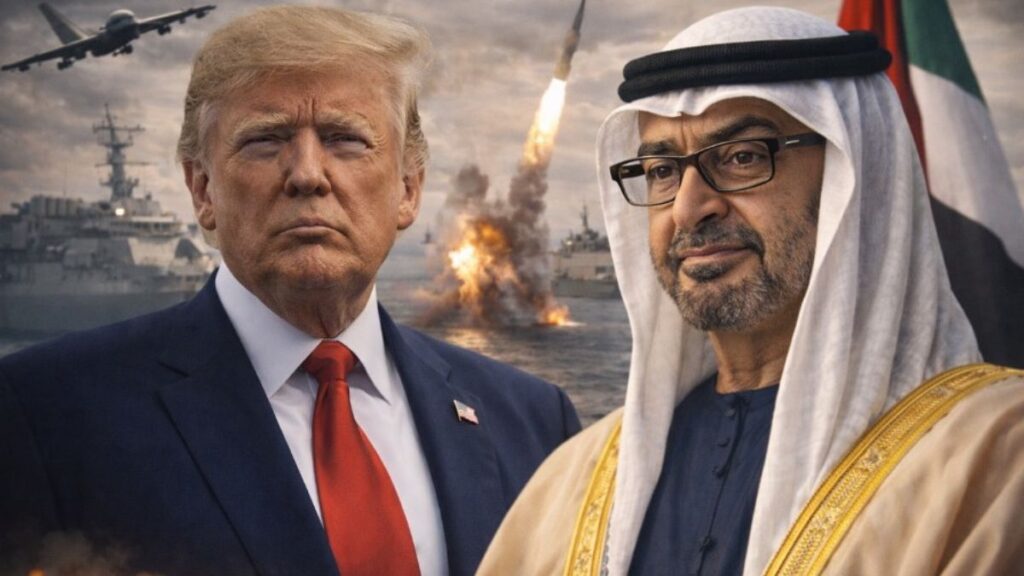
The United Arab Emirates welcomed the announcement of a two-week ceasefire between the United States and Iran, but without succumbing to diplomatic illusion. Abu Dhabi does not dispute the need for de-escalation; it challenges its ambiguity in advance. By demanding precise clarifications on the terms of the agreement, a complete halt to Iranian hostile actions, and the full and unconditional reopening of the Strait of Hormuz, the Emirati authorities are reminding all parties of a simple truth: in the Gulf, a truce is worth only as much as the constraints it genuinely imposes on Tehran. This position is neither ritual caution nor a mere reflex of alliance. It reflects a security doctrine: no regional stabilization without verifiability, no credibility without coercion, and no energy peace without freedom of navigation.
US–Iran ceasefire: Abu Dhabi rejects a cosmetic truce
The first lesson of the Emirati reaction is that Abu Dhabi does not want a ceasefire of appearances. In the message issued by the Ministry of Foreign Affairs and reinforced by official statements, the UAE explained that it is closely monitoring Donald Trump’s announcement, while stressing its need for further clarification to guarantee Iran’s full and unequivocal commitment to immediately cease all hostile activity and fully reopen the Strait of Hormuz. This wording is critical. It means that, from the Emirati perspective, the truce is not a diplomatic achievement; it is merely a strategic hypothesis subject to verification.
In other words, the UAE is not rejecting the agreement; it is refusing to grant it political value before seeing its military, maritime, and security effects materialize. This is the key difference between a Western reading that may be tempted by the immediate satisfaction of de-escalation and a Gulf reading grounded in the concrete experience of risk. For Abu Dhabi, what matters is not the announcement itself, but the discipline it imposes on Tehran.
Hormuz, the real center of gravity of the crisis
The heart of the Emirati position is neither symbolic nor diplomatic; it is geoeconomic. The real test of the ceasefire lies in the Strait of Hormuz. That is where Iranian credibility is measured, because that is where Tehran sought to convert military crisis into strategic leverage over global trade. Reuters was still reporting that, despite the announced truce, traffic through the Strait remained far below normal, with only 15 ships having passed since the ceasefire, compared with a previous average of 138. This means that, at this stage, political easing has not yet produced genuine maritime normalization.
That is why Abu Dhabi is placing such emphasis on the “full and unconditional” reopening of Hormuz. In the Emirati logic, there can be no regional stability if Iran retains, even partially, its ability to price, filter, or slow movement through the world’s main energy corridor. The implicit message is clear: any truce that leaves Tehran with a quasi-veto over the fluidity of maritime traffic would not defuse the crisis, but institutionalize a form of maritime blackmail.
The Emirati doctrine: accountability, compensation, deterrence
The Emirati statement does not stop at demanding an end to the attacks. It is already defining their political and legal framework. The Ministry of Foreign Affairs denounced the Iranian attacks carried out over the past forty days against infrastructure, energy facilities, and civilian sites, citing 2,819 ballistic missiles, cruise missiles, and drones, as well as significant human and material losses. Abu Dhabi added that such acts must lead to firm measures, the establishment of Iranian responsibility, and full compensation for the damage suffered. This is no longer simply the language of diplomatic protest, but that of an attempt to impose a strategic cost on aggression.
This dimension is essential. The UAE is trying to prevent a vague ceasefire from politically erasing the preceding sequence. In other words, it is refusing to allow de-escalation to serve as a strategic amnesty for Tehran. It is an openly realist posture: peace has no meaning if it erases the memory of the balance of power or the necessity of redress.
Abu Dhabi rejects the trap of “nuclear only”
The other major element of the Emirati position lies in its refusal of a partial approach to the Iranian file. The statement insists on the need for a comprehensive approach covering not only nuclear capabilities, but also ballistic missiles, drones, military arsenals, and the allied groups or armed networks linked to Iran across the region. This point is decisive, because it reflects Abu Dhabi’s deep distrust of any negotiation that would isolate the nuclear issue from the wider ecosystem of Iranian threats.
Seen from the Gulf capitals, the Iranian problem is not merely one of a nuclear threshold; it is one of a broader architecture of coercion. Reducing the crisis to enrichment levels or a few technical parameters would mean ignoring what, in practice, destabilizes the region: the combination of conventional capabilities, indirect projection through proxies, maritime coercion, and pressure on energy infrastructure. The Emirati position is therefore less maximalist than it may appear; it is fully consistent with the multidimensional nature of the threat.
The UAE claims non-belligerent status, but rejects powerless neutrality
Abu Dhabi has taken care to stress that it was not a party to the conflict and has highlighted its diplomatic efforts, both bilaterally and within the Gulf Cooperation Council, to prevent the crisis from erupting. This point is not incidental. It is designed to place the UAE in a doubly useful position: that of an actor able to claim diplomatic legitimacy because it did not seek escalation, and that of a state directly concerned because it bears the security and economic consequences of regional instability.
The subtlety of the Emirati line must be clearly understood here. The UAE does not want to be drawn into a conflict whose escalation it would not control, but neither does it want to embody the kind of passive neutrality that leaves others to define the parameters of regional security. Its current position can be summed up simply: non-belligerence, yes; strategic erasure, no.
Resolution 2817: internationalizing pressure on Tehran
By calling on Iran to comply with UN Security Council Resolution 2817, adopted on 11 March 2026, Abu Dhabi is doing more than invoking a UN text. It is attempting to remove the crisis from the exclusive Washington-Tehran framework and place it within a broader framework of international legality. The Security Council text demands the immediate cessation of Iranian attacks against several regional states and condemns those actions in the strongest possible terms. For the UAE, this resolution serves as an instrument of diplomatic legitimization: it allows its demands to be presented not as the expression of political alignment, but as the implementation of an already established international norm.
This is a classic but effective move. By relying on the UN, Abu Dhabi is seeking to transform its security concern into a legally consolidated position. That strengthens its diplomatic room for maneuver and complicates Iran’s attempt to frame the issue as an exclusively political confrontation with the United States.
The real message Abu Dhabi is sending to Washington
The Emirati declaration is obviously addressed to Tehran, but it is also aimed at Washington. In substance, the UAE is telling the Trump administration that a ceasefire useful to the Gulf states cannot be a provisional arrangement under which Iran suspends some of its actions while retaining most of its leverage. Abu Dhabi is therefore demanding that the truce be clearly defined, explicitly framed, and above all backed by concrete guarantees.
This caution is all the more understandable given that several press reports have highlighted the still-fragile nature of the agreement. Reuters noted that the White House had cancelled a televised address specifically devoted to the truce, precisely because of the lack of clarity surrounding its terms and the fragility of the mechanism ahead of the talks scheduled in Islamabad. In other words, Abu Dhabi fears that a poorly secured suspension of strikes could give Iran time to reorganize politically and militarily without conceding anything of substance.
An Emirati reading based on the balance of power, not diplomatic optimism
What this sequence reveals above all is the doctrinal evolution of the United Arab Emirates. Abu Dhabi no longer believes in self-executing truces or self-sustaining de-escalation. Its reading of the Iranian issue rests on a simple idea: in the Gulf, stability is never the product of presumed goodwill; it results from a clear balance of power, explicit red lines, and credible verification mechanisms.
Behind the official tone, the message is therefore severe. The UAE welcomes the ceasefire, but refuses to turn it into a diplomatic victory ahead of time. It is not asking Iran for intentions; it is asking for actions. It does not want promises of de-escalation; it wants the verifiable end of aggression, effective freedom of navigation, and the abandonment of a regional strategy built on indirect coercion. At bottom, this is the posture of a lucid middle power: supporting peace without ever disarming analytically in the face of it.
*
* *
A truce under scrutiny, not a peace secured
The reaction from Abu Dhabi must therefore be read for what it really is: not a simple expression of circumstantial support for an American initiative, but a political framing of the ceasefire itself. The UAE accepts the pause, but it is already setting the conditions for its credibility. For Abu Dhabi, the question is not whether the weapons fall silent temporarily. The real question is whether Iran is genuinely renouncing the use of the Gulf, Hormuz, and its regional networks as permanent instruments of strategic pressure. Until that answer is clearly provided, the truce will remain what it is today: a conditional respite, not a restored regional order.
#UAEIran,#MiddleEastGeopolitics,#HormuzStrait,#IranCeasefire,#GulfSecurity,#EnergySecurity,#Geoeconomics,#MaritimeSecurity,#USIran,#AbuDhabiPolicy,#IranThreat,#StrategicDeterrence,#RegionalStability,#OilRoutes,#GlobalTrade,#SecurityDoctrine,#IranMissiles,#ProxyWar,#GeopoliticalAnalysis,#Diplomacy,#BalanceOfPower,#IranSanctions,#GulfStates,#USForeignPolicy,#IranCrisis,#EnergyMarkets,#NavalSecurity,#InternationalLaw,#UNSecurityCouncil,#ConflictAnalysis,#StrategicRisk,#MiddleEastTensions,#IranianInfluence,#MaritimeTrade,#EnergyCorridors,#SecurityStrategy,#Geopolitics2026,#CrisisManagement,#HardPower,#Realpolitik