ANALYSIS – United Kingdom: A Sudanese Migrant Stabs a Man in Belfast, Bystanders Heroically Save a Life, but Anger Over Uncontrolled Immigration Erupts Across the Country
By Angélique Bouchard
Violent anti-immigration riots erupted during the night of June 9–10 in eastern Belfast, the capital of Northern Ireland, following a knife attack and attempted beheading allegedly carried out by a Sudanese asylum seeker. Very quickly, and in what has become their familiar exercise in shifting responsibility, mainstream media outlets largely focused on the ensuing outbreak of violence and public anger, allegedly triggered by online calls for hatred circulated by xenophobic and far-right groups, while overlooking the deeper causes of the crisis. Yet the abhorrent knife attack and the clashes that followed are merely the tragic consequences of the lax and idealistic immigration policies pursued for years by both the United Kingdom and the European Union. Indeed, mass, uncontrolled and often imposed immigration inevitably fuels growing tensions and, more worryingly, carries within it the seeds of intercommunal conflict and even future civil strife. Today, and even more so tomorrow, it constitutes the foremost geopolitical challenge facing Europe.
On his LinkedIn account, Régis Le Sommier, war correspondent and Editor-in-Chief of Omerta, offered a particularly insightful assessment of the recent events in Belfast: “Ireland is a unique place. Its northern region experienced a devastating civil conflict from 1974 onward, claiming nearly 3,000 lives. Protestant and Catholic communities laid down their arms in 1999, but they have never entirely forgotten them. The current wave of violence is directed against recent and uncontrolled immigration. Both communities are rediscovering their old defensive reflexes, with one major difference: this time, Protestants and Catholics, from the Falls Road to the Shankill Road, are drawing closer together to resist what they perceive as an invasion. Northern Ireland’s unique legacy, shaped by decades of armed struggle in which England played a decisive role, adds an almost revolutionary dimension to the opposition against Keir Starmer and his immigration policy. Not only has the British Prime Minister brought his country to the edge of the abyss, but he has also succeeded in reconciling yesterday’s enemies around a common cause: their own survival.”
In the article that follows, Angélique Bouchard reviews the events in Belfast, examines the political reactions they have triggered, and, above all, assesses the outcomes of the immigration policy pursued by Britain’s Labour government, the consequences of which are now becoming increasingly apparent.
A man in his forties was hospitalized with serious injuries after a brutal knife attack in Belfast, Northern Ireland, while police arrested a Sudanese migrant on suspicion of attempted murder. The attack occurred shortly after 10:30 p.m. on Monday in north Belfast, according to the Police Service of Northern Ireland. The victim suffered serious injuries to his face, neck, back, and eyes, and police recovered what they believe was a kitchen knife at the scene.
Police initially stated that the suspect was Somali but later corrected that he is believed to be Sudanese, describing the change as part of a “fast-time investigation.” Assistant Chief Constable Ryan Henderson said police understand the suspect entered Northern Ireland from Dublin, Ireland, and had been granted leave to remain, although he said the Home Office would provide further clarity on his status.
“At this stage, we have no information to suggest that this was a terrorist-related incident,” Henderson said, while stressing that the investigation remains in its early stages. “However, I must stress, we are still at the early stages of our investigation,” he said, according to The Sun.
The Heroic Intervention of Bystanders
Videos circulating online appeared to show members of the public confronting the attacker, including one person brandishing a hurling stick. PSNI Assistant Chief Constable Ryan Henderson described the bystanders as “heroic,” stating that their intervention had helped save the victim’s life, according to the BBC.
Public Fury and the Demonstrations
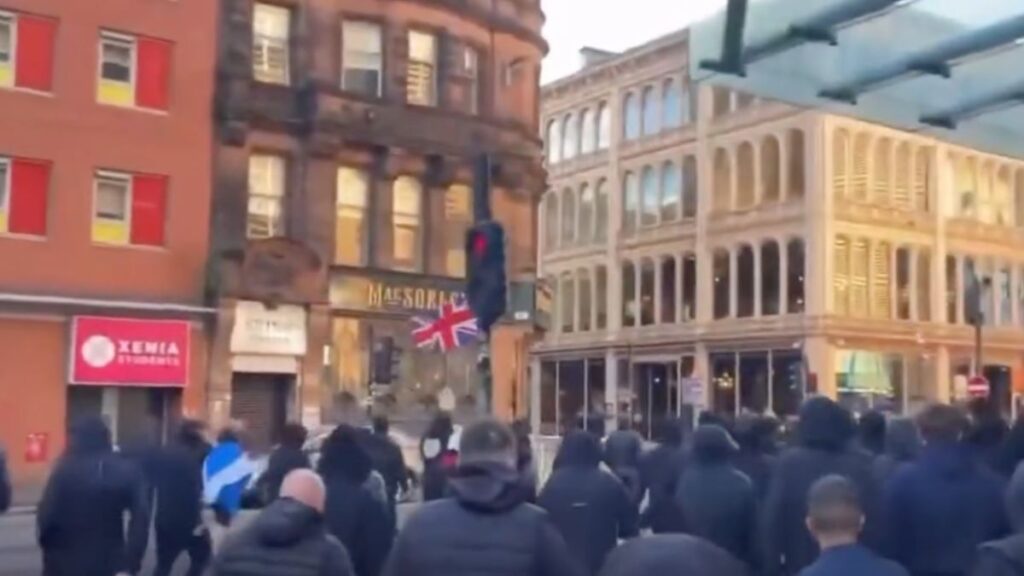
On Monday evening, protesters set fire to a Glider bus on the Newtownards Road in east Belfast as tensions rose following the gruesome stabbing, despite earlier calls from authorities for calm.
Police said they had declared a critical incident and would increase their presence across Northern Ireland amid calls for protests. Officials urged calm and asked the public to allow the investigation to proceed.
Political Reactions: Starmer and the Opposition Face the Anger
Prime Minister Keir Starmer quickly posted on X that the attack was “sickening,” adding: “I have absolutely no tolerance for abhorrent scenes of violence like this on our streets.” He said his thoughts were with the victim and thanked the first responders, including members of the public who intervened.
Starmer’s swift response marked a notable contrast with the case of Henry Nowak, an 18-year-old who was stabbed and then handcuffed by police after his attacker accused him of making racist remarks. Starmer faced criticism from some conservatives over his response in that case.
Reform UK leader Nigel Farage called on authorities to reveal the suspect’s identity and immigration status.
“What happened in Belfast last night is horrific. The authorities must reveal the identity and status of the attacker immediately. The public are entitled to the truth,” Farage wrote on X.
Robert Jenrick also wrote on X: “We’ve woken up to truly barbaric footage on a street in Belfast. Of a kind you’d think you’d never see in this country. For years now I’ve urged the police to spell out the basic, sober facts, as they have them, when there are horrors like this.”
Conservative Party leader Kemi Badenoch said people would ask whether there had been “failings in the management of our borders,” according to GB News.
Northern Ireland’s main political parties issued a joint statement condemning the violence and urging the public not to share graphic images of the attack.
“There is no place in our society for this kind of brutality. Our immediate thoughts are with the victim and his family, and we hope he makes a full and complete recovery,” the parties said, according to GB News.
À lire aussi : EXCLUSIVE – Le Diplomate’s Grand Interview with Hermann Kelly, Champion of Irish Sovereignty
The Afghan Refugee Scandal: Farage Denounces Government Lies
In a broader context of growing frustration over immigration, Nigel Farage recently criticized the government for the secret resettlement of thousands of Afghan refugees in the United Kingdom without the public’s knowledge. Around 4,500 Afghans have been relocated so far, with around 6,900 expected in total. Farage claimed that some of these Afghans are convicted sex offenders, sparking a controversy with the ruling Labour Party, which denied the allegations.
“Amongst the number that have come are convicted sex offenders – I am not, I promise you, making any of this up, and the total cost of this operation has been a staggering £7 billion,” Farage said in a post on X.
“The numbers are off the charts, the cost is beyond comprehension and the threat to women walking the streets of this country, frankly, is incalculable.” The government denied that any known sex offenders had been allowed into the UK under the program and insisted that everyone had been checked “carefully” for any criminal records.
Defense Secretary John Healey denied the claims and said that if Farage had any “hard evidence,” he should report it to the police. Relocating the 6,900 Afghans is expected to cost £850 million. The £7 billion Farage referenced is likely the total cost of all Afghan resettlement programs since 2021, involving around 36,000 Afghans through multiple schemes.
The British government earlier this week revealed that it had secretly resettled thousands of Afghan nationals in the UK after a catastrophic data breach exposed nearly 19,000 applicants who had worked with UK forces, an operation kept under wraps by a rare “super injunction” that barred even the mention of its existence. The injunction was lifted on Tuesday in conjunction with a decision by Britain’s current Labour government to make the program public.
A spreadsheet containing the personal information of the nearly 19,000 people who had applied to relocate to the UK after the Taliban takeover of Afghanistan was accidentally released in 2022 because of a defense official’s email error. The government only became aware of the leak when some of the data was published on Facebook 18 months later.
“I can’t think of a better example of the total incompetence, dishonesty and genuine lack of understanding of what the priorities of a British government are than this Afghan scandal,” Farage added.
A Broken Migration System
Alan Mendoza, executive director of the Henry Jackson Society, told Fox News Digital that the attack exposed what he described as failures in Britain’s immigration system.
“Britain’s broken border and migration system has been put into stark relief once more with this tragic — and entirely avoidable — case,” Mendoza said.
“This man should never ever have been in the U.K., let alone been granted ‘leave to remain.’ The Irish border is the soft underbelly for a process the British public has long since lost confidence in, as well as in those administering it politically. Nothing short of a revolution in who we allow into the U.K. and how will satisfy a people fed up with false promises about immigration change.”
Recent Migration Statistics and the Structural Weakness of the Irish Border
Official British figures confirm the scale of the phenomenon. Small boat crossings of the English Channel have reached record levels in recent years, with tens of thousands of arrivals annually, while overall net migration remains structurally high. But it is the Irish border that today constitutes the most critical weak point.
Since Brexit and the maintenance of the Common Travel Area between Ireland and the United Kingdom, a migrant who obtains status in the Republic of Ireland (through the European asylum system or humanitarian programs) can then enter the United Kingdom freely without border checks.
This is precisely the route described by police in the Belfast case: the Sudanese suspect arrived via Dublin with leave to remain. This loophole, which Mendoza describes as the “soft underbelly,” allows individuals whose status would have been refused or more strictly controlled if they had applied directly to the United Kingdom to bypass the system. Recent data shows that asylum claims processed in Ireland have exploded in recent years, and that secondary movement into the United Kingdom via this route has become a documented reality, amplifying pressure on British services and fueling the sense of a system incapable of controlling its own borders.
*
* *
These events in Belfast reveal the full extent of the crisis in Britain’s migration system. The heroism of bystanders saved a life in the face of a brutal attack carried out by a Sudanese migrant who entered via the Irish border and held leave to remain.
Yet public fury — with the burning of a bus in East Belfast and the demonstrations that followed — shows that the public’s patience has run out.
Political reactions confirm the divide: Keir Starmer described the attack as “sickening” and expressed his total lack of tolerance for such violence, while Nigel Farage immediately demanded the revelation of the suspect’s identity and status, Robert Jenrick denounced “truly barbaric” images, and Kemi Badenoch pointed to the “failings in the management of our borders.”
This contrast is all the more striking with the criticized response in the Henry Nowak case, where the victim was handcuffed after his attacker accused him of making racist remarks. At the same time, the secret Afghan refugee scandal — with its 4,500 people already relocated, the 6,900 expected, the exorbitant costs cited by Farage (£7 billion in total for Afghan programs), and his allegations of sex offenders among them — confirms that the system is broken.
As Alan Mendoza emphasized, nothing short of a revolution in immigration policy will satisfy a people tired of false promises. Faced with a system that allows dangerous individuals to enter through the Irish loophole, that hides ruinous Afghan programs, and that refuses to face realities, hesitation is no longer an option. The anger of the British people is legitimate. It is growing. And it will not subside until the promised revolution takes place.
#Belfast, #BelfastAttack, #BelfastStabbing, #NorthernIreland, #UKNews, #UnitedKingdom, #SudaneseMigrant, #AsylumSeeker, #MigrationCrisis, #ImmigrationCrisis, #BorderSecurity, #UKBorders, #IrishBorder, #CommonTravelArea, #PublicSafety, #KnifeCrime, #AttemptedMurder, #BystanderHeroes, #HeroicBystanders, #BelfastRiots, #AntiImmigrationProtests, #CivilUnrest, #StreetViolence, #LawAndOrder, #KeirStarmer, #NigelFarage, #KemiBadenoch, #RobertJenrick, #ReformUK, #LabourGovernment, #MigrationPolicy, #AfghanResettlement, #AfghanDataBreach, #HomeOffice, #PSNI, #EuropeanMigration, #MassImmigration, #NationalSecurity, #PoliticalCrisis, #Geopolitics