ANALYSIS – White House vs. Cruz and Pompeo: Trump Defends His Iran Diplomacy Against Accusations of ‘Appeasement’ and ‘Munich 2.0’
By Angélique Bouchard
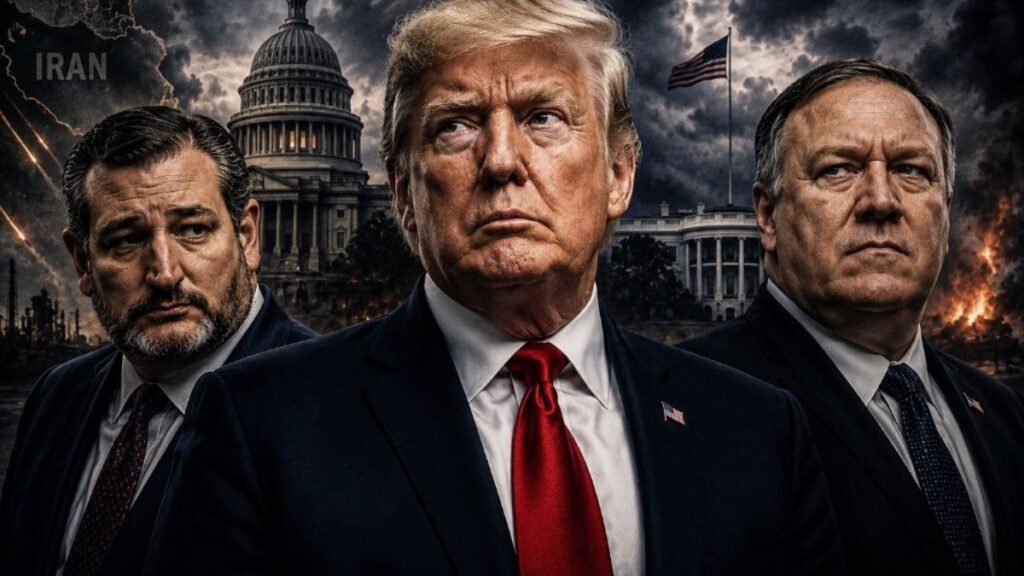
While President Donald Trump was burning the midnight oil negotiating a last-minute peace and denuclearization agreement with Iran, his inner circle at the White House was sharply attacking critics from the right. Mike Pompeo and Senator Ted Cruz were strongly rebuked for allegedly “undermining” the peace efforts or “illegally” abusing their residual security clearances.
Steven Cheung, Sebastian Gorka, and Alex Bruesewitz took to X with pointed criticism, while Trump himself stepped in to defend his approach as “the exact opposite” of the Obama deal.
Between accusations of “Iran appeasement,” warnings of a potential “Munich 2.0,” and calls to “finish the job” militarily, the debate has exposed deep fractures within the Republican camp and placed the president before a historic choice: strength or negotiation.
The Criticism from Pompeo and Cruz: “Iran Appeasement” and the Risk of “Munich 2.0”
Mike Pompeo, who served as Donald Trump’s own Secretary of State, opened fire by denouncing a potential deal as something straight out of the “Wendy Sherman-Robert Malley-Ben Rhodes playbook”: “The deal being floated with Iran seems straight out of the Wendy Sherman-Robert Malley-Ben Rhodes playbook: Pay the IRGC to build a WMD program and terrorize the world. Not remotely America First.”
This charge carries particular weight because it comes from a man who was one of the principal architects of the “Maximum Pressure” strategy during Trump’s first term. Pompeo embodied the break with the 2015 nuclear agreement: withdrawal from the JCPOA, sweeping and targeted sanctions, the designation of the IRGC as a terrorist organization, and the strike against Qassem Soleimani. That policy aimed to economically strangle the regime, restore credible deterrence, and durably weaken its regional projection capabilities. By now accusing the current administration of sliding back into a logic of appeasement, Pompeo is not offering an external critique but a warning from within the very “America First” legacy he helped shape.
Senator Ted Cruz, for his part, expressed being “deeply concerned” about a deal that would see Iran — still ruled by Islamists chanting “Death to America” — receive “billions of dollars,” enrich uranium, develop nuclear weapons, and retain effective control over the Strait of Hormuz. He recalled the military successes already achieved (destruction of missiles and drones, sinking of the Iranian navy) and warned that such an outcome would be a “disastrous mistake.” “The details are still coming out — and I pray the early reports are wrong — but the fact that Biden’s Rob Malley is praising the deal is not encouraging.”
Hugh Hewitt pushed the historical comparison to its limit: “2026 cannot become as infamous as 1938.” He recalled that Wilson had “lost the peace” after 1918 and that Obama had taken up that same fateful role. For Hewitt, Trump cannot accept “half or even three-quarters of a loaf”: he must demand the permanent abandonment of enrichment, the return of “nuclear dust” to American control, an end to ballistic missile production and terrorist support, and the restoration of basic human rights for the Iranian people.
The Sharp White House Response and Pushback from Trump’s Advisors
The response was swift. Steven Cheung wrote without restraint: “Mike Pompeo has no idea what the f— he’s talking about. He should shut his stupid mouth and leave the real work to the professionals. He’s not read into anything that’s happening, so how would he know?” Sebastian Gorka went further, suggesting that Pompeo might be “illegally” abusing his residual security clearance: “You have no knowledge of what is being negotiated in secret. If you did, you would be in possession of information illegally provided to you and which you are wholly unauthorized to have or to share. So are you a liar or a criminal, Pompeo?”
Alex Bruesewitz sharply rebuked Cruz: “Cool, Ted. No one asked you, bro. Stop trying to undermine the President and his administration.” Cruz fired back: “Hush, child. The adults are talking. I’m not your ‘bro.’ And young political grifters pushing Iran appeasement are not remotely helping the President.”
À lire aussi : ANALYSIS – Marco Rubio: The Cuban-American Pivot of Trumpian America Facing an Agonizing Castroism
Trump Clarifies His Position: “The Exact Opposite” of the Obama Deal
On Truth Social, Trump bluntly recalled that the 2015 Iran nuclear deal negotiated under Obama was “one of the worst deals ever made by our Country” and represented “a direct path to Iran developing a Nuclear Weapon.” He insisted that the current negotiation is “the exact opposite”: “The negotiations are proceeding in an orderly and constructive manner, and I have informed my representatives not to rush into a deal in that time is on our side. The Blockade will remain in full force and effect until an agreement is reached, certified, and signed. Both sides must take their time and get it right. There can be no mistakes! Our relationship with Iran is becoming a much more professional and productive one. They must understand, however, that they cannot develop or procure a Nuclear Weapon or Bomb.”
The contrast is deliberate and clear. The 2015 agreement had allowed Iran to receive hundreds of billions of dollars from lifted sanctions while retaining significant enrichment capacity. The deal currently under discussion, according to Trump, reverses that logic: no sanctions relief before certification, the blockade remains in place, and there is an explicit refusal of any nuclear weapon.
Rubio and Wicker: Cautious Diplomacy or “Finish the Job” Militarily?
Marco Rubio sought to strike a measured but firm tone: “The idea that somehow this president, given everything he’s already proven he’s willing to do, is going to somehow agree to a deal that ultimately winds up putting Iran in a stronger position when it comes to nuclear ambitions is absurd. That’s just not going to happen. But our preference is to address this through diplomatic means, and that’s what we’re endeavoring to do here.” He described himself as “cautiously optimistic” while stressing the need to verify the concrete implementation of any commitments, particularly regarding the stockpile of highly enriched uranium and future enrichment. He noted that “we’re dealing with a very difficult group of people” and that Trump “has other options” should diplomacy fail.
By contrast, Senator Roger Wicker, Chairman of the Senate Armed Services Committee, publicly urged Trump not to abandon military pressure: “We are at a moment that will define President Trump’s legacy. His instincts have been to finish the job he started in Iran, but he is being ill advised to pursue a deal that would not be worth the paper it is written on. Our commander-in-chief needs to allow America’s skilled armed forces to finish the destruction of Iran’s conventional military capabilities and reopen the strait. Further pursuit of an agreement with Iran’s Islamist regime risks a perception of weakness. We must finish what we started. It is past time for action.”
*
* *
A Historic Bet for Trump
Between calls to “finish the job” militarily, accusations of “Iran appeasement,” and warnings of a potential “Munich 2.0,” Donald Trump is navigating a narrow political space. His bet is clear: to secure through negotiation what military force has already largely made possible, without rushing and without compromising on the essentials. As Rubio summarized, diplomacy is preferred, but “Trump has other options.”
For Trump, the stakes are twofold: to consolidate a legacy of “peace through strength” while avoiding entanglement in a prolonged conflict that the American public does not want. For his critics on the right, yielding now would mean turning a military victory into a diplomatic defeat. For his supporters, it is precisely this ability to negotiate from a position of strength that defines “America First.”
The president holds the cards. Time is on his side. But history does not forgive either Munich or failed Versailles. Trump knows this. And that is precisely why he refuses to let his conduct be dictated by those who, only yesterday, accused him of weakness when he struck — and who accuse him of weakness today when he negotiates. The choice belongs to him. And with it, a significant part of the future of the Middle East.
À lire aussi : ANALYSIS – The 16 April Inauguration in Brazzaville: Denis Sassou N’Guesso and the Congo’s Strategic Return to the Diplomatic Stage
#Trump, #DonaldTrump, #Iran, #IranDeal, #IranNuclearDeal, #IranDiplomacy, #WhiteHouse, #TedCruz, #MikePompeo, #MarcoRubio, #RogerWicker, #AmericaFirst, #MAGA, #RepublicanParty, #GOP, #USPolitics, #ForeignPolicy, #MiddleEast, #MiddleEastCrisis, #NuclearDeal, #NuclearWeapons, #JCPOA, #MaximumPressure, #IRGC, #StraitOfHormuz, #Appeasement, #Munich2, #PeaceThroughStrength, #USIran, #TrumpDoctrine, #NationalSecurity, #Geopolitics, #Diplomacy, #MilitaryPressure, #ConservativePolitics, #WashingtonDC, #TruthSocial, #Sanctions, #SecurityClearance, #BreakingAnalysis