ANALYSIS – Operation Epic Fury: A Temporary Price for Lasting Peace ?
By Angélique Bouchard
The Iran Conflict and Its Immediate Repercussions on the American Economy
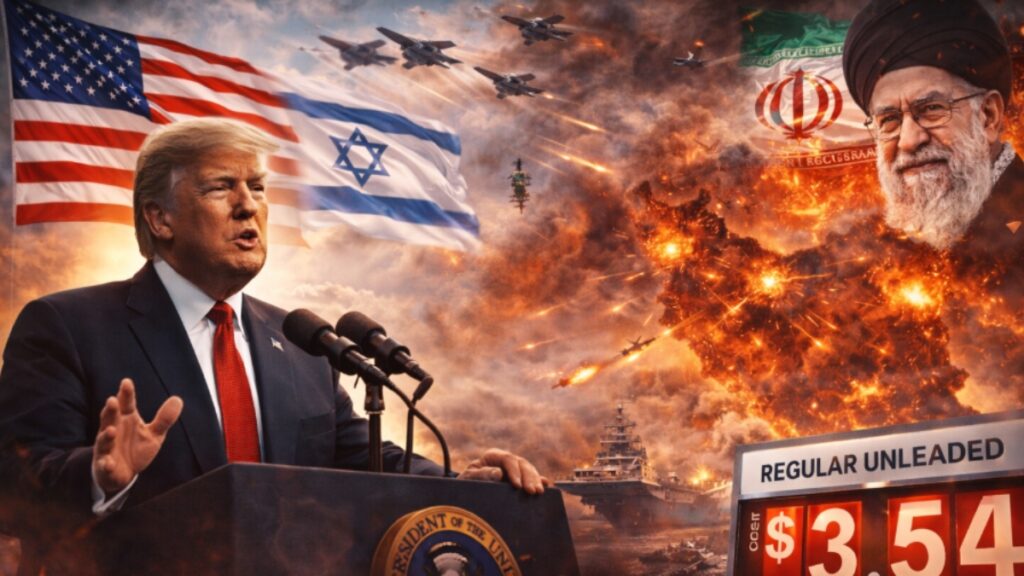
In a tense geopolitical context, Operation Epic Fury, launched jointly by the United States and Israel on February 28, 2026, marks a decisive turning point in the fight against the Iranian regime, described as the world’s leading state sponsor of terrorism. While fuel prices have surged by 50 cents per gallon to a nationwide average of $3.54, according to AAA data, Republicans under President Donald Trump have adopted a resolute stance: this increase is “a very small price to pay” to eradicate a persistent threat. This prospective analysis examines the geopolitical stakes of the conflict, highlighting how a swift victory could not only stabilize energy markets but also redraw alliances in the Middle East while weakening adversaries such as Russia and China. Rooted in a conservative and pragmatic vision, it underscores the opportunities this operation presents for America First, despite Democratic critics seeking to politically exploit temporary volatility.
The Rise in Oil Prices: Temporary Volatility in the Face of a Structural Threat
The closure of the Strait of Hormuz, a vital artery for 20% of global oil trade, has driven barrel prices above $100, resulting in higher gasoline and diesel costs across the United States. Yet, as White House Press Secretary Karoline Leavitt asserts, this disruption is “temporary.”
Prospectively, once military objectives are achieved—destruction of Iran’s nuclear and military capabilities—oil flows should resume in “a few weeks at worst,” according to the Secretary of Energy. Historically, similar conflicts, such as the 1991 Gulf War, have shown that markets stabilize rapidly following decisive intervention.
Here, the elimination of the Tehran regime could even lead to lower prices in the long term by releasing Iranian reserves under Western influence and reducing disruptions caused by Iran-backed militias.
Republicans, by rolling back Biden-era environmental regulations, had already brought prices below $3 before the conflict; victory would consolidate this “American energy dominance,” rendering Democratic calls to tap the Strategic Petroleum Reserve obsolete—a measure ironically depleted under Biden to conceal economic failures.
À lire aussi : ANALYSE – Epic Fury : Des objectifs de guerre ambitieux, mais contestables
Historical Deep Dive: Lessons from the 1991 Gulf War on Market Stabilization
To better contextualize current volatility, a close examination of the 1991 Gulf War reveals instructive parallels. Iraq’s invasion of Kuwait in August 1990 had driven oil prices from $17 per barrel in July to $36 in October, fueling fears of global shortages and contributing to a U.S. recession. However, as coalition operations began in January 1991, prices collapsed dramatically: a record one-day drop of $10 on futures markets, the largest ever recorded at the time. This swift stabilization was explained by several factors: increased Saudi production to offset Iraqi and Kuwaiti losses, successful coalition deployment protecting Saudi infrastructure, and the release of strategic petroleum reserves (SPR) by the United States and allies, injecting up to 2.5 million barrels per day into markets.
Prospectively applied to Operation Epic Fury, a decisive intervention could replicate this pattern: a post-victory price plunge, potentially below pre-conflict levels, thanks to enhanced security of the Strait of Hormuz and American-influenced exploitation of Iranian reserves. Unlike 1991, where elevated prices funded reconstruction via Saudi Arabia, a bold current strategy could see the United States dictate the redistribution of oil revenues, permanently weakening hostile regimes and ushering in an era of low prices to boost the global economy.
Geopolitical Stakes: Weakening the Iran-Russia-China Axis for Global Security
Geopolitically, Operation Epic Fury fits into a broader strategy of containing authoritarian powers.
Iran, a key Russian ally in its aggression against Ukraine, supplies drones and missiles that prolong the European conflict. By neutralizing Tehran, the United States indirectly strikes Vladimir Putin’s “war chest,” as illustrated by the letter from Texas Republicans to Treasury Secretary Scott Bessent urging harsher sanctions on Lukoil, the Russian oil giant accounting for roughly 2% of world production. Prospectively, the fall of the Iranian regime could trigger a cascading collapse: already-sanctioned Russia would see its oil revenues evaporate if its “shadow fleets”—opaque tankers evading sanctions—are exposed by the strait closure.
China, reliant on sanctioned Iranian imports for 10% of its oil, would be forced to diversify sources, weakening its Middle East influence and favoring partnerships with pro-American producers such as Saudi Arabia.
Republican senators like Lindsey Graham and Steve Daines emphasize that “destroying the largest state sponsor of terrorism” would create a more stable world with lower energy prices and reduced threats to Israel and Sunni allies. Conversely, Democrats, through Senate Minority Leader Chuck Schumer, label it an “unnecessary war,” ignoring that inaction under Biden allowed Iran to advance toward nuclear capability, directly endangering American security.
Deep Dive into Sanctions on Lukoil: An Economic Weapon to Strangle Russia
Sanctions on Lukoil, intensified in 2025 under the Trump administration, illustrate a bold escalation in pressure on Russia. In October 2025, the United States designated Lukoil and Rosneft as targets for their role in the Russian energy sector, freezing assets and prohibiting transactions with U.S. persons under Executive Order 14024.
These measures, the harshest since the Ukraine war began, aimed to force a ceasefire by drying up oil revenues funding Russia’s war effort. Lukoil, producing about 2% of global oil, saw its shares drop 9.4% immediately after the announcement, compelling fire-sale divestitures of foreign assets with extensions granted until April 2026 for authorized sales.
Prospectively and audaciously, in the context of Operation Epic Fury, these sanctions could be amplified: coordinated allied action targeting Lukoil subsidiaries (via the 50% rule) and evasion networks could result in billions in lost revenue, pushing Russia toward economic collapse and capitulation in Ukraine. This would illuminate the “dark zones” of hidden alliances—such as Lukoil’s ties to Chinese and Iranian entities—forcing Beijing to rethink its energy dependence and reinforcing American hegemony over global flows.
À lire aussi : ANALYSE – Opération Epic Fury : Trump décapite le régime iranien et met Obama face à son échec historique
Prospective Economic Impacts: Short-Term Pain for Long-Term Gains
Beyond energy, the conflict affects other sectors such as aviation, where experts warn of potential flight reductions due to rising jet fuel costs. Yet, as Jesse Neugarten of Dollar Flight Club explains, these adjustments are cyclical and could be mitigated by a rapid flow resumption.
Prospectively, an American victory would stimulate the economy: Texas-based companies could acquire Lukoil assets, strengthening domestic production and creating jobs. Reuters-Ipsos polls show 70% of Americans expect prolonged price increases, yet 44% of Republicans remain optimistic, confident in Trump’s ability to reverse the trend.
Geopolitically, this would solidify “America First”: by dominating energy markets, the United States could dictate climate agreement terms, reject European constraints, and weaken OPEC+. Democratic critics accusing Trump of “contempt” for pump prices forget that under Biden prices peaked above $5 in 2022—a “disaster” Trump corrected by prioritizing national production.
Integration of New Elements: The Shadow Fleet Under Fire and Its Consequences for Russia and China
Tehran’s closure of the Strait of Hormuz, announced with threats that vessels could be “torched,” has not only drastically reduced tanker traffic but also intensified Western pressure on the “shadow fleet”—unflagged or falsely flagged vessels linked to isolated countries like Cuba, Iran, and Russia.
As Charles Creitz reports, the United States has established a quasi-naval quarantine on oil imports to Cuba, while European partners such as Belgium have intercepted suspect tankers like the MT Ethera, tied to a key Khamenei adviser’s family.
This action, dubbed “Operation Blue Intruder” by Belgian Defense Minister Theo Francken, illustrates a new phase in the fight against sanctions-evasion networks, with direct implications for Moscow and Beijing. Prospectively, this offensive against the gray fleet could dry up Russian funds for the Ukraine war by more strictly enforcing the $44-per-barrel Ural price cap, while disrupting Chinese supply chains dependent on sanctioned Iranian oil, potentially triggering inflation in China comparable to OPEC-driven price spikes affecting the United States.
Strengthening Sanctions and Maximum Pressure: A Strategy to Strangle Adversaries
The U.S. Treasury Department, through OFAC, has sanctioned over 30 individuals and entities involved in illegal Iranian oil sales financing domestic repression, terrorist proxies, and weapons programs.
As Treasury Secretary Scott Bessent explains, “Iran exploits financial systems to sell illicit oil, launder proceeds, procure components for its nuclear and conventional weapons programs, and support its terrorist proxies.”
Prospectively, the destruction of over 30 Iranian vessels by CENTCOM—including a drone carrier roughly the size of a World War II aircraft carrier—combined with the elimination of the Supreme Leader and his successors, could dismantle not only the shadow fleet but also client-nation suppliers such as Russia and China. This would reinforce Trump’s “maximum pressure” campaign, redirecting Iranian oil revenues—diverted to terrorism rather than the Iranian people’s needs—toward global stability, with sanctioned vessels flagged in Panama, Barbados, Palau, Comoros, Iran, and Vanuatu having transported millions of barrels.
À lire aussi : DÉCRYPTAGE – Operation Epic Fury : Le seuil dangereux de l’affrontement direct
Perspectives on Fuel Prices: A Potential but Controlled Increase
Tensions in the Middle East, near the Strait of Hormuz—which handles 25% of global oil trade and 23% of liquefied natural gas—could drive U.S. fuel prices higher, with experts like Stephen Moore forecasting a 25-to-50-cent-per-gallon short-term increase.
Patrick De Haan of GasBuddy notes a $5-per-barrel oil rise and 11-cent wholesale gasoline increase, potentially pushing the national average to $3 as early as Monday.
Prospectively, if disruptions persist—as Jaime Brito of OPIS warns—prices could climb rapidly in anticipation, affecting regional markets and company strategies. Yet, from a conservative perspective, this volatility—amplified by Maersk’s suspension of strait crossings—remains temporary: a swift resolution through Operation Epic Fury would stabilize flows, avoid prolonged increases, and support seasonal demand without excessive inflation.
Bold Perspectives: Toward a New American-Dominated Global Energy Order
Prospectively and boldly, Operation Epic Fury could catalyze a cascading collapse of the Iran-Russia-China axis, leading to an American energy pax americana. By dismantling Russian shadow fleets and integrating Iranian reserves into a pro-Western market, the United States could force global prices to historically low levels, weakening Russia’s economy to the point of compelling Putin to a humiliating peace in Ukraine. China, deprived of its Iranian oil lifeline, could be pushed into major commercial concessions, while OPEC+ collapses under American pressure. This pragmatic vision, illuminating the dark zones of evasion networks and hidden alliances, would position America as the undisputed arbiter of energy flows, ensuring lasting prosperity and global security—a risky bet, but one history, as in 1991, rewards visionary leaders for.
*
* *
A Bold Strategy for a Secured Future
In sum, Operation Epic Fury represents a bold but necessary geopolitical wager: sacrificing short-term economic comfort to eradicate an existential threat and redraw the global energy map in favor of the United States. As Trump declared on Truth Social, “Death, Fire, and Fury will reign upon them” if necessary, but a swift victory promises not only lower fuel prices but also lasting peace in the Middle East, a weakening of Russia and China, and a stronger America.
Republicans, holding firm despite midterm headwinds, demonstrate that true affordability flows through national security. Against Democratic opportunism, this pragmatic approach—“peace through strength”—emerges as the path to renewed prosperity, reminding us that history rewards decisive leaders, not the hesitant.
#OperationEpicFury,#IranConflict,#USIranWar,#MiddleEastGeopolitics,#OilPrices,#EnergySecurity,#StraitOfHormuz,#USForeignPolicy,#TrumpDoctrine,#AmericaFirst,#IranSanctions,#GlobalOilMarket,#GeopoliticalAnalysis,#EnergyDominance,#RussiaChinaAxis,#IranNuclearThreat,#GlobalEnergySecurity,#OilMarketVolatility,#USMilitaryStrategy,#IranRegime,#EnergyGeopolitics,#MiddleEastConflict,#EconomicImpactOil,#GlobalSecurity,#OilSupplyShock,#USIsraelAlliance,#EnergyStrategy,#ShadowFleet,#IranOilSanctions,#RussiaEnergy,#ChinaEnergySecurity,#WorldOilTrade,#EnergyMarkets,#StrategicPetroleumReserve,#USGeopolitics,#IranMilitary,#EnergyPolicy,#GlobalPowerShift,#Geostrategy,#EnergyIndependence