ANALYSIS – Republican Fracture over the SAVE Act: House Conservatives Challenge the Senate and the White House
By Angélique Bouchard
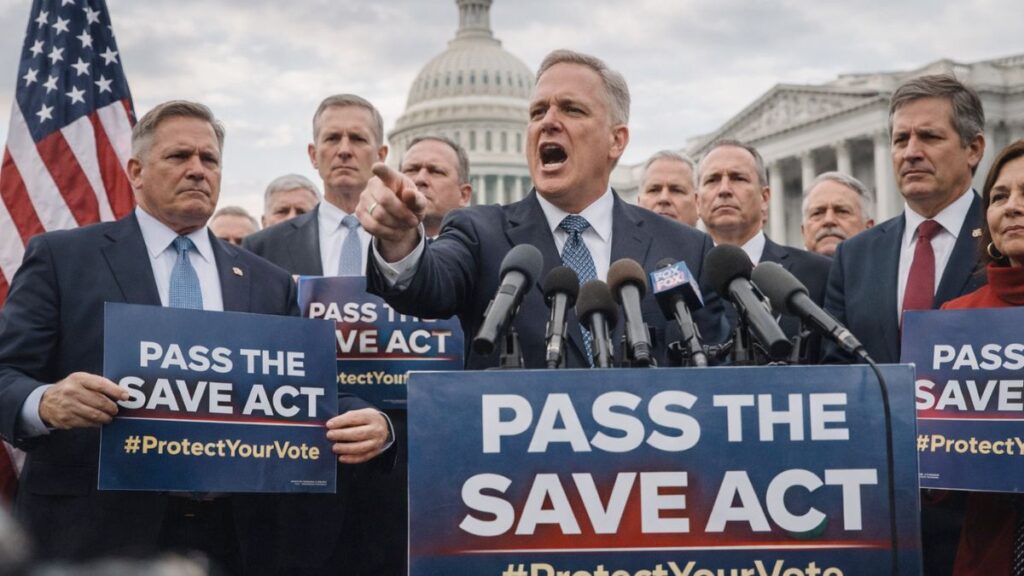
While the Department of Homeland Security remains paralyzed for six long weeks, an internal crisis threatens to shatter the fragile Republican unity. At the heart of the standoff: the Safeguard American Voter Eligibility Act (SAVE America Act), an emblematic text that requires irrefutable proof of American citizenship to register on federal voter rolls and a photo identification to cast a ballot.
For House conservatives, this is not a technical measure, but the last bulwark of popular sovereignty against uncontrolled immigration and the risks of electoral fraud it would impose.
By refusing any compromise that would dilute this text, the Freedom Caucus is issuing a clear ultimatum: no funding for the DHS without a genuine lockdown of the borders and the ballot boxes. A confrontation that lays bare, in broad daylight, the lines of fracture of a party in power, torn between Trumpian intransigence and senatorial pragmatism.
À lire aussi : ANALYSIS – Trump Reasserts American Hegemony: The Birth of the “Don-Roe Doctrine” Following Maduro’s Fall
An Ultimatum at the Heart of the Crisis: The SAVE Act or Nothing
In the sixth week of a paralysis of the Department of Homeland Security (DHS) – the longest targeted budgetary crisis affecting this agency since its creation in 2002 –, a deep fracture is widening within the American Republican Party. While the Senate and the White House are sketching out an agreement to unblock the funding of the agency in charge of domestic security, the conservatives of the House of Representatives, led by the Freedom Caucus, are firing red-hot shots. For them, this compromise is nothing other than a disguised capitulation in the face of “radical progressive” Democrats, who would have provoked the paralysis to protect “criminal aliens.” The stake goes far beyond the simple budget: it touches on the effective implementation of deportations and on the adoption of the Safeguard American Voter Eligibility Act (SAVE America Act), the pillar of the Republican electoral reform desired by Donald Trump.
The framework of the compromise, as it emerges from the negotiations conducted Monday evening at the White House between Republican senators, President Donald Trump and his advisers, is clear on paper but highly contested in reality. The major part of the DHS would be funded by a bipartisan agreement, while the funds dedicated to Immigration and Customs Enforcement (ICE) – particularly its deportation and removal operations – would be pushed back toward a budgetary reconciliation process. This mechanism, already used last year for the “big, beautiful bill” on taxes signed by Trump in July 2025, would allow the integration of provisions from the SAVE Act. But only part of the ICE agency would be concerned, the rest being funded immediately through a compromise judged too timid by the hardest-line elected officials.
The Freedom Caucus sees in it only one more “staging of failure.” In a statement published on X on Tuesday, the conservative group of the House denounces without ambiguity: “The Senate Republicans refused to impose a prolonged parliamentary obstruction by speech in order to pass the SAVE America Act, because that would have opened the way to unlimited amendments from the Democrats. Today, these same Republicans claim they will pass the SAVE Act through the budgetary reconciliation process – a procedure whose very feasibility remains uncertain in light of the Byzantine rules of the Senate –, which, upon close examination, would still authorize the Democrats to propose unlimited amendments. This is a pure exercise in manipulation. The American people are not dupes and will no longer tolerate this theater of impotence from the Republicans in Congress.”
This charge, relayed by Representative Randy Fine (Republican from Florida), who piloted a collective letter addressed to Senate Majority Leader John Thune (Republican from South Dakota), is unequivocal. “This would not solve my problem,” declared Fine to Fox News Digital on Tuesday. “They can well affirm that they will integrate the text into reconciliation if they wish. For my part, I will continue to vote against any bill emanating from the Senate as long as the SAVE America Act has not been adopted in its integral form.”
Fine does, however, make an exception for the funding of the DHS itself, on the condition that the final text takes up the version already passed by the House in January – a nuance that underscores the razor’s edge between ideological intransigence and budgetary pragmatism.
The SAVE Act: Bulwark Against Fraud or Partisan Trojan Horse?
At the heart of the standoff: the SAVE America Act, adopted by the House of Representatives in February 2026 (218 votes to 213). This text requires documentary proof of American citizenship for registration on federal voter rolls and imposes a photo identification at the time of voting. For House conservatives, it is an indispensable tool to “safeguard the eligibility of American voters” and to counter a chronic vulnerability in the face of illegal immigration perceived as a potential source of fraud. The Freedom Caucus sees in it a measure of democratic common sense, in keeping with popular sovereignty and the Trumpian priority of strict border control. The Senate opened debate on March 17, but the text has still not been the subject of a final vote, blocked by the lack of consensus and by Democratic opposition.
Yet the senatorial compromise dilutes this requirement by burying it in budgetary reconciliation – a long, politically perilous process subject to the Byrd Rule.
This senatorial rule (named after Senator Robert Byrd), inscribed in the Congressional Budget Act of 1974, prohibits the inclusion in a reconciliation text of any provision judged “extraneous” to the budget: those whose financial effect is purely incidental, those that have no direct budgetary impact, or those that increase the deficit beyond the ten-year window. Any violation can be sanctioned by a point of order; 60 votes are then required to overturn it. This is precisely why many conservatives doubt that the key provisions of the SAVE Act (proof of citizenship, photo ID) will survive this rigorous filter.
A source close to the Freedom Caucus’s thinking, quoted by Fox News Digital on Tuesday, goes further in the criticism: “The radical progressive Democrats provoked the closure of Homeland Security in order to protect foreign criminals. Why on earth would we grant them precisely what they demand by leaving the deportation wing without funding? We hold the lever of power. Let us not cede it. It is time to put an end to these incessant postponements of the application of immigration measures, which serve only to allow the Democrats to claim an undeserved victory.”
À lire aussi : ANALYSIS – Marco Rubio: The Cuban-American Pivot of Trumpian America Facing an Agonizing Castroism
A Strategic Fracture with Lasting Implications
This internal revolt is not anecdotal. It reveals the structural tensions of a Republican Party torn between a Trumpian base demanding on immigration and a more institutional senatorial wing, embodied by John Thune and Tim Scott, concerned with avoiding a total blockade. The choice to avoid parliamentary obstruction by speech in favor of reconciliation (limited debate but thematic amendments) is presented by the senators as the lesser evil. A source close to the negotiations retorted to Fox News Digital that the comparison made by the Freedom Caucus was “not at all the same thing.”
Yet, from the point of view of House conservatives, it is the same logic of retreat. By pushing back the essential operations of ICE into an uncertain future, the deal grants the Democrats a symbolic victory: the administrative machine starts turning again, while the deportation policy remains in abeyance. In a context where Donald Trump has made immigration his battle horse since 2016 – and where he has recently explicitly linked any agreement on the DHS to the passage of the SAVE Act –, this postponement risks undermining the administration’s credibility with its most mobilized electorate.
The recent history of DHS shutdowns reinforces this reading. Since the creation of the agency in 2002, budgetary paralyses have become a recurrent tool of political bargaining, particularly on immigration issues: 16 days in 2013 under Obama (linked to Obamacare), 35 days at the end of 2018–beginning of 2019 under Trump (on the border wall), 43 days in the autumn of 2025, and today this targeted crisis triggered on February 14, 2026. Each time, immigration serves as a hostage in negotiations that paralyze airports, border services, and deportation operations.
The analysis of the balance of power is unequivocal. Republicans hold narrow majorities in the House and the Senate; any internal fracture can block the legislative agenda. The Freedom Caucus, strong in its role as guardian of Trumpian orthodoxy, wields a disproportionate lever. Its refusal to vote for any senatorial text as long as the SAVE Act has not been adopted in due form places Republican leadership before a dilemma: yield to base pressures or risk yet another legislative failure.
Toward a New Test of Republican Loyalty?
At the time of writing, the bipartisan compromise on the rest of the DHS could be made public as early as this Tuesday. The White House, through an official quoted by Fox News Digital, judges the deal “acceptable” – a sign that Trump’s entourage favors a rapid exit from the crisis. But for the Freedom Caucus, yielding now would amount to a strategic betrayal: “We hold the lever. Let us not release it.”
This internal crisis of the GOP, against the backdrop of a shutdown that paralyzes airports and fuels criticism on national security, goes beyond procedural quarrels. It questions the Republicans’ ability to translate their electoral victory into concrete policy on two symbolic fronts: border control and vote protection. In an ever-polarized American political landscape, the SAVE Act crystallizes the debate on sovereignty: who decides who votes, and who enters?
The answer the Republicans give in the coming days will say much about their coherence in this year 2026, marked by the midterms of November 3. These elections, in which the entirety of the 435 seats in the House of Representatives and 35 Senate seats (22 of them held by Republicans) will be renewed, constitute an existential test. A compromise perceived as a retreat on immigration risks provoking a massive demobilization of the Trumpian base in the swing districts of the Sun Belt and the Midwest, where the SAVE Act enjoys fervent support. The primaries could then give birth to ultra-conservative challengers against elected officials judged too lukewarm, further weakening already precarious majorities. Conversely, maintained intransigence would galvanize the faithful electorate, maximize participation, and consolidate Republican positions with a view to 2028, while Democrats would exploit the theme of “democracy in danger” to reconquer moderate suburbs and pivot states.
Beyond American ballots, the stakes are geopolitical.
A perceptible weakening of American migratory and electoral policy would send a signal of vulnerability to all international actors: to Latin American countries and smuggling networks that daily test the borders, but also to European allies confronted with their own migratory crises, and to strategic rivals (China, Russia, Iran) that scrutinize every crack in American internal cohesion.
In the final analysis, the theater of Washington once again reveals the limits of a party in power but divided between senatorial pragmatists and House purists. For the Freedom Caucus, the time for half-measures is over: the door must be closed to “criminal aliens” and the electoral rolls locked, without compromise. Far more than a simple budgetary agreement, this battle will determine the very future of the Trumpian agenda – and perhaps the lasting credibility of the United States on the world stage.
#SAVEAct,#USPolitics,#RepublicanParty,#FreedomCaucus,#ElectionIntegrity,#VoterID,#ImmigrationPolicy,#DHSShutdown,#TrumpAgenda,#BorderSecurity,#USCongress,#SenateVsHouse,#PoliticalCrisis,#ElectionFraudDebate,#CitizenshipVerification,#AmericanPolitics,#Midterms2026,#GOPDivide,#ConservativePolitics,#ICE,#DeportationPolicy,#FederalBudget,#PoliticalStrategy,#WhiteHouse,#JohnThune,#TimScott,#RandyFine,#HomelandSecurity,#USShutdown,#PolicyAnalysis,#Geopolitics,#PowerStruggle,#LegislativeBattle,#Trumpism,#ElectoralReform,#DemocratsVsRepublicans,#USGovernance,#PoliticalTension,#NationalSecurity,#PolicyConflict