ANALYSIS – Starmer on the Brink: Historic Labour Rout, Reform UK Surge, and Tommy Robinson’s Massive March
By Angélique Bouchard
When Britain’s Two-Party System Is Cracking
Keir Starmer is on the edge of the abyss. Eight days after the historic rout suffered by Labour in the local elections of May 8, 2026, the British Prime Minister is fighting for his political survival. The party lost nearly 500 seats, while Nigel Farage’s Reform UK gained more than 612 (some figures put the total at 650), a tidal wave that Farage himself described as a “historic shift.” Internal pressure has become unbearable: more than 70 Labour MPs have publicly demanded his resignation or a clear exit timeline, several close aides have stepped down in protest, and a YouGov poll shows that nearly half of Britons want him gone.
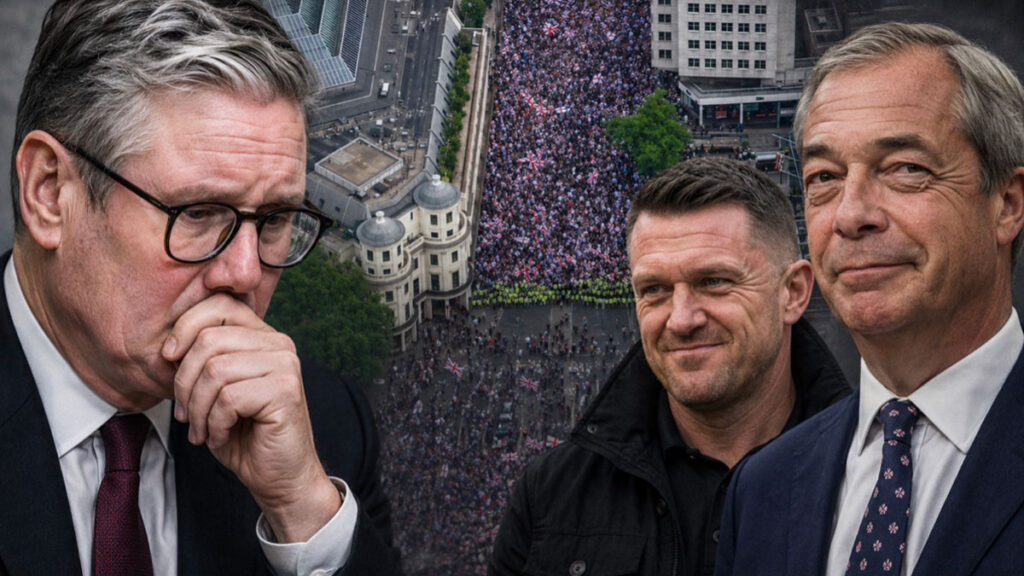
The crisis reached a spectacular new level on May 16, 2026, with the “Unite the Kingdom” march organized by Tommy Robinson, the emblematic figure of Britain’s far-right anti-immigration movement. Tens of thousands converged on central London, waving Union Jack and St George’s Cross flags, chanting patriotic slogans and calling for a “cultural revolution.” Police deployed 4,000 officers, horses, drones and helicopters at a cost of £4.5 million, while a counter-demonstration commemorating Nakba took place simultaneously. Starmer had warned against “hatred and division,” but this massive mobilization—just eight days after the local elections—illustrates in concrete terms the shockwave triggered by Reform UK’s victory. Britain’s two-party system, the bedrock of its politics for decades, is now visibly fracturing.
The Historic Labour Rout and Reform UK’s Conquest of the Red Wall
The May 8 local elections turned into a nightmare for the Labour Party. Labour lost hundreds of council seats in England, surrendered historic ground in Wales and fell further behind in Scotland. Reform UK delivered a genuine political earthquake, emerging as the clear winner of the contest—particularly in the former “Red Wall” constituencies of northern and central England, the post-industrial heartlands that had already swung heavily to the Conservatives in 2019 on the back of Brexit.
Farage successfully tapped into the deep discontent of working-class voters by promising a hard line on immigration, major tax cuts and the repeal of environmental policies seen as damaging to economic growth. This is no longer simply a protest vote: it is a lasting realignment. Voters who once formed Labour’s bedrock are now decisively breaking away from both traditional major parties. The Conservatives also suffered heavy losses, with a net decline of around 300 seats. Labour is bleeding voters both to the right (Reform UK) and to the left (Greens and independents, especially in urban and university areas, where the Gaza issue was central).
Alan Mendoza, executive director of the Henry Jackson Society, summed it up with stark clarity: “The era of two-party politics is definitively over with Reform UK’s stunning national success and the Green Party’s more localized wins. The two traditional parties of government, Labour and the Conservatives, have been routed nationally and in some cases have ceased to exist as a meaningful force in whole swathes of the country.”
The Internal Revolt: More Than 70 Labour MPs Demand Starmer’s Departure
Discontent within Labour has reached unprecedented levels. More than 70 Labour MPs have publicly called for Starmer to resign or set a clear exit timeline. Former junior Foreign Office minister Catherine West put the Cabinet “on notice”: if no minister steps forward by Monday, she will trigger a leadership contest herself. She said she would ask every member of the Parliamentary Labour Party to support her candidacy if necessary, declaring that Starmer is no longer “the right person” to revive the party.
Jon Trickett, MP for northern England, was particularly blunt: “Many Labour voters I represent are angry, disappointed, and feel betrayed. They have sent us a clear message: the party and the leadership must change immediately if we are to recover.” Sam Carlin, another MP, joined the call, stating that Starmer is no longer capable of carrying Labour’s project. West even suggested an internal reshuffle in which Starmer would be moved to an international role, making way for stronger figures such as Andy Burnham, Angela Rayner or Wes Streeting.
The Mandelson Scandal and the Wave of Resignations
The crisis has been compounded by a scandal that strikes directly at Starmer’s inner circle. His decision to appoint Peter Mandelson—a close friend of Jeffrey Epstein—as Britain’s ambassador to Washington triggered a wave of resignations among his closest aides. Several parliamentary assistants stepped down in protest. The Epstein scandal continues to haunt the government and reinforces the perception that Starmer has lost control of his own machine. At the same time, rising UK borrowing costs are fueling criticism of the government’s economic management and its failure to ease the cost-of-living crisis.
Farage, Trump Ally: A British-Style Populism That Is Redrawing the Future
Nigel Farage, close ally and friend of Donald Trump, embodies this new populism. He has described Trump’s victory as an “inspiration” and has imported the American anti-elite style, strict immigration control and robust defense of national identity into British politics. Trump himself has publicly criticized Starmer, declaring, “This is not Winston Churchill that we’re dealing with,” particularly over Britain’s reluctance to allow U.S. warplanes to use its bases at the start of the war against Iran.
The Cultural Symbol: Tommy Robinson’s March and the Patriotic Awakening
Reform UK’s rise goes far beyond the ballot box and has ignited a broader cultural battle. The “Operation Raise the Colours” campaign, which encourages the widespread display of the St George’s Cross and Union Jack, has become a powerful symbol of this patriotic revival.
Some see it as a legitimate assertion of national identity; others denounce it as “cover for far-right agendas.” This cultural momentum reached its peak on May 16 with Tommy Robinson’s “Unite the Kingdom” march. Tens of thousands converged on central London, chanting patriotic slogans and calling for a “cultural revolution.” Police had to deploy exceptional resources to manage the two simultaneous demonstrations, vividly illustrating the depth of the societal fracture opened by the May 8 results.
*
* *
A Historic Turning Point for the United Kingdom
Reform UK’s impact is historic and multidimensional. Electorally, it has shattered the dominance of the two major parties across entire regions. Culturally, it has reignited the debate over national identity and patriotism. Politically, it has plunged Keir Starmer into an existential crisis from which he may not recover. With crucial national elections just six months away, Britain is experiencing a genuine realignment: the era of traditional two-party dominance appears definitively over. Britons have clearly expressed their weariness with the policies of the elites and their desire to embrace new ideas. Reform UK is no longer a marginal party: it has become one of the central players on the British political stage. The great British rebalancing is underway—and it may well take Keir Starmer with it. The entire country will bear the consequences.
#RoyaumeUni,#UK,#KeirStarmer,#NigelFarage,#ReformUK,#TommyRobinson,#Labour,#PoliticsUK,#GrandeBretagne,#ElectionUK,#CrisePolitique,#UnionJack,#Immigration,#Populisme,#Londres,#Brexit,#Patriotisme,#FarRight,#Starmer,#BritishPolitics,#UKPolitics,#Europe,#Gaza,#IdentitéNationale,#RevoltePolitique,#TwoPartySystem,#Conservatives,#Greens,#Election2026,#Trump,#DonaldTrump,#TommyRobinsonMarch,#LeDiplomate