Analysis – Trump issues his ultimatum to NATO amid the Iranian crisis
By Angélique Bouchard
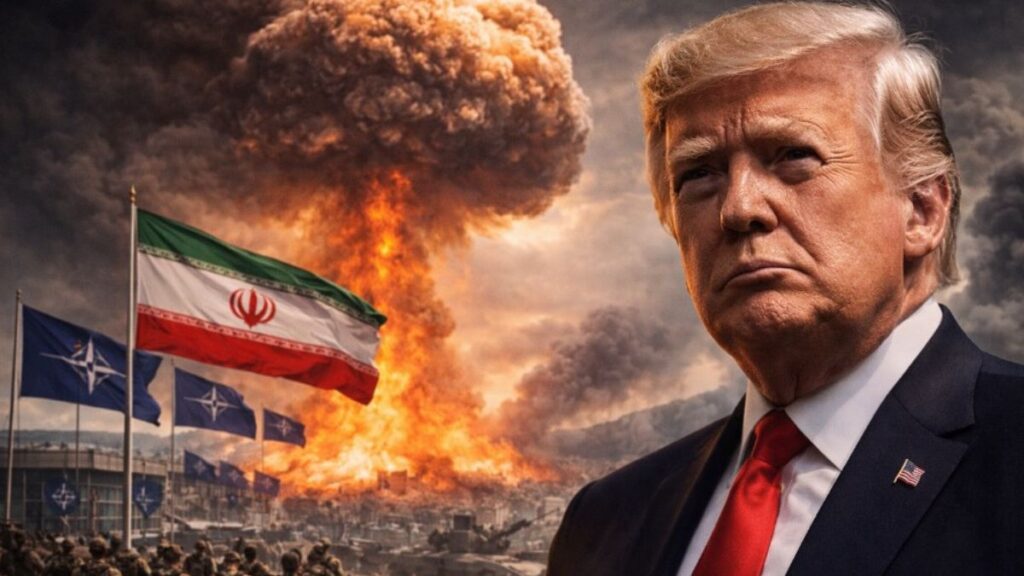
In the midst of an open war against Iran, President Donald Trump has elevated the long-standing dispute over the burden-sharing of the Atlantic Alliance to the level of an existential crisis. Frustrated by the systematic refusal of European allies to participate in securing the Strait of Hormuz – the vital waterway through which 20% of the world’s oil supply flows – he is openly threatening to withdraw the United States from NATO. The Diplomate Media dissects, beyond the rhetoric, the implacable logic of the America First doctrine confronting a now structural transatlantic fracture.
The Presidential Ultimatum: A Historic Declaration
In an interview granted to The Daily Telegraph and published on Wednesday, Donald Trump articulated his break with unmistakable clarity: “I was never swayed by NATO.” He continued: “I always knew they were a paper tiger, and Putin knows that too, by the way.” Reconsidering America’s presence in the Alliance was “beyond consideration,” he hammered home.
“Beyond not being there, it was actually hard to believe. And I didn’t do a big sale. I just said, ‘Hey,’ you know, I didn’t insist too much. I just think it should be automatic,” he explained, before adding: “We’ve been there automatically, including Ukraine. Ukraine wasn’t our problem. It was a test, and we were there for them, and we would always have been there for them. They weren’t there for us.”
These remarks come after the repeated refusal of allies to respond to Washington’s demands: sending warships to reopen and secure the Strait of Hormuz, and granting overflight or use of European bases for operations linked to the Iranian conflict.
The European Refusal Front: A Coalition of No
The facts are damning and consistent. France has banned U.S. aircraft carrying military supplies to Israel from overflying its territory. Spain has closed its airspace and “prohibited the use of the bases of Rota and Morón” for any operation linked to Iran, as its defense minister declared before Parliament. Italy initially refused access to the Sigonella base in Sicily before issuing a statement affirming that, “with reference to media reports regarding the use of military bases, the government reiterates that it acts in full compliance with existing international agreements and with the policy guidelines set out by the government to parliament,” and that “relations with the United States, in particular, are solid and based on full and loyal cooperation.”
The United Kingdom, despite maintaining certain logistical facilities, refused any direct participation. Trump personally targeted Prime Minister Keir Starmer: “You don’t even have a navy. You’re too old and had aircraft carriers that didn’t work.” Starmer replied that Britain is “fully committed to NATO,” “the single most effective military alliance the world has ever seen,” and that he would act “whatever the pressure on me and others, whatever the noise, I am going to act in the British national interest in all the decisions I make.”
On Truth Social, the American president was even more scathing toward France: “France has been VERY UNHELPFULwith respect to the ‘Butcher of Iran,’ who has been successfully eliminated! The U.S.A. will REMEMBER!!!” And toward reluctant allies regarding the strait: “All of those countries that can’t get jet fuel because of the Strait of Hormuz, like the United Kingdom, which refused to get involved in the decapitation of Iran, I have a suggestion for you: Number 1, buy from the U.S., we have plenty, and Number 2, build up some delayed courage, go to the Strait, and just TAKE IT. […] You’ll have to start learning how to fight for yourself, the U.S.A. won’t be there to help you anymore, just like you weren’t there for us.”
Defense Secretary Pete Hegseth added: “There are countries around the world who ought to be prepared to step up on this critical waterway as well. […] Last time I checked, there was supposed to be a big, bad Royal Navy that could be prepared to do things like that as well.”
The America First Doctrine: From Slogan to Strategic Rupture
At the heart of this crisis lies the America First doctrine, elevated to the structuring principle of Trumpian foreign policy since 2016. It is far more than a simple isolationist slogan: it represents a radical re-foundation of America’s place in the world. Washington no longer accepts being the “banker” and “policeman” of the Western world if allies do not pay their fair share – neither in defense spending nor in concrete operational commitment.
During his first term, Trump demanded strict compliance with the 2% of GDP threshold for military spending. In his second term, U.S. Ambassador to NATO Matt Whitaker welcomed the fact that he had pushed the Alliance to commit to 5%. Yet the current crisis shows that the debate has moved well beyond simple budgetary arithmetic to become existential.
Trump recalled this without mincing words during an informal press gaggle aboard Air Force One: “It’s only appropriate that people who are the beneficiaries of the strait will help to make sure that nothing bad happens there. If there’s no response, or if it’s a negative response, I think it will be very bad for the future of NATO.” And again: “Remember, like as an example of many cases that NATO countries, we’re always there for NATO […] But we’ve helped them.”
For the Trump administration, NATO must cease to be a unilateral shield for the Europeans and become a tool of collective power projection in service of clearly defined and reciprocal interests. The United States, now a net oil exporter, no longer needs the Gulf for its own energy security; it demands that the Europeans, the primary beneficiaries, shoulder their share of the burden. The European refusal is perceived as the ultimate proof that the Alliance has become a “paper tiger” – a structure in which Americans pay and fight while Europeans benefit without risk.
John Hemmings of the Henry Jackson Society analyzes this evolution with precision: “There is a growing transatlantic rift between right-leaning populists and left-leaning populists. […] The U.S. and many Western European countries are not only split over NATO spending and trade; they are split ideologically.”
NATO Secretary-General Mark Rutte himself acknowledged the tension: the Europeans needed time to organize “because the U.S. was not able to consult with allies because they wanted to keep the campaign secret.” More than 30 countries have since joined discussions on securing maritime routes, but this effort remains, in Washington’s eyes, insufficient and belated.
À lire aussi : EXCLUSIVE – Le Diplomate’s Grand Interview with Hermann Kelly, Champion of Irish Sovereignty
Geopolitical Consequences: A Post-Atlantic World in Gestation
The repercussions are immediate and potentially irreversible:
- For Europe: The possible end of the American umbrella would mean an unprecedented security vacuum since 1949. Most member states lack both the military capabilities and the political will to fill it quickly. Even more seriously, an American withdrawal would undermine the extended U.S. nuclear umbrella, forcing France and the United Kingdom – Europe’s only nuclear powers – to urgently rethink their own deterrence and assume a broader responsibility in the face of Russia and, above all, China.
- For energy markets: A prolonged blockade of the Strait of Hormuz would send oil prices skyrocketing, hitting already weakened European economies hard.
- For NATO’s credibility: Article 5 would lose all substance in the eyes of Moscow, Beijing, and Tehran.
- For American strategy: America First would find here its most accomplished expression since the creation of the Alliance. Trump has always said it: the United States will no longer be there for those who were not there for them.
- For the relationship with China: Beijing, which is accelerating its naval expansion in the South China Sea and the Indo-Pacific, would watch this fracture with the greatest attention. A weakened NATO would free the United States to focus on containing China, but it would also expose Europe to increased vulnerability, rendering the Old Continent less useful – and potentially less defensible – in the great Sino-American confrontation.
The Russian Strategy: A Historic Opportunity for Moscow
Vladimir Putin, indirectly cited by Trump himself (“Putin knows that too”), has long viewed NATO as a “paper tiger.” The current crisis offers Russia an exceptional strategic window. While Washington is engaged in the Middle East, the transatlantic fracture weakens the Alliance’s eastern flank, complicating any strengthening of support for Ukraine. Moscow can thus continue its war of attrition in Eastern Europe with less collective pressure, while exploiting the ideological divisions between right-wing and left-wing populisms in the West. This crisis validates, in the Kremlin’s eyes, its long-standing thesis: NATO is a disunited alliance dominated by contradictory national interests, not a monolithic bloc. An American withdrawal would accelerate the shift toward a multipolar order in which Russia gains greater room for maneuver against a fragmented West.
*
* *
The Historic Test of Truth
The threat of American withdrawal is neither a negotiating posture nor a simple bravado. It constitutes the logical and assumed culmination of an America First doctrine confronting an Alliance that, according to Trump, has ceased to be reciprocal. Faced with a weakened but still capable Iran that can paralyze global energy flows, Washington demands that its allies move from verbal solidarity to concrete and immediate action.
Europe stands today at a crossroads: either it finally accepts to genuinely share the security burden, including in zones of vital interest to the continent, or it assumes the historic risk of a NATO emptied of its core substance – and of an international order in which the United States, freed from its multilateral commitments, will pursue its America First agenda alone. In a world where China is accelerating its naval expansion, where Russia exploits every fissure, and where Iran tests the limits of Western power, this fracture is no longer a simple quarrel over cost-sharing. It may mark the beginning of the end of Atlantic hegemony as we have known it since 1949.
President Trump has posed the question in raw and definitive terms: “They weren’t there for us.” History, merciless, will judge whether the Europeans will know, this time, to be present – not only for the United States, but for the Alliance they still claim to defend… or whether this cry of frustration will mark the start of a new geopolitical chapter, written without America.
À lire aussi : TRIBUNE – Bienvenue dans le monde enchanté du NATO First
#Trump,#NATO,#IranCrisis,#Geopolitics,#StraitOfHormuz,#AmericaFirst,#TransatlanticCrisis,#WorldPolitics,#USForeignPolicy,#EuropeDefense,#OilCrisis,#GlobalSecurity,#MiddleEastConflict,#MilitaryStrategy,#InternationalRelations,#EnergySecurity,#USWithdrawal,#NATOCrisis,#GlobalTensions,#WarAnalysis,#PoliticalAnalysis,#StrategicShift,#RussiaStrategy,#ChinaThreat,#WesternAlliance,#DefenseSpending,#GlobalOrder,#SecurityCrisis,#NavalPower,#GeopoliticalRisk,#TrumpDoctrine,#AllianceBreakdown,#EuropeanUnion,#USPolitics,#MilitaryAlliance,#CrisisAnalysis,#InternationalCrisis,#GlobalInstability,#PowerShift,#StrategicAnalysis