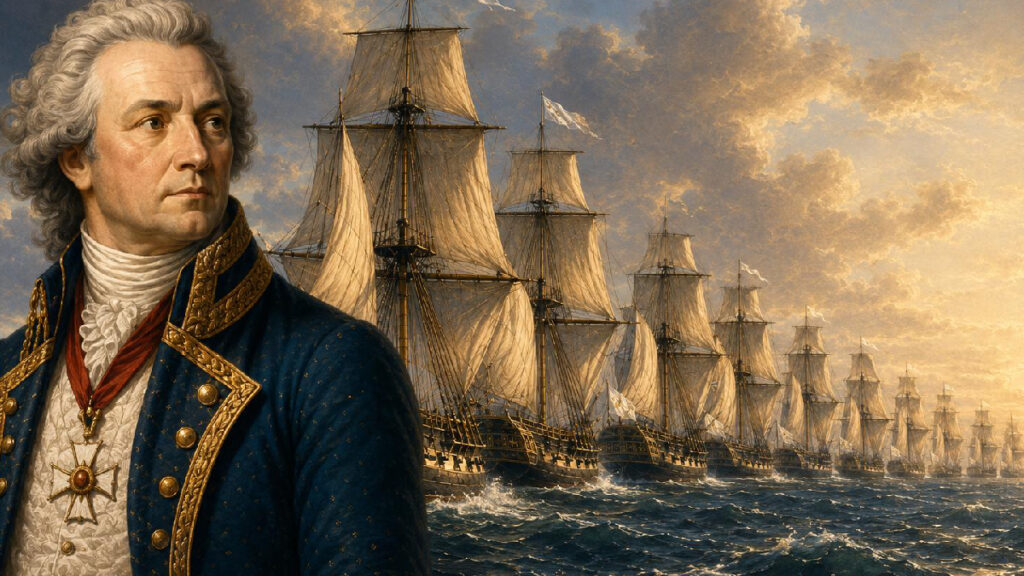
PORTRAIT – Armand-Guy Simon de Coëtnempren, Comte de Kersaint (1742-1793): a sailor of the Enlightenment in the revival of French naval power during the American War of Independence
Contribution to the 250th anniversary of the American War of Independence (1775-1783) and the 400th anniversary of the French Navy (1626-2026).
By François Souty
François Souty, PhD in Economic History, is a former International Affairs Officer at the European Commission’s Directorate-General for Competition (2021-2024). Author of a dozen books and numerous academic articles, he teaches European Institutions, European and Global Geopolitics at the Excelia Business School group (La Rochelle-Paris Cachan) as well as European Competition Law and Policy at the Faculty of Law of the University of Nantes. He is in charge of the economics section at Le Diplomate Media.
« This great and profound maxim, that whoever is master of the sea is also master of the earth… »
Armand Guy Simon de Coëtnempren, comte de Kersaint, Opinion of M. de Kersaint read to the Society of Friends of the Constitution on 1 March 1790, Archives nationales, Amérique du Sud, C7, fol. 106-107.
Executive Summary
On the occasion of the 400th anniversary of the French Navy and the 250th anniversary of the American War of Independence, this study proposes a reassessment of the historical role of the action of Armand-Guy Simon de Coëtnempren, Comte de Kersaint (1742-1793), whose contribution to French maritime history remains largely underestimated. While his political commitment during the French Revolution is well known, his naval career, his work as a reformer, his colonial action and his strategic thinking have never been the subject of an overall synthesis based on the archives.
Based on manuscript sources held in particular at the Archives nationales and the Historical Service of the Defence and, as well as numerous French, British and Dutch printed collections, this article restores the coherence of an exceptional career. It highlights a naval officer who was successively a sailor-in-war, a hydrographer, a reformer of the Marine Royale, the French Navy, a Squadron Commander (« Chef de Division » or Commodore in the British Royal Navy), a leader of a combined amphibious operation and a colonial administrator.
The study shows in particular that the expedition led by Kersaint against the Dutch colonies of Demerary, Essequibo and Berbice, occupied by the British, at the beginning of 1782 cannot be reduced to a brilliant military operation, as it has generally been considered by British, Dutch or even French historiography. Indeed, prepared by meticulous hydrographic reconnaissance of the river mouths years before, it illustrates a particularly modern and even very advanced conception of naval warfare, based on the integration of intelligence, mastery of the sea, logistics, landing and administration of conquered territories. It also sheds light on the role played by Kersaint in the provisional organization of these colonies as well as in the creation of the Longchamp Establishment, at the origin of the current Georgetown, capital of British Guiana until independence in 1966 and that of Guyana which succeeded it.
One of the main contributions of this research lies in the exploitation of an unpublished state of services, drawn up in Brest on 18 December 1789, certified by the head of division Bernard de Marigny and approved by the lieutenant general of the naval armies commanding the Navy in Brest, the Comte d’Hector. This official document makes it possible to reconstruct with precision Kersaint’s career, his embarkations, his commands, his promotions, his distinctions and his operational responsibilities. It is an exceptional testimony to the French Navy’s perception of one of its senior officers on the eve of the French Revolution. This record of service shows that, a few months before the Revolution, Kersaint already had thirty-four years of service in the Royal Navy, including nearly twenty years of commands at sea and several first-rate responsibilities. This official document reveals the extent of a maritime career that historiography, long focused on its political role during the French Revolution, had until now only very partially highlighted.
Beyond the biography of a naval officer, this study invites us to reconsider Kersaint’s place among the great naval officers of the late Ancien Régime and among the great actors of the French naval revival under the reign of Louis XVI. It shows that he belongs fully to that generation of officers who contributed to the restoration of France’s maritime power during the American War of Independence and whose influence goes far beyond the framework of military operations to extend to naval reform, maritime strategy, hydrography and colonial development.
Introduction
The French maritime history of the eighteenth century remains largely dominated by a few figures who have become emblematic, whose names are intertwined with the naval renaissance carried out under the reign of Louis XVI and with the great French victories at sea during the American War of Independence. The works devoted to Louis-Antoine de Bougainville, Jean-François de Galaup, Count de Lapérouse, Pierre André de Suffren, François-Joseph Paul Count de Grasse, Charles-Henri d’Estaing and Toussaint-Guillaume Picquet de La Motte dit La Motte-Picquet, have profoundly renewed our knowledge of naval campaigns, voyages of exploration and the reconstruction of French maritime power in the Age of Enlightenment.[1] Conversely, other officers, although regarded by their contemporaries as belonging to the first rank of the French Navy, remain relatively little studied or have only been approached through a particular episode in their career as naval officers, without an overall study having really sought to restore the unity of their action, their writings and their thought.
Such was the case of Armand-Guy Simon de Coëtnempren, Count de Kersaint (1742-1793). The collective memory has especially remembered the Girondin Convention, opponent of the death sentence of Louis XVI, arrested and then guillotined at the height of the Terror.[2] Historians of the American Revolutionary War also know the brilliant commander of the frigate Iphigénie, the victorious division leader of the expedition of Demerary, Essequibo and Berbice, as well as the provisional governor of these colonies reconquered from the British in 1782.[3] However, this picture remains incomplete. It leaves in the shadows an essential dimension of the character: that of an officer of the Enlightenment who devoted a considerable part of his activity to reflecting on the conditions of French maritime power, the organization of the Navy, the improvement of naval construction, the colonial administration, the armament of ships adapted to operations, navigation, arsenals, etc. maritime trade and the relationship between economic and military power.
This relative historiographical discretion appears all the more paradoxical since Kersaint belonged to an exceptional generation of officers trained during the Seven Years’ War and who had reached maturity at the time when Louis XVI was embarking on an ambitious policy of naval reconstruction. Under the successive impetus of Sartine and the Marquis de Castries, with the help of engineers such as Jacques-Noël Sané, Jean-Charles de Borda and Fleurieu, the French Navy underwent one of the most profound transformations in its history. The standardization of ships, the improvement of artillery, progress in hydrography, improvement of navigation instruments, rationalization of arsenals, increased professionalization of officers and renewed reflection on the strategic use of fleets were part of a vast modernization movement that allowed France to recover, in less than twenty years, a maritime rank comparable to that of the greatest European powers.[4]
The archives kept in the Archives nationales, the Historical Service of the Defence as well as numerous printed and manuscript collections reveal a much more complete character than that generally presented by historiography. The present work is an extension of research for a doctoral thesis devoted to the economic history of the colonies of Demerary, Essequibo and Berbice, in the north-west of Dutch Suriname, forming a Western Dutch Guiana, the study of which had led to several encounters with the figure of Armand-Guy Simon de Coëtnempren, Count de Kersaint, provisional Governor of these establishments after their conquest in 1781.[5] The consultation of new unpublished archival collections and the rereading of his technical, administrative and political memoirs now lead to a much broader reassessment of his career, his work and his thought.[6]
Kersaint is indeed fully in line with this dynamic. A war sailor who was distinguished several times by his superiors, an experimenter attentive to technical innovations, a colonial administrator, a member of parliament, the first vice-admiral of the Republic appointed by the Minister of the Navy and an illustrious mathematician Gaspard Monge, he was never satisfied with an admiral’s commission in operation at sea again after 1789. The archives kept at the Service Historique de la Défense, the Archives national and in several printed collections reveal an officer of character, innovative, very intellectual, who observed, compared, experimented and proposed relentlessly. Once again, his numerous memoirs deal with the nautical qualities of ships, the organization of military ports, the discipline of crews, colonial fortifications, the finances of the Navy, maritime trade and the general principles of naval warfare. They bear witness to a remarkably coherent reflection, based on the experience of the sea as much as on a solid scientific and administrative culture.[7]
The interest of this work goes far beyond the institutional history of the French Navy. Through his writings, a global conception of maritime power gradually appeared, closely associating strategic vision, technical superiority, excellence of crews, administrative efficiency, commercial development, logistics chain, control of colonial spaces and the capacity for military action. Long before the nineteenth century systematized the great theories of naval power, Kersaint already sensed that the domination of the seas was less the result of the accumulation of ships than of the ability of a state to coordinate all the instruments of its power. Without being a theoretician in the sense that Alfred Thayer Mahan, Julian Corbett or Raoul Castex would later understand it, Kersaint nevertheless appears to be one of the first French officers to have developed a true way of thinking about maritime power, directly derived from operational experience and constantly nourished by the observation of the economic, technical and political realities of his time.[8]
The ambition of this study thus goes beyond the simple reconstruction of a military career. It consists in restoring the intellectual unity of a path that historiography has long fragmented between the sailor, the soldier, the naval engineer, the colonial conqueror, the revolutionary deputy and the reformer. Based on a large corpus of manuscript and printed sources consulted for more than thirty years, originally to prepare our doctoral thesis — service records, correspondence, technical memoirs, ministerial archives, campaign accounts and parliamentary debates — the aim is to show that Kersaint was not only one of the architects of the French naval renaissance under Louis XVI, but also one of the most accomplished representatives of the maritime culture of the Enlightenment, which closely combined science, technology, administration, trade and strategy. This culture manifests itself spectacularly in the exploration of the Pacific Ocean.[9]
To this end, the study is organized into four complementary parts. The first places Kersaint’s training in the context of the reconstruction of French naval power in the aftermath of the Seven Years’ War and analyzes the family, intellectual and professional legacies that shaped his vocation. The second follows the naval officer and the combatant in order to show how the experience acquired in naval campaigns, punctuated by naval battles, all won with great struggle by the young officer, animated by an ardent feeling in reference to his heroic father, gradually nourished an original reflection on the conditions of maritime superiority. The third examines its role in the global war of the late eighteenth century through the operations of the American War of Independence, its relations with its leaders, who were among the greatest sailors in the history of the French Navy, its networks of officers, and its administration of the colonial areas conquered in Dutch Guiana. Finally, the fourth part highlights the work of the reformer by analysing his technical, administrative and political memoirs, the opinions of his leaders, in order to show that naval power constitutes, for Kersaint, a real state project, where science, technology, innovation, trade, administration and strategy contribute to the same conception of the maritime greatness of France.
I. Born a sailor in a maritime power under reconstruction: Armand-Guy Simon de Coëtnempren, Count de Kersaint and the French naval renaissance under Louis XVI
The career of Armand-Guy Simon de Coëtnempren, Count de Kersaint, most often referred to simply as « Kersaint », cannot be understood if it is isolated from the exceptional context in which it took place. More than just an individual destiny, his career belongs to a generation of officers who, after the deep humiliations suffered by France during the Seven Years’ War, were called upon to participate in one of the most ambitious naval reconstruction projects in the history of the French monarchy.
The Treaty of Paris of 1763, which put an end to the Seven Years’ War, marked a major turning point in the political, economic and maritime history of the kingdom. The loss of a large part of the first colonial empire, the weakening of the war fleet and the domination acquired by Great Britain over the oceanic areas led the political and military elites to engage in a reflection on an unprecedented scale on the foundations of French power. Far from being limited to an increase in the number of ships, this maritime renaissance mobilized all the resources of the State: administrative reform, modernization of arsenals, progress in naval architecture, improvement of artillery, scientific innovations, creation of a Naval Health Academy in Rochefort as early as 1720 enhanced in the 1760s and 1788 (after even earlier developments in 1666), development of officers academies, improvement of cartography and renewal of strategic thinking.
Under the successive impetus of the Duke de Choiseul, Antoine de Sartine and then Marshal de Castries, the French Navy thus became a veritable laboratory of reforms where administrators, engineers, scientists and naval officers collaborated: the work of Jacques-Noël Sané, Jean-Charles de Borda, the Comte de Fleurieu and Ferdinand Berthoud testifies to this desire to make scientific and technical superiority one of the foundations of French naval recovery. But this policy could not have produced its effects without the commitment of a new generation of officers capable of implementing these innovations, assessing their results at sea and transforming their courageous and often audacious operational experience into proposals for reform.
Armand-Guy de Kersaint belongs fully to this generation. Heir to a family deeply attached to the service of the King’s Navy, marked from his adolescence by the heroic death of his father during the Battle of the Cardinals (Quiberon Bay), he began his career at the very moment when the monarchy was undertaking to rebuild its naval power. His campaigns, his responsibilities, his technical observations and the numerous memoranda that he would later send to the maritime authorities cannot be dissociated from this dynamic of renewal that characterized the last two decades of the Ancien Régime.
This section thus proposes to place Kersaint’s training in this dual perspective, family and institutional. After recalling the origins of the Coëtnempren family and the legacy left by Guy François, Count de Kersaint, father of Armand-Guy, it will examine the first years of training of the future officer before showing how his beginnings in the French Navy were part of the vast maritime renaissance movement initiated under the reign of Louis XVI. Far from being a simple biographical prelude, these years of youth already allow us to understand the foundations of a way of thinking and practising the sea that would reach its full maturity during the American War of Independence.
A. Breton heritage and culture of service: the origins of a maritime vocation
On 20 November 1759, off the coast of Quiberon Bay, the French fleet commanded by Marshal de Conflans was surprised by the British squadron of Admiral Hawke. In rough seas, at the end of a battle whose outcome permanently compromised the naval ambitions of the French monarchy, the ship Le Thésée, commanded by Guy François de Coëtnempren, Count de Kersaint, capsized brutally during a daring manoeuvre to protect his flagship from an inept and incapable commander of the French squadron, before disappearing with a large part of its crew and its commander.[10]For the history of France, the Battle of the Cardinals is one of the most dramatic episodes of the Seven Years’ War.[11] For his son Armand-Guy Simon, then seventeen years old and already engaged in a military career, it represents an even more intimate drama: the death of his father, a highly esteemed naval officer, with a career prestigious for his victorious naval battles, to which is added that of two of his brothers. The national disaster thus joins the family tragedy. The future vice-admiral’s entire life seemed to be marked by a double loyalty: to the memory of his family and to the revival of French maritime power.[12]
However, this opening scene cannot be understood in isolation. It takes on its full meaning when it is placed in the broader context of eighteenth-century maritime Brittany, the true human, economic and strategic matrix of the Royal Navy. As Fernand Braudel had shown, individual destinies acquire their full meaning only in the light of the deep structures that support them.[13] Armand-Guy de Kersaint’s maritime vocation thus stems from a geography, a society and a culture of service to the royal state whose roots are rooted in the long history of Brittany. Before being a career, serving in the Navy constituted, for part of the coastal nobility, a real family and provincial culture of service to the State.
During the Age of Enlightenment, Brittany occupied a singular place in the maritime organization of the kingdom. Its geographical location, open to the Atlantic and the English Channel, the multiplicity of its ports and the importance of its coastal populations make it a major strategic space for the French monarchy. Brest, which had become the kingdom’s main military arsenal since the reign of Louis XIV, concentrated with Lorient the construction of ships and frigates, the armament of squadrons and the preparation of ocean campaigns. Saint-Malo remains a major centre of distant navigation and racing; Morlaix, Roscoff and the ports of Léon participated in Atlantic trade; Finally, Nantes established itself as one of the great centres of French colonial trade, at the heart of economic relations between Europe, Africa and the Americas.[14]
This maritime opening is not only an economic reality. It has a lasting influence on social behaviour and family strategies. In the Breton bishoprics of Léon, Cornouaille and Saint-Malo, the sea represented at the same time a space of wealth, a professional horizon and a place for the accomplishment of the noble duty. Since the reforms of Richelieu and Colbert, the monarchy had sought to constitute a permanent corps of officers capable of commanding the naval forces of the kingdom. The noble families of the coastal regions provided an important part of these cadres, putting at the service of the King an ancient military tradition associated with a concrete knowledge of maritime realities.[15]
The Breton nobility involved in the Marine royale thus belonged less to a traditional court aristocracy than to a service nobility, whose prestige was based on the continuity of the offices held for the monarchy. The command of a ship, the experience of distant campaigns and participation in major maritime conflicts became essential elements of social distinction. As Martine Acerra and Jean Meyer have shown, the French Navy of the eighteenth century was largely based on these provincial families who ensured the permanence of a corps of professional officers, attached both to their noble traditions and to the new requirements of a globalized maritime war.[16]
The Coëtnempren family, lords and then counts de Kersaint, belonged fully to this universe. Originally from Léon, in northwestern Brittany, she was part of a region where relations between the local nobility, maritime activities and military service were particularly close. Although it was not one of the largest aristocratic families in the Kingdom, it had the characteristics of the old provincial nobility who drew an essential part of their influence from their loyalty to the service of the state.[17] The choice of a naval career thus appears less as a break than as the fulfilment of a family tradition.[18]
Armand-Guy Simon’s entry into this world must also be placed in the particular context of the French Navy after the great difficulties of the reign of Louis XV. Born in 1742 in Paris, he belonged to a generation of officers who experienced the deep crisis caused by the Seven Years’ War, then participated in the naval reconstruction undertaken under Louis XVI. His individual destiny is thus placed at the crossroads of two legacies: that of a maritime Brittany that has been supplying servants of the Royal Navy for several generations, and that of a monarchy that seeks to restore its power over the oceans after the humiliations suffered at the hands of Great Britain.[19] The crossing was reinforced by a third inheritance by his marriage in Martinique to a member of a family of very high nobility, in the first circle of the French monarchy, to which we return later.
This double inscription explains the precocity of its vocation. For a young gentleman like Armand-Guy Simon, entering the Navy did not only mean adopting a military profession; It means joining a community based on specific values: loyalty to the sovereign, honour, valour, courage, discipline, technical competence and initiative. These values have shaped the Navy into the 21st century. The sea became a space where aristocratic honour and the new demands of Enlightenment rationality met. The naval officer of the eighteenth century must be at the same time a combatant, a navigator, an administrator and a man of science.[20]
Thus, even before the personal experience of the sea confirmed his vocation, Armand-Guy de Kersaint already belonged to a world that predisposed him to maritime engagement. His birth into a Breton family focused on the service of the King, his belonging to a generation marked by the crisis of French power and the example of a father engaged in the battles of the Royal Navy were the first elements of a training that would find its fulfilment in the following decades.
Kersaint’s vocation is therefore first and foremost an inherited vocation: the heritage of a province, a family and a particular conception of public service. It was precisely this continuity that Guy François de Coëtnempren, whose career and heroic death at the Cardinals would give the young Armand-Guy a lasting model of courage and loyalty.
B. Guy François de Coëtnempren, Comte de Kersaint: the legacy of a naval officer
If the family origins explain the inscription of Armand-Guy Simon de Coëtnempren de Kersaint in an ancient nobility of service, they are not enough to account for his maritime vocation. This finds its first incarnation in a tutelary figure: that of his father, Guy François de Coëtnempren, Count de Kersaint. A naval officer recognized by his contemporaries, appreciated by his superiors and crews alike, he belonged to the generation of sailors who, under the reigns of Louis XV, directly confronted the rise of British power and participated in the last major naval confrontations of the Ancien Régime before the reconstruction undertaken under Louis XVI.[21]
Born in 1712 into a Breton family deeply attached to the service of the monarchy, Guy François embraced a maritime career at a very young age, following the now traditional path of young gentlemen destined for the command of the King’s ships. His training then combined practical learning of navigation, knowledge of hydrography, mastery of naval artillery, the principles of ship construction and the progressive exercise of command of men. The eighteenth-century naval officer was no longer just a fighter: he became a professional sailor, capable of steering a ship of any draught in distant ocean spaces, of ensuring the discipline of a crew and of understanding the technical constraints that determined the effectiveness of a ship.[22]
This evolution precisely characterizes the generation to which Guy François belongs. His career took place at a time when the Franco-British rivalry was acquiring a truly global dimension. The clashes were no longer limited to European waters: they took place in the North Atlantic, around the West Indies, on the coasts of North America and in the trade routes of the Indian Ocean. The young officer thus acquired the diversified experience of naval operations that was then the true school of command: long crossings, convoy escorts, coastal reconnaissance, protection of colonial possessions and fighting against forces that were mostly superior in numbers.[23]
One of the most revealing episodes of his military qualities occurred during the operations related to the First War of the Austrian Succession. In 1746, Guy François commanded the frigate La Renommée and took part in a particularly daring mission to supply and support Louisbourg’s position in Canada, which was then threatened by the British. Succeeding in breaking through the enemy position, he accomplished an operation that required perfect nautical mastery, a great capacity for decision-making and remarkable tactical audacity. On the way back, engaged by several British ships, she sustained a violent fight during which she was seriously wounded, while her ship retained enough manoeuvring qualities to continue her journey. This episode largely contributed to establishing his reputation as a courageous officer and skilful maneuverer.[24]
This campaign also revealed the existence of a professional network that was to play a major role in French naval history. Among the officers who served at his side was the young Toussaint-Guillaume Picquet de La Motte, future Lieutenant General of the Naval Armies and one of the most brilliant leaders of the Marine Royale in the decades preceding the Revolution. The relationship forged between the two men, forged in long crossings as well as in fierce naval battles, goes beyond simple comradeship in arms. It bears witness to the professional and personal ties that structured the French Navy in the eighteenth century, where apprenticeship with experienced commanders helped train a new generation of officers. After the death of Guy François at the Cardinals, La Motte-Picquet remained close to his family and represented an important relay in the world of the Navy for the young Armand-Guy.[25]
The rest of Guy François’ career confirmed this reputation. His various commands bear witness to the confidence placed in him by the maritime administration: he successively commanded several important ships and took part in the operations that marked the last years of the Seven Years’ War. Although he did not belong to the small circle of great commanders who traditionally occupy the centre of the historiographical scene, he represented the essential category of experienced Captains on whom the Navy’s real operational capability depended. The efficiency of a fleet never depends solely on a few great leaders; It is based on a community of officers capable of transmitting knowledge, ensuring the discipline of crews and transforming the experience of the sea into collective competence.[26]
Contemporary testimonies and later notes on his career underline precisely these qualities. Guy François appears to be an officer sought after for his experience, his decision-making capacity and his ability to steer ships in difficult circumstances. Campaign accounts insist less on personal glory than on a form of professional mastery: that of a sailor capable of combining prudence and audacity, qualities that are essential in a Navy where ship commanders have a large degree of autonomy in oceanic spaces often far from the central power.[27]
The death of Guy François during the Battle of the Cardinals, however, gave this brilliant career, which was cut short too soon, a tragic dimension. On 20 November 1759, as commander of the Thésée, a 74-gun ship, he took part in the battle fought by Marshal de Conflans’ squadron against the British forces of Admiral Hawke. During a manoeuvre carried out in particularly difficult conditions, the vessel took on a considerable body of water and capsized almost instantly, taking with it the loss of its commander and a large part of its crew.[28] The young Lapérouse was wounded and captured by the English during this battle of the Cardinals. Guy François’s death occurred at the very moment when the French Navy was experiencing one of the deepest crises in its history: the defeat of the Cardinals symbolized the temporary collapse of French naval power and nourished the desire for reconstruction that would mark the following decades.
For Armand-Guy Simon, then seventeen years old, this disappearance was much more than a family tragedy. It transforms the paternal image into a moral legacy. The young officer lost a father, but he also received a professional model: that of a sailor for whom military value was based on technical competence, personal courage and a sense of service to the State. Kersaint’s entire subsequent career would bear the mark of this transmission. Like his father, he sought less individual glory than the permanent improvement of the French naval instrument, with the concern of his crews; like him, he considered that maritime power rested first and foremost on the quality of the men who served the Navy.
Thus, Guy François de Coëtnempren appears not as a simple introductory episode in the life of Armand-Guy, but as the first link in a true maritime filiation. Through him, a name, a military memory and a demanding conception of the officer’s profession are transmitted. His father’s inheritance was the starting point of a trajectory that would lead his son from the command of ships to the reflection on maritime power, then to the reform of the Navy and to political action at the top of the state.
C. Apprenticeship as a seafarer: training, first embarkations and discovery of the sea
Armand-Guy Simon de Coëtnempren’s entry into the Navy was neither an improvised choice nor a simple family inheritance. It was part of the career of these young Breton gentlemen who were destined by the monarchy very early on to serve the sea in order to renew a corps of officers on which an essential part of the state’s power now depended. Like many of his contemporaries, he was received into the Marine Guards Corps (« Gardes de la Marine ») of Brest, an institution which, since Colbert’s reforms, had been the main training crucible for naval officers. Much more than a military academy, it was a real school of government where the scientific knowledge, the habits of command and the spirit of public service that characterized the Navy of the Enlightenment were acquired.[29]
The training provided to the Marine Guards underwent a profound transformation. In addition to the traditional exercises of manoeuvring and artillery, there was the study of hydrography, trigonometry, practical geometry, nautical astronomy, drawing, cartography and new methods of calculating longitude. The progress made in scientific navigation, the work of Jean-Charles de Borda on nautical instruments, that of Ferdinand Berthoud on marine clocks and the improvements made to naval architecture now required the officer to have a solid technical culture. War at sea became a science as much as an art, and the King’s officer a practitioner capable of dialoguing with engineers, builders, hydrographers and arsenal administrators.[30]
This intellectual evolution came at a pivotal moment in French naval history. When Kersaint began his apprenticeship, the Seven Years’ War had just revealed the inadequacies of the Navy: weak infrastructure, difficulties in coordination between the squadrons, logistical inadequacies and painful losses of experienced officers. The reforms undertaken in the arsenals therefore sought to bring about the emergence of a new generation of seafarers who were better educated, more mobile and more aware of the scientific dimensions of their profession.[31] Kersaint belonged fully to this transitional generation, which would be the link between the last great officers of the reign of Louis XV and the architects of the naval revival under Louis XVI.
However, no school can replace the experience of the sea. Like all young officers, Kersaint learned above all by sailing. The first embarkations from Brest made him discover the daily reality of life on board: the discipline of watches, the difficulties of offshore navigation, the constraints of building maintenance, the requirements of manoeuvring in all winds and the responsibility of the command in the face of men and elements. Successive campaigns, stops in major military ports and long crossings were all stages of practical training in which observation played as important a role as action.
During these first years of service, he embarked successively on several ships of the French Navy, before receiving command himself. The service records kept in the national archives or in the archives of the former overseas France (in particular the Depot of Fortifications and Colonies) make it possible to reconstruct, with hitherto unprecedented precision, all the embarkations and commands exercised by Armand Guy de Kersaint between 1755 and 1788, the year of his last command at sea. This documentation shows a continuous progression, from his first embarkations as a supernumerary volunteer on Le Formidable, the ship commanded by his father and then as a Marine guard in Brest, to the command of frigates, ships of the line and an independent naval division. Beyond the diversity of the ships served, it highlights the experience acquired in the Royal Navy’s main theatres of operations – the Atlantic, the Gulf of Guinea, the West Indies and Guyana, the Mediterranean – as well as the constant confidence placed in it by its superiors. The table attached in appendix n°1 at the end of the article restores, in chronological order, the ships on which Kersaint served or that he commanded, the main campaigns in which he participated and, when the sources allow it, the missions entrusted to him. This succession of assignments does not reflect a simple hierarchical progression; it is a real school of the sea. Each vessel has its own nautical qualities, its crew, its technical constraints and its particular missions. By moving from flutes or coastguard brig, from frigate to ship, from surveillance cruises to convoy escorts or war operations, Kersaint gradually acquired this concrete knowledge of the maritime world that would later nourish all of his reflections.
Navigation also allowed him to discover the great arsenals of the Kingdom. Brest, Rochefort and, to a lesser extent, Toulon, are not only military ports; They are the laboratories of the French maritime renaissance. Young officers rubbed shoulders with construction engineers, artillery officers, administrators, hydrographers and scientists who contributed to the technical renewal of the Navy. In this world where science and practice meet, Kersaint observes the methods of construction of new buildings, the improvements to the rigging, the organization of stores, the management of supplies and the daily functioning of an administration whose qualities and inadequacies he will later emphasize. Just after his marriage in 1772 to the first cousin of the Marquis d’Ennery, Governor General of Saint Domingue, Claire d’Alisso de Paule d’Eragny, between 1772 and 1776, he even completed a real army command course as captain, second lieutenant of the 1st battalion of the Bayonne Regiment. On 14 March 1775 he became captain of marines, after having commanded in 1771-1772 the small frigate Le Rossignol in Martinique and in 1776-1777 the frigate La Favorite, still in Martinique. On October 27, 1776, he was decorated Knight of the Royal and Military Order of Saint Louis. On 13 March 1779, he was appointed capitaine de vaisseau (Captain) at the age of 37.
It is likely that during these years he crossed paths with several of the great figures who were to leave a lasting mark on the French Navy. Louis-Antoine de Bougainville, already famous for his Voyage around the world, frequented the same ports and participated in the same debates on the progress of navigation. Charles-Pierre Claret de Fleurieu, then involved in the reforms of maritime administration and hydrographic work, contributed to the dissemination of a scientific conception of navigation. Jean-Charles de Borda renewed calculation methods and nautical instruments, while Pierre-André de Suffren, Toussaint-Guillaume Picquet de La Motte, the young Jean-François de Lapérouse and Louis-René de Latouche-Tréville embodied the generation of officers who would soon make the reputation of the French Navy during the American War of Independence. Jean François de Lapérouse took part in the fighting against the British in the West Indies between 1780 and 1782: he took part in the capture of the island of Grenada and then in the battles of Saint Christophe and Les Saintes. There is nothing to affirm in the state of our knowledge of all the archival resources that Kersaint maintained with each of them at the time; but he undeniably evolved in the same professional environment, where new ideas, sailing experiences and reform projects circulated.[32]
These encounters, direct or indirect, partly explain the originality of his personality. Where many of his comrades saw the sea above all as a theatre of military operations, Kersaint seems to have taken an interest in the entire maritime system very early on. Ships, arsenals, ports, colonies, ocean trade, technical innovations, naval finances and the training of officers gradually appeared to him as elements of the same whole. This intellectual curiosity was already perceptible in the observations that he would later record in his technical memoirs. It reveals a mind that is never satisfied with immediate experience, but constantly seeks to understand the root causes of the superiority or weakness of maritime powers.
War itself became for him a school of observation. The missions in which he participated made him measure the importance of the discipline of the crews, the quality of the constructions, the speed of communications, the logistics and the mastery of the shipping lines. This concrete experience explains why his future reform projects would focus less on battles than on the conditions that made victories possible: the organization of arsenals, the quality of officers, the progress of artillery, the improvement of buildings, the ventilation of steerage decks, the copper lining of hulls, and the rationalization of naval administration.
Thus, the formative years of Armand-Guy Simon de Kersaint went far beyond the simple apprenticeship of the profession of arms. They constitute the intellectual matrix of a thought that will continue to be enriched by contact with practice. With him, reflection always proceeds from experience. Before being the reformist Deputy (elected Member of Parliament) of the Revolution, before being the conqueror of Demerary or the theoretician of maritime power, Kersaint was first and foremost a sailor who learned to observe. It is precisely this rare alliance between action and reflection that explains the singularity of his career in the history of the French Navy of the Enlightenment and that naturally prepares the decisive role he will play a few years later during the American War of Independence.
II. The sailor and the combatant: the experience of war in the service of a thought of naval power
Armand-Guy de Kersaint’s vocation has its origins in a family history and a maritime culture deeply rooted in Brittany. However, this heritage had to be tested by experience. However, for an officer of the Marine Royale in the eighteenth century, the real school of command was not to be found in the study rooms of the Gardes de la Marine, nor in the arsenals alone: it was forged at sea, in contact with crews, distant campaigns, battles and responsibilities gradually assumed. It was in this permanent confrontation with the realities of navigation and war that Kersaint’s personality was built.
The second half of the eighteenth century constitutes, in this respect, a decisive period in French maritime history. After the heavy defeats of the Seven Years’ War, the Monarchy undertook a considerable effort to rebuild its naval power. Administrative reforms, improved construction, improved officer training, and strengthened arsenals reflected a political will to restore France’s ability to compete with Britain on all the seas of the globe.[33] This renaissance was not the result of an instantaneous transformation, but of patient work carried out under the impetus of several ministers, administrators, engineers and naval officers, to whom Kersaint gradually belonged.
His career is fully in line with this movement. The campaigns in which he took part were not a simple succession of military episodes; they represent so many experiences that nourish his reflection on the conditions of naval power. The operations carried out in the Atlantic, the West Indies, on the coasts of North America and in French Guiana allowed him to observe in concrete terms the logistical constraints, the difficulties of command, and the importance of the quality of ships, crews, ports and maritime lines of communication. Little by little, the sailor also became an attentive observer of the strengths and weaknesses of the French naval instrument.
The American War of Independence naturally occupies a central place in this evolution. It offered France the opportunity to regain a maritime rank that the outcome of the Seven Years’ War seemed to have compromised. For Kersaint, it is above all the moment when the experience acquired since his first embarkations meets greater operational responsibilities. His actions during the Demerary expedition, his missions in American waters, and the testimonies of his contemporaries reveal an officer whose leadership qualities were already accompanied by a personal reflection on the means of strengthening the French Navy in the long term.[34]
However, this part will not be limited to the narrative of the campaigns. While military operations constitute the chronological thread, they will be constantly placed in a broader perspective, attentive to the transformations of naval warfare, the progress of techniques, the organization of squadrons and the economic stakes of the conflict. Kersaint’s career is not only that of a valiant officer; it sheds light on the changes in a navy engaged in a global competition where mastery of the seas depends as much on the organization of the state as on the value of the combatants.
Thus, these years of war appear to be Kersaint’s real intellectual laboratory. It was in contact with the realities of navigation, combat and command that the ideas that he would later develop in his technical memoirs and proposals for reform were gradually developed. The man of action already prepares the man of thought; the sailor announces the reformer, without the one ever being able to be understood independently of the other. The analysis of the young officer’s first campaigns preceded a synthesis of the different phases of the American War of Independence to give a global Atlantic experience to the young officer who became more seasoned and ended up commanding his own operation.
A. The first campaigns: learning the profession of the sea
Received as a Navy Guard when he was not yet fourteen years old, the young Armand-Guy de Kersaint discovered very early on that the career of an officer was not built only in the study rooms, but on the decks of the King’s ships. The knowledge acquired in the Compagnies des Gardes de la Marine — navigation, mathematics, hydrography, artillery or fortification — only really made sense during campaigns, when the officer learned to command men, to manoeuver in bad weather and to make decisions in an environment where uncertainty remained permanent. Like many young gentlemen destined for the navy, Kersaint began by observing before commanding, then by commanding before being called upon to exercise more important responsibilities.[35]
His first embarkations took place in a Navy still marked by the consequences of the Seven Years’ War. The defeats of Lagos and the Cardinals – he lived through the latter in his flesh and his family since his father disappeared there – profoundly affected the officer corps, but they also provoked an effort to rebuild that transformed the conditions of training of the new generation. This initial phase was also part of an institutional context marked by the consequences of the Seven Years’ War. The defeat of 1759 and the resulting colonial losses led to a profound reorganization of naval structures, affecting arsenals as well as the training of officers and the conduct of operations.[36] The work of Michel Vergé-Franceschi and Martine Acerra has underlined the extent to which this period of reconstruction imposes an increase in technical and operational requirements, which has a direct impact on the learning conditions of young officers.[37] The arsenals of Brest, Rochefort and Toulon gradually regained their activity, shipbuilding was relaunched and the squadrons began to set sail again with regularity. For Kersaint, this situation represents less an abstract context than a daily reality: he is learning his trade in an institution that seeks to restore its credibility and operational efficiency.[38]
The campaigns in which he participated in the 1760s and 1770s quickly revealed to him the true nature of service at sea. Kersaint’s first years of service must be understood as a process of gradual acculturation to the realities of command. On board the King’s ships, authority did not only come from rank: it was built on the ordeal of manoeuvres, the management of crews and the ability to meet the requirements of a maritime war extended to the Atlantic scale. As Jean Meyer has shown, the Marine Royale remained in the eighteenth century a professional world where practical competence largely took precedence over theoretical training alone².[39] Far from combat alone, the essential part of an officer’s activity consisted of maintaining the presence of ships on the sea routes, escorting convoys, reconnoitring enemy movements, ensuring links between the metropolis and the colonies and preserving the cohesion of the crews during often long and trying voyages. This daily experience contributed to Kersaint’s conception of command based on constant vigilance, foresight and continuity of service much more than on the search for the only decisive confrontation.[40]
Life on board also introduced him to the human diversity of the Navy. The crews include experienced sailors, novices, gunners, carpenters, sailmakers, surgeons and petty officers from very different backgrounds. Maintaining discipline, distributing tasks, preventing disease and maintaining the ability to fight for several months requires organizational skills as well as personal courage. Contemporary testimonies show that the most esteemed officers are those who know how to combine firmness and technical competence; Kersaint seems to have acquired a reputation very early on as a sailor who was attentive to men as well as to manoeuvres.[41]
These first campaigns also revealed to him the material constraints to which French naval power remained subject. The condition of the hulls, the wear and tear of the rigging, the delays in armament, the difficulties of supply or the dependence on arsenals directly condition the success of operations. For a young officer who had embarked for several months away from the metropolis, these realities were not a matter of simple administrative matters: they determined the speed of the ships, the endurance of the crews and the ability of the squadron to continue its mission. This early familiarity with the practical limits of the naval instrument partly explains Kersaint’s attention to questions of construction, organization and reform of the Navy.[42]
Long-distance navigation finally broadened its strategic horizon. Serving in the King’s fleet meant evolving in an area that linked Brest, Rochefort, Toulon, the West Indies, the coasts of North America, Guyana and the African trading posts, and even the Indian Ocean and beyond, since the Pacific Ocean fascinated the entire second half of the eighteenth century, with the Cooks, Bougainville, Lapérouse… Distances, winds, seasons, currents and delays in the transmission of orders constantly weigh on the conduct of operations. This experience taught Kersaint that the local initiative of the commander was often as important as the instructions received from the metropolis. The ability to act quickly, to interpret the intentions of the commander of the squadron and to adapt the mission to the circumstances becomes one of the essential qualities of the naval officer.[43]
The service records kept at the Archives nationales and the Historical Service of Defence bear witness to a steady progression within the officer corps. Assignment after assignment, campaign after campaign, Kersaint acquired this concrete experience that distinguished professional sailors from gentlemen simply with a certificate. The increasing responsibilities entrusted to him, as well as the favourable assessments of his superiors, already reveal an officer whose qualities go beyond personal bravery alone. Even before France entered the American War of Independence, he appeared to be a complete sailor, attentive to the men, the ships and the conditions in which operations were carried out.[44]
Thus, the years preceding 1778 were not a simple preparatory period. They formed the foundation on which Kersaint’s entire career was based. The future hero of the American campaigns acquired the reflexes of command, knowledge of the material realities of war at sea and the experience of distant navigation that would allow him, when France entered the war on the side of the American Insurgents, to assume responsibilities far superior to those of an officer who was still a novice.
Finally, this initial experience must be placed in the broader dynamic of the transformation of naval warfare in the eighteenth century. The intensification of imperial rivalries and the globalization of theaters of operations require an increased professionalization of officers and an increase in the complexity of tactical systems. Although he did not yet participate in the major decisive operations of the American War of Independence, Kersaint was already part of this general movement of structural evolution of the war at sea. Thus, these first campaigns are not only a matter of technical learning, but constitute a real phase of implicit intellectual training. They help shape a global understanding of naval warfare, in which command, logistics, and institutional constraints appear as inseparable dimensions of sea power.
B/ The major phases of the American War of Independence (1775-1783): a continental war that became a global maritime conflict
The American War of Independence was not just a political revolution or a colonial war between the Thirteen Colonies and Great Britain. From 1778 onwards, it became a global conflict in which naval operations played a decisive role. The campaigns in which Armand-Guy de Kersaint took part in this second dimension, that of a war of the seas that mobilized the main European powers and stretched from the English Channel to the West Indies, from North America to the African coast, to the Indian Ocean. We do not enter here into the gallery of portraits of the great protagonists, ministers of the Navy and general officers who animated the conflict, a gallery to which Capitaine de Frégate (Commander, Marine Nationale) Jean-Christophe Chaumery’s beautiful book has particularly contributed by providing a remarkable analysis of the central naval battle of the conflict in the Chesapeake Bay, the essential and decisive success of the fleet of the Comte de Grasse.[45] Very schematically, it is worth recalling the six phases occurring during the American War of Independence, in which Kersaint’s destiny was fulfilled.[46]
A. 1775-1777: The American War of Insurrection.
The conflict began with the battles of Lexington and Concord (April 19, 1775), followed by the proclamation of independence on July 4, 1776. During this first period, the war remained essentially on land. The British Royal Navy ensured general control of the Atlantic, while France still observed the conflict without intervening directly, while providing discreet support to the insurgents.
b. 1777-1778: the internationalization of the conflict.
The British capitulation at Saratoga (17 October 1777) convinced Versailles that the insurgents could prevail. The Franco-American treaties of alliance were signed on February 6, 1778. A few months later, France officially entered the war against Great Britain. The American theater then ceased to be a colonial conflict and became a European and oceanic war.
c. 1778-1780: the French maritime reconquest.
The first major naval campaigns saw the French squadrons regain the initiative in the Atlantic and the West Indies. The operations led by d’Orvilliers, de Guichen, de La Motte-Picquet and d’Estaing made it possible to challenge British supremacy in several theatres. It was during this period that Kersaint, commander of the Iphigénie, distinguished himself by several captures of British ships and received the first particularly laudatory evaluations from his superiors.
d. 1781: the war becomes global.
The entry of the United Provinces of the Netherland into the war (1780) and the extension of operations to the West Indies, Guyana, West Africa, Gibraltar and the Indies gave the conflict a truly global dimension. The French naval victory in the Chesapeake (5 September 1781), won by the Comte de Grasse, prevented any British maritime assistance to Cornwallis and directly prepared the capitulation of Yorktown (19 October 1781), a decisive event in the war.
E. 1782: the apogee of French naval operations.
Despite the strategic defeat of Les Saintes (12 April 1782), which led to the capture of the Count of Grasse, the Marine Royale continued to be intensely active in secondary theatres. It was in this context that Kersaint brilliantly conceived, prepared and executed the expedition against Demerary, Essequibo and Berbice (the operation was carried out in January 1782). This operation, conducted with a light Naval Division or small Squadron perfectly adapted to the local hydrographic conditions prevailing on the shores of the Guyanas, was one of the most complete successes of the French Navy during the war: the colonies were reconquered without loss of life and several British ships were captured. Unfortunately, its concomitance with the defeat of Les Saintes has made this success take a back seat.
f. 1782-1783: the war of attrition and diplomatic negotiation.
While Suffren continued his campaigns against the British Royal Navy in the Indian Ocean, military operations were accompanied by open negotiations between the belligerents. The preliminaries of peace were signed in Paris on 30 November 1782, before the final treaty of 3 September 1783. Britain recognizes the independence of the United States while retaining its maritime power. France, without regaining the entirety of its first colonial empire, demonstrated that it had once again become a great naval power capable of competing with the British Royal Navy on all oceans.
For Armand-Guy de Kersaint, this war was much more than a succession of campaigns. It represents the moment when his experience in command reached its full maturity, when his qualities were recognized by the main general officers of the Marine Royale and when the strategic reflections that he would later develop in his memoirs devoted to the reform of French maritime power took shape.
C. The American War of Independence: Kersaint’s Global Experience of the Atlantic Theatre
France’s entry into the American War of Independence in 1778 was a major turning point for Armand-Guy Simon de Coëtnempren de Kersaint. The years of training and the first commands had enabled him to acquire the essential qualities of a naval officer; The conflict that is now opening up offers him a theatre of action commensurate with his capacities. The American war was not only a succession of naval confrontations: it represented a veritable world war, in which the French Navy’s operations extended from the Atlantic to the West Indies, from the American coast to the French colonial areas. It was in this wider environment that Kersaint fully revealed his qualities as a sailor and leader.[47]
The particularity of this conflict lies precisely in its global dimension. For the first time since the Seven Years’ War, France faced Britain directly in a competition in which European, colonial and commercial issues were closely linked. Mastery of the seas is once again becoming an essential condition for strategic success. The French squadrons had not only to seek victory against the British Royal Navy, but also to protect maritime communications, support the land operations of the American allies, preserve the West Indies and maintain the circulation of resources between mainland France and the overseas territories.[48]
For an officer like Kersaint, this war was a new kind of command school. The missions entrusted to him forced him to think in a much larger maritime space than in previous campaigns. Distances, the uncertainty of intelligence, the distance from decision-making centres and the need to cooperate with other forces require a permanent ability to adapt. The building commander is no longer just an executor responsible for leading a unit according to precise instructions: he becomes an autonomous actor, capable of interpreting a strategic situation and acting in the spirit of the orders received.[49]
This experience reinforced Kersaint’s demanding conception of naval command. An officer’s worth is not only measured by his courage in combat, but by his ability to prepare for action, keep his ship in operational condition, maintain the confidence of his crew, and exploit every opportunity presented by the situation. The American campaigns thus confirmed the qualities already observed by his superiors during his first years of service: judgment, energy, composure and the ability to take responsibility in complex circumstances.[50]
The American War of Independence also allowed him to concretely measure the importance of the material factors that conditioned naval power. Operations demonstrated that victory at sea depended as much on the quality of the ships and the skill of the crews as on the ability of the arsenals to sustain a prolonged effort. Supply difficulties, maintenance constraints, and the availability of men and equipment appear to be decisive elements in the conduct of the war. These realities, already perceived during his first campaigns, are now taking on a strategic dimension.[51]
The operations in which Kersaint took part thus placed him in a generation of officers who were experiencing a new maritime war. The Marine Royale was no longer only engaged in squadron battles intended to obtain a decisive victory; It must simultaneously conduct a multitude of missions scattered over several oceans. Convoy protection, trade route surveillance, allied support operations, and coordination between naval and land forces became essential elements of military success.
This broader vision of the conflict contributed to a change in Kersaint’s view of maritime power. The American experience confirmed a conviction that already appeared in his first memoirs: an effective navy was not based solely on the number of its ships, but on the coherence of the whole, which combined command, officer training, the quality of the crews, port infrastructure and administrative capacity. The sailor engaged in the war gradually became an attentive observer of the general organization of the naval instrument.[52]
The American campaigns were therefore much more than a glorious episode in Kersaint’s career. They represent a founding experience, during which he discovers maritime warfare in all its complexity. The young officer trained in the years of reconstruction of the Royal Navy became a war leader confronted with the realities of a global conflict. This experience directly prepared the reflections he developed after the war on the conditions necessary for the lasting recovery of French naval power.
III. An Officer in the Global War: Combat, Networks and Administration of Colonial Spaces
The American War of Independence was the real military achievement of Armand-Guy de Kersaint. After nearly a quarter of a century in the service of the French Navy, he approached this new conflict with a rare experience: that of an officer trained in the last years of the Seven Years’ War, marked by the naval disaster of 1759, and then an actor in the patient recovery undertaken by the French monarchy after 1763.[53]
Kersaint’s personal trajectory thus follows that of the French Navy of the late eighteenth century. Born in 1742 in Paris into a family with deep ties to the maritime service, he knew at a very young age the human price of French naval defeats. His father, Guy-François de Kersaint, lieutenant and lieutenant of the port of Le Havre at the time of his birth, disappeared in 1759 aboard the 74-gun ship Le Thésée which he commanded as acapitaine de vaisseau, during the Battle of the Cardinals, while trying to rescue the flagship of the squadron of Marshal de Conflans. Armand Guy was aged seventeen at that moment. This death, which also struck two of his brothers, placed the young officer permanently in a generation for which French naval reconstruction became an existential necessity.
Having entered the maritime career very early, at twelve, Kersaint belonged to the generation of officers who would move from the diminished Navy of the post-war Seven Years’ War to the ambitious Navy of Louis XVI. This institutional transformation is one of the major elements in understanding his career. After the defeats of 1759 and the loss of a significant part of the first French colonial empire, the Monarchy made a considerable effort to restore its maritime power. Under the successive actions of ministers such as Maurepas, Sartine and Castries, the Marine Royale benefited from new political attention, a modernization of arsenals and an ambitious shipbuilding policy.[54]
This renaissance is not limited to the quantitative increase in the number of buildings. It was based on a real doctrinal evolution: improvement of officer training, rationalization of construction, improvement of naval artillery, development of new classes of ships and search for a better articulation between the different functions of the fleet. The engineers Borda and Sané participated in this modernization which gave France, on the eve of the Revolution, some of the best ships of the line of their time.[55]
It was in this profoundly renewed navy that Kersaint built his career. After his first commands of light reconnaissance and patrol vessels, he became lieutenant de vaisseau (lieutenant) in 1770, then capitaine de vaisseau (Captain) in 1779. This progression exemplifies the traditional way the French Navy operates: promotion is based not only on seniority, but on experience at sea, the ability to command crews, and the ability to demonstrate operational effectiveness.[56]
Thus, when France officially entered the American War of Independence in 1778, Kersaint already had a long maritime experience. However, the conflict offers it a major change of scale. The war was no longer fought only in Europe: it mobilized the entire Atlantic, the West Indies, the American coasts, trade routes and colonial areas. For French officers, it was a veritable world war avant la lettre, in which military successes depended as much on naval battle as on the mastery of imperial communications, intelligence and logistics.[57]
In this context, Kersaint perfectly embodies the new naval officer sought by the Monarchy. He is not only a brave fighter; He is a sailor capable of using technical innovations, understanding the geographical realities of theatres of operation and taking initiatives away from the major squadrons. His career during the American war reveals three complementary dimensions: that of the tactician, that of the officer belonging to an exceptional generation of commanders, and that of the administrator of colonial spaces.[58]
The first dimension appears immediately through his command of the frigate Iphigénie, an emblematic ship of the new French naval generation. The second was built in contact with the great leaders of the Navy — de Grasse, de Guichen, de La Motte-Picquet and d’Estaing — whose appreciations testify to the rapid recognition of his professional qualities. The third was fully manifested during Demerary’s expedition in 1782, an original operation during which military victory led to a real mission of colonial administration.[59]
Kersaint’s American career thus allows us to understand how the French Royal Navy, after the trauma of the Seven Years’ War, regained a global capacity for action for a few years. His individual career became the revelation of a broader institutional transformation: that of a navy which, under Louis XVI, rediscovered the ambition of a first-rate maritime power.
A. The Sailor of War: Tactics, Innovation and Practice of Naval Combat
Kersaint’s military reputation was first built in the command of light ships, before fully asserting itself with the frigate Iphigénie. His career illustrates an essential evolution of eighteenth-century naval warfare: the rise of frigates as autonomous strategic instruments, capable of carrying out not only secondary missions of lighting or liaison, but also offensive operations against enemy ships, commercial communications and colonial positions.
In this respect, the Iphigénie class is a symbol of the French naval revival. Launched in Lorient in 1777, this frigate of 620 tons, about forty meters long and armed with thirty-two guns, belongs to a generation of ships designed to respond to the inadequacies revealed during the Seven Years’ War. Fast, manoeuvrable and relatively autonomous, these ships are intended to enable the Marine Royale to improve its intelligence, surveillance capability and offensive action in distant theatres. Box 1 below specifies the importance of this complex and highly technical instrument, remarkably mastered and implemented by Kersaint.
The choice of Kersaint to command the Iphigénie from March 1778 to December 1782 is particularly revealing. The frigate required a different type of officer from the simple commander of the line: it required initiative, autonomy of decision and the ability to quickly exploit a favourable opportunity. These qualities correspond precisely to the profile of the young captain, already noticed during his previous commands. Kersaint was not content to exploit the nautical qualities of his ship; it also seeks to improve them. After observing British technical progress, he took part in the first experiments with copper lining on the Iphigénie, a process that increased the speed of the ship, which was already very efficient before the implementation of this innovation. This doubling limits the effects of prolonged stay in tropical seas on the wood of the hulls. This attention to technical performance heralds a permanent characteristic of his career: the conviction that naval power is based as much on material innovation as on the value of people.[60]
From the beginning of the American war, the results obtained confirmed this mastery of command. On 10 July 1778, Iphigenia captured the British corvette HMS Lively, and on 17 December 1778 the British Royal Navy’s corvette HMS Ceres. These successes testify to the effectiveness of the tactics of the new French frigates: speed, initiative, surprise and the ability to engage an adversary superior in power but less mobile.[61]
Box 1
The new generation of French frigates: speed, power and naval innovation under Louis XVI
The French frigate of the late eighteenth century was one of the most remarkable successes of the naval recovery undertaken after the Seven Years’ War. It reflected a new conception of maritime warfare: it was no longer just an auxiliary ship intended to illuminate the squadrons, but a truly autonomous strategic instrument, capable of monitoring ocean spaces, protecting commercial communications, conducting privateering operations, attacking enemy ships and intervening quickly in colonial theatres.
This evolution accompanied the general transformation of the Navy under Louis XVI. The arsenals of Brest, Lorient and Rochefort participated in an effort to rationalize construction, based on a better standardization of models, the improvement of plans and the search for a new balance between speed, solidity and firepower. The frigate thus became the emblematic ship of a world navy, adapted to a conflict that was taking place simultaneously in the North Atlantic, in the West Indies, on the American coasts and in colonial areas.
The Iphigénie class, launched in Lorient in 1777, is a perfect illustration of this new generation. These frigates of about 620 tons, about forty meters long, carry thirty-two guns and generally embark between two hundred and two hundred and fifty men, including officers, crew, gunners and detachment of naval infantry. Their design favours speed, finesse of lines and the ability to sustain long ocean campaigns without losing their nautical qualities.
Their armament also constitutes a qualitative breakthrough. The twenty-six twelve-pounder guns that formed their main battery represented considerable firepower for a vessel of this displacement. In the navy, this caliber still belonged to the medium guns, but it corresponded to heavy artillery if we compare it to the movement capacities of the land armies of the eighteenth century. The mass of the guns, their carriages and their supplies imposed considerable logistical constraints: land artillery trains remained limited by the towing capacity of the available teams, which made it difficult to use much heavier pieces on a regular basis outside the strongholds. The French frigate therefore combined exceptional nautical mobility with a real on-board artillery battery.
This combination explains the tactical effectiveness of these ships. Fast and manoeuverable, they could search for the opponent, choose the moment of combat, and exploit their nautical advantage. Their firepower allowed them to take on ships of the same category, but also to support operations against coastal installations and colonial possessions. They were thus particularly suited to the missions that Kersaint was to conduct: capture of British ships, offensive reconnaissance, protection of sea routes and amphibious operations.
The Marine Royale developed several similar series in response to this logic. The Iphigénie class belongs to this generation of large 32-gun frigates which also includes famous ships such as the Surveillante, the Amazone or the Bellone. In Rochefort, a comparable design resulted in the Hermione class, launched in 1779, which became emblematic for its participation in American operations. A few years later, the work of the engineer Jacques-Noël Sané led to the further perfection of this architecture with the 18-inch frigates, of which the Venus is one of the most successful models. French research then focused on all the elements likely to increase operational efficiency: hull shapes, quality of wood, rigging, interior organization, artillery and maintenance of buildings. Copper lining, which was gradually experimented with from the 1770s onwards, considerably improved performance by limiting the fouling of living works during long tropical campaigns. Kersaint was precisely one of the officers most attentive to these innovations, which he then sought to apply to ships of the line.
The French frigates of the American War of Independence thus bear witness to an exceptional moment in French shipbuilding. They gave officers a capacity for initiative unknown before and allowed commanders like Kersaint to transform a relatively light ship into a real instrument of power. Their success partly explains why the British Royal Navy, which had long been dominant in the use of fast ships, carefully observed the progress made by France during the last years of the Ancien Régime.
Sources: Jean Boudriot and Hubert Berti, La Frégate: Marine de France 1650-1850. Historique des frégates dans la Marine française, Paris, Éditions Ancre, collection « Archéologie navale française », 1992, especially p. 75-150. Jean Boudriot, L’Artillerie de mer : Marine française 1650-1850, avec la collaboration d’Hubert Berti, Paris, Éditions Ancre, 1992.
These victories quickly attracted the attention of the Squadron Commanders to whom Kersaint was subordinate. The Comte de Grasse, then Lieutenant General of the Naval Armies and his Squadron Commander, gave him an exceptional appreciation: » I have not yet seen a frigate as well conducted as the Iphigénie commanded by Monsieur de Kersaint. This officer gathers upon himself the zeal, the activity, the knowledge and the experience which announce the values of an officer fit for all parties and to make a good general officer in the future. »[62]
This judgment is particularly important because it goes far beyond circumstantial praise. De Grasse did not only emphasize the success of a fight: he identified in Kersaint the qualities necessary for a future superior leader. The vocabulary used — » knowledge « , » experience « , » all the parties » — refers directly to the French conception of the good naval officer, capable of combining technical competence, human command and strategic understanding. A few weeks later, Squadron Leader La Motte-Picquet confirmed this assessment of the son: » I cannot praise enough the conduct and values of Monsieur de Kersaint while he commanded the frigate Iphigénie under my orders. »[63]
The convergence of these testimonies is remarkable. It placed Kersaint among the promising officers of the Marine Royale on the eve of the major operations of the American war. It also shows that his merit lies not only in his personal successes, but in a way of commanding in accordance with the new requirements of a professional navy, to which we will return to the constitution of an important network in the Navy.
The Iphigénie then took part in major operations in the West Indies, notably in the Grenada campaign in 1779, where Kersaint discovered the constraints of squadron combat under the orders of experienced officers such as the Comte de Guichen. Naval warfare then appeared in all its complexity: victory depended as much on tactical manoeuver as on the preparation of ships, the discipline of crews, the circulation of information and the ability to maintain an operational fleet far from its bases.[64]
Thus, the first years of the American war made Kersaint much more than a brilliant frigate commander. They reveal an officer who understands that modern naval power is based on the combination of three inseparable elements: the quality of the ships, the excellence of the crews and the intelligence of the command. This combat experience would form the basis of his subsequent reflections on the reform and future of the French Navy.
B. Networks of officers and the recognition of a naval elite
The career of Armand-Guy de Kersaint cannot be understood in isolation. It was part of a generation of officers who, between the 1760s and the end of the Ancien Régime, ensured the rebirth of the Marine Royale. American Revolutionary War campaigns not only tested the individual qualities of commanders; They also forged lasting links between officers called upon to serve successively under the orders of the main commanders of the Kingdom. This circulation of experience contributed to the spread of common methods of command, a demanding professional culture and a renewed conception of naval warfare, based on mobility, mastery of manoeuvre and tactical initiative.[65]
Like many young officers of his generation, Kersaint successively passed under the orders of the most prestigious sailors of the time. During the campaigns of the War of Independence, he served in the squadrons of the Comte d’Orvilliers, first commander of the French fleet engaged against the British Royal Navy in the Channel, then under those of the Comte de Guichen, the Comte de Grasse, and of de La Motte-Picquet, appointed in January 1782 Lieutenant General of the Naval Armies. Kersaint maintained close relations with the Lieutenant General of the Naval Armies (Vice-Admiral) d’Estaing, a leader and one of the most prestigious sailors of his times, who spoke of him as a son: « I would consider as a personal grace that the King would deign to grant me, the pension that M. de Kersaint deserves and desires« , in a request presented to the King of France.[66] Each represented a particular way of exercising command, but all participated in the effort to rebuild French naval power that began after 1763.[67]
Within this particularly selective environment, Kersaint’s reputation quickly asserted itself. The assessments preserved in his Etat des services (record of services) testify to exceptional recognition on the part of his superiors. They do not fall within the scope of the agreed administrative formulas; they are true professional judgments made by some of the most experienced general officers of their time.[68]
The testimony of the Count de Grasse, already cited, about Kersaint’s manoeuvring qualities is undoubtedly the most revealing. The weight of this assessment deserves to be highlighted. François-Joseph Paul, Count de Grasse, was one of the most experienced officers in the French Navy. Trained as a teenager on the galleys of the Order of Malta before spending his entire career in the King’s Navy, he had already had more than forty years of sailing experience when he made this judgment. Not inclined to easy praise, he saw in Kersaint qualities that went beyond courage in combat: the ability to steer a ship, the intelligence of manoeuvring and the ability to exercise the highest responsibilities at a later date. And only a few months later, the Lieutenant General of the Naval Armies, Toussaint-Guillaume Picquet de La Motte, confirmed this impression in equally remarkable terms, also quoted above. La Motte-Picquet’s authority gives a particular value to this peer-to-peer testimony. An officer of unanimous bravery since the Seven Years’ War, during which he was second officer on the ships commanded by Guy-François de Kersaint, who was wounded several times in combat, he belonged to the small number of leaders whose competence was unanimously respected, including by the British. His judgment confirms that Kersaint’s reputation was not the result of isolated success but the result of constant practice of command. The Count d’Orvilliers, Chief of the squadron under which he served from 15 January 1778 to 7 September of the same year, noted, for example: « I certify that I have nothing but the highest praise to give to M. de Kersaint for the time he served under me, both for his zeal for the King’s service and for his knowledge and talents for the profession of the sea. »[69] The Count de Guichen, commander of the squadron under whose orders he served from 16 April 1780 to 7 July, remarked: « Nothing can be added to my satisfaction with the services that the King’s frigate Iphigénie, commanded by M. de Kersaint, captain of the navy, rendered to the squadron of which I was honored with the command, during the service he did to America. This officer distinguished himself on all occasions by his manoeuvres and his values for the profession, which makes him susceptible to the King’s favours towards him« .[70] On 2 March 1781, a few months before Demerary’s expedition, Admiral d’Estaing drew the King’s attention to the results to be expected from Kersaint, if he was placed in a position of commander of a squadron: « I do not hesitate to assure that a cruise for which he is very worthy of being in charge in chief would be all the more successful if he had formed the plan himself, as well as calculated and prepared all means. The ships rigged by him and according to his principles acquire invaluable qualities, and I am not afraid to promise that such a cruise would certainly lead to the greatest advantages… [71] Kersaint will amply justify this confidence.
This recognition is not limited to the strictly naval circle. After Demerary’s expedition, the Marquis de Bouillé, Governor General of the French Windward Islands (from 1777 to 1783), in turn underlined the quality of the operation led by Kersaint, whose preparation and execution he appreciated as much as the execution. The memoirs addressed to the Minister of the Navy show that the young captain never acted solely in the logic of military feat. He reasoned as an administrator of colonial spaces, as a connoisseur of hydrographic realities and as a strategist attentive to the geopolitical balances of the northern coast of South America. His proposals for the organization of Demerary and the establishment of a proper chief town reflect a vision that goes far beyond the immediate naval operations.[72]
The links maintained with these officers thus go beyond simple hierarchical relationships. They constitute a real professional network, within which experiences, technical innovations and reflections on the future of the Navy circulate. Successive campaigns, colonial stations and long crossings encouraged a particular sociability, made up of constant exchanges on the qualities of ships, navigation methods, the organization of squadrons or the improvement of artillery. Kersaint found there an intellectual environment favourable to the development of the ideas that he would later formulate in his memoirs devoted to naval reforms. In addition, because of his merits and operational talents, a family alliance was formed from his first posting to Martinique between 1769 and 1777: Kersaint was noticed very early on by the Marquis d’Ennery, Count of the Holy Roman Empire, Governor General of Saint Domingue, Commander General of the French Islands, Director General of the Infantry, Troops, Fortifications and Artillery of the Colonies of America. In 1772, Armand Guy de Kersaint married the first cousin of this very prestigious general officer as mentioned above, a large plantation owner in the French Caribbean Islands (Martinique, Saint Lucia in particular).
This insertion into the professional elite of the Navy and the social elite of the French West Indies finally explains the speed of his rise. When he was entrusted with the preparation of the expedition against Demerary in 1781, he was no longer simply a brilliant commander or a courageous officer. The naval authorities now recognized him as a leader capable of devising a joint operation, commanding an autonomous division, negotiating with the colonial authorities, and administering a conquered territory. The American War of Independence thus appears to be the moment when the sailor’s reputation was definitively transformed into a recognized authority.
C. The Demerary Expedition: The Experience of Colonial War and the Consecration of a War Chief
The expedition against the Dutch colonies occupied by the British of Demerary, Essequibo and Berbice was undoubtedly the pinnacle of Armand-Guy de Kersaint’s military career during the American War of Independence.[73] Up to this point, his qualities had been evident in frigate command, reconnaissance missions, naval combat, and squadron operations under the command of the French Navy’s principal general officers. The year 1781 opened a new phase: Kersaint was no longer just a brilliant performer; he became the designer and autonomous commander of a large-scale amphibious operation, called upon to combine military, diplomatic, economic and administrative objectives. This development sheds light on the confidence that Versailles, the Ministry of the Navy and several of the most prestigious general officers of his time, including Admiral d’Estaing, as we have noted, placed in him.[74]
The operation takes place in a profoundly renewed strategic context. Since the entry of the United Provinces of the Netherland into the war on the side of France and Spain in December 1780, Dutch Guiana had become a major stake in the Franco-British rivalry. In the spring of 1781, Admiral Rodney successively seized Saint-Eustache and then the Dutch settlements of Demerary, Essequibo and Berbice. In addition to their agricultural wealth, these colonies controlled communications between the West Indies, the mouth of the Orinoco River and the trade routes of South America. Their occupation would allow the British Royal Navy to extend its influence over the entire northern coast of the South American continent.[75]
It was in this context that Kersaint was called upon to develop a project of reconquest. The memoirs he sent to the minister of Marine between February and May 1781 reveal an officer whose thinking went far beyond tactical concerns. They show a sailor who already thinks like a strategist, attentive to the articulation of naval operations, geographical constraints, colonial interests and diplomatic balances. Its first concern is to adapt the means to the theatre of operations. Rejecting the useless prestige of large ships of the line, he recommended on the contrary the use of a light division, capable of operating in the shallow depths of the Guyanese estuaries, going up rivers and supporting possible landings of fusiliers that prefigured the commandos of the twentieth century. This design, based on a perfect match between the nautical characteristics of the vessels and the local hydrographic realities, testifies to a remarkable operational maturity.[76]
This analysis is based on first-hand knowledge of the field. Even before the War of Independence, Kersaint had sailed several times in the waters of the Guianas during his stations in the West Indies. His marriage in 1772 in Martinique to Claire Louise-Françoise de Paule d’Alesso d’Eragny, first cousin of the Marquis d’Ennery already mentioned, had also introduced him to the networks of the great Creole aristocratic families, owners of large sugar plantations, closely linked to the governors general of the French islands, familiar with the entourage of the King of France. His personal experience of plantation economies, regional trade and the difficulties of navigation in the Guyanese estuaries thus gave particular credibility to the proposals he submitted to the Minister. The memoirs of 1781 appear less as a simple military project than as a real strategic study of the colonial space.[77]
The perceptive observation he addressed to the minister admirably summed up this overall vision: « I think it is in the interest of the King, of Spain and of all our allies to retain this possession, if we have the good fortune to seize it. If you give the English time to establish themselves at Essequibo, they will be the masters of the superb and fertile island of Trinidad, which alone is worth all the Windward Islands; from where they will dominate towards the Orinoco, the Guaira, Cumana and will not deprive our colonies, already so unfortunate, of their last and only resource, that of salted fish, smoked beef and live cattle of all kinds. Unfortunately,[78] everything will happen exactly as analysed by Armand-Guy de Kersaint. The British returned to occupy Demerary, Essequibo and Berbice in 1792 and they kept La Trinité and the Three Rivers of Western Guyana until the twentieth century, as analysed by Kersaint.
This analysis deserves to be highlighted. Several decades before nineteenth-century theorists systematized the notions of strategic depth or control of maritime communications, Kersaint already established a close link between the control of shipping routes, the supply of colonies, the regional geopolitical balance and the freedom of action of fleets. Naval warfare appears to him as a global system where economic, logistical and geographical factors are inseparable from the conduct of operations.
The resources finally gathered reflect this reflection. The division under his command consisted of two frigates, a corvette, a brigantine, a cutter, a bombard and two transport ships, representing a total of one hundred and thirty-six artillery pieces. This choice may have been surprising in view of the large squadrons of the line that dominated the Atlantic confrontations at the time; however, it corresponds perfectly to the requirements of coastal and river navigation in the Guianas. The shallowness of the passes, the narrowness of the channels and the possible need to bombard the coastal positions made medium-tonnage vessels much more useful, fast, manoeuvrable and capable of approaching the shores.[79]
The execution of the operation fully confirms the correctness of these choices. In January 1782, Kersaint’s division successively obtained the capitulation of Demerary, Essequibo and Berbice. The four British warships in the area—two frigates and two corvettes with a total of ninety guns—and thirteen armed merchant ships surrendered without the need for a large-scale artillery battle. Even more remarkable, the entire expedition was conducted without recording a single killed or wounded in the French ranks. Few operations of the American Revolutionary War present such a favourable ratio between the means committed, the results obtained and the losses suffered.[80]
But military success was only part of the mission entrusted to Kersaint. For nearly six months, he served as acting governor general of the reconquered territories. This responsibility reveals another dimension of his personality: that of an administrator concerned with the sustainable organization of the spaces placed under his authority. He ensured the maintenance of local institutions, ensured the continuity of commercial activities and prepared an administrative reorganization of the colonies. It was with this in mind that he proposed the creation of a real capital at Longchamp, intended to structure Demerary’s administration and to strengthen the French presence in the long term. As we have shown elsewhere, this project goes beyond a simple urban foundation: it reflects a coherent reflection on the organization of colonial territories and on the conditions for the exercise of sustainable maritime power.[81]
This Guyanese experience retrospectively sheds light on Kersaint’s entire strategic thinking. The memoirs he wrote after his return to France constantly found the lessons learned from this campaign: the need to adapt ships to the missions, the priority given to mobility, the importance of maritime communications, the role of naval bases, the link between naval power and colonial development. For Kersaint, theory always proceeds from experience. The concepts he developed during the Revolution have their origins in this remarkable synthesis between military command, geographical knowledge and administration of overseas areas.[82]
IV. From the Sailor’s Experience to the Reformer’s Thought: Naval Power as a Political Project
Armand-Guy de Kersaint’s career did not end with the victorious campaigns of the American War of Independence. On the contrary, they were the culmination of a long professional maturation that now nourished a more general reflection on the future of the French Navy, the defence of the colonies and the place of maritime power in state policy. Few officers of his time had such a diversity of experiences: command of light ships, ocean campaigns, squadron combat, colonial administration, technical innovations, and autonomous operational responsibilities. This accumulation of observations gradually led Kersaint to go beyond the framework of military action to develop a real doctrine of naval power.
His numerous memoirs addressed to the Ministre de la Marine, and then the texts he published from 1789 onwards, bear witness to this evolution. The difficulties encountered during the campaigns, the lessons learned from naval operations, the constraints of ocean navigation and the experience acquired in the colonies all became arguments in favour of a profound reform of the French maritime instrument. For Kersaint, strategic thinking never proceeds from abstract speculation: it remains constantly based on lived experience. The naval officer remains present behind the theoretician.
This thought was naturally part of the profound transformations that France was undergoing on the eve of the Revolution. The debates on public finances, administrative reform, the future of the colonial empire and the reorganization of the armed forces offered Kersaint a new framework for expressing convictions forged during three decades of navigation. Elected as a Deputy (M.P.) and then called to the highest naval responsibilities, he tried to put his experience at the service of an ambitious maritime policy, convinced that economic prosperity, the security of the colonies and France’s international rank remained inseparable from the mastery of the seas.
The study of this last period thus allows us to measure all the originality of Kersaint among the officers of the end of the Ancien Régime. A war sailor recognized by the greatest squadron commanders of his time, a colonial administrator, a technical innovator and a politician of the Enlightenment, he appears to be one of the few French officers to have sought to transform his operational experience into a real global reflection on the conditions of maritime power. Revolutionary events brutally interrupted this undertaking, without erasing either its coherence or modernity.
Three aspects make it possible to follow its progress. The first sub-part will analyze the birth of a strategic thought directly resulting from the experience of naval and colonial campaigns. The second will show how this reflection translates into concrete proposals for technical, administrative and naval reforms intended to strengthen the French Navy in the long term. Finally, the third will examine Kersaint’s political commitment between 1789 and 1793, a period during which the officer tried to implement his conceptions before being swept away by revolutionary radicalization.
A. Kersaint’s experience at the service of strategic thinking about maritime power
The campaigns led by Armand-Guy de Kersaint for nearly thirty-five years did not only produce an experienced naval officer; they gradually forged a real reflection on the conditions of French naval power. Unlike many administrative memoirs written at the end of the Ancien Régime, his writings are not the result of doctrinal speculation detached from the realities of the sea. On the contrary, they are the culmination of experience accumulated in all the major Atlantic theaters, from the first campaigns of the Seven Years’ War to the operations of the American War of Independence. The Commander of the frigate, the Head of the Division, the colonial administrator and the technical innovator speak with one voice. At Kersaint, as has been pointed out, strategic thinking remains inseparable from operational experience.
The memoirs he addressed to the Minister of Marine between February and May 1781, preparatory to Demerary’s expedition, already bear witness to this maturity. Their interest goes far beyond the preparation of a one-off operation. They reveal a coherent conception of maritime warfare, based on the permanent adaptation of means to objectives, on a precise knowledge of ocean spaces and on the close articulation between naval action, geography and colonial economy. Kersaint demonstrated that a naval operation could not be conceived independently of the hydrographic characteristics of the coasts, the currents, the depths, the navigation seasons, the available resources and the commercial interests involved. This global approach already heralds a real maritime geostrategy avant la lettre.[83]
His analysis of the Guyanese coastline is a particular illustration of this method. Far from proposing a show of force based on the use of ships of the line, he advocated a light division, composed of frigates, corvettes, shallow-draft vessels and transports specially adapted to the estuaries, mud banks and narrow passes of the Demerary, Essequibo and Berbice rivers. The success of the expedition of January 1782 confirms the correctness of this assessment: the conquest of the Dutch colonies was achieved without human losses and with deliberately limited means, but perfectly adapted to the theatre of operations.[84]
However, this strategic thinking does not stop at the conduct of operations alone. Kersaint understood perfectly well that maritime warfare simultaneously engaged the economic power of states. In his eyes, the Guyanese colonies represented less a territorial objective than an essential element of Atlantic trade circuits. In his report of 19 May 1781, he stressed that their conservation conditioned the food supplies of the French West Indies, the control of communications with the Spanish possessions and the strategic balance of the entire northern coast of South America. He already perceived the interdependence between naval power, maritime trade and the security of colonial empires.[85]
This conception stems directly from the campaigns in which he had participated since 1778. Surveillance cruises, convoy escorts, seizures of British ships, fighting in the West Indies, and operations have taught him that naval victory never depends exclusively on the courage of the crews or the quality of the manoeuvres. It is the result of a set of factors involving the organization of arsenals, the quality of shipbuilding, the training of crews, logistical capacities, port networks, ocean communications and the permanence of the State’s financial effort. This systemic vision of maritime power distinguished Kersaint from many officers of his time, who were more concerned with tactical issues alone.[86]
His constant interest in technical innovations is part of the same logic. From the command of the Iphigénie, he experimented with the advantages of copper lining, took an interest in the improvements to the rigging, the layout of the artillery, the interior fittings intended to improve the life of the crew and the nautical qualities of the new frigates built according to the plans of Jacques-Noël Sané and his contemporaries. The observations collected during his campaigns would feed into the proposals he would later formulate to modernise the French fleet in the long term.[87]
Finally, this thought finds its most accomplished expression in his Opinion presented to the Society of Friends of the Constitution on March 1, 1790. Returning to the lessons of the Seven Years’ War as well as those of the American War of Independence, Kersaint formulated the idea that probably constitutes the common thread of all his work: France could only maintain its rank among the European powers by giving its navy the means to simultaneously protect its trade, its colonies and its oceanic communications. His famous statement that « whoever is master of the Sea is also master of the Land » is not just an aphorism. It summarizes thirty-five years of observations accumulated on all the oceans and reflects the conviction that maritime power is now one of the essential foundations of political power.[88]
Thus, Kersaint’s strategic thinking appears less as a theory developed in ministerial cabinets than as the intellectual synthesis of a long career as a sailor. It was the natural extension of the experiences analysed in the previous sections and foreshadowed the naval reforms that he would try to promote on the eve of the Revolution.
B. Reforming the Navy: Technical Innovations, Naval Organization and the Defence of Maritime Power
The experience accumulated by Armand-Guy de Kersaint over more than three decades of navigation does not only lead to strategic thinking; it also fuelled a well-reasoned criticism of the material organisation of the Marine Royale and the administrative choices which, in his opinion, compromised its effectiveness in the long term. Unlike many officers who limited their observations to tactical matters, Kersaint embraced all the components of naval power: construction of ships, technical innovations, organization of arsenals, port infrastructure, defense of the colonies, recruitment of crews, and articulation between naval forces and the economic needs of the monarchy. His thinking is thus part of a global conception of the navy as a coherent system, where each element conditions the State’s ability to act at sea.[89]
This approach stems directly from the responsibilities he held during the American War of Independence. The successive command of light ships, frigates and then ships of the line allowed him to concretely assess the respective qualities of each category of ship. Among these, the frigate occupies a privileged place in his thinking. The campaigns of the Iphigénie showed him that these ships combined qualities particularly suited to oceanic warfare: speed, autonomy, sufficient firepower, aptitude for missions of reconnaissance, convoy protection, intelligence, racing and support for amphibious operations. According to him, they constitute one of the most versatile instruments of the French maritime strategy.[90]
His interest in technical improvements was expressed very early on. After the capture of HMS Lively in July 1778, Kersaint was one of the first French officers to appreciate the advantages of the copper lining adopted by the British Royal Navy to protect live works against worms and marine concretions. The Iphigénie quickly received this innovation, which significantly improved its speed and seakeeping. A few months later, after the capture of HMS Ceres, Kersaint also saw to the application of this process on this new unit. These initiatives illustrate a constant in his career: the attention paid to technical advances likely to increase the operational performance of the ships under his command.[91]
However, its interest is not limited to the nautical qualities of the ships. The memoranda he sent to the Ministry showed that he was thinking about their entire design: the layout of the batteries, the improvement of the rigging, the interior layout, ventilation, the organization of the galleys, the embarkation of supplies and the living conditions of the crews. Several of these proposals foreshadowed the improvements that would gradually be adopted at the end of the eighteenth century and then under the Empire. This ability to link technical aspects to operational requirements distinguishes Kersaint from many contemporaries, who are more specialized in a particular field of naval art.[92]
His criticisms also focused on the general organization of the Navy. With his experience of the Atlantic and colonial campaigns, he believes that France has for too long favoured land fortifications to the detriment of the mobility of naval forces. In his Opinion of 1790, he unambiguously denounced a « bizarre and monstrous system of fortification applied to the defence of countries that can only be attacked, conquered and preserved by ships ». In his view, the expenditure devoted to strongholds absorbed resources that should be allocated primarily to squadrons, arsenals, shipbuilding and the maintenance of crews. This criticism is directly rooted in the lessons he draws from the Seven Years’ War as well as the American War of Independence, where the mastery of maritime communications proved decisive for the fate of colonial empires.[93]
Box 2
The main technical and strategic innovations proposed or tested by the Count of Kersaint
Armand-Guy de Kersaint’s originality does not only lie in his operational successes. Throughout his career, he sought to improve the effectiveness of the Marine Royaleby proposing innovations that were a direct result of his experience in navigation and combat. Several of these ideas, formulated in his memoirs of 1781 and then developed in his political writings of 1790, heralded certain developments that would gradually take hold in European navies at the end of the eighteenth century.
• Generalization of the copper lining of hulls. After the capture of the British corvettes HMS Lively (1778) and HMS Ceres, Kersaint was among the first French officers to promote this innovation, which was intended to increase the speed, manoeuvrability and autonomy of ships in the long term while reducing the fouling of live works.
• Strategic development of the frigate. His experience in command of the Iphigénie led him to consider the frigate as the preferred instrument of ocean warfare: reconnaissance, convoy escort, intelligence, transmission of orders, protection of trade, support for landings, operations against colonial establishments and privateering.
• Permanent adaptation of buildings to the theatre of operations. Demerary’s expedition demonstrated his willingness to use shallow-draft vessels specially adapted to the estuaries, rivers, and muddy coasts of Guyana rather than systematically engaging ships of the line.
• Modernisation of on-board fittings. Kersaint was also interested in the arrangement of batteries, rigging, ventilation, on-board galleys, storage capacities and, more generally, all the improvements likely to increase the endurance of the ships and the living conditions of the crews.
• A mobile naval defence of the colonies. Far from favouring large permanent fortifications, he believed that overseas possessions should be protected by squadrons capable of intervening quickly and controlling maritime communications.
• The mastery of ocean communications. His memoirs consistently emphasize that convoys, trade routes, port relays, arsenals, and naval bases were the true foundations of imperial power.
• A new articulation between economics and strategy. For Kersaint, the colonies were not only territories to be defended; they were part of a maritime economic system whose protection conditioned the prosperity of the metropolis.
• An integrated organization of maritime power. Shipbuilding, arsenals, technical innovation, crew training, colonial administration, trade and military operations must be thought of as complementary components of the same public policy.
All of these proposals bear witness to a remarkable intellectual coherence. They are never the result of abstract theoretical reflection but of a continuous practice of the sea, of command and administration. They explain why Kersaint appears today as one of the French officers who most clearly perceived, on the eve of the Revolution, that the power of a maritime state rested on the integration of its military, industrial, logistical and commercial capacities.
This reflection led Kersaint to propose a real reorganization of the defence of the French colonies. His experience as acting governor of the settlements of Demerary, Essequibo, and Berbice had shown him that the security of overseas possessions depended less on costly fortifications than on a permanent naval presence, capable of protecting trade routes, maintaining communications with the mother country, and intervening quickly against any attempt at landing. The fleet thus became the central element of a mobile defence, adapted to the particular geography of American colonial areas.[94]
Beyond technical and administrative issues, Kersaint’s thought finally reflected a profoundly modern conception of the role of the Navy in the power of the State. Arsenals, ports, colonies, ships, crews and maritime trade are no longer separate realities but components of the same strategic whole. Far from limiting the navy to a military function, he saw it as the main instrument of France’s economic prosperity, political influence and international independence. This integrated vision explains the coherence of the reforms he defended on the eve of the Revolution and gave his work a scope that went far beyond the immediate circumstances of his time.
Thus, Kersaint’s proposals appear to be the natural extension of a career entirely devoted to the sea. They illustrate how an officer trained by combat experience can transform the lessons of practice into a real reform project of the naval institution. It was this ambition that revolutionary upheavals would ultimately prevent from becoming a reality.
Box 3
Armand-Guy de Kersaint in ten dates
The main stages of a life in the service of French maritime power
20 July 1742 – Born in Paris
Armand-Guy Simon de Coëtnempren, Count de Kersaint, was born in Paris into a family of former Breton nobility entirely devoted to the service of the Marine Royale. His father, Guy-François de Kersaint, a lieutenant and port lieutenant of Le Havre at the time, passed on to him very early on the culture of the sea, of command and service to the State, which would mark his entire life.
1755 – Joined the Marine Royale
At the age of thirteen, he joined the Corps des Gardes de la Marine at the time when tensions leading to the Seven Years’ War were opening. His training combined scientific teaching, learning to navigate and long embarked campaigns, a veritable school for the command of officers of the French Navy.
November 20, 1759 – The drama of Le Thésée
The Battle of the Cardinals (Quiberon Bay) definitively changed his destiny. His father Guy-François and two of his brothers disappeared in the sinking of the ship Le Thésée. This family tragedy made the reconstruction of French naval power a personal as well as a professional cause.
1770 – Lieutenant de vaisseau (equivalent to Lieutenant, R.N. in the British service)
After several commands of light ships (La Lunette, La Turquoise, Le Gédéon) and several campaigns in the West Indies and on the coasts of French Guiana, he was promoted to lieutenant de vaisseau. He then acquired an exceptional knowledge of the French and Dutch colonial areas which would play a decisive role during the American War of Independence.
1778-1779 – The first successes of the Iphigénie under Kersaint
Aboard the frigate L’Iphigénie, Kersaint successively captured the British corvettes HMS Lively (10 July 1778), then HMS Ceres (17 December 1778). He participated in the introduction of copper lining in the French Navy, a technology for improving the performance and longevity or durability of wooden hulls. He constantly perfected the nautical qualities of his ship and quickly established himself as one of the best frigate commanders and boatswains in Louis XVI’s entire fleet.
March 1779 – Capitaine de vaisseau (equivalent to Captain, R.N.)
Promoted to capitaine de vaisseau, he served successively under the orders of the Counts d’Orvilliers and de Guichen, de La Motte-Picquet and Count de Grasse. The assessments preserved in his Etat des Services show a remarkable unanimity in the praise. De Grasse wrote in particular: » I have not yet seen a frigate so well conducted as the Iphigenia commanded by M. de Kersaint… La Motte-Picquet adds: » I cannot praise the conduct and talents of M. de Kersaint enough. These testimonies already announce an officer of very high level, called, according to his superiors, to exercise the highest responsibilities of the Navy.
January 1782 – Demerary’s Expedition
At the head of a Division of seven ships specially adapted to navigation on the Guyanese shoals, Kersaint took over from the British Demerary, Essequibo and Berbice. Prepared for a long time in several memoranda addressed to the Minister of the Navy, the operation was carried out in accordance with the initial plan, without any French human or material loss. He then started to administer the wealthy reconquered colonies and prepared the foundation of the local capital of Longchamp, the future Stabroek and then Georgetown, the plans of which he had drawn up while carrying out a meticulous cadastral survey of the plantations, canals ensuring an abundant source of hydraulic energy while having the nature of the crops on these plantations inventoried.
1789-1790 – The sailor becomes a reformer
After more than thirty-five years of campaigning, Kersaint left active service. Administrator of Paris and then member of the Society of Friends of the Constitution, he published several memoirs, reports and memoirs devoted to the reform of the Navy, the colonies and the French maritime organization. He developed a real doctrine of naval power based on the mobility of squadrons, technical innovation, the mastery of maritime communications and the budgetary priority given to naval forces.
1791 – A promotion refused
During the reorganization of the corps of general officers of the Navy in 1791, Kersaint was not retained among the new Chiefs of Division of the Naval Armies (Rear admirals), despite the exceptional appreciations left by d’Estaing, de Grasse, de Guichen, de La Motte-Picquet and several other leading general officers. This lack of promotion contrasted with the responsibilities of Chief of Division actually exercised in his capacity as a capitaine de vaisseau during the war and fuelled a deep disappointment in him. It partly explains his growing investment in the political debate and his desire to bring before the nation himself the reforms he had been proposing for several years under the last years of the Monarchy.
January-December 1793 – Vice-Admiral of the Republic and tragic end
At the beginning of 1793, the Minister of Marine, the renowned mathematician Gaspard Monge, who was his friend, appointed him Vice-Admiral of the Republic, thus recognizing an exemplary career in the service of the French maritime power. A few weeks later, his refusal to vote for the death of Louis XVI, his resignation from the Convention in the wake of the Terror and the radicalization of the Terror caused his disgrace. Arrested, brought before the Revolutionary Tribunal, he was guillotined on December 4, 1793, depriving France of one of its most experienced officers and one of the few sailors who had developed a real strategic thought of naval power.
C. A premonitory thought of maritime power: Kersaint’s strategic heritage
After nearly thirty-five years of navigation, campaigns, engagements and commands, Armand-Guy de Kersaint left a body of work whose coherence goes far beyond the framework of technical memoirs or administrative proposals addressed to the Ministry of the Navy. The experience accumulated from its first embarkations to the American War of Independence gradually nourished a real reflection on the conditions of French naval power. This is never the result of abstract speculation. It was the result of a constant practice of the sea, the observation of operations, the administration of the colonies and the dialogue maintained with the main general officers of his time. In this respect, the memoirs of 1781 as well as the texts published in 1790 appear less as circumstantial writings than as the synthesis of a long intellectual maturation.[95]
One of Kersaint’s major contributions was precisely to go beyond a strictly military conception of the Navy. For him, the fleet is never an autonomous reality; It was the central element of a much larger system combining arsenals, ports, construction sites, colonial settlements, trade routes, nautical information, technical innovation and the quality of the crews. This global vision was constantly reflected in the projects he presented before the Demerary expedition, where the very composition of the naval division was thought out according to the hydrographic, economic and political characteristics of the theatre of operations.[96] Long before the contemporary vocabulary of maritime strategy was imposed, Kersaint was already thinking in terms of networks, communications and interdependencies.
His colonial experience further reinforced this systemic approach. Prolonged stays in the West Indies, knowledge of the Guianas, the administration of Demerary, Essequibo and Berbice, as well as family ties forged with the great Creole families, gave him a particularly concrete perception of the relationship between naval power and economic prosperity. The colonies appear in his pen not as simple territorial possessions but as essential elements of a commercial and maritime entity whose security depended above all on the control of the seas. The memoirs addressed to the minister in February, March and May 1781 show that he was already considering Dutch Guiana from a regional perspective associating the Orinoco, Trinidad, the Lesser Antilles and the Atlantic routes linking Europe to the Americas.[97]
This understanding of maritime spaces also led Kersaint to question several dominant principles of French colonial policy at the time. In his Opinion presented on 1 March 1790 to the Society of Friends of the Constitution, he vigorously criticised the considerable expenditure devoted for several decades to the permanent fortifications of the colonies to the detriment of the fleet. His argument was based on a simple but profoundly innovative idea: overseas possessions could only be sustainably defended by the mobility of naval forces and the control of maritime communications. Fortresses could not make up for the absence of a navy capable of ensuring freedom of action at sea. This analysis, directly inspired by his operational experience, announced several principles that would dominate naval strategy in the nineteenth century.[98]
The same logic inspired his numerous proposals relating to warships. The innovations he advocated concerning copper lining, rigging, artillery, interior fittings or the organization of crews were never the result of an isolated search for technical perfection. They all serve an operational purpose: to increase the endurance of ships, improve their speed, strengthen their autonomy, facilitate their maintenance and increase their combat readiness. Technology is never an end; it is an instrument at the service of an overall strategy. This constant articulation between innovation, organization and the use of forces gives Kersaint’s thought a remarkable unity.[99]
Demerary’s expedition is perhaps the best illustration of this ability to integrate the different dimensions of maritime power. The meticulous preparation of the operation, the choice of ships adapted to shallow depths, the coordination of land and naval resources, the speed of execution, the immediate administration of the conquered territories and the project to create a new administrative centre at Longchamps reflected a particularly modern conception of maritime warfare. The objective is no longer just to achieve tactical success, but to transform a military advantage into a political, economic and territorial benefit in the long term. Naval action thus became a complete instrument of the state’s power policy.[100]
This coherence also explains Kersaint’s criticisms of the administrative functioning of the French Navy. Without questioning the foundations of the institution, he denounced the dispersion of responsibilities, the slowness of decision-making, bureaucratic resistance and the insufficient consideration of the experience of naval officers. On several occasions, he regretted that decisions relating to shipbuilding, equipment or colonies were taken far from the realities of operational command. His memoirs thus testify to a constant desire to bring political decision-making closer to the experience acquired on the oceans.[101]
Kersaint’s personal destiny finally gives a particular significance to this work. An officer unanimously appreciated by the main French commanders during naval operations of the American War of Independence, and the architect of one of the most successful operations of the conflict in the Guianas, he did not receive the rank of division chief under the Ancien Régime for which his service seemed destined him. His appointment as Vice-Admiral of the Republic in January 1793 paradoxically came at a time when political upheavals made it impossible to implement the reforms he had been calling for for several years. A few months later, his execution brought an exceptional career to an abrupt end and deprived France of an officer whose experience and ideas would probably have found their place in the reconstruction of the Navy under the Consulate and then the Empire.
On the eve of the Revolution, Kersaint thus appeared to be much more than a brilliant officer of war. A sailor, administrator, innovator and reformer, he gradually developed an integrated vision of maritime power in which naval operations, port infrastructure, shipbuilding, colonies, trade and state action were part of the same strategic whole. It is this profound unity between the experience of command and doctrinal reflection that makes all the historical interest of his work today. Long eclipsed by the great names of Suffren, Grasse, d’Estaing and La Motte-Picquet, his thought now deserves to be placed among the major contributions to the intellectual history of French naval power in the Age of Enlightenment.
D. A paradox at the end of a career still imperfectly elucidated
One of the most surprising aspects of Armand-Guy de Kersaint’s career lies in the obvious discrepancy between the exceptionally favourable assessments he received during the American War of Independence and the lack of formal promotion to the rank of chief of division of the naval armies (rear-admiral) under the monarchy: he bore the pendant of Chief of Division as a Captain of a ship commanding a Division. The testimonies preserved in his Etats des Services leave no doubt as to the esteem in which he was held by the principal general officers of the Royal Navy. It should be remembered that the Comte de Grasse stressed that he had « never seen a frigate as well conducted as the Iphigénie commanded by M. de Kersaint « , adding that the latter combined » the zeal, the activity, the knowledge and the experience which announce the qualities of an officer fit for all parties and to make a good general officer in the future « . As we have seen, La Motte-Picquet affirmed that he could not » praise enough the conduct and talents of M. de Kersaint « , assessments to which were added several equally favourable opinions from his direct superiors.[102]
However, when the general officer corps was reorganized in 1791, Kersaint was not immediately among the officers promoted to the rank of rear-admiral. The prosopographical notice published by the National Assembly simply states that he was » excluded by the ministry from the number of rear-admirals appointed in May 1791 « , without specifying the reasons for this decision.[103] The research currently available therefore does not make it possible to identify with certainty the authority or the exact considerations that led to this dismissal. Fortunately, Gaspard Monge repaired the injustice in 1792 by promoting Kersaint to the permanent rank of Rear Admiral to then raise him to the rank of Vice-admiral at the beginning of 1793.Monge even proposed to Kersaint to become Ministre de la Marine, one of the most prestigious positions in the new French Revolutionary Government, which Kersaint declined in loyalty to King Louis XVI. Unfortunately this was too late to save him from the Thermidorian Convention, which guillotined him at the end of 1793.
However, a few clues are worth noting. A study published by the Bulletin de la Société archéologique de Finistère, based on archival documents now preserved, indicates that » his new ideas, both in politics and in maritime regulations, had earned him solid enmity « , while specifying that » the intransigence of his character was not calculated to soften relations with his superiors ». The same author recalls, however, that the lieutenant general of the naval armies, the Count of Hector, remained favourable to him, as did the ministers of Castries and then La Luzerne. When he transmitted Kersaint’s resignation in December 1789, d’Hector even wrote to the minister: » The King’s service will be a great loss in this chief of division whose services and talents designated him as one of the officers most capable of commanding in chief His Majesty’s squadrons. »[104]This formula is particularly remarkable: it suggests that in the eyes of several leading officials, Kersaint already possessed the qualities expected of a general officer, even though this formal promotion was never granted to him by the Monarchy.
In the current state of the documentation, however, any attempt at a more precise explanation would be hypothetical. However, several avenues deserve to be explored: the influence of customer networks within the naval high command; the effects of a personality reputed to be independent and reluctant to compromise; the reluctance aroused by the numerous critical memoranda addressed to the ministry on shipbuilding, colonial administration or the organization of the Navy; and finally, the very mechanisms for selecting general officers on the eve of the Revolution. The systematic use of ministerial correspondence, the promotion files of general officers kept in the National Archives as well as the personal papers of the ministers of Castries and La Luzerne may allow us to better understand the reasons for this decision. At this stage, the historian must be careful not to transform these hypotheses into certainties. On the other hand, the contrast between the unanimously laudatory assessments of his chiefs and the lack of promotion is already a solidly established historical fact, which sheds new light on the last years of Kersaint’s career.[105]
Box 4
Epilogue to the French sequence in Essequibo, Demerary and Berbice
After Kersaint, a short-lived French victory, a lasting legacy
The expedition led by Kersaint at the beginning of 1782 was one of the last colonial successes of Louis XVI’s navy during the American War of Independence. After the capture of Demerary, Essequibo and Berbice, French forces temporarily re-established the sovereignty of the United Provinces over these settlements, which had recently been occupied by the British. However, this situation remains temporary. The negotiations in Paris led to the signing of the Treaty of Versailles on 3 September 1783, concluded in parallel with the Treaty of Paris recognising the independence of the United States. As part of the general settlement of the conflict, France returned the three colonies to the United Provinces.
However, this restitution takes place in a profoundly transformed context. Since the long government of Governor Laurens Storm van ‘s Gravesande, the Dutch authorities had favoured, from the mid-eighteenth century and even more so in the 1760s and 1770s, the installation of foreign planters, merchants and investors in order to accelerate the agricultural development of the colony. The British, soon to be in the vast majority of these new owners, gradually controlled an essential part of the sugar economy, trade networks and plantation financing. On the eve of the French Revolution, British economic interests were already exerting a decisive influence on the future of these territories.
The European upheavals following the French Revolution accelerated this evolution. After the creation of the Batavian Republic in 1795, an ally of France, the United Kingdom undertook the occupation of the main Dutch colonies in order to prevent their use for the benefit of its adversary. Demerary, Essequibo and Berbice came under British rule from 1796, were briefly returned in 1802, before being occupied again in 1803. Their definitive cession was enshrined in the Anglo-Dutch Convention of 1814. In 1831, the three colonies were united in British Guiana, which was now administered as a single colony of the British Crown.
One of the most lasting legacies of Kersaint’s expedition, however, lies less in its military conquest than in its work of development. Anxious to provide the colony with an establishment better suited to the requirements of maritime trade, defence and administration, he had plans drawn up for a new settlement on the bank of the Demerary, called Longchamp. After the return of the colony to the United Provinces, this settlement was retained and renamed Stabroek in 1784 by the Dutch authorities, before becoming Georgetown under British administration in 1812. When British Guiana was formed in 1831 by the union of Demerary, Essequibo and Berbice, Georgetown naturally became the capital, a status it retains today as the capital of the Co-operative Republic of Guyana.
Thus, although the French presence lasted only a few months, Kersaint’s action left a lasting imprint on the territorial organization of French Guiana. More than two centuries after the 1782 expedition, the capital of the Guyanese state still has its origins in an urban project designed by a French naval officer, reminding us that some development achievements sometimes survive much more than the military conquests themselves.[106]
Conclusion
At the end of this journey into the times of the last decades of the French Monarchy and the beginning of the American Federation, Armand-Guy de Kersaint appears to be a singular figure in the French maritime history of the eighteenth century, relatively forgotten despite several brilliant actions during the American War of Independence. Long reduced, in historiography, to the memory of the moderate Convention member guillotined in December 1793 or the theoretician of the naval reforms of the Revolution, he regains here his true stature: that of a war sailor whose thought stems first and foremost from a long experience of the oceans, the countryside and command.
His career was marked by the profound transformations of the Marine Royale between the aftermath of the Seven Years’ War and the first years of the Revolution. Having entered the service of the King at a very young age – at the age of twelve, it should be remembered – in a Navy bruised by the defeats of 1759, he participated directly in the revival of the naval instrument desired by Louis XVI and his successive ministers. His campaigns in the English Channel, the West Indies, the Western Atlantic, Guyana, the Mediterranean, the coasts of Guinea and the ocean routes bear witness to the growing globalization of naval warfare at the end of the eighteenth century. Through them, Kersaint acquired an exceptional knowledge of the tactical, logistical, colonial and human realities on all types of ships, from a small brig to a 74-gun vessel, on which maritime power was based.
The American War of Independence was naturally the decisive moment in this maturation. The battles fought aboard the Iphigénie, the capture of British ships, the participation in the major operations of the squadrons of the most prestigious admirals d’Orvilliers, de Guichen, de La Motte-Picquet, d’Estaing and de Grasse, and above all Demerary’s remarkable expedition in 1782 reveal an officer capable of combining tactical initiative, mastery of manoeuvre, understanding of hydrographic constraints and overall strategic vision. In this respect, the reconquest of Demerary, Essequibo and Berbice was much more than a brilliant colonial operation: it revealed an integrated conception of maritime warfare, in which the control of communications, rivers, anchorages, port establishments and trade was directly involved in the military decision.
This experience gradually nourished an original reflection on naval power. Long before the great theorizations of the nineteenth century, Kersaint perceived with remarkable lucidity that maritime superiority could not be based solely on the value of crews or leaders. It depended just as much on the organization of the state, the quality of the arsenals, technical innovation, the standardization of construction, the administration of the colonies, the freedom of maritime communications and a sustainable budgetary effort in favor of the fleet. The memoirs he addressed to the Ministry of the Navy between 1781 and 1790, and then his public interventions at the beginning of the Revolution, bear witness to a remarkable intellectual coherence: the officer of the Navy gradually became a true thinker of maritime power.
The study of his career also leads to a nuance of certain traditional readings of French naval history. The research undertaken for this work, enriched by the exploitation of the archives already identified, highlights an officer whose record of service and the appreciations of his superiors – successive admirals and governors general in the West Indies – are among the most laudatory of his generation. The testimonies of de Grasse, de La Motte-Picquet, de Guichen, de Bouillé, d’Ennery and the Count d’Hector all converge to recognise him as an exceptional sailor, destined for the highest responsibilities. The contrast between these unanimous judgments and the slow pace of official promotion to the rank of Chef de Division (Rear-admiral) after his brilliant command of operation under the Monarchy. The contrast was also in the First Republic promoting Kersaint, an officer of te Enlightment successively to Contre Amiral (Rear-admiral, R.N.) and then Vice-amiral (Vice-admiral, R.N.) in one year, remain one of the most stimulating paradoxes of this career. Without yet allowing a definitive conclusion, this enigma opens up a research perspective that goes beyond the sole case of Kersaint and questions more broadly the mechanisms of selection, the games of influence and the administrative cultures of the High Navy on the eve of the Revolution.
This study is an extension of the work we have devoted to Kersaint for more than thirty-five years. Our research on the foundation of Longchamp in Dutch Guiana first made it possible to place Demerary’s expedition in its colonial and urban context. The two studies recently published in the Revue Le Mérite then renewed the biographical approach of the character by re-examining, on the basis of his Etat de Service, his entire military career and his operational responsibilities. This article goes a step further by offering an overall reading that articulates, for the first time, Kersaint’s personal itinerary, his military experience, his reform work and his contribution to French naval thought on the occasion of the two hundred and fiftieth anniversary of the American War of Independence and the four hundredth anniversary of the Navy.
Kersaint’s legacy did not end with his tragic death. His younger brother, Guy-Pierre de Coëtnempren de Kersaint, whom he himself helped to train and whom he took under his orders on several occasions, pursued a brilliant naval career. Emigrating at the beginning of the Revolution, he was recalled to the service by Napoleon Bonaparte, created Baron of the Empire, decorated with the Legion of Honour, appointed Maritime Prefect of Antwerp in 1812 and then promoted to Rear-admiral under the Restoration, before serving as Prefect of La Meurthe Department. Through him, a family tradition of service to the State continued, which went through successive regimes without interruption.
His wife Claire Louise Françoise de Paule d’Alesso d’Eragny survived long after Armand Guy’s death; she went through the Revolution and the First Empire in exile with her daughter: she passed away in exile at Brussels on 2 April 1815. Armand Guy’s daughter, Claire de Kersaint, who became Duchess of Duras through her marriage, was to ensure another form of posterity. A major figure in the intellectual life of the Restoration after the Empire, she became a recognized novelist, protector and faithful friend of François-René de Chateaubriand. She made her Parisian salon one of the main centres of monarchical liberalism, perpetuating her beloved father’s spirit of Les Lumières. His literary work, particularly attentive to the question of slavery and the moral transformations of European societies, extends in another form the spirit of the Enlightenment to which his father had remained attached until his last breath.
This is how Armand-Guy de Kersaint’s true place in the history of the French Navy emerges. A combat sailor, technical innovator, colonial administrator and urban planner, thinker of naval reforms, major player in the American War of Independence and man of the Enlightenment, he embodies the generation of officers who allowed France to regain control of the seas in the face of the British Royal Navy for a few years. His premature death, at the very moment when the Revolution was shaking up the framework of the state, undoubtedly deprived France of one of the most experienced naval leaders of his time. Two and a half centuries after the events, the rediscovery of his career contributes not only to enriching the history of the American Revolutionary War, but also to a better understanding of the genesis of modern French maritime thought in the same year of commemoration of the 400th anniversary of the creation of the French Navy.
Appendix 1
State of the services of the Count of Kersaint (1755-1793)
| Date | Age | Grade / Function | Assignment or Event | Observations |
| April 6, 1755 | 12 years | Supernumerary volunteer | The Formidable | Embarked under the orders of his father, the Comte de Kersaint; first observations in the Bay of Biscay. |
| September 5, 1755 | 13 years old | Naval Guard | Brest | Official entry into the Royal Navy. |
| 1756 | 14 years old | Naval Guard | The Sphinx | Squadron of the Count of Conflans. |
| 1757 | 15 years | Ensign | The Intrepid | Gulf of Guinea campaign. |
| 1758-1760 | 16-18 years old | Sign | Amethyst | Frigate service. |
| 1760-1761 | 18-19 years old | Sign | Opal | — |
| 1761 | 19 years old | Sign | The Diligent | — |
| 1759 | 17 years old | — | Death of his father | Battle of the Cardinals (Le Thésée). |
| February 1, 1770 | 27 years old | Lieutenant | Promotion | — |
| 1771 | 29 years old | — | Wedding | Alliance with the d’Ennery family. |
| March 13, 1779 | 36 years old | Captain (Navy) | Promotion | — |
| 1781-1782 | 39 years old | Head of Division | Expedition to Guyana | Conquest of Demerary, Essequibo and Berbice. |
| May 11, 1786 | 43 years old | Head of Division | 1 Wing | 2nd division. |
| 1792 | 50 years | Rear-Admiral | — | — |
| January 1, 1793 | 50 years | Vice-Admiral | — | Latest promotion. |
| December 4, 1793 | 51 years old | — | Execution | Guillotined in Paris. |
Source: Déclaration de services de Monsieur Armand, Guy, Simon de Coëtnempren, Comte de Kersaint, Capitaine de la Marine, Chef de Division, né à Paris le 20 juillet 1742, daté de Brest, 18 décembre 1789, certifié par le Chef de Division américain agissant en tant que Major Général de la Marine et des Escadrons, Bernard de Marigny, vue par nous, Lieutenant-Général des Armées Navales, Commandant de la marine à Brest, comte d’Hector. Archives nationales, section outre-mer, dépôt des fortifications et colonies, MARINE série C7 f° 153 ; Archives nationales, M 52 MARINE, C1 172 f° 1152, C1 178 f° 191 ; C1 180 f° 255 ; C1 182 f° 388 ; C7 153 ; C1 190.
Appendix 2
The Commandments of Kersaint
| Period | Age | Building | Type | Function |
| March-Sept. 1767 | 25 years | The Bezel | Small unit | First commandment, named by Choiseul. |
| end of 1767 | 25 years | La Turquoise | frigate | Commandment. |
| 1769-1770 | 27-28 years old | The Gideon | Brick | Autonomous command. |
| Nov.1771-Aug.1772 | 29-30 years old | The Nightingale | frigate | Commandment. |
| Sept.1776-Oct.1777 | 34-35 years old | The Favourite | frigate | Commandment. |
| March 1778-Dec1782 | 35-40 years old | Iphigenia | frigate | Command for nearly five years; expedition to Guyana; Head of Division. |
| Nov.-Dec.1783 | 41 years old | The Warbler | Aviso | Transportation. |
| Dec.1783-Nov.1784 | 41-42 years old | The Reflected | Vessel | Command of the Windward Islands station. |
| Aug. 1787-Feb. 1788 | 45 years | The Leopard | Vessel | Experimentation with its technical innovations. |
Appendix C
Distinctions and responsibilities
| Date | Age | Distinction or function |
| May 1, 1772 | 29 years old | Second Lieutenant Captain of the Bayonne Regiment |
| March 14, 1775 | 32 years old | Marine Captain |
| October 27, 1776 | 34 years old | Knight of Saint-Louis |
| December 6, 1777 | 35 years | Gratuity of 3,000 pounds |
| December 22, 1780 | 38 years old | Gratuity of 2,000 pounds |
| 1782 | 40 years | Exceptional gratuity of 15,000 pounds as acting governor of Demerary, Essequibo and Berbice |
[1] Étienne TAILLEMITE, Dictionnaire des marins français, Paris, Tallandier, 2002, 573 p., spec. pp. 287-289 ; Michel VERGÉ-FRANCESCHI, The General Officers of the Royal Navy (1715-1774). Origines, conditions, services, 7 vol., Paris, Librairie de l’Inde, 1990, approx. 4,500 p., t. II, notice « Kersaint », p. 871-873 ; Michel VERGÉ-FRANCESCHI, The French Navy in the Eighteenth Century. Guerres, administration, exploration, Paris, SEDES, 1996, 451 p., pp. 261-272.
[2] See in particular Jean TULARD (ed.), Dictionnaire de la Révolution française, Paris, Robert Laffont, coll. « Bouquins », 1987, 1,117 p., notice « Kersaint », p. 603-605; Michel BIARD, Missionaries of the Republic. Les représentants du peuple en mission (1793-1795), Paris, CTHS, 2002, 623 p., p. 57-61.
[3] Jonathan R. DULL, The French Navy and American Independence. A Study of Arms and Diplomacy, 1774-1787, Princeton, Princeton University Press, 1975, 419 p., pp. 247-266 ; Patrick VILLIERS, La Marine de Louis XVI. Guerre d’Indépendance américaine, Paris, Economica, 1991, 444 p., pp. 213-235 ; Georges LACOUR-GAYET, La Marine militaire de la France sous le règne de Louis XVI, Paris, Honoré Champion, 1905, 648 p., p. 288-305.
[4] Historical Service of the Defence (Vincennes), Marine series, individual files of officers, file « Armand-Guy Simon de Coëtnempren, comte de Kersaint »; Archives nationales, Marine fonds, in particular series B 3 and Marine C 7; see also Michel VERGÉ-FRANCESCHI, Les Officiers généraux de la Marine royale (1715-1774), supra, t. II, p. 871-873.
[5] François SOUTY, Trois Rivières et l’Histoire. La Guyane néerlandaise occidentale (Demerary, Essequibo, Berbice) au XVIIIe siècle (1790-1796), PhD thesis in history, prepared under the direction of Frédéric MAURO, professor at the University of Paris X-Nanterre and at the Institut des Hautes Études de l’Amérique latine (Université Paris III-Sorbonne Nouvelle), Paris, 1995, 2 vol., 519 p. This research, devoted to the political, economic and administrative history of the colonies of Demerary, Essequibo and Berbice, already included several developments relating to the expedition of 1781 and the government exercised by the Comte de Kersaint.
[6] Armand-Guy Simon de COËTNEMPREN, comte de KERSAINT, Mémoires sur la marine, les ports, les colonies et divers projets de réforme, manuscripts preserved in the Service historique de la Défense and the Archives nationales; see also the excerpts published in Georges LACOUR-GAYET, op. cit., pp. 522-548; Patrick VILLIERS, La Marine de Louis XVI, op.cit., p. 337-364.
[7] Ibid.
[8] On the concept of maritime power in the eighteenth century, see in particular Alfred Thayer MAHAN, The Influence of Sea Power upon History, 1660-1783, Boston, Little, Brown and Company, 1890, 557 p., pp. 25-89 ; Geoffrey TILL, Seapower. A Guide for the Twenty-First Century, 4th ed., London, Routledge, 2018, 432 p., pp. 31-78 ; Hervé COUTAU-BÉGARIE, Traité de stratégie, 8th ed., Paris, Economica, 2011, 1,587 p., pp. 803-854.
[9] François SOUTY, Trois Rivières et l’Histoire. Op. cit. cit.
[10] Michel VERGE-FRANCESCHI, La marine française au XVIIIe siècle. Guerres, administration, exploration, Paris, SEDES, 1996, pp. 37-49; Jean MEYER, L’Armement nantais dans la seconde moitié du XVIIIe siècle, Paris, SEVPEN, 1969, pp. 15-42; Silvia MARZAGALLI, Bordeaux et les États-Unis, 1776-1815, Geneva, Droz, 2015, p. 21-35. Jonathan R. DULL, The French Navy and the Seven Years’ War, Lincoln, University of Nebraska Press, 2005, pp. 327-336; Patrick VILLIERS, La Marine de Louis XVI. Guerre d’Indépendance américaine, Paris, Economica, 1991, p. 17-24.
[11] Pierre de la CONDAMINE, Le combat des Cardinaux, 20 novembre 1759, baie de Quiberon et rade du Croisic, Guérande, Éditions du Bateau Qui Vire, 2nded. 1986, 111 p.
[12] Étienne TAILLEMITE, Dictionnaire des marins français, Paris, Tallandier, 2002, p. 287-289; Michel VERGE-FRANCESCHI, Les Officiers généraux de la Marine royale (1715-1774), t. II, Paris, Librairie de l’Inde, 1990, notice « Kersaint ».
[13] Fernand BRAUDEL, La Méditerranée et le monde méditerranéen à l’époque de Philippe II, vol. I, 9th ed., Paris, Armand Colin, 1990, pp. 17-22.
[14] Michel VERGE-FRANCESCHI, Ibid. ; Jean MEYER, Ibid. ; Silvia MARZAGALLI, Ibid.
[15] James PRITCHARD, Louis XV’s Navy, 1748-1762. A Study of Organization and Administration (Montreal-Kingston: McGill-Queen’s University Press, 1987), pp. 112-148.
[16] Martine ACERRA and Jean MEYER, Histoire de la Marine française. Des origines à nos jours, Rennes, Éditions Ouest-France, 1994, p. 173-205.
[17] On the origins of the Coëtnempren family and its various branches, see in particular Louis-Pierre d’HOZIER, Armorial général de France, ms., Bibliothèque nationale de France; François-Alexandre AUBERT DE LA CHESNAYE-DESBOIS, Dictionnaire de la nobilité, 3rd ed., Paris, Schlesinger frères, 1868, t. XI, p. 914-918. These genealogical data will of course have to be compared with the collections kept at the Historical Service of the Defence and the Departmental Archives of Finistère, as we have done for this article, which sometimes makes it possible to unambiguously correct several unknowns or inaccuracies.
[18] Martine ACERRA and Jean MEYER, op. cit. pp. 171-194; Michel VERGE-FRANCESCHI, op.cit., p. 37-62.
[19] Jonathan R. DULL, The French Navy and the Seven Years’ War, Lincoln, University of Nebraska Press, 2005, pp. 1-40; Patrick VILLIERS, La Marine de Louis XVI. Guerre d’Indépendance américaine, Paris, Economica, 1991, p. 17-29.
[20] Michel VERGE-FRANCESCHI, op. cit., p. 173-205.
[21] Michel VERGE-FRANCESCHI, op.cit., t. II, notice « Kersaint »; Étienne Taillemite, op.cit., « Kersaint » notice.
[22] James PRITCHARD, op.cit., pp. 83-148 ; Michel VERGE-FRANCESCHI, op.cit., p. 81-117.
[23] Jonathan R. DULL, op.cit., pp. 1-102 ; Patrick VILLIERS, op.cit., p. 17-29.
[24] Georges LACOUR-GAYET, op.cit., pp. 220-230; Étienne TAILLEMITE, Les hommes qui ont fait la Marine française, Paris, Perrin, 2008, note devoted to the officers of the generation of Louis XV; see also the career files kept at the Service historique de la Défense, sub-series Marine.
[25] Georges LACOUR-GAYET, op.cit., passages devoted to La Motte-Picquet; Étienne TAILLEMITTE, Dictionnaire des marins français, Paris, Tallandier, 2002, entry « Picquet de La Motte »; Michel VERGE-FRANCESCHI, Dictionnaire d’histoire maritime, Paris, Robert Laffont, 2002.
[26] Martine ACERRA and Jean MEYER, op.cit., pp. 180-199; Christian BUCHET, La lutte pour l’espace caraïbe et la façade atlantique de l’Amérique centrale et du Sud (1672-1763), Paris, Librairie de l’Inde, 1991.
[27] Prosper LEVOT, Biographie bretonne. Recueil de notices sur tous les Bretons qui se ont fait un nom, Vannes, Cauderan, 1852-1857, notice « Kersaint »; Louis-Mayeul CHAUDON and Antoine-François DELANDINE, Dictionnaire historique, critique et bibliographique, notices devoted to naval officers of the eighteenth century.
[28] Jonathan R. DULL, op.cit., pp. 327-336 ; Georges LACOUR-GAYET, op.cit., pp. 394-408.
[29] Michel VERGE-FRANCESCHI, Op.cit., pp. 81-117; Martine ACERRA and Jean MEYER, op.cit., p. 195-214.
[30] Jean-Charles de BORDA, Mémoires sur la navigation et les instruments nautiques, various editions; Ferdinand BERTHOUD, Traité des horloges marines, Paris, 1773; Patrice BRET, « Sciences et Marine au siècle des Lumières », Revue d’histoire maritime, n° 8, 2008, p. 57-84; James PRITCHARD, op.cit., p. 149-201.
[31] Jonathan R. DULL, op.cit., pp. 337-360; N. A. M. RODGER, The Command of the Ocean. A Naval History of Britain, 1649-1815, London, Penguin Books, 2005, pp. 277-333.
[32] Étienne TAILLEMITE, Bougainville et ses compagnons autour du monde, Paris, Imprimerie nationale, 1977; John DUNMORE, Storms and Dreams. Louis de Bougainville, Soldier, Explorer, Statesman, Fairleigh Dickinson University Press, 2005; Christian BUCHET (ed.), La Mer dans l’histoire, Paris, Boydell & Brewer, 2017, t. II, p. 521-548; Michel VERGE-FRANCESCHI, op.cit.
[33] Michel VERGE-FRANCESCHI, Les Officiers généraux de la Marine royale. 1715-1774. Origines, conditions, services, 7 vol., Paris, Librairie de l’Inde, 1990, 4000 p. (major work constituting the author’s doctoral thesis, it should be recalled); Martine ACERRA and Jean MEYER, op.cit., pp. 173-205.
[34] Jonathan R. DULL, op.cit., pp. 1-102 ; James PRITCHARD, op.cit., p. 112-148.
[35] Michel VERGE-FRANCESCHI, op.cit. ; Martine ACERRA and Jean MEYER, op.cit..
[36] Jean MEYER and Martine ACERRA, op.cit., pp. 195-214.
[37] Ibid.
[38] Jonathan R. DULL, op.cit., pp. 1-102 ; James PRITCHARD, op.cit., p. 112-148.
[39] Jean Meyer, L’Armement nantais dans la seconde moitié du XVIIIe siècle, Paris, SEVPEN, 1969, p. 15-42.
[40] Patrick VILLIERS, op.cit., pp. 17-29.
[41] James PRITCHARD, op. cit., pp. 149-201 ; Jean MEYER, L’Armement nantais dans la seconde moitié du XVIIIe siècle, Paris, SEVPEN, 1969, p. 15-42.
[42] Michel VERGE-FRANCESCHI, op.cit., p. 81-117
[43] Jonathan R. DULL, op. cit., pp. 103-180 ; Martine ACERRA and Jean MEYER, op. cit., p. 205-228
[44] Archives nationales, MARINE and DFC series, personal files of Armand-Guy Simon de Coëtnempren, Count de Kersaint, state of services and campaigns; Michel Vergé-Franceschi, Les Officiers généraux de la Marine royale…, op. cit.
[45] Jean-Christophe CHAUMERY, Chesapeake, la victoire navale française qui a changé le monde, preface by Admiral Nicolas Vaujour, Chief of Staff of the Navy, Paris, Editions Pierre de Taillac, 2024, 351 p. One of the great interests of this historian’s work, a must-read, lies in the quality of its author, a confirmed naval officer, currently a frigate captain, who was notably second in command of the frigate La Fayette.
[46] On the different phases of the American War of Independence and its naval, Atlantic and world dimensions, see in particular: J. R. DULL, op. cit., XXII-419 p. ; id., The Age of the Ship of the Line. The British and French Navies, 1650-1815, Lincoln, University of Nebraska Press, 2009, XVI-338 p.; P. VILLIERS, La Marine de Louis XVI. Guerre d’Indépendance américaine et Révolution, Paris, SPM, 2018, 502 p.; J. MEYER and M. ACERRA, Histoire de la Marine française. Des origines à nos jours, Rennes, Ouest-France, 1994, 479 p.; É. TAILLEMITE, Les marins français sous Louis XVI. Guerre d’Indépendance américaine, Paris, Perrin, 2005, 394 p.; J. BLACK, War for America. The Fight for Independence, 1775-1783, Stroud, Sutton Publishing, 1991, XII-254 p.; P. KENNEDY, The Rise and Fall of British Naval Mastery, London, Penguin Books, new ed., 2001, XXIV-438 p.; G. LACOUR-GAYET, La Marine militaire de la France sous le règne de Louis XVI, Paris, Honoré Champion, 1905, 702 p.
[47] Jonathan R. DULL, op.cit., pp. 95-210; id., The Age of the Ship of the Line. The British and French Navies, 1650-1815, Lincoln, University of Nebraska Press, 2009, pp. 142-185; Patrick VILLIERS, La Marine de Louis XVI. Guerre d’indépendance et révolution américaines, Paris, SPM, 2018, p. 95-180.
[48] On the globalization of the conflict and French naval strategy, see also Jean MEYER and Martine ACERRA, Histoire de la marine française. Op.cit., pp. 123-170 ; Christian de LA JONQUIÈRE, Les marins français sous Louis XVI. Guerre d’Indépendance américaine, Paris, Muller, 1997, 293 p. Etienne TAILLEMITE, Histoire ignorée de la marine française, Paris, Perrin, 1988, 462 p. (rééd. Tempus, 2010, 640 p.) ; Etienne TAILLEMITE, Dictionnaire des marins français, Paris, Éditions maritimes et d’Outre-Mer, 1982, 357 p.
[49] Kersaint’s service records show that between 1778 and 1782 he exercised a largely autonomous command at the head of the frigate L’Iphigénie, then of a naval division in charge of the expedition against Demerary, Essequibo and Berbice. See Archives nationales, Overseas section, Depot of fortifications and colonies, MARINE, C7, f° 153: « état des services d’Armand-Guy Simon de Coëtnempren, comte de Kersaint du 18 décembre 1789 ».
[50] The assessments made of Kersaint by his superiors were consistent with the responsibilities that were gradually entrusted to him, in particular his accession to the rank of captain of a navy (1779), then head of division and acting governor of the colonies conquered in Guyana in 1782. See also the service records mentioned above.
[51] On the role of naval arsenals, logistics, and maintenance in the American War of Independence, see Martine ACERRA, Rochefort et la construction navale française (1661-1815), 2 vols., Paris, Librairie de l’Inde, 1993; Patrick VILLIERS, La Marine de Louis XVI, op. cit.
[52] This conception of naval power based on the articulation between ships, crews, arsenals, ports and administration is found in several memoirs written by Kersaint from the 1780s onwards on the reform of the Navy, the organization of military ports, the training of officers and the conditions of naval recovery. The campaigns of the American War of Independence thus appear to be the laboratory of his strategic thinking. See also F. SOUTY, « Le comte de Kersaint et la fondation de Longchamp en Guyane hollandaise (1750-1810) », in L. VIDAL and É. d’ORGEIX (eds.), op.cit., pp. 130-135.
[53] National Archives, Overseas section, Depot of fortifications and colonies, MARINE, C7, f° 153 (State of the services of Armand-Guy Simon de Coëtnempren, Count of Kersaint, established in Brest on 18 December 1789, certified by Bernard de Marigny and stamped by the Count d’Hector); M 52, MARINE, C1 172, f° 1152; C1 178, f° 191; C1 180, f° 255; C1 182, f° 388; C1 190; M. VERGÉ-FRANCESCHI, Les officiers généraux de la Royal Navy (1715-1774). Op.cit. ; G. LACOUR-GAYET, op.cit.
[54] J. MEYER and M. ACERRA, Histoire de la Marine française. Op.cit., 479 p. ; M. ACERRA, Rochefort et la construction navale française (1661-1815), 4 vols. (doctoral thesis, Université Paris IV-Sorbonne), Paris, Librairie de l’Inde, 1993, 930 p. ; P. VILLIERS, La Marine de Louis XVI. Guerre d’Indépendance américaine et Révolution, Paris, SPM, 2018, 502 p.
[55] J. BOUDRIOT, Le Vaisseau de 74 canons, 4 vol., Paris, Éditions Ancre, 1973-1977; J. MEYER and M. ACERRA, op. cit.; P. VILLIERS, op. cit. ; see also Kersaint’s memoirs on the reform of the Navy, arsenals and naval constructions published from 1789 onwards.
[56] Archives nationales, MARINE, C7, f° 153; M 52, C1 172, f° 1152; C1 178, f° 191; C1 180, f° 255; C1 182, f° 388; C1 190. These service records make it possible to reconstruct with precision the career, embarkations, commands and promotions of Kersaint between 1755 and 1793.
[57] J. R. DULL, The French Navy and American Independence. Op.cit., XXII-419 p. ; id., The Age of the Ship of the Line. Op.cit., XVI-338 p. ; P. VILLIERS, op. cit.; C. de LA JONQUIÈRE, Les marins français sous Louis XVI. Guerre d’Indépendance américaine, Paris, Muller, 1997, 293 p.; J. BLACK, War for America. The Fight for Independence, 1775-1783, Stroud, Sutton Publishing, 1991, XII-254 p.; P. KENNEDY, The Rise and Fall of British Naval Mastery, London, Penguin Books, new ed., 2001, XXIV-438 p.
[58] This evolution of the role of the naval officer can be found in Kersaint’s memoirs devoted to the organization of the Navy, the training of officers, naval discipline and the reform of arsenals. The experience acquired during the American War of Independence appears to be the foundation of his strategic and administrative thinking.
[59] On the operations of 1782 and their administrative consequences, see P. M. NETSCHER, Geschiedenis van de Koloniën Essequebo, Demerary en Berbice, van de Vestiging dezer Koloniën tot op onzen Tijd, The Hague, Martinus Nijhoff, 1888, esp. pp. 285-325; J. RODWAY, History of British Guiana from the Year 1668 to the Present Time, vol. II, Georgetown, J. Thomson, 1893, pp. 1-45; H. KIRKE, « The Capitulation to the French in 1782, » Timehri. The Journal of the Royal Agricultural and Commercial Society of British Guiana, vol. VI, Georgetown, 1892, pp. 22-68; F. SOUTY, « Le comte de Kersaint et la fondation de Longchamp en Guyane hollandais (1750-1810) », in L. VIDAL and É. D’ORGEIX (ed.), Les villes françaises du Nouveau Monde, des premiers fondateurs aux ingénieurs du roi (XVIe-XVIIIe siècles), coéd. Somogy Éditions d’Art – Centre international de la Mer – Centre des archives d’outre-mer – Archives nationales – FLASH, Paris-Rochefort-Aix-en-Provence-La Rochelle, 1999, p. 130-135.
[60] Archives nationales, MARINE, C7 153; François SOUTY, articles cited in Le Mérite.
[61] Jean BOUDRIOT and Hubert BERTI, La Frégate. Navy of France 1650-1850. Historique des frégates dans la Marine française, Paris, Éditions Ancre, coll. « Archéologie navale française », 1992, 350 p., spec. p. 53-184. Jean BOUDRIOT, with the collaboration of Hubert BERTI, L’Artillerie de mer. Marine française 1650-1850, Paris, Éditions Ancre, coll. « Archéologie navale française », 1992, 198 p. of text, followed by 86 p. of plates, spec. p. 15-136 (artillery of warships in the eighteenth century).
[62] Letter of appreciation from the Comte de Grasse, AN Marine C7 153. A Memoir to the Minister in Kersaint’s hand, dated 18 December 1789 in Paris, takes up this subject.
[63] Letter of appreciation from the Comte de La Motte-Picquet, AN Marine C7 153. The above-mentioned Memorandum to the Minister also reproduces this text.
[64] Patrick VILLIERS, op. cit., p. 70-95.
[65] Patrick VILLIERS, op.cit., pp. 81-138; Michel VERGE-FRANCESCHI, La Marine française au XVIIIe siècle. Op.cit., p. 165-221
[66] AN Marine C7 153. A Memoir to the Minister in Kersaint’s hand, dated 18 December 1789 in Paris, takes up this subject.
[67] Martine ACERRA and Jean MEYER, Histoire de la marine française, Rennes, Ouest-France, 1994, pp. 205-248; Jonathan R. DULL, op.cit., p. 89-201.
[68] État des services d’Armand Guy Simon de Coëtnempren, comte de Kersaint, arrêté au 18 décembre 1789, Archives nationales, Marine, C7 153 ; see also Marine, C1 171-190.
[69] AN Marine C7 153.
[70] Ibid.
[71] Ibid.
[72] Memoir of 17 February 1781; Memoir of 1 March 1781; « Mémorandum pour le ministre seul concernant la demande des objets nécessaires à l’expédition projetée contre Demerary », 19 May 1781, Archives nationales, section outre-mer, Dépôt des fortifications et colonies, Îles étrangères, 2, f° 165 ; « Rapport du comte de Kersaint au marquis de Bouillé sur la prise de Demerary, Essequibo et Berbice « , 30 January 1782, Archives nationales, Marine, B4 195, f° 66-68 ; François SOUTY, « Le Comte de Kersaint et la fondation de Longchamp en Guyane hollandaise (1750-1810) », in Laurent VIDAL and Émilie d’ORGEIX (eds.), Les Villes françaises du Nouveau Monde. Op.cit., pp. 130-135.
[73] On the campaign of 1782 and the provisional administration of Demerary, Essequibo and Berbice, see in particular Pieter M. NETSCHER, Geschiedenis van de Koloniën Essequebo, Demerary en Berbice, van de Vestiging dezer Koloniën tot op onzen Tijd, The Hague, Martinus Nijhoff, 1888, spec. pp. 285-325; J. RODWAY, History of British Guiana from the Year 1668 to the Present Time, vol. II, Georgetown, J. Thomson, 1893, spec. pp. 1-45; H. KIRKE, « The Capitulation to the French in 1782« , Timehri. The Journal of the Royal Agricultural and Commercial Society of British Guiana, vol. VI, Georgetown, 1892, pp. 22-68. On the foundation of Longchamp and French urban projects in Dutch Guiana, see F. SOUTY, « Le comte de Kersaint et la fondation de Longchamp en Guyane hollandaise (1750-1810) », in Laurent VIDAL and Émilie d’ORGEIX (eds.), Les villes françaises du Nouveau Monde, des premiers fondateurs aux ingénieurs du roi (XVIe-XVIIIe siècles), coéd. Somogy Éditions d’Art – Centre international de la Mer – Centre des archives d’outre-mer – Archives nationales – FLASH, Paris, Rochefort, Aix-en-Provence, La Rochelle, 1999, p. 130-135.
[74] État des services d’Armand Guy Simon de Coëtnempren, comte de Kersaint, né en 1742, arrested on 18 December 1789, Archives nationales, Marine, C7 153; see also Archives nationales, Marine, C1 171-190. On Kersaint’s military career, see François SOUTY, « Le comte de Kersaint et la fondation de. Longchamp… « , op. cit. ; also F. SOUTY, « Armand-Guy Simon de Coëtnempren, comte de Kersaint, capitaine de vaisseau (1772-1788) », Revue Le Mérite, n°186, December 205, p. 38-42. A second part is to be published in August 2026.
[75] Jonathan R. DULL, The French Navy and American Independence, op.cit., pp. 245-286; Patrick VILLIERS, La Marine de Louis XVI. Op. cit. , pp. 251-282 ; Martine ACERRA and Jean MEYER, op.cit., p. 223-244
[76] « Memoir presented to the Minister of the Navy », 17 February 1781, Archives nationales, Marine, C7 153 ; « Mémoire concernant l’expédition projetée contre Demerary », 1 March 1781, Archives nationales, Marine, C7 153 ; « Mémoire pour le Ministre seul, relatif à la demande des objets essentiels à l’expédition projetée contre Demerary », Paris, 19 May 1781, Archives nationales, section Outre-Mer, Dépôt des Fortifications et des Colonies, Îles étrangères, 2, f° 165. These three memoirs constitute the complete preparatory file for the expedition.
[77] On Kersaint’s earlier stations in the West Indies, his marriage to Louise-Françoise de Paule d’Alesso d’Escagny and his knowledge of the Guianas, see État des services, Archives nationales, Marine, C7 153.
[78] « Mémoire pour le Ministre seul, relatif à la demande des objets essentiels à l’expédition projetée contre Demerary », Paris, 19 May 1781, Archives nationales, Dépôt des Fortifications et des Colonies, Îles étrangères, 2, f° 165. The quotation is reproduced from the original manuscript
[79] Ibid.
[80] « Rapport du comte de Kersaint au marquis de Bouillé, gouverneur général des Îles du Vent, sur la prise de Demerary, Essequibo et Berbice », 30 January 1782, Archives nationales, Marine, B4 195, f° 66-68; State of services, National Archives, Navy, C7 153.
[81] Ibid.
[82] Armand Guy de Kersaint drew lasting lessons from the experience that he would later present to the National Assembly during the revolutionary period. See in particular Opinion de M. de Kersaint présentée à la Société des Amis de la Constitution le 1er mars 1790, Archives nationales, South America, C7, f° 106-107. This text takes up several themes already present in the memoirs of 1781: the primacy of naval power, the role of maritime communications, criticism of the overvaluation of land fortifications and the need for a coherent maritime policy
[83] « Mémoire, » 17 February 1781, Arch. nat., Marine, C7 153 ; « Mémoire », 1 March 1781, ibid. ; « Mémoire pour le Ministre seul relatif à la demande des objets essentiels à l’expédition projetée contre Demerary », 19 May 1781, Arch. nat., section Outre-Mer, Dépôt des Fortifications et des Colonies, Îles étrangères 2, f° 165.
[84] « Rapport du comte de Kersaint au marquis de Bouillé sur la prise de Demerary, Essequibo et Berbice « , 30 January 1782, Arch. nat., Marine, B4 195, f° 66-68.
[85] « Mémoires pour le ministre seul… « , 19 May 1781, op.cit. ; François SOUTY, « Le comte de Kersaint et la fondation de Longchamp en Guyane néerlandaise (1750-1810) », op. cit. cit., pp. 130-135.
[86] Jonathan R. DULL, op.cit., pp. 245-286 ; Patrick VILLIERS, La Marine de Louis XVI, op. cit., pp. 191-282; Michel VERGE-FRANCESCHI, op.cit., pp. 183-236.
[87] Jean BOUDRIOT, Histoire de la frégate, Paris, ANCRE, 1993, t. I, p. 146-188; Jean BOUDRIOT and Hubert BERTI, L’Hermione. Frégate de 12, Paris, Ancre, 1997, p. 18-67; Jean-Claude LEMINEUR, Les Vaissées du Roi Soleil et de Louis XVI, Paris, Ancre, p. 235-274.
[88] Opinion de M. de Kersaint présentée à la Société des Amis de la Constitution le 1er mars 1790, Arch. nat., South America, C7, f° 106-107.
[89] Michel VERGE-FRANCESCHI, La Marine française au XVIIIe siècle. Op.cit., pp. 237-301; Martine ACERRA and Jean MEYER, Histoire de la Marine française. Op.cit., pp. 223-252.
[90] Jean BOUDRIOT, op.cit. p. 146-223.
[91] Ibid.; Jean BOUDRIOT and Hubert BERTI, L’Hermione. Frégate de 12, Paris, ANCRE, 1997, p. 59-98.
[92] Archives nationales, Marine, C7 153 (Etat des services; memoirs of 1781); Jean-Claude LEMINEUR, op.cit., pp. 235-302 ; Jean BOUDRIOT, Le Vaisseau de 74 canons, Paris, ANCRE, 4 vols., notably t. I, p. 5-74, and t. IV, p. 165-248.
[93] Opinion de M. de Kersaint lue à la Société des Amis de la Constitution le 1er mars 1790, Archives nationales, South America, C7, f° 106-107.
[94] « Rapport du comte de Kersaint au marquis de Bouillé, Gouverneur général des Iles sous le vent », 30 January 1782, Archives nationales, Marine, B4 195, f° 66-68; François SOUTY, « Le comte de Kersaint et la fondation de Longchamp en Guyane néerlandaise (1750-1810) », op.cit., p. 130-135; « note du 3 Janvier 1783 », Archives nationales, Marine, C7 153.
[95] État des services d’Armand Guy Simon de Coëtnempren, 18 December 1789, Archives nationales, Marine, C7 153; François SOUTY, « Armand-Guy Simon de Coëtnempren, comte de Kersaint », in Le Mérite, op.cit.
[96] « Memoir dated February 17, 1781 »; « Memorandum dated March 1, 1781 »; « Mémoire pour le ministre seul concernant la demande des objets nécessaires à l’expédition projetée contre Demerary », 19 May 1781, Archives Nationales, Marine, C7 153 and Depot of Fortifications and Colonies, Foreign Islands 2, f° 165.
[97] « Rapport du comte de Kersaint au marquis de Bouillé sur la prise de Demerary, Essequibo et Berbice « , 30 January 1782, Archives nationales, Marine, B4 195, f° 66-68; François SOUTY, op.cit., p. 130-135.
[98] L’opinion de M. de Kersaint a été lue à la Society of Friends of the Constitution le 1er mars 1790, aux Archives nationales, Amérique du Sud, C7, f° 106-107.
[99] Jean BOUDRIOT, op.cit., t. I, Paris, Ancre, 1993, p. 146-223; Jean BOUDRIOT and Hubert BERTI, op.cit., p. 18-98.
[100] François SOUTY, art. above; Archives nationales, MARINE, C7 153 ; MARINE B4 195.
[101] Opinion of M. de Kersaint…, op.cit.
[102] État des services d’Armand Guy Simon de Coëtnempren, comte de Kersaint, 18 December 1789, Archives Nationales, Marine, C7 153.
[103] National Assembly, Base Sycomore. Armand Guy Simon de Coëtnempren, comte de Kersaint, biographical note from Adolphe Robert and Gaston Cougny, Dictionnaire des parlementaires français (1789-1889): « Excluded by the ministry from the number of rear-admirals appointed in May 1791… ». However, for example, the Count d’Hector, his last superior in Brest, did refer to Kersaint by using the title of « chef de division« .
[104] État des services …, op. cit. Louis Le Guennec, « Le comte de Kersaint », Bulletin de la Société archéologique du Finistère, t. LXXX, 1954, p. 82-88. Quotation from the letter of the Comte d’Hector to the minister accompanying the resignation of Kersaint (December 1789).
[105] Lines of research: Historical Service of the Defence, Marine Department (Vincennes), series relating to the appointments of general officers (1788-1792), correspondence of Minister Charles Eugène Gabriel de La Croix de Castries, papers of Minister César Henri de La Luzerne, files of the Marine Council and correspondence of Lieutenant General Louis d’Hector. These collections could probably make it possible to elucidate the enigma and identify the criteria for selecting the heads of division between 1788 and 1791, as well as the opinions given on Kersaint’s candidacy
[106] See note 69 below. On the foundation of Longchamps and its evolution into Stabroek, then Georgetown, see in particular F. SOUTY « Longchamp: une ville française oubliée à l’origine de Georgetown (Guyana)« , in É. d’ORGEIX and L. VIDAL (eds.), op.cit. See also the numerous historical studies published in the journal Timehri, the journal of the Royal Agricultural and Commercial Society of British Guiana. On the evolution of Demerary, Essequibo, and Berbice after 1783, see, e.g., J. RODWAY, History of British Guiana from the Year 1668 to the Present Time, 3v., Georgetown, J. Thomson, 1891-1894; id., The Story of Georgetown, Georgetown, 1903; H. KIRKE, « The Capitulation to the French in 1782, » Timehri, vol. VI, 1892, pp. 22-68; M. McTURK, « A Journey up the Cuyuni, » Timehri, vol. I, 1882, pp. 126-150.
#Kersaint, #MarineFrançaise, #HistoireMaritime, #LouisXVI, #GuerreIndépendanceAméricaine, #MarineRoyale, #HistoireDeFrance, #PuissanceNavale, #StratégieMaritime, #XVIIIeSiècle, #RévolutionFrançaise, #Géopolitique, #HistoireMilitaire, #MarineDeGuerre, #RoyalNavy, #ComteDeKersaint, #France, #ÉtatsUnis, #IndépendanceAméricaine, #Navires, #OfficierDeMarine, #Hydrographie, #ColoniesFrançaises, #Guyana, #Demerary, #Essequibo, #Berbice, #LouisXVI, #Patrimoine, #HistoireNavale, #BatailleNavale, #PuissanceMaritime, #OcéanAtlantique, #MarineNationale, #Lumières, #EmpireColonial, #Défense, #Stratégie, #PatrimoineMaritime, #Histoire