ANALYSIS – The 2026 Blowback: Why the West Is Creating Its Own Worst Enemies?
By Angélique Bouchard
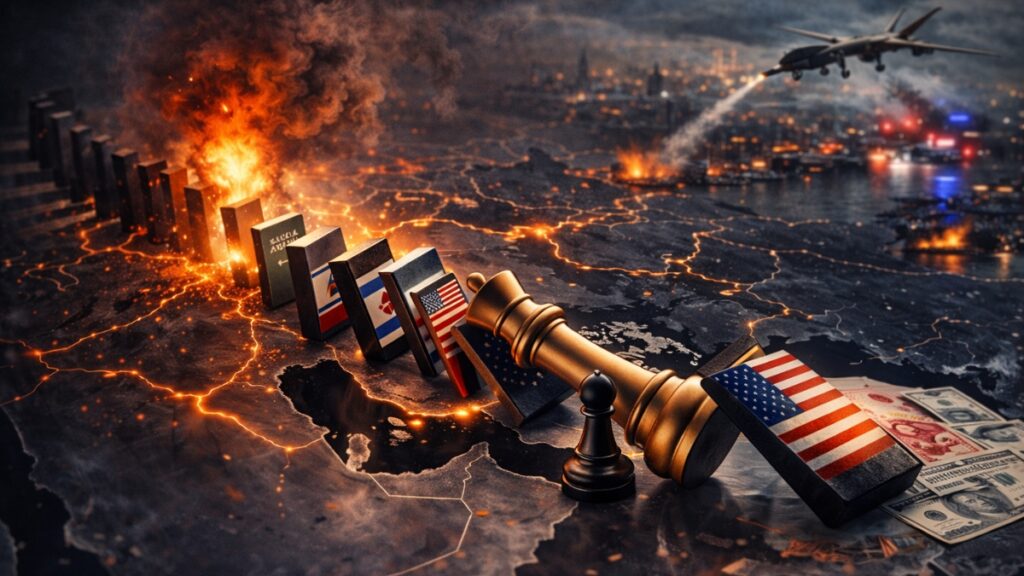
March 2026. The ashes of Tehran are barely settling when the West discovers, stunned, the true nature of its “success.” Operation Epic Fury decapitated the Iranian regime in a few days. Khamenei is dead, the nuclear sites are in ruins, the Axis of Resistance seems broken. Yet, far from the triumphant images of drones, a much more insidious threat is already unfolding: the blowback. This geostrategic backlash, foreseen by all those who have studied history without blinders, is no longer a hypothesis. It is underway. In 2026, its first consequences are already measured in narrowly foiled attacks, in violent demonstrations, in irreversible social fractures, and in a silent shift in the global balance of power. This is not a passing crisis. It is the metastasis of a cancer that we have imported ourselves.
The Mass Exodus of Islamist Cadres: Europe and America as New Rear Bases
The destruction of the Iranian regime liberates an Islamist nebula that, deprived of a rear base, seeks refuge and regeneration in the West, with the United States as a priority target.
Ayaan Hirsi Ali, fellow at the Hudson Institute, poses the rhetorical question haunting security circles: “We must ask ourselves: where are these people going to go? Where will the Islamists go, the people who run the Houthis, those who run Hezbollah, those who benefited from the Islamist regime of Iran, where will they go? They will try to come to the West.”
And she specifies: “They will try to come to America. They will come to Europe.” This migration is not random. It relies on preexisting networks, as Chris Swecker, former deputy director of the FBI, points out: “If ever a Hezbollah cell or a Hamas cell is to act in a violent way in the United States, it’s now.” He adds that these organizations, supported by Iran since the 1980s, already have an American presence: “We know that they have cells here. We also know that there are lone sympathizers, many of whom have come out in these protest groups.”
Geostrategically, this means that Operation Epic Fury, by weakening Tehran, has decentralized the threat: the Iranian proxies (Shiite Hezbollah, Sunni branches like the Muslim Brotherhood) are transforming into autonomous actors, capable of infiltrating through already established channels – associations, mosques, university campuses.
The border vulnerabilities, inherited from the previous administration, amplify the risk. Swecker insists: “We are coming off four years of open borders, and I have said before that that was an open door for terrorists, for terrorist cells and terror sympathizers to infiltrate. Many were already here, but it’s impossible that they would not infiltrate into these particular groups and sort of act as catalysts, as enablers.”
In a context where the Iranian regime collapses without a credible political transition, these infiltrations could transform the United States into a new theater of hybrid operations: ideological subversion, occult financing, and sporadic attacks. Europe, for its part, is paying dearly for its years of openness: thousands of individuals equipped with fake Syrian or Afghan passports, often already listed as S-files, are settling in the suburbs of Paris, Brussels, Berlin, and London.
Immediate consequence: Salafist mosques and “cultural” Shiite associations are recording an influx of funds and seasoned preachers. Hawala (informal transfer systems) are replacing Tehran’s official wire transfers. The European Hezbollah, formerly limited to fundraising, is shifting to operational mode: recruitment, training, constitution of light weapons stocks.
The blowback materializes first through this silent colonization of the republic’s lost territories.
À lire aussi : ANALYSIS – Operation Epic Fury: Trump Decapitates the Iranian Regime and Confronts Obama with His Historic Failure
The FBI’s Maximum Alert: A Proactive Posture or an Admission of Powerlessness?
The immediate reinforcement of the American security posture, detailed in the articles, illustrates the perceived gravity. FBI Director Kash Patel announces on X: “Last night, I instructed our Counterterrorism and intelligence teams to be on high alert and mobilize all assisting security assets needed.” He specifies that the Joint Terrorism Task Forces (JTTF) are working 24/7 to “address and disrupt any potential threats to the homeland.”
Jason Pack, former FBI special agent, contextualizes: “The intelligence and counterterrorism communities work on this kind of scenario continuously, long before any conflict begins. When the United States commits to a joint military campaign with Israel, the domestic threat environment doesn’t simply remain static. It could shift, potentially significantly.”
This alert is not cosmetic. It fits into a geostrategic doctrine of “maximum pressure” under Trump, which closed the borders but inherits a Biden-era legacy of porosity. Homeland Security Secretary Kristi
Noem affirms being “in direct coordination with our federal intelligence and law enforcement partners as we continue to closely monitor and thwart any potential threats to the homeland.” Yet, the partial shutdown of the Department of Homeland Security, mentioned in the sources, reveals a flaw: limited resources at the moment when surveillance must intensify on priority suspects, human sources, and technical intelligence.
Geostrategically, this poses a dilemma for Washington: the military victory against Iran strengthens the alliance with Israel and the Gulf monarchies, but it exposes the United States to an asymmetric blowback. The adversarial actors – Islamic Revolutionary Guard Corps, external networks of Hamas – have demonstrated a historical capacity to retaliate through indirect means. Without specific credible threats identified, the maximum alert signals an anticipation of a shift: from conventional war to domestic terrorism, amplified by anti-war protests that serve as a breeding ground for sympathizers.
As early as the summer of 2025, the first concrete signs of “low-cost” terrorism appear in Europe. In Paris, a knife attack on a synagogue is claimed by an “Iranian revenge cell” unknown until then. In London, an artisanal bomb targets a Jewish community center. In Berlin, “pro-Palestine” demonstrations degenerate into urban pogroms. The blowback is no longer spectacular like in 2001. It is diffuse, incessant, exhausting. “Lone wolves” radicalized online by exiled imams, cells of 3-4 people trained in handling civilian drones or artisanal explosives.
The cost for states is colossal: multiplied security budgets, generalized mass surveillance, cities transformed into fortresses. Public confidence collapses. The middle classes flee the metropolises.
Low-cost terrorism becomes the perfect asymmetric weapon of the decentralized networks that we ourselves have liberated.
The Institutionalized Red-Green Alliance: The Left in the Service of Islamism
Beyond the physical threat, the sources insist on a more insidious subversion. The most destructive phenomenon of 2026 is political. The European and American far left, already committed to the “decolonial” cause, transforms the fall of the Iranian regime into a new victim narrative.
Anti-Israeli and anti-American demonstrations, funded underhand by the new exiled networks, now gather hundreds of thousands of people. Parties like La France Insoumise, Die Linke, or the Democratic Squads in America openly integrate Islamist figures into their lists.
In France, “insoumise” town halls grant subsidies to associations linked to the Muslim Brotherhood. In the United States, elite universities (Columbia, Harvard) see their campuses transformed into lawless zones where anti-Zionism turns into assumed anti-Semitism.
This subversion relies on a “red-green alliance,” where the “reds” (communists, Marxists, far leftists) and the “greens” (Islamist movements) share anti-Western goals. In the United States, this manifests in recent protests in New York and elsewhere, where Swecker sees “lone sympathizers” emerging as catalysts. Geostrategically, this internal dynamic weakens American cohesion, making the country more vulnerable to foreign influences (Russia, China) that could exploit these fractures. The fall of the Iranian regime, without a multilateral plan to stabilize the region, risks transforming the United States into an unwilling sanctuary for these networks, undermining Atlantic supremacy.
The political blowback is there: radical Islamism, deprived of its state sponsor, finds a new ideological and financial sponsor inside Western institutions themselves. Liberal democracy is committing suicide out of compassion.
Economic and Demographic Consequences: The Unsustainable Bill
The year 2026 also sees the explosion of indirect costs. The energy markets, already shaken by Iran’s disappearance, suffer attacks from Houthis 2.0 on tankers. The price of a barrel soars. Europe, dependent on Russian and Qatari gas, enters a technical recession. Internal security expenditures (police, intelligence, prisons) absorb 15 to 20% of the budgets of already indebted states. Demographically, the shock is even deeper: secondary migratory flows (families of Islamist cadres) accelerate cultural replacement in sensitive neighborhoods.
Polls show growing radicalization among young Muslims born in Europe, who see the strikes on Iran as a new “crusade.” The differential birth rate and rapid conversion in prisons complete the picture.
The West is not only losing lives : it is losing its soul and its demographic future.
Global Geostrategy : China and Russia Scoop Up the Winnings
While the West exhausts itself in internal war, Beijing and Moscow advance their pawns. Russia consolidates its influence in Syria and Libya, recovering the former Iranian proxies. China signs colossal contracts to rebuild Iranian infrastructures in exchange for privileged access to the remaining oil. The mutated “Axis of Resistance” becomes a hybrid tool in the service of anti-Western Eurasia. The geostrategic blowback is total: by wanting to eliminate a regional enemy, the West has weakened its own global power and strengthened its systemic rivals.
À lire aussi : ANALYSIS – Marco Rubio: The Cuban-American Pivot of Trumpian America Facing an Agonizing Castroism
The blowback is not an accident of history.
It is not a simple “miscalculation” or an “unforeseen event” either. It is the structural product, almost mechanical, of a Western geostrategic doctrine that rests on three poisoned pillars: imperial hubris, historical amnesia, and the refusal of any long-term responsibility. Every time Washington, London, or Paris decide to “settle” a problem by force – whether it’s Mossadegh in 1953, the mujahideen in 1979, Saddam in 2003, or Kadhafi in 2011 – the same mechanism triggers. With the decapitation of the Iranian regime in 2026, this mechanism reaches an unprecedented scale. For the deep causes are no longer merely tactical; they are civilizational. They reveal an ontological incapacity to think the world other than in terms of immediate domination and denial of consequences. At the heart of the blowback lies the messianic belief that the West can reshape millennial societies like reformatting a hard drive.
This arrogance ignores the fundamental anthropological law: the power vacuum does not engender freedom, but the war of all against all. Local actors – tribes, clans, militias, religious ideologues – fill this void with the tools they master: violence, clientelism, radical theology. The blowback is born precisely from this blindness: one underestimates the resilience of informal structures (the Iranian Pasdaran, hawala networks, transnational Shiite alliances) that survive the central state and relocate where the West is most vulnerable: at home.
The West suffers from selective amnesia. It forgets that Iran is not a simple “theocracy” but a Persian civilization of 2,500 years, where Shiism structures national identity for centuries. It forgets that Hezbollah is not an isolated “terrorist group” but a social, political, and military actor rooted in Lebanese Shiite society. It forgets that the Houthis are the product of decades of Yemeni marginalization, not a creation ex nihilo from Tehran.
This ignorance is not innocent: it is functional. It allows justifying the intervention by reducing the adversary to a cliché (“evil regime,” “axis of evil”). Result: one strikes without understanding the ethnic, confessional, and social fractures that, once liberated, produce hydras more dangerous than the initial monster. The blowback is cultural before being military: it is the price of ethnocentrism that refuses to read the history of others.
Behind every intervention hides a cynical calculation: oil, arms contracts, support for lobbies, maintenance of dollar hegemony. In 1953, Mossadegh is overthrown for oil. In 1979, the mujahideen are armed to weaken the USSR. In 2003, Iraq is invaded for oil, Israel, and the “remodeling of the Greater Middle East.” In 2011, Libya is destroyed to prevent an African gold dinar and secure oil fields. These immediate gains mask the deferred cost: the creation of a transnational Islamist ecosystem that, once deprived of a state base, finances itself through organized crime, diasporas, and opportunistic alliances (Russia, China, Turkey). The blowback is economic: the West pays today, in surveillance, attacks, and social fracture, the dividends it collected yesterday.
The deepest cause, the most insidious, is internal to the West itself. A civilization that no longer believes in its own values – universalism, secularism, merit, borders – cannot confront an enemy who, for his part, believes furiously in his. Post-colonial repentance, debased multiculturalism, the red-green alliance: all this creates an ideal welcoming ground for uprooted networks. Europe, in particular, has spent fifty years flagellating itself for its past crimes while opening wide its doors to ideologies that hate it. This moral void transforms the blowback into a cultural victory for the adversary: radical Islamists no longer need to conquer by arms; they settle, reproduce demographically, and use Western institutions (freedom of expression, social aids, justice) against the West itself.
Finally, Western military power – drones, hypersonic missiles, cyber – excels at destroying centralized states. But it is powerless against decentralized, resilient, low-tech networks. By atomizing Iran, one shifts from an identifiable adversary (Tehran) to a global nebula impossible to target. This is the ultimate blowback: the technology that was supposed to ensure victory perpetuates perpetual war.
*
* *
At the end of 2026, the assessment is unequivocal. The “victory” of Epic Fury will have cost infinitely more than all the Middle East wars combined. Not in bombs, but in lost national cohesion, curtailed freedoms, stolen future. The blowback is no longer a theory: it is the daily reality of the streets of Paris, London, New York, and Berlin.
The deep causes of the blowback are therefore not conjunctural. They are structural, inscribed in the DNA of a Western geopolitics that privileges immediate domination over durable stability, technical illusion over human understanding, and short-term interest over civilizational survival.
With Iran 2026, this cycle reaches its paroxysm: we have just liberated the world’s largest Islamist nebula without any plan to contain its dispersion. The Trump administration has set up a first rampart, but without systematic dismantling of existing networks and heightened ideological vigilance, the United States could pay dearly for this Iranian “liberation.”
The history of Western interventions teaches us that the real danger is not the defeated enemy, but the metamorphosed enemy. Washington must now choose: anticipate or suffer.
The time of triumphant illusion is over; that of implacable vigilance is imposed. There remains a narrow window to reverse the trajectory: hermetic border control, systematic expulsion of radicalized foreigners, dissolution of foreign influence associations, and above all ruthless ideological reconquest of the public space.
Without this total and immediate rupture, 2026 will not be the year of the end of radical Islamism. It will be the year when the West officially began to die from within – killed by the monster it itself engendered.
The time of denial is over.
That of survival begins now.
À lire aussi : ANALYSE – Le blowback 2026 : Pourquoi l’Occident fabrique lui-même ses pires ennemis ?
#Geopolitics,#BlowbackEffect,#Iran2026,#EpicFury,#MiddleEastConflict,#GlobalSecurity,#TerrorismThreat,#HybridWarfare,#IslamistNetworks,#WestVsIslamism,#Geostrategy,#WorldPowerShift,#RussiaChinaAlliance,#WesternDecline,#SecurityAnalysis,#IntelligenceReport,#PoliticalIslam,#Hezbollah,#MuslimBrotherhood,#Houthis,#AsymmetricWarfare,#CounterTerrorism,#MigrationCrisis,#EuropeanSecurity,#USNationalSecurity,#Radicalization,#GlobalPowerBalance,#StrategicAnalysis,#ForeignPolicy,#WarConsequences,#CivilizationalConflict,#WesternStrategy,#RedGreenAlliance,#IdeologicalWar,#InternationalRelations,#GeopoliticalRisk,#StrategicForecast,#SecurityCrisis,#PostIranWar,#GlobalInstability