ANALYSIS – Elon Musk: The Revenge of the Trillionaire Who Creates Millionaires !
By Angélique Bouchard
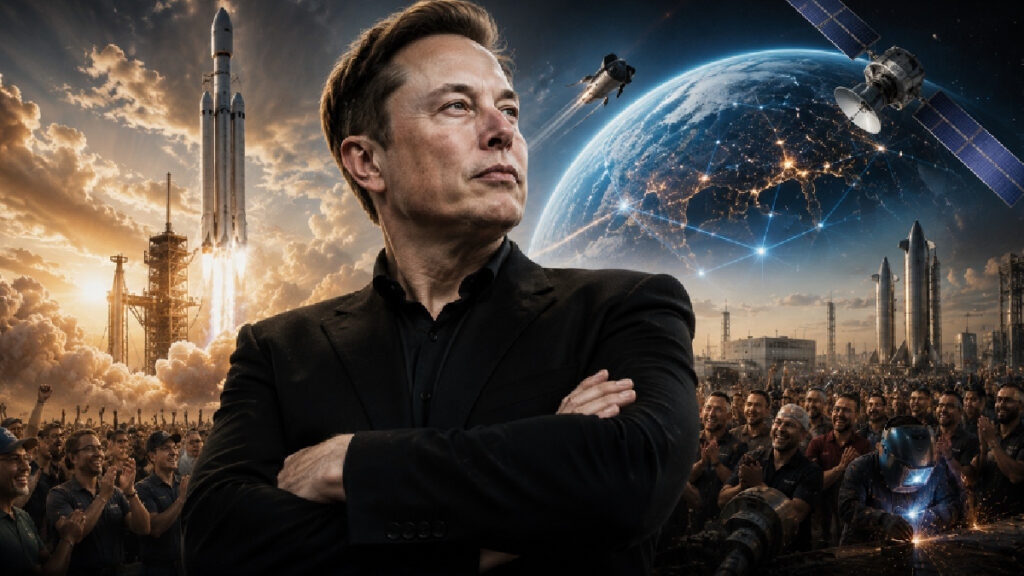
The initial public offering of SpaceX made Elon Musk the world’s first trillionaire in U.S. dollars. But what really matters is not only his personal fortune. It is that this operation transformed more than 4,400 current and former employees of the company — welders, cafeteria workers, engineers, contractors — into millionaires through their stock options and equity grants. Some are now worth well over $100 million.
Faced with the virulent attacks from Ro Khanna, who accuses him of having “possibly sentenced 4.5 million children around the world to death” by dismantling USAID, Elon Musk is not remaining silent. He is striking back directly, exposing the frauds, and turning the political offensive into a strategic counter-offensive.
This is the revenge of a man who refuses to be intimidated by the resentment of the zero-sum left.
The Mechanisms of Stock Options: The Weapon That Aligns Performance and Collective Enrichment
Stock options and equity grants are based on a revolutionary principle: giving employees a stake in the ownership of the company they work for. Unlike a fixed salary or a cash bonus, these instruments allow employees to acquire shares at a predetermined price, often after a vesting period spread over several years. If the company prospers and the stock price rises, the options gain considerable value. If it fails, they are worth nothing. It is a calculated bet that rewards loyalty, innovation, and collective performance while aligning employees’ interests with those of the company over the long term.
At SpaceX, this mechanism has been applied at every level of the hierarchy. Juan Hernandez, a contract welder hired about ten years ago, received shares as part of his compensation package. Today, his holdings are worth several million dollars. He now teaches investing to his three children. This is not an isolated case. Thousands of employees, including the most modest ones, have seen their lives change. As Carol Roth explains: “Wealth is inextricably tied to the ownership of assets, ideally assets that have the opportunity to appreciate in value. By allowing employees to participate in the ownership of the company for which they work, they have an incentive to do their part in making the company successful, knowing that they will derive some of that benefit.”
The vesting period spread over several years retains talent and aligns time horizons. Unlike cash bonuses that encourage short-term thinking, options tie compensation to the creation of lasting value. Employees become owners who think like entrepreneurs. This system creates a virtuous cycle: employees stay longer, innovate more, and behave like shareholders rather than mere executors. This is exactly what happened at KKR, where Pete Stavros ensured that the hourly employees of CHI Overhead Doors received between $20,000 and $800,000 during the sale of the company, for a total of $360 million distributed, the majority of which went to non-C-suite employees.
Tesla versus SpaceX on the Stock Market: Two Trajectories, One Same Demonstration of Shared Wealth Creation
Tesla and SpaceX perfectly illustrate how stock options transform companies into machines that create millionaires on a large scale. At Tesla, the journey was long and chaotic: years of losses, constant doubts, extreme stock price volatility. But those who stayed were rewarded beyond their dreams. The stock multiplied in value by dozens of times, creating colossal wealth for early employees after periods of near-collapse. Musk has spoken openly about the moments when both Tesla and SpaceX were on the brink of collapse. Most entrepreneurs would have retreated. He doubled down.
SpaceX followed a different but equally powerful trajectory. The June 2026 IPO instantly created more than 4,400 millionaires among current and former employees. The company raised $75 billion and was valued at approximately $1.8 trillion. The stock price moved from $135 to over $176 in just a few days. Unlike Tesla, which took years to become profitable, SpaceX delivered faster and broader wealth creation, reaching a very wide range of profiles. From welders to executives, including support staff, everyone participated in the rise. As Liz Peek notes: “With the company’s initial public offering last week, some 4,400 workers at the company reportedly became millionaires overnight, and some 400 are now each worth more than $100 million.”
The comparison is revealing. Tesla showed that perseverance in innovation can create colossal wealth over the long term. SpaceX demonstrates that employee ownership, combined with exceptional execution and a well-calibrated IPO, can multiply the number of millionaires in record time. In both cases, it is not only the leaders who get rich: it is the entire value chain. The employees who believed in the vision and stayed were rewarded beyond their expectations.
Elon Musk’s Revenge: “It’s Time to Sue This Liar”
Faced with these successes, the left erupted. Democratic Congressman Ro Khanna stated on the “I’ve Had It” podcast that Musk had “possibly sentenced 4.5 million children around the world to death” by dismantling USAID through DOGE. He called for investigations, subpoenas, and accountability. Elon Musk struck back directly on X: “It’s time to sue this liar.” He described these claims as “a total lie” and recalled that “all DOGE did was require contact information for the recipients of aid so that we can confirm that the funds were being used legitimately. Anything less than this is insane! Multiple people from USAID have been charged by the Justice Department with stealing money. Moreover, they pled GUILTY!!”
In another post, Musk wrote: “The standard applied by DOGE was very simple and easy: Provide contact information for the recipients of aid, so that we can confirm it is not fraudulent. The reality is that money was being sent to corrupt politicians under the guise of aid! Liars and stock insider traders like Ro the Robber should be in prison!!” He accused Khanna of questionable stock trading practices and nicknamed him “Ro the Robber.”
Khanna struck back by presenting himself as a defender of free speech: “Today, Elon Musk threatened to sue me, and he called on the Justice Department to put me in prison. […] Elon, I thought you were a free speech guy. Why not debate me on these issues instead of threatening lawfare? You’re not going to be able to intimidate me.”
This response from Musk is not merely a personal defense. It is a strategic counter-offensive. He turns the accusation around by highlighting the real frauds within USAID, documented by criminal convictions. He transforms the political attack into a debate about accountability and transparency of public funds.
À lire aussi : DÉCRYPTAGE – Les menaces de Trump sur l’Iran et la guerre que personne ne contrôle
The Reaction of the American Left: Envy as a Political Engine
The American left does not merely criticize. It turns envy into political strategy. Elizabeth Warren and Bernie Sanders systematically denounce “unprecedented inequality” and call for heavier taxation of successes like Musk’s.
Graham Platner, the Democratic Senate candidate in Maine, goes so far as to wish that he would be “the last trillionaire.” This posture reveals an ideology deeply hostile to individual wealth creation.
Instead of celebrating that thousands of modest employees are becoming millionaires through stock options, they prefer to attack the man who made it possible. It is a zero-sum vision in which one person’s success is perceived as a collective injustice. Musk, by striking back directly and threatening legal action, refuses to be intimidated by this resentment machine and forces the debate onto the terrain of facts.
America That Still Makes Us Dream: The Dream That Makes the Impossible Possible
Elon Musk’s story is also the story of an America that continues to inspire dreams. As Ted Jenkin recalls, Musk arrived in the United States in 1992 as a young immigrant seeking educational and entrepreneurial opportunities. Few could have imagined that three decades later he would build a collection of companies that have transformed industries ranging from payments and transportation to aerospace, communications, and artificial intelligence. He helped create PayPal, which fundamentally changed digital payments. He then used much of his fortune to pursue ventures that many investors considered reckless. Tesla challenged a century-old automotive industry and accelerated the global adoption of electric vehicles. SpaceX dramatically lowered the cost of launching payloads into space while accomplishing feats that many believed only governments could achieve. Starlink is bringing internet connectivity to the most remote regions of the globe. Neuralink and his artificial intelligence initiatives continue to push the boundaries of what many thought possible.
Musk did not become a trillionaire by inheriting a dominant corporation or benefiting from a protected monopoly. His fortune is largely tied to companies that investors voluntarily assigned value to because they believe those businesses have changed the world and will continue doing so in the future. How many people has he employed over time? How much payroll tax has he paid into our system? And how many millionaires has Musk created simply by employing them in his companies?
The fact that his journey could take place in the United States is no coincidence. The United States remains one of the few places in the world where an entrepreneur with a compelling vision can access capital, recruit talent, challenge established competitors, and attempt to build something revolutionary. Our system is far from perfect, but it continues to provide a level of economic freedom that is difficult to replicate elsewhere. Musk’s rise reminds us that the American Dream is not a promise of wealth. It was never a guarantee of success. It was the freedom to pursue ambitious goals, the opportunity to take risks, and the ability to build something meaningful regardless of where you started.
*
* *
The story of SpaceX is clear: an immigrant who arrived in 1992 with a crazy vision built companies that transformed entire industries. Along the way, he turned thousands of his employees into millionaires through stock options.
The left, instead of celebrating this, invents numbers about dead children to discredit the man and demand investigations. Musk does not merely endure: he strikes back, exposes the frauds, and turns the narrative around. Capitalism, when it works, enriches broadly. The mechanisms of stock options align interests, reward performance, and create shared prosperity.
Those who refuse to see this — Sanders, Warren, Khanna, Platner, and their allies — do not defend workers. They defend envy and resentment. America does not need more redistributors of misery. It needs more wealth creators like Elon Musk. And more companies ready to do what SpaceX has done: give their employees a real share of the cake they helped grow.
That is real wealth sharing — and Musk will no longer let anyone tarnish it without fighting back.
À lire aussi : Le Grand Entretien avec le général Pinatel (2S) – Iran–États-Unis–Israël : Vers une guerre d’attrition régionale ?
#ElonMusk, #SpaceX, #Tesla, #StockOptions, #EmployeeOwnership, #IPO, #Trillionaire, #Millionaires, #WealthCreation, #Capitalism, #AmericanDream, #Innovation, #Entrepreneurship, #Business, #Investing, #Finance, #Markets, #EquityCompensation, #WealthBuilding, #Success, #USA, #DOGE, #USAID, #Politics, #EconomicFreedom, #CorporateFinance, #SpaceEconomy, #TechNews, #Leadership, #OwnershipEconomy, #Startup, #PrivateEquity, #Shareholders, #EconomicGrowth, #FreeMarket, #ValueCreation, #ElonMuskNews, #SpaceXIPO, #MillionaireMindset, #FinancialFreedom