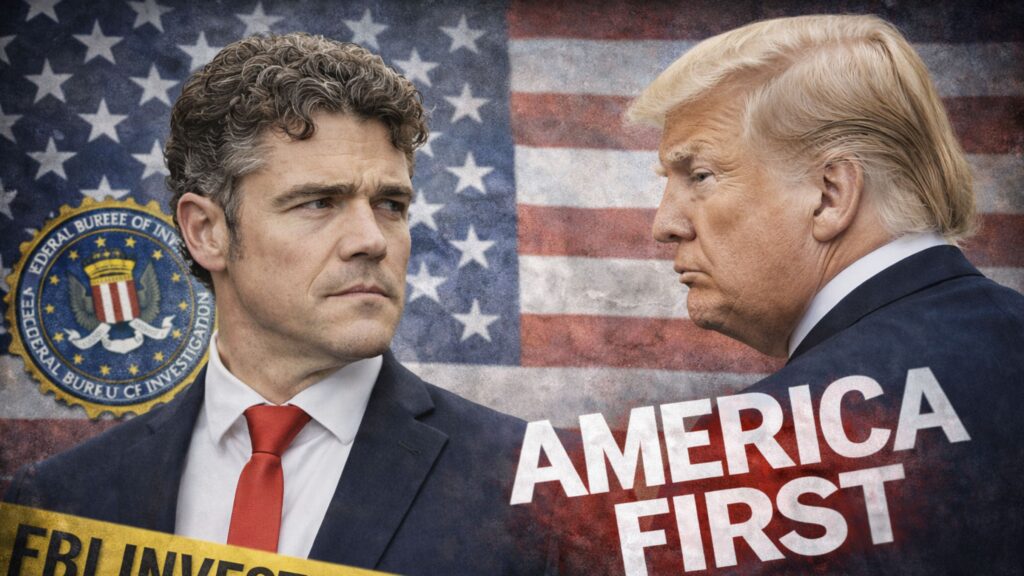
ANALYSIS – The Rift in Trump’s National Security Team over Iran: Joe Kent, the FBI Probe, and the Assertive “America First” Doctrine
By Angélique Bouchard
The resignation of Joe Kent as Director of the National Counterterrorism Center (NCTC) on March 17, 2026, followed by revelations of an ongoing FBI investigation into alleged leaks of classified information, is no mere administrative shift. It exposes a genuine divide within the Trump administration’s national security apparatus: between a faction inclined to downplay current threats and a presidential line faithful to the “peace through strength” doctrine, which opts for targeted firmness against an Iran that has never abandoned its regional ambitions. Far from a sign of weakness, this clarification demonstrates Donald Trump’s ability to make decisive calls in defense of core American interests.
A Veteran Turned Dissident
A former Green Beret, CIA paramilitary officer, and Gold Star widower (his first wife, Shannon Kent, was killed in Syria in 2019), Joe Kent embodied the archetype of the combat-hardened critic of “endless wars.” His congressional runs in Washington State, backed by Donald Trump, positioned him as a credible voice in the populist “America First” wing. His resignation letter, posted on X, marks a sharp break: “Iran posed no imminent threat to our nation,” he wrote, attributing the conflict to “pressure from Israel and its powerful American lobby” amplified by a “misinformation campaign” from high-ranking Israeli officials and U.S. media.
This reversal is striking for someone who, in 2020, called for wiping out Iran’s ballistic capabilities after the Soleimani strike, and who in 2024 still advocated “peace through strength” through sanctions, precision strikes, and troop withdrawals. He even cited Operation Midnight Hammer in June 2025 as a positive example of decisive action without entanglement.
The Charge of Antisemitism and the Republican Response
The backlash was swift. Senate Republican Leader Mitch McConnell condemned the language as “virulent antisemitism” and “incendiary conspiracy theories” unfit for government service. White House Press Secretary Karoline Leavitt dismissed the claims as “false and laughable,” noting that downplaying the Iranian threat echoes Democratic and media talking points. Even Director of National Intelligence Tulsi Gabbard distanced herself: “Yes, those statements concern me,” she conceded.
These condemnations underscore a red line: strategic analysis must remain factual and avoid slipping into conspiratorial tropes that undermine national unity at a moment when Operation Epic Fury (launched February 28) aims to neutralize a real risk.
The FBI Investigation: A Matter of Loyalty and National Security
According to administration sources, Joe Kent had been under FBI investigation for weeks—possibly months—for alleged leaks of classified information. He had been excluded from presidential daily briefings for months and was not involved in Epic Fury planning. The White House had flagged him to Gabbard as a “known leaker” and suggested his removal, though she did not act immediately. In a context where safeguarding sources and methods is paramount, this probe aligns with bipartisan precedent: leaks that could compromise national security are treated with utmost seriousness.
The Real Iranian Threat: The Foundation of the Presidential Decision
Far from Kent’s denial, the available evidence fully justified the action. Karoline Leavitt emphasized that President Trump acted on “strong and compelling evidence” from multiple sources indicating an imminent Iranian attack on the United States. Intensive negotiations had been offered: permanent abandonment of the nuclear program in exchange for sanctions relief, free nuclear fuel, and economic partnerships. Tehran refused, as nuclear weapons remained its “fundamental goal.” House Speaker Mike Johnson, after reviewing all briefings, confirmed an imminent threat: Iran was nearing nuclear enrichment thresholds and producing missiles at an unmatched pace.
Tulsi Gabbard herself evolved on the issue: in March 2025, she stated Iran was not building a nuclear weapon; by June 2025, she acknowledged it could produce one “within weeks to months” if it chose to finalize assembly. Operation Epic Fury—targeted strikes on nuclear sites, ballistic arsenals, naval forces, and command structures—follows the doctrine applied in 2020 against Soleimani: destroy offensive capabilities without ground occupation.
À lire aussi : ANALYSIS – The 2026 Blowback: Why the West Is Creating Its Own Worst Enemies?
Tulsi Gabbard: From Historic Restraint to Pragmatic Loyalty in Intelligence
A longtime critic of regime-change wars, Tulsi Gabbard built her credibility on opposing endless interventions. Yet in this crisis, she has refused to publicly contradict the president: “The president alone determines what constitutes an imminent threat and whether to act.” After reviewing the intelligence, Trump concluded that the Islamist terrorist regime posed an imminent threat and took decisive action.
Her recent hiring of Dan Caldwell (a restraint-minded voice previously investigated for leaks under Secretary Hegseth) shows she retains expertise favoring caution—provided it remains loyal and non-disruptive. Gabbard’s evolution illustrates the maturation of Trumpism: pure isolationism is insufficient; it must pair with decisive strike capability when vital interests are at stake.
U.S.-Israeli Cooperation: Objective Partnership, Not Submission
The “all-powerful lobby” thesis Kent invokes is a classic conspiratorial trope. In reality, U.S.-Israeli cooperation on Iran’s nuclear program and terrorist networks is a major asset: real-time intelligence sharing, coordinated precision strikes, and the expansion of the Abraham Accords. This enables America to strike effectively without deploying hundreds of thousands of troops—precisely what Trump promised to avoid.
Preliminary Assessment of Epic Fury: Proof the Doctrine Works
Three weeks in, Epic Fury has inflicted massive damage: annihilation of Iran’s navy, severe degradation of ballistic capabilities, elimination of key leaders, partial air superiority. No ground occupation, limited U.S. casualties, clear objectives upheld: destroy missiles, navy, proxies, and prevent nuclear breakout. Unlike past neoconservative adventures, this operation proves “peace through strength” delivers: strike hard, fast, precisely, without entanglement.
*
* *
Trump and the Restoration of Realistic “Peace Through Strength”
Far from signaling failure, the Kent affair reveals the strength of the Trump administration: its ability to identify and sideline dissonances that weaken national security. Joe Kent, marginalized for months over leak suspicions, represented a sincere but increasingly isolated isolationist minority within the MAGA movement.
By choosing firmness against an Iran that continues to fund terrorism and target the region, Donald Trump honors his “America First” promise—not as retreat, but as active sovereignty. The partnership with Israel is no submission; it is an objective asset in a strategic environment where reliable allies are scarce.
By sidelining voices that minimize the threat, Trump does not betray his mandate—he fulfills it. Voters in 2024 did not choose isolationist retreat; they chose an America that strikes hard, fast, and justly. The Kent affair is not a fracture in Trumpism: it is its purification. Washington remains master of its foreign policy—and that is exactly what Americans mandated.
À lire aussi : ANALYSIS – Marco Rubio: The Cuban-American Pivot of Trumpian America Facing an Agonizing Castroism
#TrumpIran,#JoeKent,#AmericaFirst,#IranThreat,#USPolitics,#Geopolitics,#NationalSecurity,#TrumpDoctrine,#PeaceThroughStrength,#FBIInvestigation,#USForeignPolicy,#MiddleEastConflict,#IranNuclear,#PoliticalAnalysis,#TrumpAdministration,#SecurityCrisis,#USIranTensions,#IntelligenceWar,#StrategicAnalysis,#GlobalSecurity,#BreakingPolitics,#IranCrisis,#TrumpStrategy,#MilitaryDoctrine,#USDefense,#ForeignPolicyAnalysis,#PoliticalDivide,#WashingtonPolitics,#IranMissiles,#NuclearThreat,#USLeadership,#AmericaFirstPolicy,#TrumpVsIran,#SecurityLeaks,#FBIProbe,#PoliticalControversy,#MiddleEastStrategy,#USMilitaryPower,#Trump2026,#GlobalGeopolitics