ANALYSIS – Russia: The Seizure of CANPACK Reveals the Kremlin’s Double Game
By Angélique Bouchard
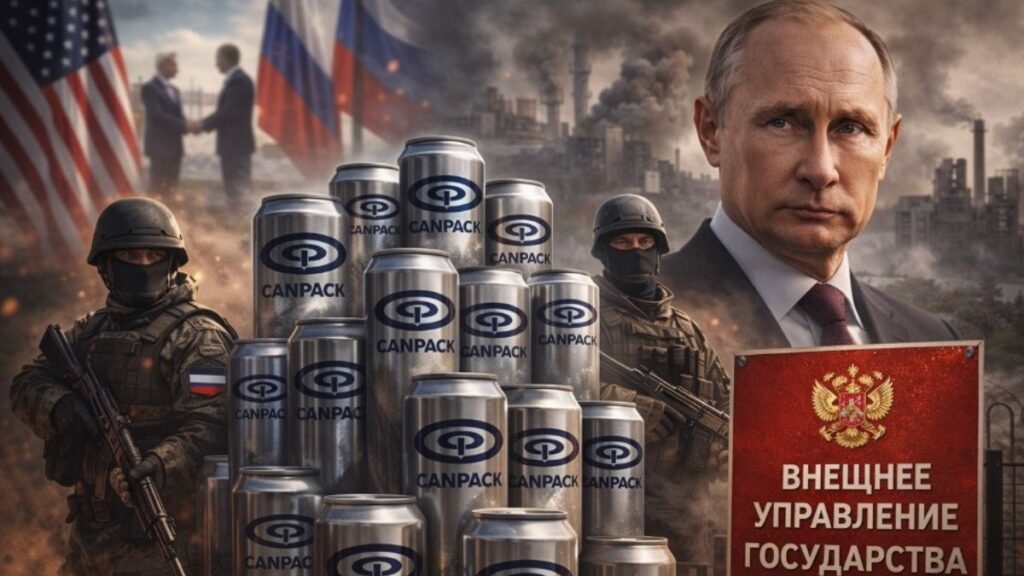
At the very moment Vladimir Putin is dispatching envoys to Washington to explore pathways for peace in Ukraine and future economic cooperation with the Trump administration, the Kremlin has delivered a quiet yet deeply symbolic blow against a major Western asset. A Pennsylvania-linked manufacturer, CANPACK—a global leader in aluminum beverage cans—has seen its Russian operations, valued at roughly $700 million, placed under “state external administration” by a decree signed on December 31, 2025, by President Vladimir Putin himself. This is no mere bureaucratic adjustment: it amounts to the outright confiscation of 100 percent of the company’s shares, now controlled by Kremlin-appointed managers. The move, which came to light in April 2026, crystallizes the profound ambiguities of a Russia that extends one hand across the Atlantic while tightening its grip on foreign-owned assets still inside its borders. Above all, it underscores the enduring vulnerability of Western companies that chose to remain in Russia after the 2022 invasion of Ukraine, clinging to the hope of a return to normalcy that has never materialized.
Surgical Seizure of CANPACK: Three Decades of Investment Wiped Out with a Stroke of the Pen
CANPACK, owned by a Pennsylvania-based holding company, operates across Europe and North America. In Russia, where it had been established for nearly thirty years, it commanded an estimated 35 to 40 percent of the aluminum beverage-can market—a strategically significant foothold in a sensitive industrial sector. The December 31, 2025, decree changed everything. By mid-January, state administrators had taken physical control of the facilities and operations. Peter Giorgi, the company’s CEO, pulled no punches in an interview with Fox News Digital: “I’m only a nominal shareholder. I lose all control of the company.” Senior Russian executives, including the general manager and chief financial officer, were removed. Those who remained have faced mounting pressure, with demands to approve financial decisions under threat of dismissal or worse. Since the takeover, the parent company has had no direct access to, or communication with, its Russian operations. The entity designated to oversee the assets, Stalelement, is described by company representatives as little more than a shell company with close ties to the Russian government.
CANPACK has raised the matter with U.S. officials, yet no concrete action has been taken. The dossier, however, continues to grow heavier. According to reporting by the Russian business daily Vedomosti in February 2026, CANPACK’s Russian division donated approximately 500 million rubles to a pro-Kremlin fund supporting Moscow’s war effort in Ukraine. Company officials estimate that roughly $18 million was funneled to state-linked funds backing Russian operations, with an additional $6 million directed to a Russian Orthodox church, based on Russian media accounts and information from former executives. Fox News has not independently verified those transfers, but they illustrate how swiftly financial control can shift once external administration is imposed. Modest though these sums may be relative to the company’s overall valuation, they reveal the alarming speed with which cash flows escape their original owners.
A Systemic Phenomenon: Selective Caution Toward Americans, Wholesale Redistribution of Assets
CANPACK is far from alone. The same December 31 decree also targeted the Russian subsidiary of Danish insulation maker Rockwool. Other major Western groups—the French food giant Danone and brewer Carlsberg—have faced similar treatment in recent years. Alexander Kolyandr, a fellow at the Center for European Policy Analysis, notes that “we are talking about dozens of companies.” He cautions against an overly U.S.-centric view: “CANPACK is not alone.” According to Kolyandr, American-linked firms have sometimes been handled with greater caution than their European counterparts, as Moscow seeks to keep the door open to warmer ties with Washington. “American companies fared much better than the European ones,” he observes.
The policy rests on a legal framework introduced in 2023 that allows the Russian government to place certain foreign-owned assets under temporary state control. The practice accelerated sharply after the full-scale invasion of Ukraine in 2022. “It all started in earnest with the beginning of the war,” Kolyandr explains. As Western companies began suspending operations or exiting the market, Russian authorities found it far easier to seize their holdings. The researcher sees the moves as part of a sweeping redistribution of property designed to bring profitable or strategically important assets under tighter state influence. “It sends a signal across the system,” he says: “if you do not toe the line, your property may be taken away.” While the seizures do generate some budgetary revenue—“on the one hand, it helps to generate a bit of cash for the budget”—Kolyandr insists this is not the primary motive. The real purpose is political and economic control.
For its part, CANPACK had considered leaving after 2022 but encountered insurmountable obstacles: unwinding decades of investment proved impossible, and no buyer would offer a fair price. “We decided to stay the course,” Giorgi recalls, hoping conditions would eventually stabilize. That gamble, like so many others, proved illusory.
Disturbing Parallel: U.S. Senators Sound the Alarm Over Sanctioned Russian Lawmakers in Washington
This internal policy of confiscation and external diplomacy of seduction finds a troubling echo in another story uncovered by Fox News. Even as Kirill Dmitriev, Putin’s special envoy for foreign investment, meets with Trump administration officials in Washington to discuss a potential Ukraine peace deal and future economic ties, a delegation of Russian Duma members—all sanctioned by the United States for “conduct deemed harmful to U.S. national security”—was welcomed in the capital in late March 2026.
A bipartisan inquiry by Senate Armed Services Committee Chairman Roger Wicker (R-Miss.) and Sen. Jeanne Shaheen (D-N.H.), the top Democrat on the Senate Foreign Relations Committee, has raised serious counterintelligence red flags. In a letter to Secretary of State Marco Rubio and Treasury Secretary Scott Bessent, the senators write bluntly: “The delegation came onto U.S. soil for one purpose: to advance the Kremlin’s strategic aims—including gathering additional useful intelligence.” They add: “They did not come to engage in dialogue or pursue democratic aims.”
The visit, arranged by Rep. Anna Paulina Luna (R-Fla.) and joined by Reps. Eli Crane (R-Ariz.), Derrick Van Orden (R-Wis.), Andy Ogles (R-Tenn.), and Vicente Gonzalez (D-Texas), included a guided tour of the Capitol. Luna later posted on X: “As representatives of the world’s two greatest nuclear superpowers, we owe our citizens open dialogue, the exchange of ideas, and open lines of communication. We will continue to foster this dialogue and push for peace in support of this administration’s efforts, as well as economic opportunity.”
Wicker and Shaheen are having none of it. They remind colleagues that these Duma members “include Kremlin subordinates who have committed numerous cyber and ransomware attacks on Americans and have facilitated war crimes against Ukrainian civilians.” Even more damning: “Remarkably, they are now helping Iran target U.S. military and diplomatic personnel across the Middle East.” Among them are Vyacheslav Nikonov, who in 2023 referred to the United States and NATO as the “Fourth Reich” on Russian television; Mikhail Delyagin, an advocate for destroying Ukraine’s energy sector; and Boris Chernyshov, who once described Russian retaliatory strikes as “an expression of our hatred [of Ukraine].”
The senators demand answers: Why were sanctions waived for the visit? What meetings occurred with Trump administration officials? What counterintelligence assessments were conducted? They stress that the delegation arrived “at a time when Russia’s intentions are unambiguously clear,” citing public reports of Russian support for Iranian strikes on American personnel, European intelligence warnings that Moscow plans attacks on NATO states in coming years, and Putin’s own statements that peace in Ukraine is a mirage—his sole ambition being to erase the country’s very existence.
*
* *
When Moscow Extends a Hand and Clenches a Fist
The seizure of CANPACK on one side and the warm reception of sanctioned Duma deputies on the other: in the spring of 2026, the Kremlin is delivering a masterclass in geopolitical cynicism. It multiplies gestures of goodwill toward the Trump administration while methodically plundering Western interests on its own soil. This duplicity is not diplomatic clumsiness—it is the strategy itself.
To foreign companies still operating in Russia, the message is now crystal-clear and ice-cold: staying is no longer a calculated risk; it is an act of culpable naïveté. The era when Moscow pretended to safeguard foreign investors is definitively over. What remains are assets to be confiscated at will, according to the regime’s budgetary, political, or punitive needs.
For Washington, the equation is brutal and impossible to ignore: how much longer will America lend an ear to the siren song of dialogue with a power that, in the very same breath, strips American companies bare and rolls out the red carpet for those helping Iran target U.S. troops? In this exquisitely choreographed theater of deception, the line between “partnership” and outright predation has ceased to be merely blurred—it has become obscene.
À lire aussi : ANALYSE – Russie : La saisie de CANPACK révèle le double jeu du Kremlin
#RussiaUkraineWar,#KremlinStrategy,#GeopoliticsAnalysis,#RussiaEconomy,#ForeignInvestorsRisk,#PutinPolicy,#AssetSeizure,#EconomicWarfare,#SanctionsRussia,#WesternCompanies,#BusinessRisk,#GlobalMarkets,#RussiaNews,#UkraineConflict,#GeopoliticalRisk,#InvestmentRisk,#StateControl,#RussiaUSRelations,#EconomicSecurity,#CorporateRisk,#EnergyPolitics,#IndustrialStrategy,#RussiaSanctions,#WarEconomy,#PoliticalRisk,#EmergingMarketsRisk,#RussiaBusiness,#ForeignAssets,#GlobalStrategy,#DefenseAnalysis,#SecurityPolicy,#InternationalRelations,#EconomicPower,#MarketInstability,#RussiaIndustry,#StrategicAnalysis,#RiskManagement,#CapitalExpropriation,#CorporateStrategy,#GlobalTensions