ANALYSIS – Trump Surprises Immigration Hawks by Defending Chinese Students in the U.S.
By Angélique Bouchard
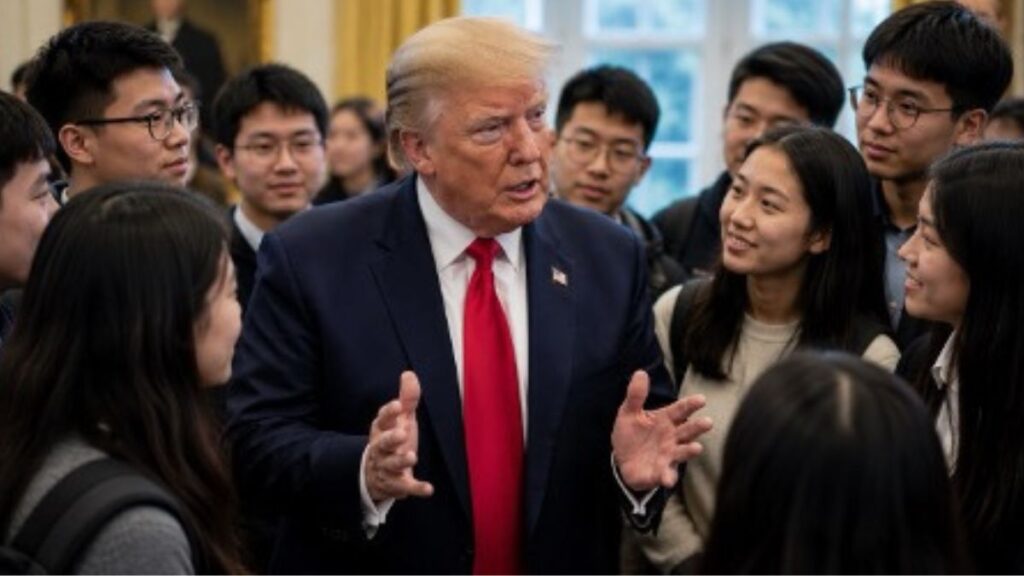
In a statement that sent shockwaves through the conservative camp, President Donald Trump distanced himself from the hardest-line immigration hardliners by openly defending the presence of Chinese students in the United States.
In an interview with Sean Hannity from Beijing, Trump described these students as “good students” and argued it would be “insulting” to China to bar them from American universities.
He also downplayed concerns about Chinese entities purchasing American farmland, noting that “they’ve owned a lot of it for a long time” and that the Obama administration did nothing about it. The comments created an unusual rift inside the MAGA movement while unexpectedly finding common ground with some moderate Democrats. At the heart of the debate: national security, the economics of American universities, and strategic control over farmland.
Trump’s Unexpected Defense of Chinese Students: “They Learn Our Culture”
When asked by Sean Hannity about the risks posed by the roughly 500,000 Chinese students currently in the United States, Donald Trump took a nuanced — and for a Republican president, surprising — position. “I frankly think that it’s good that people come from other countries and they learn our culture and many of them want to stay here,” he said. He acknowledged that this stance “doesn’t sound like a very conservative position,” but insisted it was simply “common sense”: “MAGA is common sense.”
Trump also warned of the consequences of a blanket ban: without these students, many second- and third-tier universities would face financial collapse because foreign students often pay full tuition.
The Concrete Impact on Tuition Fees and the “Big Ed” Model
Lora Ries, former counsel for the House Judiciary Committee’s immigration subcommittee and a 30-year policy expert now with the Heritage Foundation, delivered a sharply critical analysis of the American university model (“Big Ed”).
According to her, universities have become excessively dependent on foreign students who pay full freight, creating a distorted market. American students are often denied admission to high-quality institutions while universities balance their budgets thanks to this financial windfall, which in turn drives up tuition costs for everyone else.
This system has direct economic consequences: to offset declining public subsidies and attract international students (who pay far higher rates than in-state students), many universities have significantly raised tuition in recent years. International tuition is often two to three times higher than for American residents. The result is heavier student debt for American families and greater inequality in access to higher education.
Ries also denounced the mass production of low-return-on-investment degrees (gender studies and the like) that lead to few qualified jobs. “Why on earth do we want to keep universities afloat that depend on those sorts of degrees?” she asked. The “Big Ed” model no longer provides a level playing field for American students, who struggle to get into good schools and then struggle even more to find meaningful employment afterward. She cited medicine as a counter-example: “You can’t say medicine is a job Americans won’t do. So what’s going on?”
For Ries, the problem is structural. The university system needs deep reform rather than being artificially propped up by foreign tuition dollars. She believes Trump could use this issue to “shake up” Big Ed by incentivizing high-value degrees and discouraging programs with poor job prospects.
Marjorie Taylor Greene and the Backlash from MAGA Hawks
The position immediately triggered a fierce reaction from the right wing of the MAGA movement.
Former Rep. Marjorie Taylor Greene shot back bluntly: “No — that’s not commonsense. Imagine being an American student and receiving a rejection letter while 500,000 Chinese students get in.”
She also rejected the idea that China should continue buying American farmland, calling it a direct strategic threat.
The Sensitive Issue of Chinese Farmland Purchases and the AFIDA Legislation
Trump also downplayed concerns about Chinese land purchases. Yet the issue remains highly sensitive. Republican Sen. Pete Ricketts of Nebraska and Democrat Sen. John Fetterman of Pennsylvania have joined forces to advance the bipartisan Agricultural Foreign Investment Disclosure (AFIDA) Improvements Act.
The bill implements recommendations issued by the Government Accountability Office (GAO) in January 2024, which found the 1978 AFIDA law inadequate to address foreign — and especially Chinese — purchases of American agricultural land.
The legislation would require mandatory disclosure for any foreign investor holding more than 1% interest in U.S. agricultural land. It strengthens information-sharing between the Committee on Foreign Investment in the United States (CFIUS) and the Department of Agriculture (USDA), calls for updates to the AFIDA handbook, and sets a deadline for the creation of an online reporting system.
Ricketts emphasized: “Communist China is our greatest geopolitical threat.” He noted that Beijing is not only buying land but acquiring parcels near sensitive military installations such as Grand Forks Air Force Base in North Dakota and Fort Liberty in North Carolina. Between 2010 and 2021, Chinese ownership of U.S. agricultural land grew from 13,720 acres to 383,935 acres, according to USDA data.
A Rare Point of Agreement with Moderate Democrats
Paradoxically, Trump’s remarks found resonance with some moderate Democrats. Rep. Gabe Vasquez of New Mexico, chairman of the New Democrat Coalition’s Border Security Working Group, praised the idea of attracting “the best and brightest” from around the world to study, work, and build businesses in the United States. However, like the Republicans, he insisted on banning Chinese purchases of American farmland: “Food security is national security.”
*
* *
A Pragmatic Trump Who Is Shaking Up the Lines
By defending Chinese students and softening his stance on Chinese farmland purchases, Donald Trump has once again shown his ability to surprise even his own base. Far from rigid ideology, he is taking a pragmatic approach: preserving the economic interests of American universities, avoiding unnecessary escalation with Beijing, and keeping open a dialogue on legal immigration. The position creates an unusual tension inside the MAGA movement while, for the first time in a long while, opening a rare area of overlap with moderate Democrats.
The debate goes far beyond student visas. It touches the very foundations of American power: the ability to attract the world’s brightest minds without compromising national security or the future of young Americans. Between hawks demanding immediate crackdowns and pragmatists advocating nuance, Donald Trump is once again imposing his signature style — that of a president who rejects dogma and prioritizes what he calls “common sense.” University leaders, farmers, and national-security strategists are watching closely. The already complex U.S.-China relationship has just gained a new layer of unpredictability.
#Trump, #DonaldTrump, #MAGA, #China, #ChineseStudents, #Immigration, #StudentVisas, #USChina, #USChinaRelations, #NationalSecurity, #AmericanUniversities, #HigherEducation, #BigEd, #ForeignStudents, #InternationalStudents, #ImmigrationPolicy, #ConservativePolitics, #RepublicanParty, #MAGAMovement, #MarjorieTaylorGreene, #SeanHannity, #FoxNews, #ChineseFarmland, #USFarmland, #FarmlandSecurity, #FoodSecurity, #AgriculturalLand, #AFIDA, #CFIUS, #USDA, #GAO, #PeteRicketts, #JohnFetterman, #GabeVasquez, #Geopolitics, #Beijing, #AmericaFirst, #StrategicCompetition, #ConservativeAnalysis, #PoliticalAnalysis