The History of “Two-Tier Policing” in the United Kingdom: Origins, Evolution and Political Uses
By Angélique Bouchard
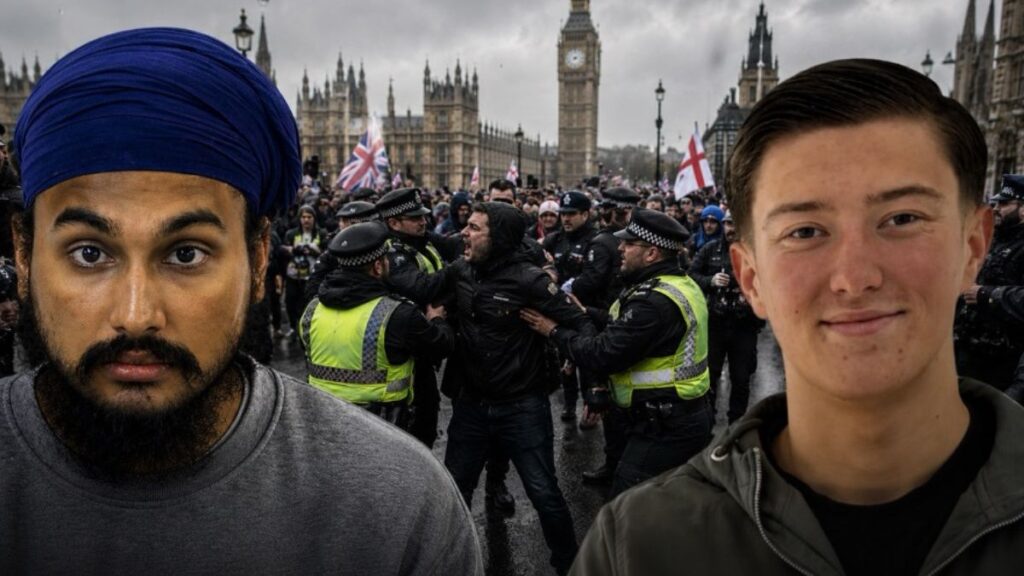
The concept of “two-tier policing” refers to the idea that British law enforcement applies different standards depending on the ethnic origin, political identity or cause defended by the individuals involved. Long confined to the margins of public debate, the term has, in recent years, become a central element in controversies surrounding policing, justice and national identity in the United Kingdom. Its history helps to understand how a marginal criticism gradually developed into a structured framework for interpreting British political life and the Henry Nowak case…
1. The Origins: The Macpherson Report and the Recognition of Institutional Racism (1999)
The debate over differential treatment by the police has one of its deepest roots in the Macpherson Report, published in February 1999 following the racist murder of Stephen Lawrence in 1993.
The report concluded that the Metropolitan Police was guilty of institutional racism. Macpherson defined the concept as “the processes, attitudes and behaviour which amount to discrimination through unwitting prejudice, ignorance, thoughtlessness and racist stereotyping which disadvantage minority ethnic people.” This definition did not limit itself to individual acts of racism but targeted the structural and cultural mechanisms within institutions themselves.
The report made 70 recommendations, particularly regarding diversity training, changes to stop-and-search practices, and improved handling of racist crimes. While it aimed to correct real inequalities and restore the trust of ethnic minorities in the police, it also produced lasting and paradoxical effects.
On one hand, the Macpherson Report forced the British police to publicly acknowledge the existence of systemic failures. It imposed an institutional awareness and launched a wide-ranging programme of reforms. On the other, it contributed to the emergence of a culture in which many officers developed a fear of being accused of racism. This fear, gradual but real, sometimes led to a form of self-censorship and to practices being adapted not solely according to the facts, but also according to the perceived identity of the individuals concerned. It is in this tension that some analysts locate one of the distant origins of the “two-tier policing” debate: the report sought to correct discrimination, but it also laid the foundations for an approach in which differential treatment based on ethnic origin became, for some, a central concern of police action.
Subsequently, the reforms inspired by the Macpherson Report — particularly mandatory diversity training, changes in recruitment criteria and the evolution of control practices — produced ambivalent effects. While they allowed for greater consideration of discrimination issues, they also contributed, according to several observers, to creating a police culture in which the fear of being accused of racism sometimes took precedence over a strictly factual assessment of situations. This development gradually fostered a sense of differential treatment based on the identity of the individuals involved, thereby laying one of the foundations for the contemporary debate on “two-tier policing.”
2. The Emergence of the Term During the Pandemic (2020–2021)
The term “two-tier policing” gained national visibility during the Covid-19 pandemic, particularly from the summer of 2020 onwards.
Several events fuelled this perception:
• During the large Black Lives Matter demonstrations, the police were often accused of showing relative leniency despite incidents of violence and vandalism.
• Conversely, more modest gatherings (anti-lockdown protests or the vigil for Sarah Everard in March 2021) were sometimes met with firmer police interventions.
• Images of police officers kneeling in front of BLM demonstrators were widely circulated and interpreted as a sign of ideological partiality.
It was during this period that political figures, mainly on the right, began to use the expression “two-tier policing” systematically to denounce what they perceived as a justice system and law enforcement applied in a differentiated manner according to the cause being defended. The health crisis acted as a revelation: lockdown rules, applied unevenly depending on the gatherings, reinforced the feeling that there were double standards in police action.
À lire aussi : ANALYSE – L’historique du « two-tier policing » au Royaume-Uni : Origines, évolution et usages politiques
3. The Institutionalisation of the Debate (2022–2024)
Between 2022 and 2024, the debate intensified and became structured around several institutional elements:
• The publication of internal police documents encouraging forces to aim for “equality of policing outcomes” rather than strict equality of treatment. These formulations were criticised for introducing a form of positive discrimination into police work.
• The development of mandatory training on diversity, inclusion and microaggressions in many police forces.
• High-profile cases in which the police were accused of reacting differently depending on the ideological or ethnic profile of demonstrators (anti-immigration or pro-Palestinian protests, for example).
At this stage, the concept of “two-tier policing” was no longer confined to the most radical circles. It was taken up by more mainstream political figures, including Nigel Farage and parts of the Conservative Party, and found growing resonance in public opinion. The debate ceased to be purely factual and became ideological: it opposed two visions of policing, one centred on strict impartiality, the other on taking structural inequalities into account.
4. The Explosion of the Debate with the Henry Nowak Case (2025–2026)
The Henry Nowak case marked a decisive turning point. For the first time, the concept of “two-tier policing” was directly associated with a murder and particularly explicit bodycam footage:
• A young white man stabbed to death.
• Police officers who, believing the attacker’s version (who claimed to have been the victim of a racist assault), handcuffed the dying victim as he repeated “I can’t breathe.”
• The release of the bodycam footage several months after the events.
Nigel Farage and other voices immediately presented the case as the clearest proof of the existence of a biased policing system. Farage stated that “an accusation of racism had been treated more seriously than a murder” and called for a “pure, cold rage.” The case triggered strong political polarisation, mutual accusations of instrumentalisation, and renewed interest in internal police diversity guidelines. It also highlighted the concrete consequences that a police culture marked by the fear of being accused of racism can produce.
5. A Real Phenomenon Before Being Instrumentalised
The history of “two-tier policing” reveals a structural tension within contemporary British policing. While the term is sometimes used in a political manner, the evidence accumulated over recent years shows that the phenomenon it describes rests on concrete realities.
Official documents and internal training have explicitly encouraged differentiated approaches according to groups, with the aim of achieving “equality of policing outcomes.” These orientations, combined with a culture of fear of being accused of racism, have led some officers to adapt their behaviour according to the perceived identity of the individuals involved rather than the facts alone. Several high-profile cases have illustrated this tendency, in which the treatment of demonstrators or suspects varied significantly depending on their ethnic or ideological profile.
It is true that the concept of “two-tier policing” is now widely used in political debate, sometimes in an instrumentalised way. However, reducing the entire phenomenon to a mere rhetorical construction would mean ignoring the repeated signals that have emerged over more than twenty years: a gradual evolution in practices and police culture, the consequences of which have become particularly visible in cases such as that of Henry Nowak.
The debate thus opposes two readings. One, which remains in the minority within institutions, considers that “two-tier policing” describes a real drift resulting from the reforms undertaken since the Macpherson Report. The other, dominant in governing circles, prefers to see it as an exaggeration or a tool of political contestation. The facts accumulated in recent years nevertheless tend to lend credibility to the first reading.
*
* *
The concept of “two-tier policing” did not appear suddenly with the Henry Nowak case. It forms part of a long and cumulative history, which began with the recognition of institutional racism in the Macpherson Report in 1999, intensified during the social and health crises of 2020, and became a central political tool from 2022–2023 onwards.
Today, the term lies at the heart of a major cultural and political battle in the United Kingdom. For its defenders, it describes a tangible reality: a police force that has gradually incorporated ideological biases to the detriment of its founding principle of impartiality. For its detractors, it constitutes a largely instrumentalised concept, used to challenge diversity policies and stoke identity divisions.
The Henry Nowak case gave this debate a new intensity by providing powerful images and a concrete case that is difficult to dismiss. More broadly, this divide reveals a deep fracture in the very conception of justice in the United Kingdom: between those who defend strict impartiality, independent of any identity consideration, and those who believe it necessary to adapt institutional practices in order to correct historical inequalities. This debate, far from being closed, will very probably continue to structure political confrontations around policing, immigration and national identity in the years to come.
À lire aussi : ANALYSIS – Six Months to Midterms: Explosive Fox News Poll – Republicans Dominate Security Issues as SPLC Scandal Hits Racism Racket
#TwoTierPolicing, #TwoTierPolicingUK, #UKPolicing, #BritishPolice, #PolicingBias, #PoliceImpartiality, #RuleOfLaw, #LawAndOrder, #BritishPolitics, #UKPolitics, #PolicingDebate, #MacphersonReport, #StephenLawrence, #InstitutionalRacism, #PoliceReform, #PoliceAccountability, #StopAndSearch, #EqualityBeforeTheLaw, #JusticeSystem, #CriminalJusticeUK, #PublicOrder, #PoliticalPolicing, #IdeologicalPolicing, #BLMUK, #AntiLockdownProtests, #SarahEverardVigil, #ProPalestineProtests, #AntiImmigrationProtests, #HenryNowak, #HenryNowakCase, #NigelFarage, #ConservativePolitics, #ReformUK, #NationalIdentity, #ImmigrationDebate, #CultureWar, #BritishJustice, #PoliceTraining, #DiversityPolicies, #CivilLiberties