ANALYSIS – Trump Warns China of ‘Big Problems’ Over Iran as Xi Summit Nears: Washington Hardens Its Stance
By Angélique Bouchard
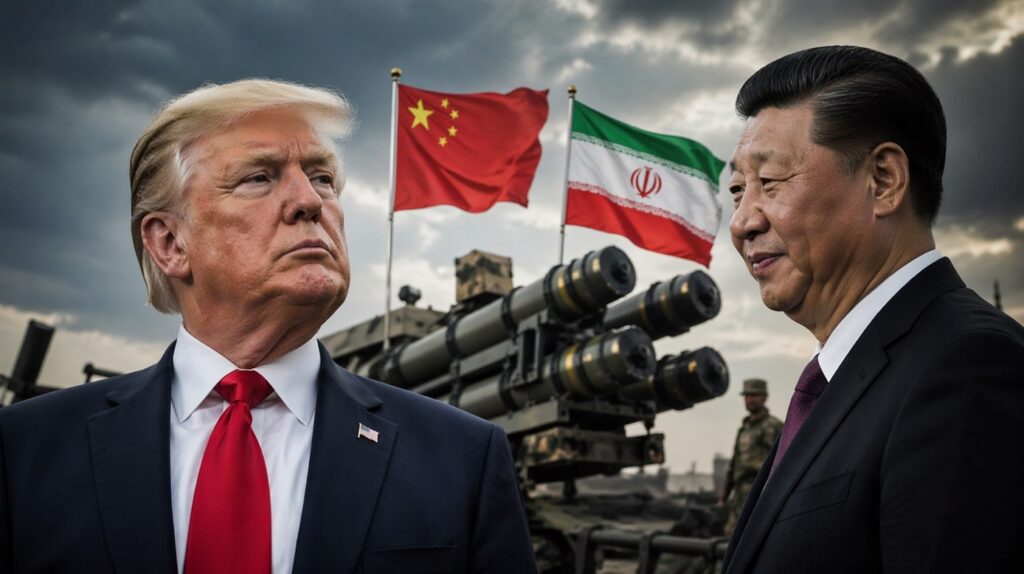
At the precise moment when preparations for a high-level summit between Donald Trump and Xi Jinping are accelerating in Beijing for the month of May, the American president has chosen direct confrontation. In an unfiltered declaration delivered Saturday to reporters, Trump warned Beijing that it would face “big problems” if it supplied air defense systems to Iran, while Tehran remains locked in open conflict with the United States and Israel.
Far from a mere rhetorical flourish, this warning is rooted in intelligence assessments indicating that China may be preparing to deliver—or may have already begun transferring—man-portable air defense systems (MANPADS) to Iran. It also comes just weeks ahead of a bilateral meeting initially postponed because of the war—one that promises to be explosive: trade, Taiwan, and China’s role in the Iranian conflict will all be on the table. This arm-wrestling exposes the persistent ambiguities of a China that, even as it casts itself as a mediator, is quietly strengthening Tehran’s military capabilities.
À lire aussi : ANALYSIS – The 2026 Blowback: Why the West Is Creating Its Own Worst Enemies?
The Muscular Warning from Trump and the Concerns of U.S. Intelligence
“If China does that, China is gonna have big problems, OK?” Donald Trump declared without mincing words. American intelligence evaluations point to a concrete risk: the possible delivery—or delivery already under way—of shoulder-fired air defense systems, those MANPADS capable of striking low-flying aircraft. Such weapons could dramatically heighten the dangers facing American pilots during low-altitude missions in the region. It is worth recalling that Trump himself attributed the downing of a U.S. F-15E over Iran in early April to a “shoulder-fired missile”—the first loss of a manned American aircraft in the conflict.
Although officials stress that the information remains non-definitive and that no evidence shows these systems have been used against U.S. or Israeli forces, the mere possibility is enough to alarm Washington. Separate investigations, based on satellite imagery and maritime tracking data, have identified Iranian vessels departing Chinese ports with cargoes suspected of containing sodium perchlorate, a key ingredient in ballistic-missile fuel. According to reports, several such shipments have reached Iran during the conflict, raising serious questions about Beijing’s real contribution to Tehran’s rearmament.
China’s Double Game: Official Denials and Long-Standing Structural Support
Beijing has firmly denied the allegations. The Chinese embassy in Washington stated that the country “never provides weapons to any party to the conflict” and described the reports as unfounded. Yet China has long played a central role in bolstering Iran’s military capabilities. Defense analysts recall that it has supplied components for ballistic missiles and drones, as well as surveillance and targeting technologies. In recent years, Iran has actively explored the acquisition of more advanced Chinese systems—anti-ship missiles and air defense platforms—in order to rebuild capabilities damaged by previous strikes.
At the same time, Beijing has sought to position itself as a diplomatic facilitator, pressing Iran to engage in talks with Washington and Tel Aviv through regional channels. This ambivalent posture—public calls for de-escalation on one hand, discreet material support on the other—places China at the heart of a high-stakes game as the May summit draws near.
Transatlantic Frustration: Trump Lambasts a Failing NATO
This warning to China fits into a broader context of American discontent toward its traditional allies. Upon his return from Florida on Sunday, Trump proclaimed Iran’s navy “destroyed.” “Their military is destroyed,” he stated. “Their whole Navy is underwater. You know that 158 ships are gone. Their navy is gone. Most of their mine droppers are gone.” He announced the imposition of an energy blockade effective the following day at 10 a.m., with other nations determined to prevent Iran from selling its oil. The president also highlighted American energy independence, noting that numerous international vessels are now heading toward the United States to load up on oil.
But it is toward NATO that Trump directed his sharpest criticism. “I’m very disappointed in NATO,” he asserted. “They weren’t there for us. We pay trillions of dollars for NATO, and they weren’t there for us.” He indicated that America’s massive financial commitment—particularly in deterring Russia—would now be subject to “very serious examination.” While certain NATO countries are now offering belated support, Trump deems the effort insufficient and far too late.
Defense Secretary Pete Hegseth echoed the rebuke, denouncing allies who are “hemming and hawing about the use of force.” Concrete examples abound: Spain closed its airspace and denied access to its bases for strikes against Iran; France, under Emmanuel Macron, blocked Israeli aircraft carrying U.S.-made munitions; Turkey criticized the operation and expressed sadness at the death of Ayatollah Khamenei. The United Kingdom initially hesitated before authorizing the use of bases such as Diego Garcia. Germany, through Chancellor Friedrich Merz, warned against an Iraq- or Afghanistan-style “quagmire” while acknowledging the Iranian dilemma.
Justin Fulcher, former senior adviser to Hegseth, described the moment as a “critical inflection point” at which NATO must act in unified fashion. He called it “shocking” that Europe is hesitating when Iran has funded terrorism on European soil for decades. “Europe and NATO have the most to gain from neutralizing the threat emanating from Iran,” he insisted, stressing that support must go beyond mere words.
*
* *
When Washington Draws Its Red Lines
The warning issued to China and the broadside delivered to NATO are not two separate files: they constitute the two sides of the same Trumpian reaffirmation of power. As the May summit in Beijing looms under intense pressure, Donald Trump sets the terms of dialogue from the outset: no double game will be tolerated. China has been put on notice; Europe as well.
In this major geopolitical rebalancing, the line between reliable partner and hostile actor has never been sharper. The era of blank checks, strategic ambiguities, and allies who “turn their backs” at the critical moment is over. It remains to be seen whether Beijing will heed the message—or whether the “big problems” announced by Trump are no longer merely rhetorical threats but the prelude to a new phase of open confrontation, at the heart of a Middle East already in flames.
À lire aussi : ANALYSIS – Marco Rubio: The Cuban-American Pivot of Trumpian America Facing an Agonizing Castroism
#TrumpChina, #TrumpXiSummit, #USChinaTensions, #IranConflict, #Geopolitics2026, #ChinaIranAlliance, #TrumpWarning, #MiddleEastCrisis, #USForeignPolicy, #GlobalSecurity, #MilitaryThreat, #IranWar, #ChinaStrategy, #USvsChina, #TrumpDoctrine, #DefenseAnalysis, #InternationalRelations, #GeopoliticalRisk, #ChinaMilitarySupport, #IranWeapons, #AirDefenseSystems, #MANPADS, #USIntelligence, #StrategicTensions, #WorldPolitics, #EnergyWar, #NATOCrisis, #TransatlanticTensions, #USAllies, #ChinaDiplomacy, #GlobalConflict, #SecurityThreats, #WarAnalysis, #MilitaryPower, #TrumpPolicy, #ChinaInfluence, #IranMilitary, #USStrategy, #GlobalInstability, #PowerShift