ANALYSIS – The Geopolitics of the Seas put to the Test of the Straits in the 21st Century: From Alfred Thayer Mahan to Raoul Castex and James Stavridis, between command of chokepointsand weaponization of flows
By François Souty
François Souty, PhD in economic history, author of a Doctor Thesis on the Dutch West India Company (W.I.C.) and the Atlantic in the eighteenth century, he is a former senior civil servant at the French Ministry of Economy and Finance and at the European Commission (DG Competition). He teaches EU institutions and geopolitics at the Excelia Business School group (La Rochelle-Paris Cachan) and EU Competition Law and Policy at the Faculty of Law of the University of Nantes. He is the author with D. Poton deXaintrailles and Pieter Emmer of Les Pays-Bas et l’Atlantique, 1500-1800, Rennes, PUR, 271 p. He is in charge of the Economics section at Diplomate Média.
« The history of Sea Power is largely, though by no means solely, a narrative of contests between nations, of mutual rivalries, of violence frequently culminating in war. »
Alfred Thayer Mahan, The Influence of Sea Power upon History, 1660–1783 (Boston: Little, Brown and Company, 1890).
Executive Summary
This article proposes a renewed analysis of the geopolitics of the seas based on the study of straits and maritime chokepoints, considered as critical spaces for structuring and tension in the international system. In line with the founding thought of Alfred Thayer Mahan, who establishes a direct link between mastery of the seas and global power, he confronts this classical approach with contemporary transformations of maritime conflict.
The analysis highlights a gradual change: the straits can no longer be understood as simple crossing points based on a logic of territorial control or naval superiority. They now constitute systemic nodes of interdependence, within which the continuity, disruption or instrumentalization of flows — energy, trade and logistics — tends to become a central lever of power. This evolution extends the intuition of Raoul Castex and finds a direct echo in the contemporary analyses of James Stavridis and Geoffrey Till.
Observation of recent developments, particularly in the light of the tensions affecting the Strait of Hormuz in 2026, leads to a shift in the centre of gravity of maritime power towards a logic of armour of interdependencies. In this configuration, dependencies on maritime flows appear as potential instruments of coercion. This reconfiguration is particularly visible in the Indo-Pacific space, consecrated as a central theater of strategic competition by recent doctrines, in particular the National Security Strategy (2025) and the National Defense Strategy (2026).
Contemporary analyses stemming from French strategic thinking converge with these developments. The work of Pierre Vandier and Christophe Prazuck highlights the transformation of the maritime environment into a space of permanent competition, marked by the vulnerability of flows and the rise of infra-threshold conflictuality. Research carried out in particular within the French Institute for Strategic Research, the Military School and the Navy’s Center for Strategic Studies confirms the centrality of chokepoints as areas of systemic vulnerability.
In this context, the straits appear to be ambivalent geographical and strategic points, both vectors of power and hotbeds of vulnerability, whose relative instability is likely to produce systemic effects on a global scale.
Introduction
Straits are one of the most constant and ambivalent geopolitical objects in the history of international relations. Both obligatory crossing points and potential instruments of strategic blockage, they condense a structural tension between circulation and sovereignty, fluidity of trade and control of flows. In this sense, they are not only part of a geography of exchanges, but also of a real geopolitics of constraints, in which tight maritime spaces appear as privileged places for the crystallization of power rivalries.
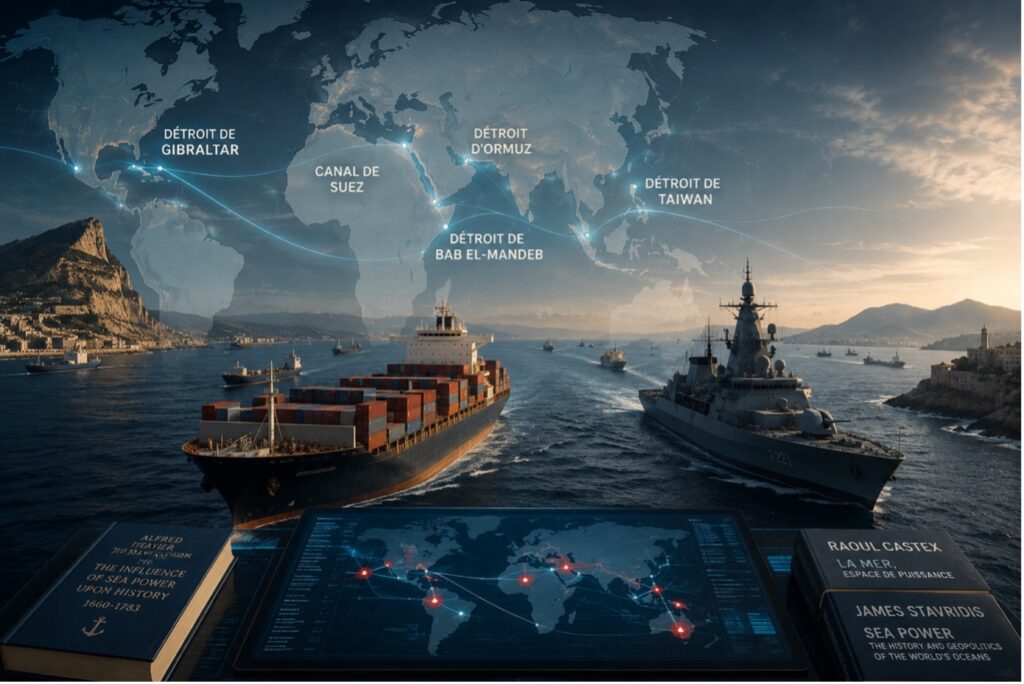
From this perspective, the geopolitics of the seas cannot be reduced to a simple mapping of the world’s maritime routes. It can be understood as a general theory of power through constrained spaces, in which chokepoints [1]— straits, canals and strategic passages — occupy a central place as points of control, vulnerability and projection. Their mastery does not only refer to a military capability, but to a systemic ability to influence the material and immaterial flows that structure the contemporary world economy.
This centrality was formulated in 1890 in a founding manner by the American admiral Alfred T. Mahan, for whom the mastery of the seas is one of the foundations of world power.[2] This vision has become structuring for classical strategic thinking, with the formula « mastery of the seas is the key to global power ».[3] This intuition has durably structured naval doctrines, placing the control of maritime routes and strategic passages at the heart of power strategies. However, this reading grid is now being profoundly reconfigured by the intensification of economic interdependencies, the increasing complexity of supply chains and the rise of strategies for weaponizing flows.
In this regard, contemporary analyses emphasize that the oceans can no longer be understood as simple spaces of circulation, but as systems of interconnected vulnerabilities. James Stavridis thus highlights the systemic nature of maritime spaces, within which localized disturbances can produce global effects[4]. This reading is extended by the British academic Geoffrey Till, who insists on the transformation of the seas into an area of global connectivity structured by trade networks whose security conditions the functioning of the global economy.[5]
This evolution is in line with the approach developed by Raoul Castex, in a renewed form, for whom the naval strategy cannot be dissociated from the general strategy of the States.[6] It is now explicitly reflected in contemporary strategic doctrines, particularly American ones, which have been enunciated until recently, which place the security of maritime flows, the resilience of supply chains and the control of maritime lines of communication (Sea Lines of Communication or « SLOCs« ) at the heart of strategic priorities.[7]
The observation of recent developments in maritime conflict, in particular the tensions affecting the Strait of Hormuz in 2026, suggests that the straits are no longer just strategic crossing points, but nodes of interdependence that can be instrumentalised. In this context, even limited disruption of maritime flows is likely to produce systemic effects, simultaneously affecting energy markets, supply chains and geopolitical balances.[8]
Contemporary analyses stemming from French strategic thinking converge with these developments. The work and positions taken by actors such as the sailors Pierre Vandier and Christophe Prazuck highlight a transformation of the maritime environment into a space of permanent competition, characterized by the growing vulnerability of logistics chains and flows.[9] In this perspective, the control of maritime spaces tends to be complemented, or even partially supplanted, by the ability to act on traffic conditions, thus joining the idea of a strategic centrality of flows.
The work carried out within institutions such as the French Institute for Strategic Research at the École Militaire and the Centre for Strategic Studies of the Navy confirms this evolution by highlighting the growing role of chokepoints as spaces of systemic vulnerability, at the crossroads of economic, military and technological issues.[10]
Therefore, a central question can be formulated: to what extent do maritime straits and chokepoints , long conceived as classic instruments of naval power, tend to become devices for the weaponization of global interdependencies?
The analysis of contemporary dynamics, enlightened by the above-mentioned doctrinal contributions, leads to the observation of a shift in the centre of gravity of maritime power. The control of the straits is no longer solely a matter of territorial or maritime domination, but is part of a logic of systemic power, in which the ability to secure, direct or disrupt flows appears to be a determining factor in international conflict. Straits can thus be understood as essential strategic nodes of globalization, within which the articulation between economic interdependence and power rivalries is at stake.
In this perspective, the study will first analyze the historical permanence of the centrality of the straits in strategic thinking (I), before highlighting their contemporary transformation into instruments of geoeconomic coercion (II), then proposing a renewed reading grid of the geopolitics of the seas in the era of strategic interdependencies (III), and finally examining the emergence of a real arsenalization of maritime interdependencies, in which the operational capacity to act on flows — by securing them, directing them or disrupting them — constitutes a central lever of power (IV).
I. The Historical Construction of Straits as Matrices of Maritime Power
The historical analysis of maritime power shows that the straits are not mere geographical data, but structuring spaces of international power relations, the control of which conditions both the circulation of flows and the capacity for strategic action of states. From the doctrinal formalization of naval power to their operational role in major conflicts, to their gradual integration into a systemic approach to interdependencies, the straits appear as enduring matrices of maritime power. This trajectory can be analyzed through the doctrinal construction of their centrality (A), their role in modern conflicts (B) and their requalification as strategic nodes of globalization (C).
A. The doctrinal foundation of naval power: from the control of routes to the intuition of strategic passages
Historically, the reflection on maritime power has been structured around the control of traffic routes, long before straits were identified as autonomous strategic objects. In his analysis of the Peloponnesian War, Thucydides highlighted the decisive role of maritime communications in the ability of cities to support the war effort, to project their influence and to secure their supplies. [11] Although the straits were not yet conceptualized as such, the centrality of flows and lines of communication already appeared to be a structuring factor of power.
This intuition finds, in the modern period, a particularly successful empirical translation in the practices of the United Provinces. The commercial expansion of the Dutch East India Company (the VOC) in the seventeenth century was based on a fine mastery of the Asian maritime routes, and more particularly on the control of narrow passages linking the great trade basins of the Indian Ocean and East Asia. The leaders of the VOC, governors general, sailors and administrators, identified very early on the strategic importance of certain straits, in particular the Straits of Malacca and the Sunda Strait, whose domination made it possible to control access to spice production areas and to organize a commercial monopoly on a regional scale.[12] This practice reveals an early understanding of the link between the control of narrow passages and the control of flows, mentioned in the internal reports of directors and the logbooks of the Company’s ships, without however giving rise to an explicit theoretical formalization, often for commercial reasons and, as it would be called today, of « trade secrets ».
The reflections developed at the end of the eighteenth century by Armand Guy Simon de Coetnempren de Kersaint also testify in France to an early understanding of the strategic dimension of maritime communications and control positions.[13] Without isolating the straits as an autonomous category, Kersaint highlights the decisive role of strongpoints, trade routes and constrained spaces in the structuring of naval power. This approach, articulating military and economic issues, announces in a still implicit form the contemporary logics of flow control, without, however, leading to a systemic conceptualization of chokepoints.
It was not until the end of the nineteenth century that this empirical intuition was truly systematized in a doctrine consistent with the work of Alfred T. Mahan. In his famous work among historians of the great maritime powers, The Influence of Sea Power upon History,[14] Mahan establishes a structuring correlation between naval power, control of maritime routes and hierarchy of powers. Although he did not develop a specific theory of chokepoints, his insistence on the mastery of lines of communication and strategic positions contributed to making maritime passages essential elements of power. Mahanian thought thus makes a decisive transition from empirical practice to strategic conceptualization, by placing the control of maritime flows at the heart of global power.
The evolution observed between Antiquity, the modern period and the end of the nineteenth century thus highlights a progressive dynamic: from an intuition of the role of circulations in Thucydides, we move successively to an empirical exploitation of passages by commercial powers such as the United Provinces, or an identification of the strategic role of constrained passage spaces and points of support by Kersaint, until their integration into a structured doctrine with Alfred T. Mahan. This trajectory underlines that chokepoints, before being theoretical objects, were first and foremost strategic realities that were gradually identified and exploited, announcing their centrality in contemporary maritime geopolitics.
B. Straits in Major Conflicts: Strategic Locking and Power Projection
The history of contemporary conflicts confirms and deepens this centrality of the straits, by showing that they are privileged instruments of naval strategy. During the two world wars, these spaces became nerve centres for the conduct of operations, at the heart of the logic of control and prohibition.
The operations carried out in the straits during the first half of the twentieth century—whether in the Dardanelles, Gibraltar or the access to the North Sea—illustrate their dual function. On the one hand, they ensure the continuity of maritime lines of communication, which are essential for the supply of economies and the armed forces. On the other hand, they make it possible to disrupt or block adverse flows, by exerting direct pressure on its logistical, industrial and energy capacities.
This strategic locking function is part of a logic of economy of means: rather than controlling all maritime spaces, it becomes possible to act on critical crossing points, producing disproportionate effects: the case of the blockage of the Strait of Hormuz since the first half of 2026 and its very highly inflationary knock-on effects on value chains and the prices of world products are exemplary. Straits are thus instruments for optimizing naval power.
The industrialization of war further reinforced this dynamic, by increasing the dependence of states on maritime flows. The supply of raw materials, energy and manufactured goods makes shipping routes vitally important, turning the straits into critical infrastructure. Securing them is becoming a strategic imperative, while their vulnerability is a factor of structural fragility.
This evolution heralds a more profound transformation: straits tend to appear as points of systemic vulnerability, the disruption of which can produce chain effects. This interpretation is now fully integrated into contemporary naval doctrines, whether American[15] , French[16] or British[17], which identify interruptions in flows as major factors in the destabilization of the international system.
Finally, the straits play an essential role in power projection, by allowing the rapid deployment of forces between different theatres. They constitute interfaces between regional spaces and global dynamics, reinforcing their structuring function in geopolitical balances.
C. Towards a systems approach: from crossing points to strategic nodes
The evolution of strategic thinking in the twentieth century led to a move beyond a strictly geographical approach to the straits to integrate them into a more global vision of the balance of power. Raoul Castex[18] thus stresses that the naval strategy cannot be dissociated from the general strategy of the States, implying a close articulation between the military, economic and political dimensions.
From this perspective, the straits cease to be understood solely as control points and become strategic interfaces, at the crossroads of multiple logics: circulation of flows, power projection, regulation of exchanges and interaction between state and non-state actors. Their importance lies as much in their location as in the systemic effects that their control or disruption can generate.
This evolution finds a direct extension in the contemporary analyses of James Stavridis[19] and Geoffrey Till,[20] who highlight the transformation of the oceans into a space of global connectivity structured by networks of interconnected flows. In this context, the straits appear to be critical nodes, whose vulnerability is likely to produce cascading effects on a global scale, as already mentioned in the consequences of the blockade of the Strait of Hormuz currently.
This systemic reading is now explicitly integrated into contemporary doctrines, including French ones. The analyses of the French Navy underline that the sea must be understood as a space of flow, the control of which conditions the freedom of strategic action.[21]
This doctrinal convergence between American, British, and French traditions confirms a major conceptual shift: maritime power is no longer defined solely by the ability to occupy spaces, but by the ability to act on the circulations that cross them. The straits thus appear as strategic nodes of globalization, within which the articulation between economic interdependence and international conflict is at stake. This tends to develop new visions of geopolitics but also, probably in the long term, of the theory of international trade in the twenty-first century, with a return to the first half of the twentieth century.
II. Straits as structuring spaces of the global strategy of States
The contemporary evolution of power relations leads us to go beyond a strictly naval approach to the straits to integrate them into a global strategy of states, at the crossroads of the military, economic and political dimensions. In a context marked by the intensification of interdependencies and the rise of systemic rivalries, the straits appear not only as crossing points, but as strategic interfaces, the control of which conditions the stability of flows and the capacity of the powers to influence. This transformation can be analysed through their integration into a systemic approach to power (A), their role as an articulation between regional theatres and global dynamics (B), and their insertion into contemporary logics of militarisation and strategic competition (C).
A. A systemic approach: straits at the heart of the overall strategy of States
The analysis of the straits cannot be dissociated from the general evolution of the strategy of States, characterized by an increasing integration of the military, economic and informational dimensions. In line with Raoul Castex’s intuitions,[22] naval strategy tends to be thought of as a component of a broader system, in which the control of maritime spaces is closely linked to the security of flows and the preservation of national interests.
From this perspective, the straits appear as points of strategic convergence, where issues of security, trade and influence meet. Their control is no longer limited to a military presence, but implies an ability to organise, secure and, if necessary, constrain the traffic that crosses them.
This is reinforced by the rise of economic interdependencies, which gives maritime flows systemic importance. Straits concentrate a significant part of world trade, particularly in energy, which makes them particularly sensitive to disturbances. Their role therefore goes beyond the military dimension to be part of a logic of global economic and strategic security.
Contemporary doctrines confirm this approach. National strategies focus on the resilience of supply chains, the protection of Sea Lines of Communication, and the ability to deal with localized disruptions that could have global effects.[23] Straits thus become central elements of a strategy to secure interdependencies.
B. Straits as interfaces between regional theatres and the world order
Beyond their functional dimension, the straits play a structuring role in the articulation between regional dynamics and the international order. As tight spaces concentrating global flows, they constitute junction points between different scales of power.
This intermediate position gives them a particular strategic importance. The tensions that arise there do not remain confined to their immediate environment, but are likely to produce effects on a global scale. The straits thus appear as amplifiers of crises, capable of transforming regional rivalries into systemic disturbances.
The example of the Strait of Hormuz illustrates this dynamic in a particularly clear way. By concentrating an essential part of global energy flows, it constitutes a space where regional tensions can quickly affect international markets, supply chains and geopolitical balances.
This dimension is particularly visible in the Indo-Pacific region, where a growing share of global trade is concentrated. The straits of this region — Malacca, Lombok, Sunda (Sunda Strait) — appear to be critical articulations of globalization, at the heart of the power strategies of the great maritime nations. These Asian straits will most likely be the next strategic focus after the completion of the Strait of Hormuz crisis.
The recent strategic doctrines already mentioned once again confirm this centrality. In particular, the U.S. National Security Strategy and National Defense Strategy explicitly identify securing maritime flows and strategic crossing points as priorities, particularly in the Indo-Pacific.[24] The straits appear as key spaces in contemporary strategic competition.
C. Militarization, grey zones and strategic competition around the straits
The strategic centrality of the straits is accompanied by a transformation of the forms of conflict that unfold there. Far from classic naval confrontations, these spaces are now the scene of hybrid forms of competition, mixing military presence, economic pressure and actions in the grey zones.
Christophe Prazuck’s analyses [25] highlight the development of strategies « below war », characterised by graduated actions aimed at exerting coercion without crossing the threshold of open conflict. In this context, the straits constitute privileged spaces for the expression of these logics, because of their sensitivity and systemic importance.
In a convergent way, Pierre Vandier[26] ‘s work underlines the transformation of the maritime environment into a space of permanent competition, marked by the rise of vulnerabilities and the interweaving of security and economic issues. Flow protection and the ability to operate in contested environments are becoming central functions of naval power.
This evolution is reflected in an increased militarization of the straits, through the deployment of naval capabilities, the multiplication of bases and the reinforced surveillance of traffic areas. It is also accompanied by a diversification of power instruments, including legal, economic and technological means.
In this context, the straits appear as spaces of multidimensional competition, where logics of deterrence, control and disruption are combined. They are privileged places for experimenting with new forms of conflictuality, characterized by their indirect, gradual and systemic nature.
This transformation directly prepares the emergence of strategies for the weaponization of interdependencies, in which the control of flows becomes a central lever of power.
III. Contemporary reconfiguration: from chokepoints to the economy of flows
The intensification of globalization and the transformation of economies into deeply interconnected systems have profoundly changed the strategic nature of maritime spaces. Straits and chokepoints can no longer be understood solely as crossing points or military positions, but as critical nodes in a world economy based on the continuous circulation of flows. This evolution is reflected in a rise in maritime interdependencies, an accentuation of systemic vulnerabilities and the development of coercion strategies based on the disruption of circulations.
A. Globalization and maritime interdependence of economies
Contemporary globalization is decisively based on the fluidity of maritime trade, which ensures the bulk of international trade, in particular for raw materials, hydrocarbons and manufactured products. The oceans must therefore be understood as real global traffic infrastructures, structured by dense, hierarchical and deeply interdependent maritime routes. In this architecture, the straits occupy a singular position, concentrating a substantial part of the flows and constituting obligatory points of passage within logistics chains characterized by their increasing complexity, synchronization and low tolerance to disturbances.
This transformation is an extension of the analyses of James Stavridis[27] and Geoffrey Till,[28] who describe the oceans as a system of global connectivity based on networks of interconnected flows. In this perspective, the sea can no longer be reduced to a space for power projection, but must be considered as a structuring system of the world economy, the continuity of which conditions the stability of trade, energy security and the resilience of economies. Contemporary strategic doctrines extend this reading by explicitly emphasizing the security of maritime lines of communication (Sea Lines of Communication), the protection of critical flows and the ability to prevent or contain localized disturbances likely to affect the entire international system, as illustrated by the recent orientations of American national security strategies.[29]
Thus, straits appear to be nerve centres of globalisation, the importance of which lies not only in their geographical location, but in their function within global supply chains. Their centrality reveals a profound transformation of maritime geopolitics, now structured by the logic of flows and interdependencies rather than by the sole control of spaces.
B. Supply chain vulnerabilities and critical dependencies
However, the intensification of maritime flows is accompanied by a correlative rise in vulnerabilities, resulting from the concentration of trade in a limited number of crossing points. Straits therefore appear to be bottlenecks whose disruption can produce cascading effects on a global scale. This vulnerability is due to a combination of several structural factors, including the geographical concentration of flows, the energy dependence of many economies, the weakness of alternative routes and the increased synchronization of contemporary supply chains, which considerably reduces the margins for adaptation in the event of a disruption.
In this context, the straits are becoming critical points of systemic fragility, within which risks affecting the global economy crystallize. A disruption, even if limited in duration or intensity, can have disproportionate effects, resulting in increased volatility in energy markets, increased shipping costs, tensions on supply chains and, more broadly, a destabilisation of international economic balances. The analysis of recent tensions in the Strait of Hormuz illustrates this dynamic in a particularly enlightening way. The incidents, threats and restrictions affecting this strategic passage have demonstrated that a localised deterioration in maritime safety can produce immediate global effects, simultaneously affecting oil flows, insurance mechanisms, risk premiums and the expectations of economic actors.
This structural vulnerability is now fully integrated into contemporary strategic analyses, which emphasize the need to strengthen the resilience of supply chains, secure critical flows and diversify supply routes. However, these strategies come up against the reality of a persistent dependence on certain straits, whose centrality cannot be easily circumvented, as underlined by recent American doctrines on logistical resilience and securing flows.[30]
C. The rise of coercive strategies through flows
In this context of increased interdependence and systemic vulnerability, maritime flows tend to become instruments of power themselves. Straits appear to be potential levers of coercion, making it possible to exert pressure on state or economic actors without resorting to a direct military confrontation. This is reflected in the development of strategies for controlled disruption of flows, based on graduated actions aimed at affecting traffic conditions without causing a total break that could lead to escalation.
These practices take various forms, ranging from threats to freedom of navigation to targeted harassment of commercial vessels, operations conducted in grey areas and the instrumentalization of security or legal risks. They are part of the logic of indirect conflictuality, analysed in particular by Christophe Prazuck[31] and Pierre Vandier,[32] who highlight the rise of forms of competition located below the threshold of open war, characterised by their ambiguity and progressiveness.
Straits are particularly favourable areas for these strategies, because of their sensitivity and systemic importance. They allow for targeted pressure that can produce significant economic and political effects, while limiting the risks of direct military escalation. This dynamic is explicitly taken into account in contemporary doctrines, particularly in the United States, which identify the protection of flows and the prevention of disruptions as central issues of national security and military planning.[33] It contributes to redefining the very nature of maritime power, which is now based on the ability to act on traffic conditions rather than solely on the control of spaces.
Ultimately, this evolution marks a profound transformation of maritime geopolitics: straits appear as potential instruments of systemic coercion, at the heart of new forms of international conflict, in which the management of interdependencies becomes a central lever of power.
Box 1 — The Strait of Hormuz: archetype of a systemic chokepoint and revealing the weaponization of flows
The Strait of Hormuz is one of the most emblematic examples of the strategic centrality of chokepoints in contemporary geopolitics. Located between the Persian Gulf and the Gulf of Oman, this narrow passage, about thirty nautical miles wide in its navigable portion, concentrates an essential part of the world’s energy flows, in particular hydrocarbon exports from the Gulf riparian states. This configuration makes it a space where geographical, economic, military and legal issues of exceptional intensity are superimposed.
From a historical and doctrinal point of view, the strait fully illustrates the permanence of the centrality of strategic passages, as highlighted by Alfred T. Mahan, for whom the control of maritime routes and crossing points conditions the power of states. As such, the Strait of Hormuz is part of a classic logic of strategic lock, the control of which makes it possible to influence regional and international balances. However, this traditional reading is today profoundly renewed by contemporary dynamics of interdependence. Indeed, the strait is a critical node in a globalized system of energy flows, illustrating the transformation analyzed by James Stavridis and Geoffrey Till, for whom maritime spaces must be understood as connectivity networks whose stability conditions the world economy. The concentration of a significant part of the world’s oil exports in this restricted area makes it a major point of systemic vulnerability, where any disruption, even limited, is likely to produce immediate global effects. Recent events, including the tensions observed in 2026, have confirmed this structural vulnerability. Incidents affecting the safety of navigation – attacks on ships, seizures, threats of closure or implicit restrictions – have led to higher insurance premiums, increased volatility in energy prices and a partial reorganisation of trade flows. These phenomena illustrate the extreme sensitivity of global supply chains to localized disruptions, confirming the role of straits as crystallization points of contemporary vulnerabilities.
In this context, the Strait of Hormuz also appears to be a privileged space for the implementation of indirect coercion strategies. The practices observed are less a logic of total closure than a gradual disruption of flows, part of forms of conflict located below the threshold of open war, as analysed by Christophe Prazuck and Pierre Vandier. This ability to affect traffic conditions without completely interrupting exchanges gives the strait a renewed strategic function, at the heart of contemporary competitive logics.
Finally, the Strait of Hormuz is a particularly clear illustration of the emergence of an arsenalization of maritime interdependencies. The dependence of world economies on the continuity of energy flows transforms this transition into a potential lever of systemic power, allowing them to exert a disproportionate influence in relation to the resources committed. This configuration confirms that contemporary maritime power is no longer based solely on the control of spaces, but on the ability to act on the flows that cross them, by securing them, directing them or disrupting them.
Thus, the Strait of Hormuz appears as a paradigmatic case, both revealing of the permanence of the classic logics of control of strategic passages and emblematic of contemporary transformations in maritime geopolitics, characterized by the centrality of flows, the rise of vulnerabilities and the emergence of new forms of coercion.
IV. Towards the weaponization of maritime interdependencies
The combined evolution of globalization, systemic vulnerabilities and contemporary forms of conflict is leading to a profound transformation of maritime power. Straits and chokepoints are no longer just spaces to be controlled or secured, but tend to become instruments of strategic action in their own right, which can be mobilized in the logic of indirect competition. This change reflects the emergence of a veritable arsenal of maritime interdependencies, in which the ability to act on flows — by securing them, directing them or disrupting them — constitutes a central lever of power. This dynamic is manifested through the transformation of chokepoints into systemic instruments (A), the strengthening of the logics of security and governance of critical spaces (B), and the gradual recomposition of global maritime hierarchies (C).
A. Chokepoints as instruments of systemic power
In the contemporary context, maritime chokepoints appear more and more as levers of systemic power, the control of which makes it possible to act indirectly on the world economy and on geopolitical balances. Their importance no longer lies solely in their geographical or military value, but in their ability to concentrate essential flows and to condition their continuity.
This transformation is an extension of the analyses of James Stavridis, who underlines the interconnected and vulnerable nature of contemporary maritime spaces, as well as those of Geoffrey Till, for whom maritime power is now based on the control of traffic networks. In this context, the control of a strait is no longer limited to a physical interdiction capacity, but implies an ability to influence the operating conditions of a global system.
Chokepoints thus become points of application of power, allowing to exert a disproportionate influence with regard to the means used. Their instrumentalization can take various forms, ranging from the active security of flows to their partial disruption, including deterrence strategies based on the implicit threat of blockage. This logic gives the straits a renewed strategic function, transforming them into interfaces between military power, political economy and management of interdependencies.
Box 2 — The weaponization of maritime interdependencies: elements for conceptualization
Recent developments in maritime geopolitics highlight a profound transformation in the ways in which power is exercised. In a context characterised by intensifying economic interdependencies and the centrality of maritime flows in the functioning of the world economy, dependency relationships are increasingly emerging as potential instruments for strategic action. This dynamic leads us to consider the notion of « arming maritime interdependencies » as a framework for accounting for contemporary transformations of conflict.
This notion is an extension of the analyses of « asymmetric interdependence », developed in particular by Robert Keohane and Joseph Nye,[34] which have shown that exchange relations between states can constitute sources of differentiated power. It is also echoed in more recent work on the « weaponization of interdependence« , according to which the structures of globalization can be mobilized for the purpose of coercion or coercion.[35] Transposed to the maritime domain, this approach leads to considering flows as vectors of power, likely to be secured, directed or disrupted from a strategic perspective.
From this perspective, the weaponization of maritime interdependencies does not refer to a logic of breaking off trade, but to a capacity to act on traffic conditions. It is based on graduated interventions, often below the threshold of open conflict, which aim to exploit the vulnerabilities inherent in flow systems. These practices can take the form of pressure on freedom of navigation, targeted disruptions to supply chains, instrumentalization of legal norms or even naval presence strategies intended to influence the behavior of economic actors.
Contemporary analyses stemming from naval strategic thinking converge with this reading. The work of James Stavridis and Geoffrey Till highlights the transformation of the oceans into an interconnected system of flows and vulnerabilities, in which security can no longer be thought of solely in terms of territorial control. In addition, the reflections developed in the French doctrinal framework, in particular by Pierre Vandier and Christophe Prazuck, underline the rise of forms of indirect conflictuality and the growing importance of maritime spaces in the logic of strategic competition.
In this context, straits and chokepoints appear as privileged spaces for the expression of this weaponization. Their function as obligatory points of passage, combined with their systemic importance, makes them potential levers of influence and constraint. The ability to act on these spaces makes it possible to exert significant pressure on energy, commercial and logistical flows, without necessarily resorting to forms of direct confrontation.
Finally, the weaponization of maritime interdependencies is part of a strategic environment marked by the rise of competition between great powers and by the spread of practices located in gray zones. It contributes to redefining the nature of maritime power, which is now based on the control of circulation and vulnerabilities rather than on the sole domination of spaces. From this perspective, the sea appears not only as a space of projection, but as a system of constraints and opportunities, at the heart of contemporary dynamics of power.
B. Securitization, militarization and governance of critical maritime spaces
Faced with this increased centrality of chokepoints, States are developing strategies aimed at strengthening the security and control of critical maritime spaces. This dynamic is reflected in an intensification of the naval presence, the consolidation of surveillance systems and the development of rapid intervention capabilities in sensitive areas.
Pierre Vandier’s analyses[36] highlight the transformation of the maritime environment into a space of permanent competition, in which the control of flows becomes inseparable from the ability to operate in contested environments. In a very logical convergent way, Christophe Prazuck[37] underlines the importance of grey areas and forms of indirect conflict, which are particularly expressed in the narrow spaces that constitute the straits.
This evolution is accompanied by a rise in the challenges of governance of maritime spaces. Straits, as areas of international movement, are subject to specific legal regimes that provide a framework for freedom of navigation, while leaving room for interpretation and dispute. The tension between the freedom of the seas and the sovereignty of coastal states is thus a structuring factor in the geopolitics of chokepoints.
Moreover, the security of the straits is no longer solely a matter of national logic, but is part of international cooperation frameworks, involving naval coalitions, multilateral mechanisms and strategic partnerships. This collective dimension reflects the profoundly interdependent nature of contemporary maritime issues.
C. Strategic fragmentation and recomposition of global maritime hierarchies
The gradual weaponization of maritime interdependencies is contributing to a recomposition of power hierarchies on a global scale. In a system characterized by the interconnection of flows, the ability to act on the nerve points of circulation becomes a determining factor of power, in the same way as traditional military capabilities.
This evolution encourages the emergence of differentiated strategies, in which states seek to secure their supplies, diversify their routes and reduce their dependence on certain chokepoints, while developing the capacity to influence these same areas. It is also reflected in a growing fragmentation of the maritime space, marked by the superimposition of logics of cooperation, competition and confrontation.
The straits thus appear as spaces where the balance of power is recomposed, revealing the asymmetries of interdependence between actors. Some states have an increased capacity to secure or disrupt flows, while others remain highly dependent on the stability of these strategic crossings.
Contemporary doctrines, particularly those of the United States, highlight this dimension by emphasizing the importance of supply chain resilience, critical infrastructure protection, and the ability to respond to systemic disruptions³⁰. In this context, maritime power tends to redefine itself around the ability to organise, secure and, if necessary, disrupt global traffic.
Ultimately, the weaponization of maritime interdependencies reflects a shift in the center of gravity of power, which no longer resides solely in the domination of spaces, but in the control of the dynamics of circulation that structure them. Straits thus appear as ambivalent instruments, both vectors of power and hotbeds of vulnerability, at the heart of contemporary transformations in the geopolitics of the seas.
Conclusion
The analysis of the straits and maritime chokepoints highlights a double dynamic, made up of both historical continuity and profound functional transformation. On the one hand, the centrality of these spaces in the structuring of maritime power is part of a long term, solidly established by classical strategic thought, from Alfred T. Mahan to Raoul Castex, for whom the control of maritime routes and crossing points is an essential condition for the power of states. On the other hand, the contemporary evolution of economic and strategic systems is leading to a substantial redefinition of the role of these spaces, which are now at the heart of a geopolitics of flows and interdependencies.
Recent developments in maritime conflict, particularly those observed in critical areas such as the Strait of Hormuz, show that straits can no longer be understood solely as positions of territorial control or military locks. They now appear as systemic nodes, within which essential flows are concentrated, the continuity of which conditions the global economic equilibrium. In this context, even limited disruption to these flows can produce disproportionate effects, revealing the depth of vulnerabilities that characterize contemporary economies.
This transformation is part of a broader movement of recomposition of power, analyzed by contemporary approaches to maritime strategy, in particular those of James Stavridis and Geoffrey Till, who highlight the interconnected nature of ocean spaces and the centrality of flows in the structuring of the international system. It is also echoed in the analyses of French strategic thought, which underline the rise of forms of indirect conflict and the growing importance of maritime spaces in the logic of contemporary competition.
The observation of recent events thus leads to the observation of a shift in the centre of gravity of maritime power. This is no longer based exclusively on the ability to control spaces, but increasingly on the ability to act on the conditions of circulation of the flows that cross them. The securitization, orientation or disruption of these flows appear to be decisive instruments of power, which can be mobilized in configurations of conflict often located below the threshold of open war.
From this perspective, straits and chokepoints can be understood as spaces of articulation between interdependence and conflictuality, revealing the asymmetries of dependence that structure the international system. Their role now goes beyond that of simple points of passage to become that of real systemic levers, at the heart of contemporary power dynamics.
This evolution is in line with the intuition formulated by Raoul Castex, according to which » naval strategy can only be conceived in terms of the general strategy of states « . In the current context, this proposal can be extended by emphasizing that maritime power is no longer measured solely by the capacity to dominate spaces, but by the ability to organize, secure and, if necessary, disrupt the circulations that structure the world economy.
Thus, the geopolitics of the seas appears today as a geopolitics of controlled or exploited interdependencies, in which the straits occupy a central place as ambivalent instruments of power and vulnerability. The weaponization of maritime interdependencies constitutes, in this context, a particularly relevant reading grid for accounting for contemporary transformations of international conflict.
In this regard, the increasing instability of some chokepoints, combined with intensifying power rivalries and the fragility of global supply chains, point to a shift towards a more fragmented, contested and potentially more unstable maritime system. In such a context, the security of flows appears less as an achievement than as a permanent strategic issue, calling for renewed forms of governance, cooperation and regulation at the international level.
Ultimately, contemporary maritime power seems to lie less in the mastery of the seas than in the ability to act on the dynamics of circulation that cross them, confirming that, in a world of interdependence, the control of flows tends to become one of the essential foundations of power.
Appendix 1 – Theoretical typology of strategic straits
| Detroit | Historical phase | Major powers/protagonists | Power Configuration | Theoretical concept(s) | Dominant issue | Control Type | Structuring strategic teaching |
| Dardanelles Strait | Antiquity → World War I | Ottoman Empire, United Kingdom, France, Russia | Land/sea conflict | Sea Power¹ | Strategic access blocked | Militarized territorial | Geography limits naval power |
| Bosphorus Strait | Antiquity → today | Ottoman Empire → Turkey, Russia | Regional Interface | Geopolitical Pivot² | Black Sea access | State sovereignty | Sustainable control by riparian state |
| Strait of Gibraltar | Eighteenth → Second World War | United Kingdom, Spain, Axis Powers | Maritime hegemony | Command of the sea¹ | Mediterranean Domination | Naval Base | One checkpoint, one pool |
| Strait of Malacca | Twentieth to twenty-first century | Singapore, Malaysia, Indonesia, China, United States | Multipolarity | Complex interdependence³ | Flow security | Security cooperation | Shared governance needed |
| Strait of Hormuz | Twentieth to twenty-first century | Iran, United States, Gulf Monarchies | Asymmetrical rivalry | Coercive Geoeconomics⁴ | Energy pressure | Deterrence / threat | Global Strategic Weapon |
| Bab-el-Mandeb Strait | Twenty-first century | Yemen, Saudi Arabia, United Arab Emirates, naval powers | Fragmentation | Security of the commons⁵ | Instability | International presence | Internationalization of security |
| Taiwan Strait | Twenty-first century | China, Taiwan, United States | Systemic rivalry | A2/AD⁶ | Risk of major conflict | Contested control | Overall Critical Point |
| Bering Strait | Twenty-first century | Russia, United States | Emerging rivalry | Arctic Highways⁷ | Climate change | Monitoring | New strategic axes |
| Sunda Strait | Twentieth to twenty-first century | Indonesia, global players | Strategic alternative | Stream redundancy³ | Circumvention | Diffuse control | Diversification of routes |
| Lombok Strait | Twentieth to twenty-first century | Indonesia, international navies | Strategic depth | Naval Projection¹ | Large tonnage passage | Indirect control | Importance of the technical factor |
Appendix 2 – Comparative Table of the Major Theories of Maritime Power – United States, United Kingdom, France, Germany
| Author | Alfred Thayer Mahan | Julian Stafford Corbett | Alfred von Tirpitz | Raoul Castex |
| Nature of sea power | Power based on mastery of the seas | Power as an instrument for the control of maritime communications | Threat Capability-Based Power (Risk Fleet) | Power integrated into a general strategy of States |
| Central Strategic Objective | Dominating the oceans to dominate the world | Control Sea Lines of Communication | Produce a sufficient deterrent risk against the adversary | Articulating sea, land and air in a global strategy |
| View of the Straits | Lockpoints to control for global dominance | Communication nodes to secure or neutralize depending on the policy | Indirect levers of strategic pressure (via threat of rupture) | Critical points integrated into a global power system |
| Relationship to Naval Warfare | Decisive war between fleets | Limited and contextual warfare | Deterrence by threat of potential all-out war | Warfare as a multi-domain system |
| Dominant logic | Domination | Flexible control | Deterrence / risk | Systemic integration |
| Power Type | Material and territorial | Functional and relational | Psychological and probabilistic | Systemic and Joint |
| Contribution to the geopolitics of the Straits | Basis of the strategic value of chokepoints | Analysis of maritime flows and communications | Introduction of the logic of indirect coercion | Global vision of the straits as systemic strategic nodes |
| Contemporary scope | Basis of classical geostrategy | Widely used in modern naval doctrines | Foreshadows the weaponization of flows | Very close to contemporary analyses of complex systems |
[1] Chokepoints: In maritime geopolitics, the term refers to narrow passages (straits, canals) through which essential flows pass and whose control makes it possible to influence or disrupt their circulation.
[2] Alfred Thayer Mahan, The Influence of Sea Power upon History, 1660–1783 (Boston: Little, Brown and Company, 1890), 25–89. Alfred T. Mahan (1840–1914), a graduate of the U.S. Naval Academy (1859), a rear admiral in the U.S. Navy, was a professor and then president of the Naval War College in Newport (1886–1893; 1895–1896). A major theoretician of maritime power in history, he profoundly influenced the naval doctrines of the late nineteenth and early twentieth centuries, and even well beyond. His seminal work, The Influence of Sea Power upon History, 1660–1783 (Boston: Little, Brown and Company, 1890), establishes a structuring correlation between control of maritime lines of communication, commercial power, and the international hierarchy of states.
[3] Alfred T. Mahan, op.cit.
[4] James Stavridis, Sea Power: The History and Geopolitics of the World’s Oceans (New York: Penguin Press, 2017), pp. 211–245. James Stavridis (b. 1955), U.S. Navy Admiral (ret.), graduate of the U.S. Naval Academy (1976) and Ph.D. in International Relations (The Fletcher School, Tufts University), served as NATO’s Supreme Allied Commander Europe (SACEUR) and Commander of the U.S. European Command (2009–2013). He also served as President of the Naval War College (2006–2009). The career of this distinguished American naval officer is absolutely remarkable, both from an academic point of view and from that of operational life and strategy. In this, he can be placed on the same level as Alfred T. Mahan, mainly focused on scientific works and innovations. His work, including Sea Power: The History and Geopolitics of the World’s Oceans (New York: Penguin Press, 2017), offers a contemporary analysis of the oceans as interconnected systems of flows, vulnerabilities and strategic competition.
[5] Geoffrey Till, Seapower: A Guide for the Twenty-First Century, 3rd ed. (London: Routledge, 2013), esp. pp. 85–120.
This reading is extended by Geoffrey Till, a British academic and one of the leading contemporary specialists in maritime strategy. Professor emeritus at King’s College London and long associated with the Corbett Centre for Maritime Policy Studies, he is not an operational sailor but a theoretician of naval power, whose work is part of the renewal of Anglo-Saxon strategic thinking. In Seapower: A Guide for the Twenty-First Century, his conception of maritime power focuses on the transformation of the seas into a space of global connectivity structured by networks of exchange whose security conditions the functioning of the global economy. His ideas mark a shift from traditional territorial approaches, integrating the contribution of digitalization.
[6] Raoul Castex, Théorie stratégiques, Paris, Economica, re-ed. 1997 (orig. ed. 1937–1939), t. I, p. 45–78. Raoul Castex (1878–1968), French vice-admiral, former major of the Naval Academy, professor at the Centre des hautes études navales and at the École de guerre navale, was one of the leading European theorists of strategy in the twentieth century. In his Theories stratégiques, Paris, Sirey, 1937–1939 (re-ed. Economica), he developed a global conception of strategy integrating the military, political and economic dimensions, and affirmed that naval strategy could not be dissociated from the general strategy of states.
[7] National Security Strategy, Washington, The White House, Nov. 2025, ca. 40 p.; National Defense Strategy, Washington, U.S. Department of War (ex-U.S. Department of Defense), 2026, approx. 30 p. These two documents enshrine the centrality of maritime flows, logistical resilience and the American strategic priority for the Indo-Pacific.
[8] On the systemic effects of disruptions to contemporary maritime flows, particularly in the Strait of Hormuz, see recent maritime safety and energy conservation reports (2025–2026), publications by international think tanks and sectoral analyses
[9] Amiral Pierre Vandier, « The Armed Forces Facing the Contagion of Chaos: The Challenges of the Armed Forces General Staff », Revue Défense Nationale, 2024/1, No. 866, p. 7–12; Admiral Christophe Prazuck, « Below the war, beyond peace: the grey zones », Revue Défense Nationale, 2020/3, n° 828, p. 29–32
[10] French Institute for Strategic Research of the Military School; Naval Center for Strategic Studies, recent reports and publications related to maritime security, chokepoints, and contemporary naval power dynamics
[11]Thucydides, Histoire de la guerre du Péloponnèse, text established and translated by Jacqueline de Romilly, Paris, Les Belles Lettres, coll. « Classiques en poche », 2000 (re-ed. of the 1953–1972 edition), spec. books I and II, pp. 70–120 ca.
[12] Dutch East India Company, see, e.g., Femme S. Gaastra, The Dutch East India Company: Expansion and Decline (Zutphen: Walburg Pers, 2003), pp. 45–78. In particular, it presents analyses of trade routes in Southeast Asia, including the Strait of Malacca and the Sunda Strait.
[13] Armand Guy Simon de Coetnempren de Kersaint (1742–1793), naval officer then vice-admiral and deputy to the Convention, a true intellectual imbued with the spirit of the Enlightenment, developed at the end of the Ancien Régime an advanced reflection on the link between maritime power, trade and naval communications. Unfortunately, he was guillotined in 1793: his ingenuity and spirit of innovation were sorely missed by the French Navy during the wars of the Revolution and the Empire. See in particular: Mémoire sur la marine de France (c. 1788–1789) and Œuvres du comte de Kersaint, Paris, an III (1795), 1 vol. in-8°, variable pagination (ca. 400 p.) spec. on the organization of ports and the protection of trade routes, observed during its operations during the American War of Independence. V. François Souty, « Armand Guy Simon de Coëtnempren, Comte de Kersaint, Capitaine de vaisseau, chef de division des armées navales (contre-amiral) de la Marine Royale, vice-amiral de la Première République, 1742-1793 », Le Mérite, Dec. 2025, pp. 38–42.
Kersaint emphasizes, by prefiguring Mahan, the importance of strongpoints, strategic ports and maritime traffic routes in the structuring of power, by closely articulating military and economic issues. Without isolating the straits as an autonomous category, he highlights the role of constrained passage spaces in the control and disruption of adversary flows, announcing a conception of maritime warfare as a war of communications. On the historiographical level, see: Martine Acerra and Jean Meyer, La grande époque de la marine à voile, Rennes, Ouest-France, 1987, pp. 245–260; Patrick Villiers, Marine royale, marine républicaine (1789–1799), Paris, Economica, 1992, pp. 45–72. These analyses confirm the modernity of his thinking, without attributing to him an explicit conceptualization of chokepoints, which would later be systematized in particular by Alfred T. Mahan.
[14] Op. cit. at note 2, especially pp. 29-82.
[15] On contemporary American strategy, v. U.S. Navy, U.S. Marine Corps, U.S. Coast Guard, A Cooperative Strategy for 21st Century Seapower: Forward, Engaged, Ready, Washington D.C., March 2015, pp. 2-4 and pp. 6-9. The document underlines that maritime power aims in particular to « prevent or contain local disruptions before they impact the global system » (p. 4), explicitly highlighting the link between the security of maritime flows, systemic stability and the management of localized disturbances, with the need to know how to anticipate. It also insists on the protection of the Sea Lines of Communication (SLOCs) and the securing of trade and energy flows as central functions of contemporary naval power.
[16] On the current French maritime strategy in particular, see French Navy, Strategy of the French Navy, Ministry of the Armed Forces, 2021, spec. p. 5–18 (strategic environment), p. 21–35 (strategic functions of the Navy) and p. 37–52 (control of air-sea spaces and securing flows). This doctrinal document emphasizes freedom of action at sea, the protection of maritime lines of communication and the rise of hybrid conflicts in common spaces. See also Pierre Vandier, Chief of Staff of the Navy (2020–2023), whose interventions underline the return of inter-state competition in common spaces and the centrality of flows in contemporary conflict: « degradation of the geopolitical context » and hybridization of modes of action at sea; see also his interventions on the control of maritime spaces and flows. See in particular the interview with Admiral Vandier in 2021: « We are already far beyond the missions provided for in the White Paper », La Tribune, 01 July 2021; disp. Online: https://www.latribune.fr/entreprises-finance/industrie/aeronautique-defense/nous-sommes-largement-au-dela-des-missions-prevues-par-le-livre-blanc-amiral-pierre-vandier-888038.html?utm_source=chatgpt.com
[17] On the contemporary British strategic vision, see UK Ministry of Defence, British Maritime Doctrine (BR 1806), 4th edition, London, Development, Concepts and Doctrine Centre, 2011, pp. 1-2 to 1-4 and pp. 2-1 to 2-3. Current British doctrine defines the sea as « a medium for the movement of goods, people and information » (p. 1-2) and specifies that maritime control consists of « ensuring access for oneself and denying it to an opponent » (p. 2-1). It thus establishes a direct link between control of the sea, control of flows and the capacity for denial, the doctrinal foundation of the strategic importance of the straits.
[18] Raoul Castex, op.cit., t. I, p. 45–78.
[19] James Stavridis, op. cit. pp. 211–245
[20] Geoffrey Till, op. cit., pp. 85–120
[21] French Navy, op. cit., see note 15.
[22] Op.cit.
[23] Op.cit.
[24] Op.cit. at note 7.
[25] Op. cit.
[26] Op. cit. cit.
[27] Op. cit. cit.
[28] Op. cit. cit.
[29] U.S. Navy, U.S. Marine Corps, U.S. Coast Guard, op. cit. at 15, at 2-9.
[30] The White House, National Security Strategy, op.cit., pp. 12–18 and pp. 22–25. These sections focus respectively on economic security and supply chain resilience and on securing critical infrastructure and global flows, explicitly highlighting the vulnerability of interconnected systems and the need to prevent disruptions affecting international trade.
[31] Christophe Prazuck, op.cit., p. 29-32.
[32] Pierre Vandier, op.cit., p. 7-12.
[33] U.S. Department of Defense, National Defense Strategy 2026, op. cit., pp. 8–13 and 18–21. These passages address contested logistics, the protection of strategic lines of communication, and the need to ensure supply chain resilience in a degraded environment, explicitly integrating vulnerabilities related to maritime flows into strategic planning
[34] Robert Keohane and Joseph Nye, Power and Interdependence (Boston: Little, Brown, 1977 (re-ed. 2012), esp. pp. 8–25.
[35] Henry Farrell and Abraham L. Newman, « Weaponized Interdependence: How Global Economic Networks Shape State Coercion, » International Security, Vol. 44, No. 1, 2019, pp. 42–79. The expression refers to the idea that mutually beneficial economic, logistical or technological relations can be transformed into instruments of constraint or coercion (sanctions, flow control, critical dependencies, etc.).
[36] Op.cit.
[37] Op.cit.
#MaritimePower,#Geopolitics,#StraitOfHormuz,#Chokepoints,#SeaPower,#IndoPacific,#GlobalTrade,#MaritimeSecurity,#NavalStrategy,#Geoeconomics,#SupplyChains,#GlobalEconomy,#USNavy,#China,#Iran,#Russia,#MaritimeRoutes,#EnergySecurity,#Geostrategy,#WorldTrade,#Hormuz,#Malacca,#BabElMandeb,#TaiwanStrait,#Bosphorus,#Gibraltar,#Mahan,#Castex,#JamesStavridis,#GeoffreyTill,#PierreVandier,#ChristophePrazuck,#Weaponization,#Interdependence,#Shipping,#MilitaryStrategy,#InternationalRelations,#GlobalCrisis,#EconomicWarfare,#FrançoisSouty