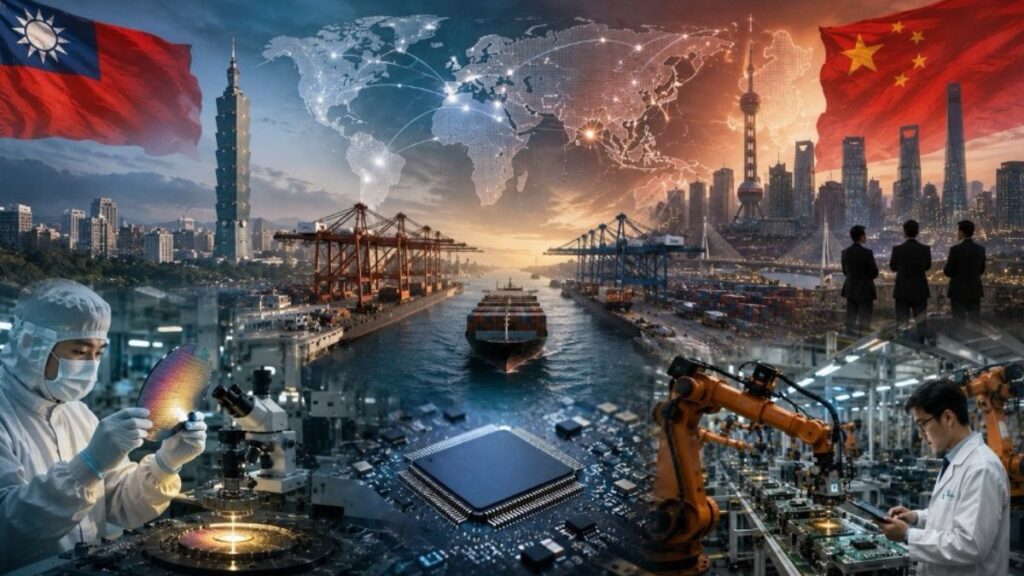
ECONOMY – The recomposition of the Taiwanese Industrial State since China’s accession to the WTO (2001-2026): From globalization to economic security
By François Souty, PhD Lecturer in geopolitics at Excelia Business School, La Rochelle and Paris-Cachan. Lecturer in EU competition law and policy at the Faculty of Law of Nantes. Head of the economics section at Le Diplomate Média
« The State should develop those industries which private capital cannot adequately undertake. »[1]
Sun Yat-sen, The International Development of China, Shanghai, 1922.
Executive Summary
China’s accession to the World Trade Organization in December 2001 was a major turning point in Taiwan’s contemporary economic history. By accelerating the integration of value chains on both sides of the Strait, it opens up new development prospects for Taiwanese companies while creating unprecedented economic, technological and geopolitical dependencies. The Taiwanese authorities were then faced with a strategic challenge: to preserve the competitiveness of an economy that was deeply integrated into globalization without compromising its industrial and technological autonomy.
The article shows that this evolution is not limited to an adaptation of existing industrial policies. It reflects a recomposition of the economic state. Without renouncing the foundations of the developing state that had accompanied the island’s industrial take-off, Taiwan is gradually reorganizing its intervention instruments around new priorities: innovation, mastery of critical technologies, resilience of supply chains and economic security.
Growing integration with China is encouraging investment, industrial relocations and the integration of Taiwanese companies into global value chains. At the same time, the public authorities are strengthening research policies, supporting technological institutes, developing science parks and consolidating an ecosystem involving universities, public bodies and private companies. The rise of semiconductors, digital technologies and high-tech industries is thus the result of a long-term public strategy combining financing, innovation and institutional coordination.
Sino-American tensions, the Covid-19 pandemic and the increasing fragmentation of the world economy then accelerated a new development. Industrial policy is becoming an instrument of economic security. The protection of critical technologies, the security of supply chains, the control of sensitive investments, cybersecurity and technological sovereignty are now essential as complementary objectives of industrial competitiveness.
The Taiwanese experience thus highlights an original model in which the state does not act primarily as a planner, but as an organizer of an innovation ecosystem bringing together public research, funding, high-tech companies and public-private partnerships. This institutional coherence offers several lessons for the European Union, particularly in terms of the governance of critical technologies, technology transfer, the articulation between industrial policy, competition and economic security, as well as the resilience of value chains. It also highlights the limits of direct transposition, linked to the institutional, economic and geopolitical differences between Taiwan and the EU.
Beyond the Taiwanese case, this study defends a more general thesis: globalization has not led to a decline in public intervention, but to a recomposition of the economic state. The state does not renounce either the market or industrial policy; It is redefining the objectives of its action in order to reconcile competitiveness, innovation, resilience and economic security. Taiwan thus appears to be one of the most successful expressions of this contemporary evolution, in which industrial policy is once again becoming a major instrument of economic power and technological sovereignty.
Introduction
For nearly three decades, economic globalization has been widely analyzed as a vector for a gradual decline in public intervention in the economy. The opening of markets, the liberalization of trade, the international fragmentation of value chains and the internationalization of investments seemed to herald the lasting disappearance of industrial policies in favor of an allocation of resources more governed by market mechanisms. This reading, dominant in part of the economic and legal literature of the 1990s and 2000s, has nevertheless been profoundly challenged by the successive crises that have marked the beginning of the twenty-first century: the global financial crisis of 2008, the Covid-19 pandemic, tensions on supply chains, Sino-American technological rivalry and the return of economic security as a strategic priority of the great powers. Far from having disappeared, industrial policy has once again become one of the main instruments of economic power, innovation and resilience of states.[2]
Among Asian economies, Taiwan occupies a singular place in this respect. Few territories simultaneously have such a high degree of trade openness, such advanced industrial specialization in advanced technologies, significant economic dependence on the Chinese market and such direct exposure to contemporary geopolitical recompositions. The semiconductor industry, in which Taiwanese companies occupy a central position in global value chains, illustrates this double reality in itself: a major factor in economic competitiveness, it has become one of the main challenges of international strategic competition. In this context, China’s accession to the World Trade Organization in December 2001 is much more than a simple chronological milestone. It marks the starting point of a profound reconfiguration of Taiwan’s economic environment, accelerating both productive integration between the two sides of the Strait and the emergence of new industrial, technological and geopolitical vulnerabilities.[3]
The hypothesis defended in this study is that this evolution has in no way led to a withdrawal of the state from the economic sphere. On the contrary, it has begun a continuous process of recomposition of the industrial state. Without renouncing the foundations of the developing state that had accompanied the island’s economic take-off from the 1960s onwards, the Taiwanese authorities have gradually redefined the purposes of their intervention. Initially focused on industrial development and international competitiveness, public action then turned towards technological innovation, before integrating more broadly the imperatives of value chain resilience, protection of critical technologies and economic security. This trajectory therefore reflects neither a break with the historical model nor a simple return to economic interventionism. It reveals a continuous adaptation of the instruments of the State to the transformations of globalization and to the evolution of international power relations.[4]
This reading is an extension of recent research on contemporary changes in industrial policies and comparative economic law, particularly with regard to the United States, Japan, South Korea, China and the European Union. The analysis of the Taiwanese experience completes this reflection by highlighting an original way of recomposing the economic state, based less on a highly integrated central administration than on the coordination of an ecosystem associating public research, technological institutes, universities, innovative companies, financial instruments and public-private partnerships. It thus offers a useful insight into the conditions under which an open economy can reconcile international competitiveness, innovation and economic security, while feeding European reflection on technological sovereignty and new forms of industrial policy.[5]
In order to verify this hypothesis, the study will successively analyze the consequences of China’s accession to the WTO on the Taiwanese economy and the first adjustments of the industrial state (I), then the assertion of an innovative state based on strategic technologies and research ecosystems (II), before examining the gradual emergence of a strategic state of economic security in a context of growing geopolitical rivalries (III). It will conclude with a reflection on the main lessons that can be drawn from the Taiwanese experience for the European Union and its Member States (IV).
I. China’s accession to the WTO: the starting point for the recomposition of the Taiwanese industrial state (2001-2008)
China’s accession to the World Trade Organization on December 11, 2001, was one of the major turning points in Taiwan’s contemporary economic history. Far from producing unequivocal effects, this event opened a period of profound recompositions. The accelerated integration of the economies of the two sides of the Strait is simultaneously promoting the international expansion of Taiwanese companies, the intensification of investments to the mainland, the reorganization of industrial value chains and the emergence of new economic and technological vulnerabilities. The environment in which the Taiwanese industrial state had developed since the 1960s was profoundly transformed.[6]
However, this new configuration does not lead to a disengagement of the State or to a simple maintenance of the instruments inherited from the developing State. It ushered in a more complex process of recomposition of the industrial state, during which the public authorities gradually adapted their priorities, instruments and modes of intervention to an economic environment that had become much more competitive, interdependent and unstable. International competitiveness can no longer be dissociated from the challenges of technological control, investment control, protection of strategic assets and, gradually, economic security.[7]
The analysis of this first period thus allows us to understand the foundations of this recomposition. It first examines the effects of the accelerated economic integration between Taiwan and mainland China (A), before examining the way in which the Taiwanese authorities have sought to preserve their technological and industrial capacities in the face of these new interdependencies (B). Finally, it highlights the first instruments for securing strategic technologies and sensitive investments, which already heralded the more profound changes in Taiwan’s industrial policy over the following decades (C).[8]
A. China’s accession to the WTO: a break in Taiwan’s economic environment
China’s entry into the World Trade Organization on December 11, 2001, is one of the main structuring events in the contemporary Asian economy. For Taiwan, this membership goes far beyond the mere opening of a new market. It profoundly changes the conditions in which Taiwanese enterprises are competitive by accelerating economic integration on both sides of the Strait, promoting the international fragmentation of production processes and intensifying regional technological competition. The Taiwanese economy, which has been strongly export-oriented for several decades, is thus confronted with a double dynamic: the considerable expansion of the opportunities offered by the mainland market and the emergence of new forms of industrial and strategic dependence.[9]
This development comes at a time when Taiwanese companies already have a significant presence in mainland China. As early as the 1990s, many industrial groups had made investments in the coastal provinces in order to benefit from lower labour costs and increasing integration into global production networks. Beijing’s accession to the WTO accelerates this movement by strengthening legal certainty for trade, facilitating direct investment and stimulating the creation of integrated value chains between the two economies. Taiwanese companies then became major players in Chinese industrialization, particularly in the electronics, computer components, information technology and, gradually, semiconductor sectors.[10]
This productive integration produces considerable economic effects. Taiwanese exports to China and Hong Kong are growing rapidly, while direct investment is at record levels. From the mid-2000s, mainland China became Taiwan’s leading trading partner and the main destination for its foreign investment. This interdependence contributes powerfully to the growth of Taiwanese companies, but it also increases their exposure to political, regulatory and strategic developments on the continent. The economic success of this integration thus brings to light the first debates on the risks of excessive dependence on the Chinese market and on the consequences of possible transfers of industrial and technological capacities.[11]
The evolution is all the more significant as competition is no longer solely about production costs. The rapid increase in Chinese industrial capacity, supported by a particularly ambitious industrial policy, is gradually leading the Taiwanese authorities to question the preservation of their comparative advantages. Information technology, integrated circuits, electronic equipment and research activities are becoming sectors whose mastery appears to be decisive not only for economic growth but also for national security. Technological innovation is thus beginning to establish itself as the main differentiating factor in the face of a China whose industrial capacities are growing rapidly.[12]
This period thus reveals a founding paradox of the recomposition of the Taiwanese industrial state. Globalization, far from reducing the role of public authorities, on the contrary increases the need for public action capable of supporting the internationalization of companies while preserving the most sensitive technological assets. The opening of markets does not therefore eliminate industrial policy; it gradually transforms its purposes. The state is no longer only called upon to promote growth or exports. It must also anticipate vulnerabilities created by economic interdependence, preserve national innovation capacities and prepare the instruments that will later ensure the resilience of strategic value chains.
This first phase explains why Taiwan’s industrial policy cannot be understood solely through the opposition between economic openness and public intervention. It is precisely the intensification of globalization that is gradually leading the authorities to redefine the missions of the industrial state. This development prepares the first decisions relating to the maintenance of critical technologies on the island’s territory and the instruments intended to regulate investments in the most sensitive sectors.
B. Preserving technological and industrial capabilities in the face of new interdependencies
The acceleration of economic exchanges with mainland China soon revealed the limits of integration based solely on comparative advantages. As early as the mid-2000s, the Taiwanese authorities became aware that the internationalization of national companies, while a powerful factor for growth, could also weaken the technological foundations of the island’s economy. The relocation of manufacturing activities, the growing presence of Taiwanese groups on the mainland and the rapid increase in Chinese industrial capacity are gradually fuelling a debate on the preservation of the most sensitive know-how, decision-making centres and technologies.[13]
However, this development does not call into question the international openness of the Taiwanese economy. Governments are favouring a more nuanced approach of maintaining integration into global value chains while strengthening higher value-added activities at home. The objective is no longer just to produce more, but to maintain the most strategic functions: research, design, engineering, intellectual property, manufacturing of the most sophisticated components and management of international industrial networks. This strategy is gradually helping to shift the centre of gravity of industrial policy towards technological innovation and the control of intangible assets.[14]
The semiconductor sector is a particular example of this evolution. While assembly or standardized production activities can be gradually internationalized, advanced technologies remain tightly concentrated in Taiwan. Public authorities, in close cooperation with research institutes, universities and large companies, seek to preserve the scientific capacity, engineering skills and infrastructure on the island that are essential for maintaining a sustainable technological advantage. This orientation contributes to strengthening an industrial model based on specialization in the most complex segments of global value chains rather than on cost competitiveness alone.[15]
At the same time, the State is gradually adapting its intervention instruments. Public policies are giving increasing importance to the funding of research, support for innovative companies, the promotion of intellectual property and the development of science parks. Public action is no longer aimed solely at supporting industrialization but at organizing an environment conducive to permanent innovation and the upscaling of national companies. This development already reflects a profound change in the missions of the industrial state, whose function is now as much to preserve technological capabilities as to promote economic growth.[16]
The emergence of this new orientation is also the result of a transformation in the risks perceived by public authorities. As Taiwanese companies increase their investments in China, the issue of technology transfer, protection of trade secrets and retention of strategic skills is becoming increasingly important. Industrial policies are therefore gradually integrating considerations that were previously mainly the responsibility of economic or trade policy. Innovation is becoming a competitiveness issue but also an instrument for preserving industrial autonomy in an increasingly competitive regional environment.[17]
The implementation of Taiwan’s industrial policy is not based on a single administration, but on a real institutional ecosystem involving government authorities, research organizations, public funding instruments, universities and major technology companies. This architecture, which is more reticular than strictly hierarchical, reflects a partnership conception of the strategic state, based less on centralized management than on permanent coordination between the different levels of decision-making, expertise and innovation. The continuity of these interactions, preserved despite political alternations, is one of the main factors in the stability and effectiveness of Taiwan’s industrial policy, while giving it a remarkable capacity to adapt to technological and geopolitical developments. The main actors in this governance are presented in the box below.
Box 1 – The main actors in Taiwan’s industrial policy
Strategic leadership: Executive Yuan (government coordination), National Development Council (strategic planning and economic development) and Ministry of Economic Affairs (MOEA) (industrial policy, energy, investment and competitiveness).
Research and innovation: National Science and Technology Council (NSTC), responsible for national research policy; Industrial Technology Research Institute (ITRI), the main technology transfer organization; Institute for Information Industry (III), specializing in digital transformation, information technology and artificial intelligence.
Financing and support for industry: National Development Fund, the main financial instrument of the State for strategic sectors, complemented by public banks and mechanisms to support innovation and private equity.
Industrial ecosystem: large technology companies (TSMC, UMC, ASE, MediaTek, Foxconn), universities, science parks (including Hsinchu Science Park) and networks of innovative SMEs, associated in a model of close cooperation between public authorities, research and industry.
This period thus appears to be a decisive stage in the recomposition of the Taiwanese industrial state. Without calling into question the principles of the open economy, the public authorities are gradually redefining the priorities of their intervention around the protection of national technological capacities. This development paved the way for the instruments that would be developed over the next decade in order to provide a more direct framework for sensitive investments, to secure critical technologies and to fully integrate economic security objectives into the heart of industrial policy.
C. The first instruments for securing strategic technologies and sensitive investments
The rise of industrial interdependencies with mainland China is gradually leading the Taiwanese authorities to supplement the traditional instruments of industrial policy with mechanisms designed to preserve the most sensitive economic interests. This evolution remained gradual during the 2000s. It does not in any way call into question the openness of the economy or the desire to maintain close trade relations with the continent. Rather, it reflects an awareness that in a knowledge-based economy, certain technologies, certain know-how and certain industrial capacities acquire a strategic dimension that goes beyond their economic value alone.[18]
The public authorities are thus gradually developing a set of rules designed to regulate investments in the most sensitive sectors, to control the transfer of certain technologies and to preserve national capacities in areas deemed essential for long-term competitiveness. Prior authorization mechanisms, restrictions on certain investments in mainland China, and controls on advanced technologies are still relatively limited, but they reflect an important shift in public priorities. Industrial policy no longer pursues only growth objectives; It is also beginning to incorporate considerations relating to the control of strategic assets.[19]
This development particularly concerns the semiconductor, microelectronics, communication equipment, biotechnology and, more broadly, the research and development-intensive industries. The authorities are seeking to prevent the internationalisation of companies from leading to a lasting weakening of the island’s scientific and industrial base. The trade-offs are less about production volumes than about the location of research activities, the most advanced technologies, the most complex manufacturing processes and strategic management functions. It is already a question of preserving the most value-creating segments of global production chains.[20]
This orientation also leads to a gradual transformation of administrative instruments. Innovation policies, public support for research, financing mechanisms for technology companies, rules on investments and the first interministerial coordination mechanisms tend to be understood as components of the same strategy. The state no longer acts solely as a regulator of the markets or as a financial support for industry; it is gradually becoming the organizer of an environment designed to preserve national technological capabilities in a context of increasing interdependence.[21]The originality of this period lies precisely in this silent evolution. No major institutional change has yet been made to enshrine an explicit policy of economic security. However, the main instruments that will be considerably strengthened during the 2010s are already in the pipeline. The protection of critical technologies, the monitoring of sensitive investments, the maintenance of critical scientific capabilities at home, and the growing focus on industrial resilience herald the directions that will be required in the future as a result of China-US technology rivalries and disruptions in global value chains.
Thus, between 2001 and the end of the first decade of the twenty-first century, Taiwan’s industrial policy underwent an evolution whose scope went far beyond the adaptation of a few administrative instruments. The foundations of the developing state remain present, but they are gradually being reoriented towards new purposes. This first phase thus marked the starting point for the recomposition of the Taiwanese industrial state: innovation gradually became inseparable from the mastery of critical technologies, a prelude to the emergence of a real strategic state for economic security. The political changes that have taken place since democratization have not called into question the foundations of Taiwan’s industrial policy. The following table traces the main stages of this evolution.
Table 1 – The main developments of the Taiwanese strategic state since 2000
| Period | President (party) | Dominant orientation | Industrial priorities | Evolution of the strategic state |
| 2000-2008 | Chen Shui-bian (Democratic Progressive Party – DPP) | Technological modernization and economic affirmation | Semiconductors, electronics, biotechnology, innovation | Consolidation of the national innovation system, strengthening the role of the State in advanced technologies |
| 2008-2016 | Ma Ying-jeou (Kuomintang – KMT) | Economic openness and regional integration | ICT, investment, trade with mainland China, competitiveness | Increased internationalisation of companies, deepening of Asian value chains |
| 2016-2024 | Tsai Ing-wen (DPP) | Economic security and industrial resilience | Semiconductors, artificial intelligence, cybersecurity, defense, « Five plus Two Innovative Industries Plan » and then « Six Core Strategic Industries » | Strong return of the State as a strategist, diversification of partnerships and reduction of critical dependencies |
| Since 2024 | Lai Ching-te (DPP) | Strengthening economic security and technological cooperation | Critical technologies, AI, advanced computing, secure supply chains | Deepening integration into the technological networks of industrial democracies |
While successive governments have given varying importance to economic opening, relations with mainland China or economic security, all have maintained sustainable support for advanced technological sectors, innovation and the upgrading of the production system. This continuity distinguishes Taiwan from many industrialized states, where changes in majority are often accompanied by sharper shifts in economic priorities. It illustrates the ability of Taiwanese institutions to preserve, beyond partisan alternations, a long-term strategic vision based on technological competitiveness, public-private coordination and permanent adaptation to changes in the international environment.
II. The Affirmation of an Innovative State: Strategic Technologies, Industrial Ecosystems and Moving Upmarket (2008-2016)
The first decade following China’s accession to the World Trade Organization gradually revealed the limits of a strategy based mainly on the internationalization of production. While this openness contributes to the dynamism of Taiwanese companies, it also highlights the need to sustainably preserve the technological advantages that are the main foundation of their international competitiveness. The global financial crisis of 2008, the acceleration of China’s industrial policies and the intensification of competition in high-tech sectors further reinforced this awareness. The challenge is no longer just to support the changes of globalization; it is about consolidating the innovation capabilities that will allow Taiwan to maintain its place in the most strategic segments of global value chains.[22]
This development marks a new stage in the recomposition of the Taiwanese industrial state. Without breaking with the principles inherited from the developing state, the public authorities are gradually reorienting their instruments towards the production of knowledge, support for research, the organization of technological ecosystems and the upgrading of industrial activities. Industrial policy is thus tending to become an innovation policy, based on coordination between administrations, research institutes, universities, technology companies and financial instruments. The State is no longer satisfied with supporting industry; it shall organise the conditions for its permanent renewal.[23]
This second phase allows us to understand the concrete modalities of this transformation. It first leads to an analysis of the role of major research institutes and technological clusters in the structuring of a national innovation ecosystem (A), before examining the progressive specialization of industrial policy around critical technologies and strategic sectors (B). Finally, it will show how this industrial move upmarket prepares for the growing integration of the considerations of resilience and economic security that will characterize the following period (C).[24]
A. The role of major research institutes and technology clusters in structuring a national innovation ecosystem
The move upmarket of Taiwanese industry is not only the result of the ability of private companies to adapt. It is also based on the gradual constitution of an innovation ecosystem whose coherence, continuity and financing are ensured by the State. From the end of the 2000s, this organisation became one of the main instruments of industrial policy. The public authorities are no longer limited to supporting certain sectors of activity; They promote the emergence of an institutional environment designed to accelerate the production of knowledge, the transfer of technologies, the creation of innovative companies and the dissemination of innovations to the industrial fabric.[25]
This strategy is based first and foremost on the major public research institutes, whose role goes far beyond scientific production alone. The Industrial Technology Research Institute (ITRI) is central to this. Since its creation in 1973, it has acted as an interface between fundamental research, industrial applications and private companies. During the 2000s, this mission was gradually strengthened in order to support the development of semiconductors, information technologies, communications, advanced materials, robotics, biotechnologies and, more recently, artificial intelligence. Other public bodies, such as the National Applied Research Laboratories (NARLabs), as well as government agencies in charge of science and technology, contribute to this same logic of coordination between public research and industrial innovation.[26]
Territorial organisation is a second pillar of this industrial policy. The Taiwanese government has gradually developed real territorial innovation ecosystems, associating higher education institutions, public research organizations, technology companies, incubators, investors and specialized administrations in the same space. The Hsinchu Science Park offers the most emblematic illustration of this.[27] Far from being limited to a business park, it constitutes an integrated environment promoting the circulation of skills, the transfer of technology, the creation of innovative companies and cooperation between public research and industry. This model will then be extended to the scientific hubs of Tainan and Taichung, participating in the creation of a real national innovation network.[28]
Universities also occupy an essential place in this institutional architecture. The most specialized institutions, including National Tsing Hua University, National Yang Ming Chiao Tung University and National Taiwan University, are developing close relationships with research institutes and technology companies. Engineering training, joint laboratories, applied research programmes and technology transfer mechanisms help to reduce the time between the production of scientific knowledge and its industrial exploitation. This close articulation between higher education, research and business is one of the main specificities of the Taiwanese model, which is nevertheless too little imitated in Europe, particularly in France for essentially ideological reasons on the part of left-wing and far-left trade unions.[29]
However, public intervention is not limited to institutional coordination. It also mobilises a range of financial instruments designed to provide sustainable support for innovation: national research programmes, competitive funding, venture capital, aid for the creation of technology companies, support for the internationalisation of research and cooperation mechanisms between public laboratories and the private sector. The State thus acts as a catalyst for an ecosystem in which public investment is aimed less at replacing companies than at reducing the risks inherent in emerging technologies and promoting the emergence of new industrial capacities.[30]
This organization reflects a profound evolution in Taiwanese industrial policy. The public authorities no longer seek to promote only a few strategic sectors; they gradually put in place the institutional conditions for continuous innovation. The State thus becomes the architect of a national innovation ecosystem based on cooperation between public research, universities, companies and investors. This transformation is one of the most significant manifestations of the recomposition of the industrial state. It largely explains Taiwan’s ability to maintain a leading position in the most advanced technologies despite intensifying international competition and paves the way for the growing specialization of industrial policy around critical technologies.
B. The progressive specialization of industrial policy around critical technologies and strategic sectors
The organization of a national innovation ecosystem is gradually leading the Taiwanese authorities to specify the priorities of their industrial policy. As international technological competition intensifies, the goal is no longer just to support research or foster the diffusion of innovation. It also becomes a question of identifying the sectors whose mastery is a lasting condition for the competitiveness of the national economy and its technological autonomy. This development marks a new stage in the recomposition of the industrial state: public instruments now tend to focus on a limited number of critical technologies, considered essential for growth, technological sovereignty and, still implicitly, economic security.[31]
Semiconductors naturally occupy a central place in this strategy. For several decades, Taiwan has had an outstanding comparative advantage in the design and manufacture of integrated circuits. However, the public authorities are seeking to go beyond this historical specialization by supporting the upgrading of manufacturing processes, the development of the most advanced components, the continuous improvement of research capacities and the mastery of new-generation technologies. This policy is not only aimed at preserving a dominant position in world markets; It also aims to prevent the most sensitive scientific and industrial skills from being gradually transferred outside the national territory.[32] Thus, Taiwan has avoided the process of devitalization of scientific and industrial skills observed especially in France over the past fifteen years with the inertia of the French public authorities reinforced by the control of state aid exercised by the European Commission as an « alibi » for inaction and laissez-faire.
Other priority areas revolve around this first pillar: artificial intelligence, high-performance computing, robotics, advanced electronics, cybersecurity, biotechnology, medical technologies, new materials, energy and green industries. These sectors are not understood in isolation. Public authorities favour a systemic approach based on the complementarities between basic research, industrial innovation, skills development, private investment and international cooperation. Industrial policy thus tends to promote the creation of genuine national value chains in the most promising technologies.[33]
This growing specialization is accompanied by a change in the methods of public intervention. Public funding is becoming more selective; national research programmes are more oriented towards emerging technologies; partnerships between research institutes, universities and companies are being strengthened; Finally, project evaluation mechanisms are giving greater importance to their industrial and technological potential. The State retains its role as coordinator but now intervenes according to a logic of strategic prioritization that distinguishes sectors of national interest more clearly from other economic activities.[34]
This transformation does not reflect a return to industrial dirigisme. Rather, it reflects the adaptation of public policies to a technological environment characterized by very intensive investments, rapid innovation cycles and particularly concentrated global competition. In such a context, the public authorities consider that certain technologies present economic, scientific and strategic externalities justifying specific State intervention. Industrial policy is thus tending to become a policy of priority allocation of public resources to the benefit of technologies deemed decisive for the economic future of the island.[35]
This specialization constitutes a new stage in the recomposition of the Taiwanese industrial state. The principles inherited from the developing state are still present, but they are now oriented towards a more precise objective: to ensure the sustainable control of critical technologies that simultaneously condition competitiveness, innovation and strategic autonomy. This development directly paved the way for the emergence of a fully assumed economic security policy, which developed from the second half of the 2010s onwards as a result of the intensification of technological and geopolitical rivalries.
C. Industrial upgrading as a prelude to resilience and economic security
The progressive specialization of industrial policy around critical technologies is not only changing the productive structure of the Taiwanese economy. It is also transforming the way in which public authorities approach economic and industrial risks. As the most innovative sectors become the main engine of national growth, their protection appears to be an essential condition for maintaining international competitiveness. The notions of resilience, technological mastery and continuity of productive capacities are thus gradually beginning to be integrated into the traditional objectives of industrial policy.[36]
This evolution is the result of a twofold awareness. On the one hand, global value chains, long perceived as a factor of competitiveness, also reveal their vulnerability to economic crises, trade tensions or supply disruptions. On the other hand, the strategic value of advanced technologies is increasing as they become indispensable to civilian industries as well as defence applications, digital infrastructure and communication systems. Technological innovation thus ceased to be exclusively a lever for growth and gradually became an element of economic resilience and national power.[37]
In this context, the Taiwanese authorities are gradually strengthening policies aimed at consolidating national research, production and training capacities in the most strategic sectors. Public investment is increasingly focusing on activities that can preserve the continuity of scientific expertise, foster the emergence of new generations of technologies and limit over-dependencies in the most sensitive areas. This approach is still mainly economic, but it already reflects a profound change in the purposes assigned to public action.[38]
The industrial move upmarket also contributes to strengthening cooperation between the various players in the national innovation ecosystem. Economic administrations, research organisations, universities, technology companies and investors are gradually developing closer coordination mechanisms in order to anticipate technological developments and direct resources to priority sectors. This ability to anticipate is gradually becoming an instrument of industrial policy in its own right. The state no longer limits itself to correcting market failures; it seeks to collectively organize the preparation of future industrial transformations.[39]
The originality of this period thus lies less in the adoption of new legal instruments than in the transformation of the aims of industrial policy. The objectives of competitiveness, innovation and growth remain fully present, but they are now accompanied by a growing focus on the resilience of productive capacities, the protection of critical technologies and the control of industrial dependencies. Although this development does not yet constitute a real economic security policy, it is already outlining its main conceptual and institutional foundations.
Thus, between the global financial crisis of 2008 and the mid-2010s, Taiwan’s industrial policy took a new step in its recomposition. After adapting its institutional environment and then organising a national innovation ecosystem, the State is beginning to integrate resilience requirements at the very heart of its industrial strategy. This development directly paved the way for the more profound transformations that would accompany, from the second half of the 2010s, the rise of technological rivalries, Sino-American tensions and the affirmation of a genuine economic security policy.
III. From the Innovative State to the Strategic State: The Affirmation of Economic Security (2016-2026)
From the mid-2010s, Taiwan’s industrial policy entered a new phase of its evolution. The transformations that have been underway since China’s accession to the World Trade Organization have been profoundly accelerated by the deterioration of the regional and international strategic environment. The assertion of China’s technological power, the growing tensions in the Taiwan Strait, the Sino-American rivalry, the export restrictions on certain sensitive technologies, the consequences of the Covid-19 pandemic and the lasting disruptions to global value chains are leading the authorities to reconsider the very purposes of industrial policy. This is no longer solely aimed at supporting growth, promoting innovation or supporting the upscaling of the national economy. It is gradually becoming an instrument of resilience, strategic autonomy and economic security.[40]
This development does not constitute a break with previous phases. On the contrary, it extends its logic. Institutions created or strengthened in previous decades, innovation ecosystems, technology hubs and national scientific capacities now provide the foundations for a public policy that explicitly integrates the imperatives of protecting critical technologies, securing supply chains, controlling sensitive investments and cooperation with strategic partners sharing common interests. The developing state and then the innovative state are thus invested with an additional function: guaranteeing the resilience of the economy in the face of geopolitical and technological risks.[41]
This third stage in the recomposition of the industrial state leads first of all to an analysis of the gradual integration of economic security into industrial policy and the new priorities assigned to critical technologies (A). It will then examine the strengthening of instruments to control investments, technology transfers and the resilience of supply chains (B). Finally, it will show that this evolution now goes beyond the national framework to include Taiwan’s industrial policy in a growing network of international cooperation with the main industrial democracies, making economic security a shared issue as well as a domestic policy objective (C).[42]
A. The progressive integration of economic security into industrial policy and the redefinition of critical technologies
From the second half of the 2010s, Taiwan’s industrial policy underwent a major qualitative shift. Without abandoning its traditional objectives of competitiveness and innovation, it is gradually integrating considerations relating to economic security. This evolution is not the result of an immediate doctrinal break, but of the convergence of several dynamics: intensifying technological rivalries between great powers, hardening of Chinese industrial policies, increasing restrictions on exports of sensitive technologies, and vulnerabilities revealed by tensions on global supply chains.[43]
In this context, the notion of « critical technology » acquires a more precise and normative content. It no longer refers only to sectors with high added value or high research and development intensity, but to technologies whose mastery conditions the ability of the Taiwanese economy to preserve its functional autonomy and its strategic position in global value chains. Semiconductors remain at the center of this architecture, especially the most advanced design and manufacturing segments, but this category now extends to artificial intelligence, advanced communication technologies, cybersecurity, embedded systems, as well as dual technologies with potential civil and military applications.[44]
This gradual redefinition is accompanied by an evolution of public instruments. The authorities are strengthening coordination mechanisms between economic ministries, science and technology agencies, and national security agencies. Innovation policies are increasingly articulated with the objectives of industrial resilience and the protection of strategic technological capabilities. The State retains a largely incentive-based approach, but this is now part of a logic of explicit prioritization of technological priorities, where certain sectors benefit from increased support because of their systemic importance.[45]
One of the most significant features of this period lies in the evolution of the very language of public policies. The notions of « competitiveness », « upgrading » or « innovation » are gradually coexisting with those of « resilience », « security of supply chains » and « technological sovereignty ». This hybridization of terminology reflects a more profound transformation: industrial policy is no longer thought of exclusively as an instrument of growth and also becomes an instrument for managing strategic vulnerabilities.
This development is particularly visible in the most sensitive sectors, first and foremost the semiconductor industry, dominated by players such as Taiwan Semiconductor Manufacturing Company (better known by the acronym TSMC). The public authorities are seeking to reconcile the maintenance of international openness, which is essential for the competitiveness of the sector, with the limitation of the most sensitive technology transfers to environments deemed strategically risky. This tension now structures the whole of Taiwan’s industrial policy.
Thus, between 2016 and the early 2020s, economic security gradually became an integrated dimension of industrial policy. It is not yet an autonomous regime or a fully stabilised institutional framework, but it is already reconfiguring the objectives, instruments and priorities of public action. This phase thus marks a decisive transition: that of the transition from an innovative state to a strategic state, in which the mastery of critical technologies becomes inseparable from the preservation of national economic autonomy.
B. Strengthening instruments to control investments, technology transfers and supply chain resilience
From the second half of the 2010s, the integration of economic security into Taiwan’s industrial policy resulted in a gradual strengthening of the instruments for controlling and regulating sensitive economic flows. This evolution is not based on the creation of new mechanisms from scratch, but on the adaptation and intensification of existing mechanisms, initially designed with a view to managing foreign investment and supporting industrialization. In a context marked by rising geopolitical and technological tensions, these instruments are gradually being reinterpreted as tools for protecting national strategic capabilities.[46]
The first axis of this transformation concerns the control of outgoing and incoming investments in sensitive sectors. The authorities are strengthening prior approval procedures for certain investments to mainland China, particularly in high-tech industries, while tightening the framework for foreign investment in sectors considered strategic for the island’s economic security. The objective is not to restrict economic openness, but to prevent the risks of transfer of critical technologies, loss of control over key industrial assets or over-reliance on partners who may engage in unpredictable economic or geopolitical behaviour.[47]
The second axis concerns the protection of technologies and intangible capital. The mechanisms relating to intellectual property, industrial secrets and the transfer of know-how are gradually being strengthened. Public authorities are paying increasing attention to the conditions under which Taiwanese companies cooperate with foreign partners, especially in the fields of semiconductors, microelectronics and advanced technologies. This reflects an increased awareness of the strategic value of intangible assets in knowledge-based economies, where the loss of a technological advantage can have lasting structural effects.[48]
The third axis concerns the resilience of supply chains. The global financial crisis, and especially the Covid-19 pandemic, highlight the vulnerability of highly internationalized production systems. The Taiwanese authorities then developed policies aimed at securing access to critical inputs, diversifying certain sources of supply and strengthening national capacities in the most sensitive segments of the value chains. Without calling into question the model of global integration, these policies introduce a logic of securing and continuity of essential industrial flows.[49]
Semiconductors are central to this. The systemic importance of this sector, illustrated in particular by TSMC’s dominant position, leads the public authorities to strengthen the detection and protection systems for the most advanced production capacities, while maintaining a high level of integration in global value chains. This tension between openness and security is becoming one of the structuring features of contemporary Taiwanese industrial policy.
All of these developments reflect a more general transformation of economic governance. Legal, administrative and financial instruments are no longer only mobilised to support growth or innovation, but also to anticipate and reduce strategic vulnerabilities. The State retains a largely incentive and coordinating approach, but it now explicitly integrates the economic security dimension into the prioritization of its priorities.
Thus, between the end of the 2010s and the beginning of the 2020s, Taiwan’s industrial policy took a further step in its recomposition. The instruments of economic regulation are gradually becoming instruments of security, without a formal break but by a gradual rereading of their purposes. This evolution directly prepares the consolidation of a true strategic state, in which the management of economic and technological dependencies becomes a central element of public action.
C. The growing inclusion of Taiwan’s industrial policy in international networks of economic security and technological cooperation
From the second half of the 2010s and even more so in the early 2020s, Taiwan’s industrial policy ceased to be exclusively defined within a national framework and gradually became part of a set of international cooperation structured around the challenges of economic security and critical technologies. This is a direct result of intensifying technological rivalries between great powers, the reconfiguration of global value chains, and rising concerns about strategic dependence in the most advanced sectors of the digital and industrial economy.[50]
This internationalization of economic security is manifested first of all in a strengthening of technological cooperation with the main industrial democracies. Taiwan is thus developing increasingly close relations with the United States, Japan and some European partners (the Netherlands) in the fields of semiconductors, artificial intelligence, cybersecurity and advanced communication technologies. These cooperations are not only based on the classic logic of scientific exchange or industrial complementarity; They are part of a logic of securing value chains and reducing critical dependencies in strategic technologies.[51]
This dynamic is particularly visible in the semiconductor sector, where TSMC’s central position already highlighted above makes it a systemic player in global value chains. Cooperation with the United States and Japan, particularly in terms of the partial relocation of certain production capacities and the geographical diversification of supply chains, illustrates how Taiwan’s industrial policy is now articulated with allied industrial strategies. The issue is no longer just economic; it becomes explicitly strategic.
At the same time, Taiwan is participating indirectly but increasingly in international forums on the resilience of supply chains and the security of critical technologies. The work of the Organisation for Economic Co-operation and Development, the G7 and international economic organisations highlights the need to strengthen coordination between States that share common concerns in terms of industrial dependencies. In this context, Taiwanese experiences in the organization of technological ecosystems and industrial upgrading become an implicit point of reference for public policies in many industrialized countries.[52]
This inclusion in international networks of economic security does not mean a dilution of the national industrial strategy. On the contrary, it is an extension of it. The Taiwanese government continues to define its industrial priorities autonomously, but it now articulates them with broader cooperation frameworks aimed at strengthening the collective resilience of advanced economies to technological and geopolitical risks. This articulation between strategic autonomy and organized interdependence is one of the most original characteristics of contemporary Taiwanese industrial policy.
Thus, the recent period marks the gradual completion of a transformation that began in the early 2000s. After adapting its economy to globalization, structuring a national innovation ecosystem, and integrating the requirements of economic security, Taiwan is now placing its industrial policy in a transnational space of technological and strategic cooperation. This development directly prepares the final comparative phase of the analysis, which focuses on the lessons that this trajectory can offer to the major advanced economies, in particular the European Union and its Member States.
To recapitulate, let us observe that since the beginning of the 2000s, Taiwan’s industrial policy has undergone several successive evolutions that reflect less ruptures than gradual adaptations to the technological and geopolitical changes of the world economy. While the instruments mobilized and the sectoral priorities have evolved in line with the changes in the international environment, the overall logic remains remarkably constant: to strengthen technological competitiveness, promote innovation and preserve the ability of the productive apparatus to adapt. The following table highlights the main stages of this evolution.
Table 3 – The main changes in Taiwan’s industrial policy since 2001
| Period | Strategic Direction | Industrial priorities | Main instruments | Evolution of the model |
| 2001-2008 | Technological upgrading and the knowledge economy | Semiconductors, electronics, biotechnology, R&D | National Innovation Plans, ITRI, Hsinchu Science Park, R&D support, tax incentives | Shift from export-oriented manufacturing to an innovation-based economy |
| 2008-2016 | Internationalization and regional integration | ICT, electronics, international investments, Asian value chains | Economic agreements, export support, investment development, industrial cooperation | Strengthening integration into global value chains, particularly with mainland China |
| 2016-2020 | Strategic Innovation and Diversification | « Five plus Two Innovative Industries », AI, biomedicine, green energy, digital economy | MOEA coordination, public funding, cluster support, technology investments | Rebalancing international partnerships and gradually reducing dependencies |
| 2020-2024 | Economic security and industrial resilience | Advanced Semiconductors, Cybersecurity, Critical Technologies, Supply Chains | National Development Fund, partial relocation policy, cooperation with the United States and Japan, enhanced support for TSMC | Integration of industrial policy into economic security strategies |
| Since 2024 | Consolidation of technological sovereignty | AI, advanced computing, critical components, dual technologies | International cooperation, strategic investments, strengthening national innovation capacities | Affirmation of an industrial state fully integrated into international economic security networks |
IV. Lessons from the recomposition of the Taiwanese industrial state for the European Union and its Member States
An analysis of Taiwan’s trajectory since China’s accession to the World Trade Organization in 2001 reveals a set of lessons that go far beyond the scope of a national study. The evolution observed is not a simple adjustment of industrial policy to a changing international environment. It reveals, more profoundly, a process of gradual recomposition of the industrial state, marked by the superimposition of successive functions: economic development, technological innovation, and then integration of the imperatives of economic security.[53]
This dynamic is of particular interest to the European Union and its Member States, insofar as it highlights a structural transformation of advanced capitalisms confronted with the rise of technological rivalries, the fragmentation of global value chains and the reaffirmation of the logic of economic power. In this respect, the Taiwanese case is a particularly revealing laboratory of the contemporary tensions between economic openness, industrial competitiveness and strategic autonomy.[54]
Three main lessons can be drawn from this trajectory. The first concerns the very nature of the contemporary industrial state, which increasingly appears as a cumulative system of functions rather than as a substitute institutional model. The second refers to the central role of innovation ecosystems in the structuring of industrial and technological capacities. The third highlights the gradual emergence of economic security as a cross-cutting dimension of industrial policies in advanced economies.[55]
In this perspective, the European Union is confronted with a structuring question: how to articulate a legal framework based on competition and the opening of markets with the growing need to preserve critical industrial and technological capacities in an international environment marked by strategic rivalry? The answer to this question cannot be solely normative or institutional; it presupposes a deeper rereading of the functions of the economic state in the twenty-first century.
Thus, the Taiwanese experience is not only an object of comparative analysis. It provides a framework for shedding light on the contemporary tensions that run through all advanced economies. Above all, it opens the way to a broader reflection on the conditions for the recomposition of the European industrial state in a context of structural transformation of globalisation.
A. The need for a cumulative reading of the European industrial state: overcoming the opposition between competition policy and industrial policy
One of the main lessons of Taiwan’s trajectory lies in the evidence of a cumulative evolution of the functions of the economic state. Far from replacing each other, the logics of development, innovation and economic security are gradually superimposed, forming a coherent set of public interventions adapted to the transformations of globalization. This observation invites us to go beyond a strictly normative reading of European economic policy, which has long been structured by the opposition between competition policy and industrial policy.¹[56]
In the European case, this opposition has historically been a central organizing principle of public action. Competition policy, conceived as a guarantee of the opening up of markets and consumer protection, has long been thought of as potentially incompatible with sectoral industrial interventions. Conversely, industrial policy has often been seen as an exceptional derogation from a general competitive order. However, the Taiwanese experience shows that this distinction tends to lose its relevance in an economic environment characterized by massive economies of scale, strong technological externalities and an increased concentration of innovation capacities.²[57]
In this context, industrial policy can no longer be analysed as a simple correction of market failures. It is becoming a structuring instrument of systemic competitiveness, integrating long-term objectives related to the mastery of critical technologies, the structuring of value chains and the reduction of strategic dependencies. This evolution implies a rereading of competition policy itself, no longer as an autonomous and self-sufficient framework, but as one element among others of a broader set of economic policies oriented towards productive power.³[58]
The European Union is already engaged in this transformation, notably through recent changes in its industrial policy, the establishment of foreign investment screening mechanisms and the development of instruments to support critical technologies. However, these developments often remain fragmented and insufficiently articulated in an overall vision. The main lesson of the Taiwanese case lies precisely in the need to think of these instruments as components of the same institutional system, and not as one-off adjustments to external constraints.
Thus, the recomposition of the European industrial state presupposes less a radical break than a gradual integration of new purposes within the existing instruments. Economic security, the resilience of value chains and the mastery of critical technologies should not be seen as competing objectives of competition policy, but as complementary dimensions of the same economic sovereignty project.
B. The rise of European economic security instruments: investment screening, targeted industrial policies and technological sovereignty
Over the last decade, the European Union has gradually integrated economic security instruments, but has not yet fully stabilised its overall doctrine. This evolution is the result of the convergence of several factors: the awareness of strategic dependencies in global value chains, the rise of trade and technological tensions between major powers, as well as the structural effects of successive crises, in particular the Covid-19 pandemic and the resulting energy and industrial disruptions.[59] Moreover, the policies or instruments developed at the Brussels level are far from having been implemented by the Member States (one only has to consider protection against cybercrime and protection against attacks on cyberspace to be convinced of this). Sometimes, European policies even directly contradict the industrial interests of some of the most innovative Member States, as in the case of France in the field of defence industries.[60]
The first structuring instrument of this evolution is the foreign direct investment screening mechanism. Initially designed as a tool for coordination between Member States, it has gradually asserted itself in recent years as a mechanism for protecting European strategic assets in sensitive sectors such as critical infrastructure, advanced technologies, cybersecurity and defence. Without constituting a real centralised authorisation system, this mechanism nevertheless marks a significant shift in the way in which the Union finally apprehends the opening of its markets to non-European capital.[61] However, sometimes excessive national measures and standards continue to discourage these non-European investments, which are sometimes placed in « niches » (cf. the case of Qatari investments in tax-exempt real estate, with no product for the French economy, except for an inflationary trend in the real estate sector in large cities benefiting from it, such as Paris).
The second axis concerns the strengthening of targeted industrial policies, in particular through instruments related to critical technologies. The initiatives – once again too recent in comparison with Asian industrial strategies, such as the Important Projects of Common European Interest (IPCEIs), the European Chips Act or the programmes to support the digital and ecological transition – show a certain desire to structure European industrial capacities in sectors deemed strategic. Finally, these policies reflect a significant evolution, although it does not precede much earlier: public intervention is no longer conceived solely as a one-off correction of market failures, but as a lever for structuring complete industrial sectors, based on the Japanese and South Korean models.[62]
The third axis concerns technological sovereignty, understood as the ability to master digital infrastructures, data, computing capacities and advanced technologies. In this area, the European Union is developing – very recently – a hybrid approach combining regulation, public investment and cooperation with private industrial partners. This strategy aims to reduce critical dependencies in areas such as the cloud, artificial intelligence or semiconductors, while maintaining a high degree of economic openness and compatibility with international trade rules.[63]
In this context, the Taiwanese example appears particularly enlightening. TSMC’s systemic position in global value chains highlights the challenges related to the concentration of technological capabilities and the need to secure critical production segments. Without aiming for an institutional reproduction of the Taiwanese model, the European Union is thus led to develop functional security instruments that are comparable in their objectives, if not in their modalities.
This increase in the power of European economic security instruments does not therefore constitute a break with the previous legal order, but a gradual transformation of its purposes. The opening up of markets and competition policy remain structuring principles, but they now coexist with a growing logic of protection of essential industrial and technological capacities. The European Union is thus engaged in a process of institutional hybridization, in which the objectives of competitiveness, resilience and economic sovereignty tend to be articulated within the same set of norms.
C. Towards a Transnational Model of Economic Security: Convergences, Differences, and Reconfiguration of Advanced Capitalisms
All the trajectories analysed – Taiwan, but also, in the background, the United States, Japan, South Korea and the European Union – highlight a convergent evolution of advanced capitalisms towards a gradual integration of economic security objectives into industrial policies. This convergence does not mean the emergence of a single model, but the spread of the same set of structural constraints linked to the transformation of globalization, technological concentration and the intensification of geoeconomic rivalries.[64]
In this context, Taiwan appears to be a particularly advanced case of functional integration between industrial policy and economic security, in interaction with the normative or institutional equivalents of Japan and South Korea. The centrality of semiconductors in the Taiwanese economy, the density of its innovation ecosystems and the strong internationalisation of its value chains have led to an early articulation between technological competitiveness and strategic resilience, which Europe has not yet achieved, far from it. This development has points of convergence with US strategies for the partial relocation of critical value chains, Japanese policies to secure strategic technologies and Korean efforts to consolidate their industrial capacities in high-tech sectors.[65]
These convergences are accompanied by significant institutional differences. The Taiwanese model is based on a strong integration between public research institutes, private companies and territorialized technological ecosystems. The American model favours a link between dominant private innovation and targeted public intervention in strategic sectors. The Japanese model retains a strong tradition of sectoral administrative coordination, while the Korean model still relies heavily on the centrality of large industrial conglomerates. The European Union, on the other hand, is characterised by a more fragmented structure, which is still in the process of gradual consolidation around common instruments of regulation and industrial support.[66]
In this context, economic security appears less as a unified doctrine than as a transversal structuring principle, reinterpreted according to the institutional traditions specific to each economy. It is a functional focal point rather than a homogeneous institutional model. This logic explains why the instruments adopted — investment screening, targeted industrial policies, support for critical technologies, diversification of supply chains — are increasingly similar, while maintaining highly differentiated implementation modalities.
This development marks a more profound transformation of global economic governance. Globalization based on the assumption of neutral interdependence is gradually giving way to globalization structured by considerations of resilience, technological sovereignty and economic security. In this new environment, governments are no longer just seeking to optimise their integration into global value chains, but to secure strategic segments and control their points of vulnerability.
Thus, the Taiwanese trajectory, far from being an exception, is part of a broader movement of recomposition of advanced capitalisms. It is even one of the most successful expressions of it, because of the centrality of critical technologies in its economy and the intensity of its insertion into contemporary geopolitical rivalries. This comparative reading therefore makes it possible to understand economic security not as a paradigmatic break, but as a progressive and differentiated reconfiguration of the instruments of the industrial state in the twenty-first century.
C. Towards a Transnational Model of Economic Security: Convergences, Differences, and Reconfiguration of Advanced Capitalisms
All the trajectories analysed – Taiwan, but also, in the background, the United States, Japan, South Korea and the European Union – highlight a convergent evolution of advanced capitalisms towards a gradual integration of economic security objectives into industrial policies. This convergence does not mean the emergence of a single model, but the spread of the same set of structural constraints linked to the transformation of globalization, technological concentration and the intensification of geoeconomic rivalries.[67]
In this context, Taiwan appears to be a particularly advanced case of functional integration between industrial policy and economic security. The centrality of semiconductors in its economy, the density of its innovation ecosystems and the strong internationalization of its value chains have led to an early articulation between technological competitiveness and strategic resilience. This development has points of convergence with US strategies for the partial relocation of critical value chains, Japanese policies to secure strategic technologies and Korean efforts to consolidate their industrial capacities in high-tech sectors.[68]
However, these convergences are accompanied by significant institutional differences. The Taiwanese model is based on a strong integration between public research institutes, private companies and territorialized technological ecosystems. The American model favours a link between dominant private innovation and targeted public intervention in strategic sectors. The Japanese model retains a strong tradition of sectoral administrative coordination, while the Korean model still relies heavily on the centrality of large industrial conglomerates. The European Union, on the other hand, is characterised by a more fragmented structure, but one that is gradually consolidating around common instruments of regulation and industrial support.[69]
In this context, economic security appears less as a unified doctrine than as a transversal structuring principle, reinterpreted according to the institutional traditions specific to each economy. It is a functional focal point rather than a homogeneous institutional model. This logic explains why the instruments adopted — investment screening, targeted industrial policies, support for critical technologies, diversification of supply chains — are increasingly similar, while maintaining highly differentiated implementation modalities.
This development marks a more profound transformation of global economic governance. Globalization based on the assumption of neutral interdependence is gradually giving way to globalization structured by considerations of resilience, technological sovereignty and economic security. In this new environment, governments are no longer just seeking to optimise their integration into global value chains, but to secure strategic segments and control their points of vulnerability.
Thus, the Taiwanese trajectory, far from being an exception, is part of a broader movement of recomposition of advanced capitalisms. It is even one of the most successful expressions of it, because of the centrality of critical technologies in its economy and the intensity of its insertion into contemporary geopolitical rivalries. This comparative reading therefore makes it possible to understand economic security not as a paradigmatic break, but as a progressive and differentiated reconfiguration of the instruments of the industrial state in the twenty-first century.
Conclusion
The Taiwanese experience confirms that industrial policy can no longer be understood as a one-off set of measures designed to support certain sectors of the economy. Far from constituting a short-term resurgence of public intervention, it now appears to be a permanent function of state action, mobilized to support technological transformations, strengthen productive competitiveness and preserve strategic autonomy in an international environment marked by a lasting intensification of economic and geopolitical rivalries.
The study of the Taiwanese case highlights several characteristics that go far beyond national specificities. The continuity of public action, the capacity for coordination between administration, research and business, constant investment in advanced technologies, and the ability to adapt industrial priorities to changes in the international environment illustrate a renewed conception of industrial policy, based less on the protection of existing sectors than on the continuous organization of their transformation.
This development also leads to a redefinition of the relationship between economic and security policy. Semiconductors, digital infrastructure, information technology, artificial intelligence and research capacity are no longer just factors of growth; they have become essential determinants of the sovereignty, economic resilience and international influence of states. Industrial policy is thus part of a broader movement to integrate economic, technological and strategic objectives, of which Taiwan today offers one of the most successful illustrations.
However, this trajectory cannot be interpreted as a universal model that can be mechanically transposed to other national contexts. It remains inseparable from the historical, institutional and geopolitical characteristics of Taiwan. On the other hand, it highlights more general mechanisms — long-term investment, public-private coordination, support for innovation, permanent adaptation to technological breakthroughs and integration into international cooperation networks — whose scope goes far beyond the Taiwanese case alone.
In this respect, Taiwan’s experience is part of a deeper transformation of industrial policies observed in most major advanced economies. After several decades during which the opening up of markets and international specialization seemed to be the privileged horizon of public policies, the succession of financial, health, energy and geopolitical crises has brought the requirements of resilience, mastery of critical technologies and economic security back to the forefront. Without calling into question the principles of the market economy, this development is leading the public authorities to redefine the conditions for exercising their strategic responsibility in the organization of national productive capacities.
The Taiwanese case thus suggests that industrial policy in the twenty-first century can no longer be reduced to a policy of support for industry. It aims to become a policy for the governance of economic, technological and geopolitical transformations, simultaneously mobilizing the instruments of innovation, investment, international cooperation and economic security. It is probably in this permanent capacity to adapt, more than in the size of the resources mobilized, that one of the main factors in the competitiveness of industrialized states lies today.
Finally, the Taiwanese example invites a more general reflection on the evolution of industrial policy theory. The classic categories opposing public intervention and competitive market, planning and liberalism, protection and international openness do not perfectly account for contemporary transformations. The converging experiences observed in East Asia, but also in the United States, bear witness to the emergence of States that no longer limit themselves to correcting market failures or conducting a phase of industrialization, but that continuously organize the adaptation of their productive apparatus to technological and strategic changes. Without claiming to exhaust this question, the study of Taiwan thus offers a particularly fertile ground for the development of a renewed theory of industrial policy, conceived as a permanent function of strategic transformation of contemporary economies. This evolution observed in the practices since 2001 of the United States, Japan, South Korea, but also of China and Taiwan, now goes beyond the Taiwanese framework studied here: it calls for a more general rereading of the traditional categories of the theory of the industrial state, especially in Europe where the adaptations of productive structures, technological, scientific, but also political and mental developments have been largely delayed in this first quarter of the twenty-first century.
Appendices
The tables presented in the appendix are intended to complement the foregoing developments by providing a cross-sectional reading of the evolution of Taiwan’s industrial policy and its main comparative features. They are not intended to replace analysis, but to facilitate its synthesis and comparison with the other models studied.
Annex 1
The metamorphoses of Taiwan’s industrial policy
| Period | Dominant characteristics | Purpose of industrial policy | Role of the State | Emblematic sectors |
| 1950s-1970s | Export-oriented industrialization | Developing productive capacities and manufacturing exports | Developer and Planner State | Textiles, light industries, manufactured goods |
| 1980s-1990s | Technological upgrade | Increasing added value and international competitiveness | Investor State and coordinator | Electronics, computer science, science parks |
| Years 2000-2015 | Knowledge economy | Innovation, research, internationalisation | Innovation partner state | Semiconductors, biotechnology, ICT |
| Since 2016 | Economic security and resilience | Preserving critical technologies and securing value chains | State strategist and coordinator of ecosystems | Advanced Semiconductors, AI, Cybersecurity, Critical Technologies |
Annex 2
The major financing phases of Taiwan’s industrial policy (2001-2024)
| Period | Key Priorities | Main public funding* | Effort national de R&D | Strategic purpose |
| 2001-2008 | Innovation, electronics, semiconductors, scientific infrastructures | Public R&D expenditure: ≈ TWD 90 to TWD 120 billion/year (≈ €2.3 to €3.0 billion) | ≈ 2.0% to 2.4% of GDP | Accelerate technological upscaling and strengthen national innovation capacities. |
| 2008-2016 | Internationalisation, industrial competitiveness, ICT | Public expenditure: TWD≈ 120 to TWD 150 billion/year (≈ €3.0 to €4.0 billion) | ≈ 2.8% to 3.1% of GDP | Consolidate integration into global value chains and support industrial innovation. |
| 2016-2020 | » Five plus Two Innovative Industries « , digital economy, biotechnology | National Development Fund (intervention capacity: TWD≈1,000 billion, i.e. €≈30 billion); continuous increase in public R&D funding | ≈ 3.3% to 3.5% of GDP | Diversify strategic sectors and reduce industrial dependencies. |
| 2020-2024 | Advanced Semiconductors, AI, Cybersecurity, Critical Technologies | Cumulative mobilization of several hundred billion TWD (≈ €10 to €20 billion depending on the program); Public R&D above TWD 170 billion/year (€≈ 5 billion) | ≈ 3.8% to more than 4% of GDP | Fully integrate industrial policy into the economic security and technological resilience strategy. |
* The amounts shown correspond to the main public industrial policy support schemes (budget appropriations, strategic funds, financial instruments and national programmes). They do not track all public or private spending on research and innovation.
Annex 3
Summary Table – Contemporary Configurations of the Industrial State in East Asia
| Criteria | Japan | South Korea | Taiwan |
| Strategic management | METI | MOTIE | MOEA |
| Lead Innovation Organization | NEDO | KIST | ITRI |
| Dominant productive organization | Keiretsu | Chaebols | Technology Clusters |
| Historical priority | Automotive, electronics | Shipbuilding, electronics | Semiconductors |
| Current Priorities | Green transition, robotics, digital | AI, batteries, biotechnology | Semiconductors, AI, economic security |
| Dominant logic | Industrial resilience | Technology leadership | Economic security and resilience of value chains |
[1] « The state must develop industries that private capital cannot develop effectively on its own. »
Sun Yat-sen, The International Development of China, New York and London, G. P. Putnam’s Sons, The Knickerbocker Press, 1922, X-265 p., spec. Preface, p. V-VIII, and Programme I, pp. 11-29. In this seminal work, the first leader of the Republic of China, Sun Yat-sen, advocated that the state should assume responsibility for the development of infrastructure and industries that private capital cannot finance or organize effectively. This conception of a state as the driving force of economic development prefigured, in several respects, the industrial policies implemented subsequently in East Asia and especially in Taiwan during the last decades after the Second World War. The case of Taiwan thus appears to be a real model of development for the whole of contemporary Asia.
[2] See, in particular, Dani Rodrik, « Industrial Policy for the Twenty-First Century, » Harvard Kennedy School Faculty Research Working Paper Series, RWP04-047, Cambridge, Mass.: Harvard University, November 2004, 57 p., esp. pp. 1-12; Mariana Mazzucato, The Entrepreneurial State. Debunking Public vs. Private Sector Myths, London, Anthem Press, 2013 (2nd ed., 2015), 266 p., spec. pp. 1-35 and 109-158; Robert H. Wade, Governing the Market. Economic Theory and the Role of Government in East Asian Industrialization, Princeton, Princeton University Press, 1990, XIV-438 p., esp. pp. 25-62 and 297-336. This work shows that globalization has not abolished industrial policies but has profoundly renewed their instruments.
[3] This study is an extension of a research program devoted to contemporary transformations of industrial policies, competition law and economic security in the main economic powers. See online, in particular, François Souty, « The Transformation of South Korean Industrial Policy (1997-2025): From the Asian Crisis to Economic Security », Le Diplomate Média, 24. June 2026, 40 p.; F. Souty, « The transformation of Japanese industrial policy in the face of the Chinese challenge and American digital domination (2001-2025): from the Developmental State to the Economic Security State« , Le Diplomate Média, 17 June 2026, 53 p.; F. Souty, « The return of the strategic state: the industrial policy of the United States between power, national security and technological competition (2001-2025) », Le Diplomate Média, 11 June 2026, 45 p.; F. Souty, « Industrial and Competition Policy in China since 2001: A Strategic Convergence at the Antipodes of the European Model? « , Le Diplomate Média, 3 June 2026, 43 p.; F. Souty, « Chinese competition law: from the 2007 anti-monopoly law to the strategic regulation of an integrated market economy (2008-2025)« , Le Diplomate Média, 29 April 2026; F. Souty, « »America First Antitrust« : The Conservative Renewal of American Antitrust by the Trump II Administration, Continuities, Ruptures and Doctrinal Recompositions », Le Diplomate Média, 12 January 2026, 35 p.; F. Souty, « European Digital Markets Act, competition policy and sovereignty: geopolitical consequences and strategic impact of the law on the digital economy« , Le Diplomate Média, 4 February 2026, 35 p. ; F. Souty, « Artificial Intelligence, Normative Sovereignty and Geopolitics: The Fragmentation of Global Governance Between Technological Powers« , Le Diplomate Média, 4 March 2026, 19 p.; F. Souty, « Cyberspace, security, sovereignty, technology and global geopolitical rivalries: legal issues, regulation and priorities for the European Union and for France« , Le Diplomate Média, 11 February 2026, 24 p. This contribution constitutes the third Asian part of this comparative research devoted to the contemporary recomposition of the economic state in the face of the challenges of globalization, technological competition and economic security.
[4] China’s accession to the World Trade Organization on 11 December 2001 has profoundly changed trade flows, foreign direct investment and the organization of value chains in East Asia. See, in particular, Richard Baldwin, The Great Convergence. Information Technology and the New Globalization, Cambridge (Mass.), Harvard University Press, 2016, 344 p., esp. pp. 1-28 and 145-188; Barry Naughton, The Rise of China’s Industrial Policy, 1978-2020, Mexico City, Universidad Nacional Autónoma de México, 2021, 72 p., spec. p. p. 41-60; World Trade Organization, World Trade Report 2008. Trade in a Globalizing World, Geneva, WTO, 2008, 240 p., chaps. II-III.
[5] Contrary to a reading opposing the developer state and the market economy, this study defends the hypothesis of a recomposition of the Taiwanese industrial state , i.e. a gradual transformation of the purposes and instruments of public intervention under the effect of globalization, technological competition and economic security. This approach is an extension of the analyses devoted to the contemporary evolution of the strategic state in East Asia, while proposing a specifically legal reading of the interactions between industrial policy, competition law and economic security.
[6] World Trade Organization, World Trade Report 2008, op.cit., p. 15-62; Richard Baldwin, The Great Convergence, op.cit., esp. pp. 145-188; Barry Naughton, The Rise of China’s Industrial Policy, op.cit. spec. pp. 41-60.
[7] Robert H. Wade, Governing the Market. Economic Theory, op.cit,, pp. 297-336; Peter B. Evans, Embedded Autonomy. States and Industrial Transformation, Princeton, Princeton University Press, 1995, X-323 p., esp. pp. 3-20 and 229-255; Dani Rodrik, « Industrial Policy for the Twenty-First Century« , op.cit., esp. pp. 1-16; Mariana Mazzucato, The Entrepreneurial State, op.cit., p. 35-67.
[8] On the first adjustments to Taiwan’s industrial policy after China’s entry into the WTO, see in particular Alice H. Amsden and Wan-wen Chu, Beyond Late Development. Taiwan’s Upgrading Policies, Cambridge (Mass.), MIT Press, 2003, XVI-224 p., esp. pp. 1-45 and 151-198; Dan Breznitz, Innovation and the State. Political Choice and Strategies for Growth in Israel, Taiwan and Ireland, New Haven, Yale University Press, 2007, XII-279 p., esp. pp. 91-162; Robert H. Wade, « The Developmental State: Dead or Alive? « , Development and Change, vol. 49, no. 2, 2018, pp. 518-546, esp. pp. 518-529.
[9] World Trade Organization, World Trade Report 2003. Overview, Geneva, WTO, 2003, esp. pp. 1-22; Richard Baldwin, The Great Convergence, op.cit. pp. 145-188; Barry Naughton, The Rise of China’s Industrial Policy, op.cit., pp. 41-60.
[10] Alice H. Amsden, Wan-wen Chu, Beyond Late Development, op.cit., pp. 27-74; Dan Breznitz, Innovation and the State. op.cit., pp. 91-162; Robert H. Wade, Governing the Market, op.cit. p. 297-336.
[11] Organisation for Economic Co-operation and Development (OECD), OECD Economic Outlook, Paris, OECD Publishing, June 2003 editions, No. 73, pp. 183-205 (emerging Asia), then successive editions until 2010; Chung-Hua Institution for Economic Research, (CIER), Taiwan Economic Forecast, Taipei, quarterly and annual publications, including 2004-2010; Ministry of Economic Affairs (MOEA Taiwan), Statistical Yearbook of the Republic of China, Taipei, Annual Editions 2003-2010, chaps. I-III (Industrial Development, Foreign Trade, Manufacturing), pp. 1-145.
[12] Barry Naughton, The Rise of China’s Industrial Policy, op.cit., pp. 41-60; Dan Breznitz, Innovation and the State, op.cit.., pp. 163-208; OECD, Science, Technology and Industry Scoreboard, Paris, various editions.
[13] Alice H. Amsden, Wan-wen Chu, Beyond Late Development, op.cit., pp. 47-89; MOEA, White Paper on Taiwan Industrial Technology 2005, Taipei, 2005, 156 p.; MOEA, Industrial Development Bureau, Industrial Development Yearbook, Taipei, Annual Editions 2005-2008.
[14] Dan Breznitz, Innovation and the State, op.cit., pp. 91-176; Robert H. Wade, Governing the Market, op.cit., pp. 297-336.
[15] OECD Reviews of Innovation Policy: Chinese Taipei, Paris, OECD Publishing, 2010, 294 p., esp. pp. 19-84 (overview of the national innovation system), pp. 85-164 (research governance and public policies), pp. 165-233 (technological performance, industrial research and technology transfer); Ministry of Science and Technology (MST, formerly National Science Council or NSC), Indicators of Science and Technology, Taiwan (also published as Science and Technology Indicators), Taipei, annual editions, approx. 180 to 250 pp. depending on the year, including the sections devoted to R&D expenditure, scientific human resources, patents and international comparisons; Industrial Technology Research Institute (ITRI), Annual Report, Hsinchu, annual editions, approx. 90 to 150 p. depending on the year, including chapters on technology transfer, cooperation with industry, innovation platforms and applied research results.
[16] Mariana Mazzucato, The Entrepreneurial State, op.cit., pp. 109-180; OECD, Science, Technology and Industry Scoreboard, Paris, various editions; Korea Development Institute, Economic Outlook, Seoul, various editions (comparison of innovation policies in East Asia).
[17] Barry Naughton, The Rise of China’s Industrial Policy, op.cit., pp. 41-67; Richard Baldwin, The Great Convergence, op.cit. pp. 183-226; WTO-WTO, World Trade Report 2013. Factors Shaping the Future of World Trade, Geneva: WTO, 2013, esp. pp. 177-220.
[18] MOEA, Annual Report, Taipei, 2004-2009 editions; OECD Reviews of Innovation Policy: Chinese Taipei, Paris: OECD Publishing, 2010, esp. pp. 37-84; Dan Breznitz, Innovation and the State, op.cit., pp. 177-221.
[19] MOEA, Statute for Investment by Overseas Chinese and Foreign Nationals (consolidated versions and implementation reports); MOEA, Regulations Governing Investment in Mainland China, various versions; OECD, Investment Policy Reviews: Chinese Taipei, Paris, various editions; Barry Naughton, The Rise of China’s Industrial Policy, op.cit. p. 52-67.
[20] Industrial Technology Research Institute (ITRI), Annual Report, Hsinchu, various editions; Ministry of Science and Technology (MST), Science and Technology Indicators, Taipei, various editions; Alice H. Amsden, Wan-wen Chu, Beyond Late Development, op.cit. p. 151-198.
[21] Peter B. Evans, Embedded Autonomy, op.cit.pp. 229-255; Mariana Mazzucato, The Entrepreneurial State, op.cit., pp. 139-180; OECD, Science, Technology and Industry Outlook, Paris, various editions.
[22] OECD Reviews of Innovation Policy: Chinese Taipei, Paris, OECD Publishing, 2010, 294 p., pp. 17-63; OECD, Science, Technology and Industry Outlook 2010, Paris, OECD Publishing, 2010, pp. 23-61; Dan Breznitz, Innovation and the State, op.cit., pp. 177-221.
[23] OECD Reviews of Innovation Policy: Chinese Taipei, Paris, OECD Publishing, 2010, 294 p., pp. 17-63; OECD, Science, Technology and Industry Outlook 2010, Paris, OECD Publishing, 2010, pp. 23-61; Dan Breznitz, Innovation and the State, op.cit., pp. 177-221.
[24] ITRI, Annual Report, Hsinchu, 2009-2016 editions; MST, Science and Technology Indicators, Taipei, various editions; NSTC, White Paper on Science and Technology, Taipei, various editions; OECD, Science, Technology and Innovation Outlook, Paris, 2012 and 2014 editions.
[25] Dan Breznitz, Innovation and the State, op.cit., pp. 91-176; OECD Reviews of Innovation Policy: Chinese Taipei, Paris, OECD Publishing, 2010, 294 p., esp. pp. 63-129.
[26] ITRI Annual Report 2012, Hsinchu, 2013, 164 p.;ITRI, Annual Report 2015, Hsinchu, 2016, 172 p.; National Applied Research Laboratories, Annual Report, Taipei, 2012 to 2016 editions; MST, Indicators, Taipei, various editions; OECD, , Science, Technology and Industry Outlook 2014, Paris, OECD Publishing, esp. p. 255-276/
[27] Wei-Tzen Yang and Wen-Hsiung Lee, « The Cradle of Taiwan High Technology Industry Development – Hsinchu Science Park (HSP)« , Technovation, vol. 20, No. 1, January 2000, pp. 55-59; Shiann-Far Kung, « Hsinchu Science-Based Industrial Park: Past Twenty Years and Prospects« , in International Symposium on Seoul DMC: Challenges and Opportunities, Seoul, KDI, 2001, pp. 67-94.
[28] Alice H. Amsden and Wan-wen Chu, Beyond Late Development, op.cit., pp. 91-137 (organization of innovation ecosystems and articulation between industrial policy, research and enterprises); National Science and Technology Council, Hsinchu Science Park Annual Report 2023, Hsinchu, Hsinchu Science Park Bureau, 2024, approx. 180 p., spec. pp. 12-35 (institutional organization of the park), pp. 36-72 (research, innovation and technology enterprises); Hsinchu Science Park Statistical Yearbook 2023, Hsinchu, Hsinchu Science Park Bureau, 2024, approx. 250 p.; National Science and Technology Council, Southern Taiwan Science Park Annual Report 2023, Tainan, Southern Taiwan Science Park Bureau, 2024, approx. 160 p., spec. pp. 14-46; Central Taiwan Science Park Annual Report 2023, Taichung, Central Taiwan Science Park Bureau, 2024, approx. 160 p., spec. p. 12-43; Ministry of Science and Technology, Indicators of Science and Technology, Taiwan, Taipei, 2023 edition, approx. 220 pp., chaps. 3 to 6; Industrial Technology Research Institute (ITRI), Annual Report 2023, Hsinchu, 2024, approx. 120 p., spec. p. 18-52.
[29] The reports of Taiwanese universities highlight each year the achievements and industrial applications developed with their partnerships with private companies: National Tsing Hua University, Annual Report, Hsinchu, various editions; National Yang Ming Chiao Tung University, Annual Report, Hsinchu, various editions; National Taiwan University, Annual Report, Taipei, various editions; KAIST, Annual Report, Daejeon, various editions (elements of comparison with the Korean model).
[30] Dan Breznitz, Innovation and the State, op.cit., pp. 91-176; OECD Reviews of Innovation Policy: Chinese Taipei, Paris, OECD Publishing, 2010, 294 p., pp. 63-129.
[31] Dan Breznitz, op. cit., pp. 177-221 ; OECD, OECD Reviews of Innovation Policy: Chinese Taipei, op. cit., pp. 131-188 ; Robert H. Wade, Governing the Market, op. cit., pp. 315-336.
[32] ITRI, Annual Report 2015, op. cit., pp. 24-67 ; Hsinchu Science Park Bureau, Annual Report 2014, op. cit., pp. 31-82 ; Alice H. Amsden, Wan-wen Chu, Beyond Late Development, op. cit., p. 181-198.
[33] MST, Science and Technology Indicators, op. cit., pp. 45-96 ; OECD, Science, Technology and Innovation Outlook 2014, op. cit., pp. 117-156 ; Mariana Mazzucato, The Entrepreneurial State, op. cit., pp. 183-221.
[34] Peter B. Evans, Embedded Autonomy, op. cit., pp. 235-255 ; Dan Breznitz, op. cit., pp. 201-221 ; OECD, Science, Technology and Industry Outlook 2014, op. cit., pp. 255-276.
[35] Barry Naughton, The Rise of China’s Industrial Policy, op. cit., pp. 58-67 ; Richard Baldwin, The Great Convergence, op. cit., pp. 183-226 ; Mariana Mazzucato, The Entrepreneurial State, op. cit., pp. 209-221.
[36] OECD, Science, Technology and Innovation Outlook 2014, op. cit., pp. 145-182 ; Mariana Mazzucato, The Entrepreneurial State, op. cit., pp. 183-221 ; Dan Breznitz, op. cit., pp. 201-221.
[37] Richard Baldwin, The Great Convergence, op. cit., pp. 183-226 ; Barry Naughton, The Rise of China’s Industrial Policy, op. cit., pp. 58-67 ; WTO-WTO, World Trade Report 2013, op. cit., pp. 177-220.
[38] MST, Science and Technology Indicators, op. cit., pp. 72-108 ; ITRI, Annual Report 2015, op. cit., pp. 68-104 ; OECD, OECD Reviews of Innovation Policy: Chinese Taipei, op. cit., pp. 189-237.
[39] Peter B. Evans, Embedded Autonomy, op. cit., pp. 235-255 ; Robert H. Wade, Governing the Market, op. cit., pp. 315-336 ; Mariana Mazzucato, The Entrepreneurial State, op. cit., pp. 209-221.
[40] Richard Baldwin, The Great Convergence, op. cit., pp. 227-295 ; World Trade Organization, World Trade Report 2023. Re-globalization for a Secure, Inclusive and Sustainable Future, Geneva, 2023, esp. pp. 17-58 and 83-129; Barry Naughton, The Rise of China’s Industrial Policy, op. cit., pp. 58-72 ; Organisation for Economic Co-operation and Development, OECD Economic Outlook, op. cit., chapters on supply chains and geopolitical tensions.
[41] Mariana Mazzucato, The Entrepreneurial State, op. cit., pp. 209-243 ; Peter B. Evans, Embedded Autonomy, op. cit., pp. 235-255 ; Dan Breznitz, op. cit., pp. 201-221 ; OECD, Science, Technology and Innovation Outlook 2023, Paris, OECD Publishing, esp. pp. 35-92.
[42] OECD, Supply Chain Resilience Review, op. cit. ; WTO-WTO, World Trade Report 2023, op. cit., pp. 151-220; U.S. Center for Strategic and International Studies (CSIS), Reshoring, Friend-shoring and Allied Industrial Cooperation in the Indo-Pacific, Washington, various studies 2022-2025; Daniel Fiott, Strategic Investment: Making Geopolitical Sense of the EU’s Defence Industrial Policy, Chaillot Paper, n° 156, Paris, European Union Institute for Security Studies, December 2019, 70 p. (industrial policy, defence innovation and strategic autonomy). Daniel Fiott and Roderick Parkes, Protecting Europe: The EU’s Response to Hybrid Threats, Chaillot Paper, n° 151, Paris, European Union Institute for Security Studies, 2019, 42 p. EUISS Yearbook of European Security, Paris, European Union Institute for Security Studies, annual editions with 220 to 300 p.
[43] Richard Baldwin, The Great Convergence, op.cit., pp. 227-295; Barry Naughton, The Rise of China’s Industrial Policy, op.cit., pp. 58-72; OECD, Science, Technology and Innovation Outlook 2017, Paris, OECD Publishing, pp. 41-88.
[44] OECD, OECD Reviews of Innovation Policy: Chinese Taipei, op. cit., pp. 191-238 ; NSTC, Science and Technology White Paper, Taipei, 2016-2021 editions; Mariana Mazzucato, The Entrepreneurial State, op. cit., pp. 209-243.
[45] Peter B. Evans, Embedded Autonomy, op. cit., pp. 235-255 ; WTO-WTO, World Trade Report 2023, Geneva, WTO, pp. 83-129; Dan Breznitz, Innovation and the State, op. cit., pp. 201-221.
[46] OECD, OECD Investment Policy Reviews: Chinese Taipei, op. cit., pp. 143-198 ; Barry Naughton, The Rise of China’s Industrial Policy, op. cit., pp. 63-72 ; Richard Baldwin, The Great Convergence, op. cit., pp. 227-295.
[47] MOEA, Regulations Governing Investment in Mainland China, Taipei, consolidated versions 2015-2022; OECD, Investment Policy Reviews: Chinese Taipei, op. cit., pp. 201-244 ; Dan Breznitz, op. cit., pp. 201-221.
[48] World Intellectual Property Organization (WIPO), World Intellectual Property Indicators 2020, Geneva, WIPO, 2020, pp. 35-78; Mariana Mazzucato, The Entrepreneurial State, op. cit., pp. 209-243 ; OECD, Science, Technology and Innovation Outlook 2019, Paris, OECD Publishing, pp. 97-142.
[49] WTO-WTO, World Trade Report 2023, Geneva, WTO, pp. 83-129; OECD, Supply Chain Resilience Review, Paris, 2021-2023 editions; Peter B. Evans, Embedded Autonomy, op. cit., pp. 235-255.
[50] On the internationalization of industrial policy and the warning on economic security, mainly in Anglo-Saxon spheres, v. OECD Reviews of Innovation Policy: Chinese Taipei, Paris, OECD Publishing, 2010, 294 p., especially pp. 19-84; European Commission, Updating the 2020 New Industrial Strategy: Building a Stronger Single Market for Europe’s Recovery, COM(2021) 350 final, Brussels, 5 May 2021, 23 p., pp. 3-20; OECD, OECD Science, Technology and Innovation Outlook 2023. Enabling Transitions in Times of Disruption, Paris, OECD Publ., 2023, 680 p., spec. chap. 2 and 3 (on value chain resilience, critical technologies and economic security).
[51] On the reorganization of technology supply chains, particularly in Taiwanese cooperation with the United States, Japan and several Western partners, see in particular MOEA, Industrial Development Yearbook, Taipei, Industrial Development Bureau, annual editions 2019-2024; MST, Indicators of Science and Technology, Taiwan, Taipei, annual editions; OECD Reviews of Innovation Policy: Chinese Taipei, op.cit., pp. 165-233; Daniel Yergin, Peter Orszag, and Thomas Stephenson, The New Map: Energy, Climate, and the Clash of Nations, New York, Penguin Press, 2020, 512 p., pp. 365-412.
[52] On the resilience of value chains and the international recognition of the Taiwanese model, see in particular OECD, OECD Science, Technology and Innovation Outlook 2023, op.cit.; G7, Hiroshima Leaders’ Communiqué, 20 May 2023 (sections relating to economic resilience and economic security); European Commission, European Economic Security Strategy, JOIN(2023) 20 final, Brussels, 20 June 2023, 24 p.; OECD, OECD Reviews of Innovation Policy: Chinese Taipei, op.cit.
[53] François Souty, The transformation of South Korean industrial policy (1997-2025): From the Asian crisis to economic security, Le Diplomate Média, 24 June 2026, 41 p.; F. Souty, « The transformation of Japanese industrial policy in the face of the Chinese challenge and American digital domination (2001-2025): from the Developmental State to the Economic Security State« , Le Diplomate Média, 17 June 2026, p. 1-53; F. Souty, « The return of the strategic state: the United States’ industrial policy between power, national security and technological competition (2001-2025) », Le Diplomate Média, June 11, 2026, p. 1-45.
[54] Richard Baldwin, The Great Convergence, op. cit., pp. 227-295 ; Mariana Mazzucato, The Entrepreneurial State, op. cit., pp. 209-243 ; OECD, OECD Science, Technology and Innovation Outlook, op. cit., pp. 35-92.
[55] Dan Breznitz, Innovation and the State, op. cit., pp. 201-221 ; Peter B. Evans, Embedded Autonomy, op. cit., pp. 235-255 ; WTO-WTO, World Trade Report 2023, Geneva, WTO, pp. 83-129.
[56] François Souty, « Competition and Antitrust Policy in Europe and the United States: Transatlantic Perspectives and Geopolitical Issues », Le Diplomate Média, 30 December 2025, 9 p.; F. Souty, « State Aid, Energy Sovereignty and Nuclear Renaissance: The European Union to the Test of the EDF Case and State Responses », Le Diplomate Média, 07 April 2026, 18 p.; F. Souty, » Competition Law and Policy in Europe in 2025: A Review of the First Year of the von der Leyen II Commission », Le Diplomate Média, 24 March 2026, 33p.; F. Souty, The Geopolitical Limits of the European Anti-Foreign Subsidies Regulation », Le Diplomate Média, 21 January 2026, 20 p. ; F. Souty, « European Digital Markets Act, competition policy and sovereignty: geopolitical consequences and strategic impact of the law on the digital economy », Le Diplomate Média, 4 February 2026, p. 1-35; OECD, OECD Competition Policy Roundtables, Paris, OECD Publishing, several recent regular editions; Eleanor M. Fox, « Competition, Development and Regional Integration, » op. cit., pp. 112-146.
[57] Carl Shapiro, Hal R. Varian, Information Rules, op.cit, pp. 1-42 and 173-205; Nicholas Carr, The Big Switch. Rewiring the World from Edison to Google, New York, W. W. Norton, 2008, pp. 87-131; OECD, OECD Industrial Policy Papers, op. cit., p. 55-98.
[58] The Commission has dealt extensively with industrial policy in many reports that have been read more or less since 2001, without however implementing operational concepts, for reasons directly linked to pronounced Franco-German divergences on the subject, which will be returned to in a future article. In any case, European deindustrialization demonstrates a failure to develop an effective industrial strategy, including and particularly in the digital field but also in more traditional industrial fields such as pharmaceuticals, automotive, white and brown household products, etc. Only Mario Draghi’s report on Europe’s Competitiveness published in September 2024 has signalled a high-level desire for urgent action by a European industrial policy. One year later, Mario Draghi drew a rather unpleasant assessment of the action of the von der Leyen II Commission in September 2025 in an important speech « one year later »: Mario Draghi, « Mario Draghi in Brussels—One Year On, Sep 2025 at https://geopolitique.eu/en/2025/09/16/mario-draghi-in-brussels-one-year-on/. See also F. Souty, « The European Union, the Draghi report on the future of European competitiveness: what inspiring strategic consequences for France? », Le Diplomate Média, 09 December 2025, 14 p. On the long succession of European reports, useless to thwart the stalling process caused by Chinese strategic policy, we can nevertheless consult, among others for the anecdote: European Commission, A New Industrial Strategy for Europe, COM(2020) 102 final, Brussels, 10 March 2020, 16 p.; European Commission, Updating the 2020 New Industrial Strategy: Building a Stronger Single Market for Europe’s Recovery, COM(2021) 350 final, Brussels, 5 May 2021, 23 p., esp. pp. 3-20; European Commission, Commission Staff Working Document – Strategic Dependencies and Capacities, SWD(2021) 352 final, Brussels, 5 May 2021; Commission Staff Working Document – Annual Single Market Report 2021, SWD(2021) 351 final, Brussels, 5 May 2021.
[59] OECD Economic Outlook 2024, Paris, OECD Publishing, chapters on value chains and the fragmentation of world trade; WTO-WTO World Trade Report 2023, Geneva, WTO, pp. 83-129; Richard Baldwin, The Great Convergence, op. cit., pp. 227-295.
[60] François Souty , « Defence Industries, EU Competition Policy and Antitrust in the United States: Legal Asymmetries, Industrial Issues and Strategic Autonomy », Le Diplomate Média, 15 April 2026, 23 p.
[61] Regulation (EU) 2019/452 of the European Parliament and of the Council of 19 March 2019 establishing a framework for the screening of foreign direct investments in the Union; European Commission, Report on the Implementation of the FDI Screening Regulation, Brussels, 2023; OECD, Investment Screening in OECD Countries, Paris, OECD Publishing, recent editions.
[62] European Commission, European Chips Act, COM(2022) 46 final, Brussels, 2022; European Commission, Important Projects of Common European Interest (IPCEI): State of Play, Brussels, 2020-2024 editions; Mariana Mazzucato, The Entrepreneurial State, op. cit., pp. 209-243.
[63] Carl Shapiro, Hal R. Varian, Information Rules, op. cit., pp. 173-205 ; Nicholas Carr, The Big Switch, op. cit., pp. 87-131 ; OECD, Digital Economy Outlook 2024, Paris, OECD Publishing, pp. 115-162.
[64] Richard Baldwin, The Great Convergence, op. cit., pp. 227-295 ; WTO-WTO, World Trade Report 2023, Geneva, WTO, pp. 83-129; Barry Naughton, The Rise of China’s Industrial Policy, op. cit., pp. 58-72.
[65] Dan Breznitz, Innovation and the State, op. cit., pp. 201-221 ; Mariana Mazzucato, The Entrepreneurial State, op. cit., pp. 209-243 ; OECD, OECD Science, Technology and Innovation Outlook, op. cit., pp. 35-92.
[66] Carl Shapiro, Hal R. Varian, Information Rules, op. cit., pp. 173-205 ; Nicholas Carr, The Big Switch, op. cit., pp. 87-131 ; Peter B. Evans, Embedded Autonomy, op. cit., pp. 235-255.
[67] Richard Baldwin, The Great Convergence, op. cit., pp. 227-295 ; WTO-WTO, World Trade Report 2023, Geneva, WTO, pp. 83-129; Barry Naughton, The Rise of China’s Industrial Policy, op. cit., pp. 58-72.
[68] Dan Breznitz, Innovation and the State, op. cit., pp. 201-221 ; Mariana Mazzucato, The Entrepreneurial State, op. cit., pp. 209-243 ; OECD, OECD Science, Technology and Innovation Outlook, op. cit., pp. 35-92.
[69] Carl Shapiro, Hal R. Varian, Information Rules, op. cit., pp. 173-205 ; Nicholas Carr, The Big Switch, op. cit., pp. 87-131 ; Peter B. Evans, Embedded Autonomy, op. cit., pp. 235-255.
#Taiwan,#Chine,#OMC,#Geopolitique,#Geoeconomie,#SecuriteEconomique,#SemiConducteurs,#TSMC,#Technologie,#Innovation,#Industrie,#PolitiqueIndustrielle,#SouveraineteTechnologique,#Resilience,#ChainesDeValeur,#CommerceInternational,#EconomieMondiale,#TaiwanEconomy,#ChinaEconomy,#IndustrialPolicy,#EconomicSecurity,#Semiconductors,#SupplyChain,#ArtificialIntelligence,#Cybersecurite,#Investissement,#TechnologiesCritiques,#Strategie,#RelationsInternationales,#Asie,#TaiwanStrait,#USAChina,#TechWar,#Globalisation,#Deglobalisation,#Competitivite,#RechercheEtDeveloppement,#InnovationTechnologique,#UnionEuropeenne,#Souverainete