ANALYSIS – Ceuta: Trump Denounces a “Catastrophe” and an “Invasion” – 50,000 to 60,000 Migrants, Madrid Under Fire
By Angélique Bouchard
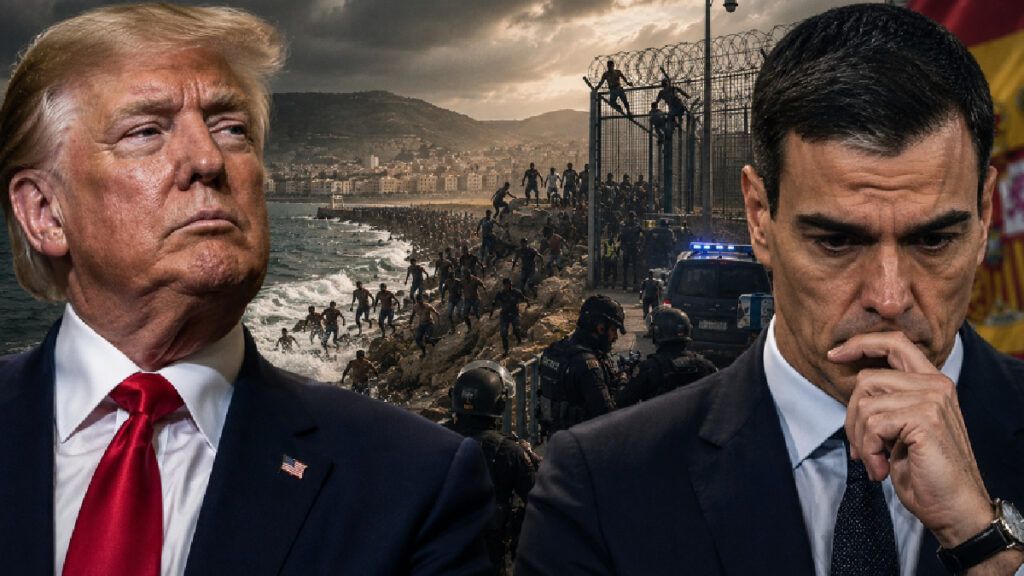
Images are looping nonstop: groups of men, the vast majority of them young, emerge from the sea, climb the rocks, skirt the Tarajal barriers and pour into the streets of Ceuta, the Spanish enclave in North Africa. According to Ceuta’s president, Juan Jesús Vivas, around 60,000 people tried to cross from Morocco within 24 hours. Spain’s Interior Ministry puts the figure at some 50,000 arrivals since Thursday, of whom 37,500 have already left. At least 41 migrants have died. Security forces are struggling to regain control.
Ceuta requested a national state of emergency. Madrid refused. Donald Trump called the scene a “catastrophe” and an “invasion.”
Amnesty, Pull Factor and the American Reaction
Republican Rep. Brandon Gill of Texas immediately targeted Pedro Sánchez: “The socialist prime minister of Spain announced he was going to grant amnesty to millions of illegal immigrants. Now his country is being invaded by hordes of military-aged men from Africa. Because that’s what happens every single time a politician offers amnesty.”
Earlier this year the socialist government launched an “extraordinary regularization” program allowing migrants already on Spanish soil to obtain residency and work permits. For Madrid, this is about economic integration. For its critics, it is a clear pull factor. The political analysis that follows is straightforward: a national regularization measure, even when framed as technical, is read beyond the borders as a lasting softening of the rules. That is precisely the mechanism Gill and Trump are attacking.
On Friday, during a Cabinet meeting at Camp David, Donald Trump elevated the attack to the presidential level: “You know, I saw Spain yesterday, and I watched the catastrophe that took place. It looks like an invasion of a country by hundreds of thousands of people. And that same thing is going to happen to us if the Republicans don’t get elected. Except worse, much bigger, much easier to get into. […] If we’re not in office, our country will be invaded at levels that made Spain look small time.”
He pressed further: “When you look at what happened to Spain, they don’t know what to do. […] They’re coming in by the tens of thousands. It’s just invading the country. And what that is is weak law, bad management, but very liberal law. They passed a couple of laws and people read, you know, people are smart. They read from other countries, and they swam that three-mile swim or however they got in.”
Earlier that morning, speaking to Fox News, Trump summed it up: “It’s terrible. Remember that picture. That’s going to be us in three years if the wrong side gets in. If the Democrats get in, you will not live a very good life.”
He also broadened the parallel to the United States: “The biggest thing, the worst thing that Biden did is allowing 25 million people into our country, because many of those people are criminals. They’re murderers. A lot of them are gone now. We got them out. But they allowed people to come into this country that you can’t allow to come into a country.”
On the numbers, the available data allow for precision. Trump cites 25 million for the Biden period; CBP statistics point instead to several million “encounters” at the border between 2021 and 2024 — an indicator of apprehensions and attempts, distinct from the net number of permanent entries. On removals under Trump’s second term, ICE reports more than 350,000 removals in fiscal year 2026 (as of mid-July) and roughly 320,000 in 2025. DHS stated in spring 2026 that nearly 900,000 deportations had been carried out since January 2025, to which the administration adds more than 2 million voluntary departures. These orders of magnitude, still within an ongoing fiscal year, feed the campaign narrative: a border “under control” versus the Spanish collapse.
Trump explicitly turned Ceuta into a midterm campaign argument: “I said, ‘I’m going to say it because I knew you were going to be at Camp David.’ And I say, ‘That’s going to be a talking point for the midterms, because when you look at what happened to Spain, they don’t know what to do.’” The message is clear: the Spanish crisis is no longer merely a European event; it has become an electoral warning aimed at American public opinion. On this reading, any policy perceived as amnesty or a softening of the rules acts as a transnational magnet. Ceuta serves as proof by image: if Spain tips in a matter of hours, the United States, without a Republican majority, could face a scenario “much worse.”
The midterm impact is twofold. First, it hardens the border as a security and sovereignty issue at a moment when Republicans are trying to hold or expand their majorities. Second, it forces the Democratic side to distance itself from images of a submerged Europe while recalling the Biden years marked by record encounters. Trump is not merely commenting on a foreign crisis: he is building a three-part narrative — Spain illustrates the failure of “very liberal” policies; the images from Ceuta foreshadow an American risk; his record on removals and falling crossings is presented as the safeguard.
The White House had anticipated this the day before. Deputy press secretary Anna Kelly told Fox News: “President Trump has long warned Europe about what would happen if they continued to pursue far-left, globalist policies, including by encouraging mass migration. Spain and other countries that have adopted this destructive philosophy should reverse course immediately or risk their own demise.”
À lire aussi : ANALYSE – Ceuta : La frontière européenne mise à l’épreuve par une pression migratoire de masse
Emergency Denied, Supreme Court and Operational Breakdown
Ceuta’s president, Juan Jesús Vivas, formally asked Pedro Sánchez to declare a national state of emergency in order to obtain exceptional resources. The Interior Ministry refused, as cited by El País: the declaration of a national emergency falls under the state’s civil-protection regulations, which do not treat migratory flows as a risk to the national civil-protection system and establish neither special plans, nor guidelines, nor specific instruments for managing them. It is therefore “not possible to activate this mechanism.”
Authorities in Ceuta and Madrid partly link the surge to a recent Spanish Supreme Court ruling that migrants arriving by sea could not be summarily returned, unlike those who cross by land or climb the border fence. Pedro Sánchez accused smuggling networks of having “misinterpreted” the ruling: the interpretation “spread like wildfire over the past few hours through the networks of human-trafficking organizations,” he said.
The paradox is double. On one side, a judicial ruling limits immediate returns by sea; on the other, the civil-protection framework explicitly excludes migratory flows from national emergency mechanisms. Result: Ceuta requests exceptional means, Madrid replies that the law does not allow it, then deploys the army anyway to support the Guardia Civil. The legal refusal of emergency thus coexists with an operational escalation, a sign of a system caught off guard. It is precisely this kind of tipping point — a law perceived as more permissive, networks that adapt, authorities overwhelmed — that Trump holds up as an illustration of what would await the United States if Democrats returned to power.
The sequence also reveals a doctrinal gap. By refusing to classify the migratory flow juridically as a civil-protection risk, the state deprives itself of emergency tools while being forced, in practice, to militarize the response. The army therefore arrives not as the application of a planned framework, but as a stopgap for a normative vacuum. For Sánchez’s critics, this gap between the law and the ground confirms the structural unpreparedness denounced at every Ceuta crisis.
On X, the prime minister pledged to “guarantee the safety of Ceuta’s residents,” intensify the presence of security forces in the streets, deploy a “physical containment barrier in the sea” to facilitate repatriations “in compliance with the Supreme Court ruling,” accelerate the removal files of migrants who arrived irregularly, and maintain cooperation with Moroccan authorities against human-trafficking mafias. The armed forces have been deployed. Morocco is using water cannons and warning shots to slow departures, according to rights groups.
This is not the first crisis of its kind. In 2021, more than 8,000 people entered Ceuta in two days, triggering a sharp diplomatic crisis with Rabat. This time, the volume and speed of the flow again overwhelmed local capacity. Facilities for unaccompanied minors are saturated. Before this peak, the Interior Ministry already reported nearly 3,000 entries into Ceuta by land or sea from the start of the year through mid-July. The repetition of the scenario — sudden surge, saturation, appeal to Rabat, deployment of exceptional means — suggests less an isolated accident than a permanent vulnerability of the enclave, reactivated whenever a legal or political signal is perceived as favorable to departures.
Demography Versus Sovereignty
Pedro Sánchez has long justified his line by Western demographic decline. In a February op-ed in The New York Times, he wrote: “The West needs people. Currently, few of its countries are experiencing population growth. Unless they embrace migration, they will experience a sharp demographic decline that will prevent them from keeping their economies and public services afloat. Their GDP will stagnate. Their public health and pension systems will suffer. Neither AI nor robots will be able to prevent this outcome. […] The only option to avoid decline is to integrate migrants in the most orderly and effective way possible.”
His opponents reply that the “orderly” has disappeared. Javier Negre, a conservative journalist and owner of La Derecha Diario, told Fox News Digital: “When they cross the border as minors, you cannot send them back to Morocco. The Spanish state has to take care of them and pay NGOs to look after them until they turn 18. This is proof that Europe and Spain are on the verge of becoming a failed continent because of these policies and the promotion of this illegal invasion under Pedro Sánchez.”
On the ground, several young Moroccans interviewed by the Associated Press already say they want to return given the chaos. “There’s nothing at home. I’d have to work 12-hour shifts for a meager wage. That’s why I came here,” said 21-year-old Abdulah Buji, from Tetouan. “But I haven’t found any opportunities here either, so I have to go back.”
The crisis is spilling beyond Spanish borders. Italian Prime Minister Giorgia Meloni has threatened to suspend Italy’s participation in the Schengen area with Spain in order to “defend our borders and ensure the safety of our citizens.”
A Prime Minister Under Pressure on Every Front
Pedro Sánchez is not facing this crisis from a position of strength. His government is weakened by family scandals — his wife Begoña Gómez under investigation for corruption, his brother also cited in an influence scandal — by tensions with the Trump administration over NATO, Iran and the use of U.S. bases in Spain, and by low popularity: 61 percent unfavorable opinions according to a March YouGov poll, his lowest level since taking office in 2018.
Some of his critics argue that his anti-Trump posture and positions on the Middle East amount to electoral marketing designed to divert attention from domestic troubles. Javier Negre sums it up: “President Pedro Sánchez’s position against President Donald Trump is neither improvised nor based on convictions. It is pure electoral marketing.”
*
* *
Ceuta is no longer merely a submerged enclave. It has become a transatlantic campaign argument. Trump sees in it proof of what awaits the United States if the left returns to power, and he explicitly makes it a “talking point” for the midterms. Sánchez sees a crisis manageable through cooperation with Rabat, a sea barrier and accelerated repatriations. The images, the deaths, the initial refusal of a state of emergency and the Supreme Court ruling point to the same conclusion: a model of border management that, once an opening signal is perceived — whether from a regularization or a court decision — can tip in a matter of hours.
The question is no longer only how many entered and how many left. It is whether governments that chose controlled openness are still capable of regaining control when it collapses.
À lire aussi : DÉCRYPTAGE – Crise migratoire à Ceuta, la frontière qui fissure l’Europe
#Ceuta, #Spain, #Trump, #DonaldTrump, #PedroSanchez, #Migration, #IllegalImmigration, #BorderCrisis, #BorderSecurity, #MassMigration, #MigrantCrisis, #Europe, #Morocco, #Schengen, #SpanishPolitics, #ImmigrationPolicy, #NationalSecurity, #Sovereignty, #BorderControl, #Geopolitics, #EuropeanUnion, #Mediterranean, #NorthAfrica, #BreakingNews, #PoliticalAnalysis, #ConservativeNews, #GlobalPolitics, #HumanTrafficking, #MigrationCrisis, #USPolitics, #Midterms2026, #Republicans, #Democrats, #FoxNews, #SupremeCourt, #Emergency, #CeutaCrisis, #SecurityForces, #InternationalRelations, #Analysis