ANALYSIS – Keir Starmer on the Brink: Labour in Full Rebellion, the Epstein Scandal and Electoral Defeats Threaten to Bring Everything Down
By Angélique Bouchard
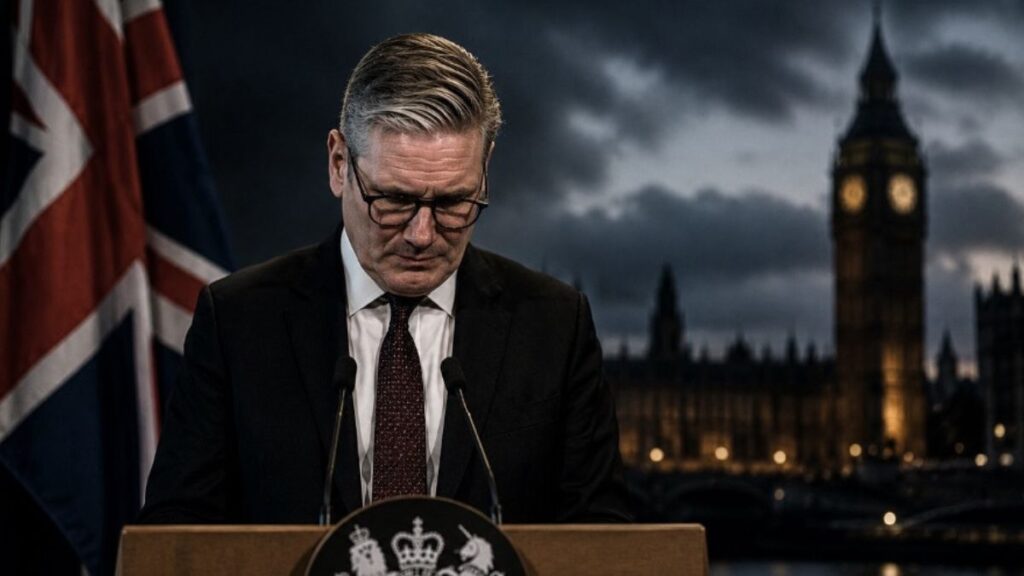
The British Prime Minister Keir Starmer is reportedly considering stepping down from power. According to information published by The Observer, he is currently reflecting on his future with his wife at Chequers and could announce a timetable for his departure as early as next week. Senior Labour Party figures expect an official statement regarding his future in the coming days.
This prospect comes at a time when pressure on Starmer has continued to intensify for several months, fuelled by a series of scandals, electoral setbacks, and an increasingly structured internal rebellion within the Labour Party.
The Mandelson Affair: A Scandal That Has Lastingly Undermined Starmer’s Authority
The scandal surrounding the appointment of Peter Mandelson as British Ambassador to the United States constituted a major turning point in the crisis currently facing Keir Starmer. Documents revealed that Mandelson had maintained contact with Jeffrey Epstein after the latter’s conviction in 2008. Faced with the backlash, Mandelson was removed from his post and resigned from the Labour Party.
Starmer acknowledged an error of judgment, stating that he regretted his decision and offering his apologies to Epstein’s victims. However, the impact of this scandal goes far beyond the simple issue of an unfortunate appointment. It highlighted weaknesses in the selection process for senior officials and deeply undermined the Prime Minister’s credibility. Two of his closest collaborators, his Chief of Staff Morgan McSweeney and his Director of Communications Tim Allan, resigned in the aftermath, reinforcing the sense of a structural weakening of authority at Downing Street.
This scandal had a particularly damaging effect because it came on top of other difficulties that already existed. It provided both internal and external opponents of Starmer with a concrete and symbolically powerful argument to call into question his capacity for judgment and his moral authority. In an already tense context, this scandal acted as a catalyst, transforming diffuse discontent into open and structured opposition.
Electoral Defeats That Have Weakened the Foundations of Power
Starmer’s difficulties were amplified by the results of the May 2026 local elections. Labour recorded massive losses, shedding several hundred seats in England and also losing ground in Wales and Scotland. At the same time, Reform UK achieved a historic breakthrough by winning more than 600 seats.
Farage did not hide his satisfaction after these results, describing the situation as a “historic shift in British politics.” He particularly welcomed Labour’s collapse in the former “Red Wall,” those constituencies in northern and central England that had historically been Labour strongholds. These defeats have reinforced within the Labour Party the feeling that Starmer is no longer able to unite his camp or deliver a credible message to the party’s traditional electorate.
These defeats are not merely numerical. They reveal a deeper erosion of Labour’s electoral base, particularly in territories where the party had regained ground in 2024. Reform UK’s progress in these areas shows that the discontent of part of Labour’s traditional electorate has translated into a clear and structured protest vote.
Farage and Reform UK’s Strategy: Exploiting Labour’s Weakness
Far from adopting a passive oppositional role, Nigel Farage and Reform UK have pursued an offensive and opportunistic strategy in response to Labour’s crisis. Farage notably stated that he would be “very sad” to see Starmer leave, while describing him as the “greatest asset” his own camp possessed. This ambiguous position reveals a clear strategy: Reform UK is capitalising on the weakness and internal divisions of the governing party without seeking to appear as the main architect of its downfall.
By capitalising on Labour’s electoral defeats and the internal divisions within the party in power, Reform UK is managing to establish itself as a credible and rising political force, particularly in traditionally Labour-held constituencies. This strategy allows Farage to continue expanding his base while avoiding accusations of destabilising the country. The more Starmer appears weakened and contested, the more Reform UK gains in legitimacy and visibility.
À lire aussi : DÉCRYPTAGE – America Party : Elon Musk défie Trump et déclenche l’Armageddon populiste
An Internal Rebellion That Reveals a Structural Loss of Authority
The rebellion within the Labour Party has become organised and structured. More than 100 Labour MPs have publicly called on Starmer to resign or to set a timetable for his departure. Figures such as Catherine West have threatened to trigger a leadership challenge themselves if no Cabinet member comes forward by Monday. Anas Sarwar, the leader of Scottish Labour, has also intervened to call for a change in leadership.
Starmer has so far resisted calls to resign. He has repeatedly stated that he does not intend to “plunge the country into chaos” and that he accepts responsibility for remaining in office. He has also insisted that he is “not ready to walk away.” However, these statements stand in contrast to the scale of internal opposition, revealing a progressive loss of authority within his own party.
This situation highlights a broader dynamic: the combination of a personal scandal, electoral setbacks, and a parliamentary rebellion creates a cumulative effect that significantly weakens the Prime Minister’s position. Each element reinforces the others, transforming what could have remained manageable difficulties into a systemic crisis.
A Crisis That Raises Questions About the Future of the Labour Party
Beyond Keir Starmer personally, this crisis raises deeper structural questions about the Labour Party’s ability to remain united and retain power in the long term. Reform UK’s advances, which are capturing part of Labour’s traditional electorate in the former strongholds of northern England, show that the governing party is being challenged on its own political territory.
Furthermore, the emergence of figures such as Andy Burnham, who won a by-election last Friday, illustrates the internal tensions and personal ambitions currently at play within the party. The combination of these factors points to a prolonged period of instability, regardless of the immediate outcome of the current crisis. The Labour Party risks emerging weakened from this period, whether through Starmer remaining in office under degraded conditions or through a leadership change carried out in haste.
This crisis also reveals a form of exhaustion of the political model embodied by Starmer since 2024. The difficulty in maintaining internal cohesion, combined with the inability to stem Reform UK’s progress, raises the question of the medium-term viability of the Labour political project as it has been conceived in recent years.
*
* *
Keir Starmer is currently facing one of the most serious crises of his premiership. Between rumours of his departure, the Mandelson-Epstein scandal, heavy electoral defeats, and the growing internal rebellion within the Labour Party, his authority has been deeply undermined.
Should the Prime Minister effectively announce a timetable for his resignation in the coming days, this would mark not only the end of a political experience begun less than two years ago, but also the opening of a period of instability within the Labour Party. In a context where Reform UK continues to advance and where the traditional two-party system appears increasingly fragile, Starmer’s departure could accelerate a major political realignment in the United Kingdom. The countdown now appears to have begun, and the outcome of this crisis could durably reshape the British political landscape.
À lire aussi : ANALYSE – Elon Musk lance l’“America Party” après la signature du méga budget par Trump : « Un système corrompu, unipartite »
#KeirStarmer, #StarmerResigns, #KeirStarmerResignation, #LabourParty, #LabourCrisis, #LabourRebellion, #LabourLeadership, #UKPolitics, #BritishPolitics, #PoliticalCrisis, #DowningStreet, #Westminster, #UKGovernment, #BritishGovernment, #PrimeMinister, #AndyBurnham, #NigelFarage, #ReformUK, #ReformUKRise, #LabourCollapse, #ElectionResults, #LocalElections2026, #UKLocalElections, #ElectoralDefeat, #PoliticalAnalysis, #Geopolitics, #UnitedKingdom, #BritishElection, #LeadershipCrisis, #StarmerGovernment, #PeterMandelson, #MandelsonScandal, #EpsteinScandal, #LabourMPs, #RedWall, #BritishDemocracy, #PoliticalRealignment, #TwoPartySystem, #BreakingPolitics, #UKNews