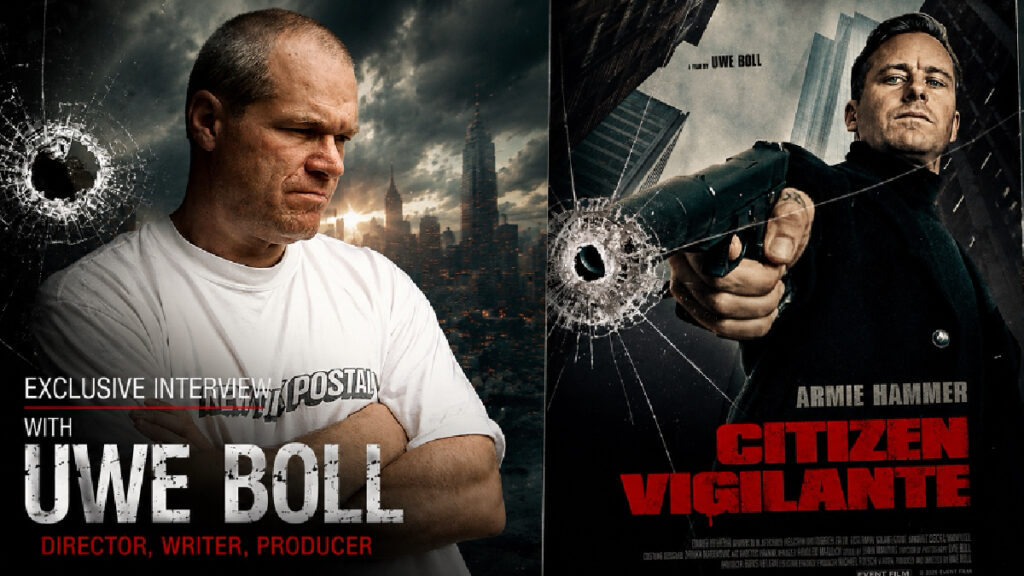
EXCLUSIVE – The Big Interview with Uwe Boll, Director of Citizen Vigilante: « You Can Only Push a People So Far. »
Few working directors have a relationship with the film establishment as adversarial as Uwe Boll‘s. Over three decades, the German filmmaker built a body of work outside the studio system, financed on his own terms, and met critical hostility with an unusual willingness to answer back in public. Whatever one makes of the results, the independence is not a pose: he has consistently made the films he wanted to make, and paid the price for it.
Citizen Vigilante was shot in Croatia in early 2025 and released in the United States on 19 June 2026 through Quiver Distribution. Written, produced and directed by Boll on a reported budget of around four million dollars, the 89-minute thriller stars Armie Hammer — in one of his first leading roles since 2021 — alongside Costas Mandylor, with an original score by Rodolfo Matulich. It follows Sanders, an American living in a European city, who concludes that the institutions meant to protect citizens will not, and decides to take justice into his own hands.
The release itself became the story. The film was banned in Germany over concerns that it could incite violence against immigrants, after which Elon Musk made it available to stream free on X for forty-eight hours. Within days it topped Amazon’s rental charts and reached second place on Apple TV’s most-watched list, outperforming productions with budgets many times its size. Critics were merciless; audiences turned it into one of the digital hits of the summer; a sequel is already being teased.
After analyzing Citizen Vigilante in a previous article, Le Diplomate Media sat down for an exclusive interview with its director, Uwe Boll. He discusses what led him to make this film now, his approach to portraying violence, the extraordinary release shaped by a ban and the intervention of a billionaire, and the message he hopes to convey to European audiences — and to the French people in particular.
By Angélique Bouchard
Interview conducted in writing, July 2026. Answers are reproduced in full; grammar and syntax have been lightly corrected at the interviewee’s request, with no change to meaning. The views expressed are those of the interviewee alone and do not reflect the position of Le Diplomate Media.
Le Diplomate Media: Citizen Vigilante arrives at a moment when trust in institutions is measured at historic lows on both sides of the Atlantic. Was there a specific trigger — a news story, a personal experience, a conversation — that made you want to make this film now rather than five years ago?
Uwe Boll: I see Citizen Vigilante in connection with my films Hanau and Run, with Amanda Plummer. Citizen Vigilante is the amalgamation of the facts. By facts, I mean the clearly visible downfall and decline of Europe, based on mass migration from third-world countries. A mass rape case in Hamburg, where the rapist went free and where the press was actually justifying the minimal punishment the rapists received, finally triggered in me the wish to make a blunt film — full of rage against the injustice and the ignorance of the governments in Europe.
The vigilante film has a long lineage, from Death Wish to Taxi Driver and beyond. What did you feel was missing from those films, or what did you want to say that they had not said?
They had their relevance at the time they were made. Death Wish was a reaction to all the crime in the New York subway, and Taxi Driver was about the Vietnam veterans who couldn’t fit in anymore. My vigilante is an ice-cold analyst who comes to the conclusion that we will have an Islamist Europe in forty years if we don’t stop it now.
The film asks an audience to understand a man who acts outside the law. Where do you personally place the line between showing why someone reaches that point and endorsing what he does? Is that a line you thought about while shooting?
No. As an artist, you cannot fear the consequences. I have made a lot of films against the norm, such as Assault on Wall Street, Rampage, Run Amok and Postal. In fiction films you can create a world you don’t want to have, and you can warn society to stop with the wrong politics — otherwise it will face a dystopian, violent future.
How did you direct the violence? Did you want the audience to feel it as realistic and costly, or as something more stylised and cathartic — and what does that choice do to the film’s argument?
I always film violence dry, hard and realistic. Watch my films Darfur, 1968 – Tunnel Rats or Rampage, for example.
What were the hardest decisions in the edit? Were there scenes that worked on the page but that you had to cut or soften because of what they made the film say?
No. Everything worked as shot. The only scene we made much shorter in the edit was the one where Sanders shoots the SWAT team to pieces. We had more gore material, but we felt we didn’t need it.
You have worked outside the studio system for most of your career. What did that independence allow you to do on this film that a financed studio production would not have allowed?
I worked with studios on my video game based movies, like In the Name of the King – Dungeon Siege, Far Cry, Alone in the Dark, House of the Dead and BloodRayne. But all my hard action and realistic films were independent, because I was able to raise the money myself and so didn’t have to listen to anybody. Most of my films, like Citizen Vigilante, would never have got financing from a streamer or a studio.
À lire aussi : ANALYSE – Citizen Vigilante : Quand le cinéma d’exploitation dit la vérité que les élites refusent d’entendre
How did you work with Rodolfo Matulich on the score? What did you ask the music to do that the images could not do on their own?
I gave him free range to compose the music and to record it with a symphony orchestra. His title music is very sad and dramatic, and it nails my feelings about the future of Europe. I’m very sad to see us falling apart. He sent me proposals and I approved them, and in the end, in the editing, I made the decision about which tracks I used and which I did not.
What was the budget reality of this production, and how did it shape the film you were able to make?
I knew, paying for the film myself, that I could only spend a few million dollars. But I also knew that in Croatia I would get three times the production value for that money that I would get in the UK, Germany or the USA.
The film was banned in Germany over concerns that it could incite violence against immigrants. What is your answer to that decision — and to the underlying charge that the film targets a community rather than criminals?
The German rating system is absurd. They want to protect teenagers from watching certain films — but if you give a film an 18 rating, you are protecting those teenagers, so it is total bullshit to disallow a film in total. That only happens in Germany, where a film can be given no rating at all: then no store will carry the Blu-ray, and you cannot put the film on a streamer or on television. All other countries simply have an 18+ or R rating. The film is against violent criminals, not against a whole group of people. Tons of migrants love my film — they do not identify with the new wave of migrants who came in since 2016.
Elon Musk then made the film available to stream free on X, and within days it topped digital rental charts. What did that intervention do for the film — and does it complicate the independence you have always claimed, when the world’s richest man effectively becomes your distributor?
He loved the trailer and the film, and he gave it a great boost for two days. The film already had traction before he posted it — otherwise he would not have noticed it. Until now, no streamer wants to buy it, despite its success on pay TV and pay streaming. So I am very thankful to X for helping to bring the film to a bigger audience.
Many people in Europe say the traditional parties have lost touch with everyday concerns — security, immigration, the cost of living. Do you share that reading, and do you think your film speaks to it?
One hundred per cent. Governments are the victims of a long-lasting campaign of « we want to be the good people », but they are no longer aware of what good and bad are. Good is when you do something that is good for you and for others. Bad is when you do something that is bad for you but is presented as good for others. That is what they do. Mass migration from Senegal, Somalia, Afghanistan or Syria is very bad for our internal security and for our economy.
France goes to a presidential election, Germany is in a period of political and economic uncertainty, Italy has been through successive populist governments, and Britain is still working through the aftermath of Brexit. Do you see one European story in that, or several very different national ones?
In Italy we can see, in a positive way, that a right-wing government works without turning Italy into Mussolini part two. In Germany, the wall that mainstream politicians keep up against the AfD, which is the biggest party in the country, is absurd. The majority of the population wants a full stop to migration from these countries.
Your protagonist loses faith in institutions and acts alone. Do you think that kind of individual response becomes more likely in Europe if conditions continue to deteriorate — and would you regard that as a warning or as an outcome you understand?
I want this as a warning. I want the state to protect the citizens, the law and the culture of our countries. I don’t think vigilante justice leads to anything good. But if a government fails to protect its own citizens, then at some point people boil over.
What do you think cinema can still actually do at a moment of this much division? Can a film change how someone thinks about justice, or does it mostly confirm what they already believe?
My film, against all odds and with no advertising budget, was maybe the most talked-about film of all time. Of course The Odyssey and other mega films get massive press, but they also spend a hundred and fifty million dollars on advertising. In my case it was the content of the film that hit everybody like a sledgehammer. People love the film because it shows their fears and their worries, and because it has to do with their daily lives. The critics hate the film because they work for the studios and the streamers, who try everything to sugarcoat and deny reality.
If you had to put the central argument of Citizen Vigilante in a single sentence, what would it be?
You can push the population only so far.
Is there anything you would want to say specifically to European audiences, and to French voters ahead of the presidential election, about what this film is and is not arguing?
The film is an action film with a strong political background. Our main rapist in the finale of the film is, by the way, an actor from Paris.
À lire aussi : ANALYSIS – Alert: Socialists Have Seized Control of the U.S. Democratic Party
#UweBoll, #CitizenVigilante, #InterviewExclusive, #Cinema, #Film, #Thriller, #ActionMovie, #FilmPolitique, #Justice, #Vigilante, #ElonMusk, #XPlatform, #QuiverDistribution, #ArmieHammer, #CostasMandylor, #CinemaIndependant, #Realisateur, #SortieCinema, #CritiqueCinema, #Culture, #Societe, #Immigration, #Europe, #PolitiqueEuropeenne, #LiberteExpression, #DebatPublic, #FilmControverse, #ActualiteCinema, #Streaming, #AmazonPrimeVideo, #AppleTV, #Interview, #LeDiplomateMedia, #Cinema2026, #ThrillerPolitique, #FilmIndependant, #AnalyseCinema, #Actualite, #Hollywood, #BoxOffice