HISTORY – French Naval Strategic Thinking in the Twenty-first Century – Reflections on four centuries of maritime history around Admiral Nicolas Vaujour’s book, Les guerres des mers (2026)
By François Souty
François Souty, PhD (Hist. Econ.), is a former Antitrust Case Officer on Financial Markets (2018-2021) and then an International Affairs Officer (2021-2024) at the European Commission’s Directorate-General for Competition. Author of a dozen books and numerous academic articles, he teaches European institutions, European and global geopolitics at the Excelia Business School group (La Rochelle-Paris Cachan) as well as European competition law and policy at the Faculty of Law of the University of Nantes. He is in charge of the economics section at Diplomate Média.
« The defence! This is the first reason for the state’s existence. He cannot fail to do so without destroying himself. »
Charles de Gaulle, Bayeux Speech, 14 June 1952.
« Strategy is the art of making force contribute to the attainment of the goals of politics. »
Admiral Raoul Castex, Théorie stratégiques, t. I., 1929[1]
Executive Summary
The return of power rivalries at the beginning of the twenty-first century has profoundly renewed the place of maritime spaces in international relations. China’s rise in naval power, Russia’s return to the oceans, conflicts in the Black and Red Seas, tensions in the Strait of Hormuz and the Indo-Pacific, as well as the protection of submarine cables, energy infrastructure and major traffic routes are a reminder that the sea is now one of the main theatres of global strategic competition.
In this context, France occupies a unique position. As the world’s second-largest maritime power in terms of the extent of its maritime space, with a strategic oceanic force, a naval air group, a leading naval industry and a permanent presence on all the oceans, it has assets that give its strategic thinking a scope that goes far beyond the military field alone.
Taking as its starting point the recent work of Admiral Nicolas Vaujour, The Wars of the Seas. The French Navy at the heart of the new challenges of the world[2], this article does not offer a simple reading note. It endeavours to demonstrate that there is now a truly contemporary French school of naval strategy, built gradually since the beginning of the twenty-first century by a generation of general officers who have held the highest operational and joint responsibilities. Heir to the strategic tradition of Admiral Raoul Castex, this doctrinal reflection renews the French approach to maritime spaces by integrating the transformations of contemporary conflict, the rise of autonomous systems, the protection of critical infrastructures, the control of the deep sea and the requirements of multi-domain competition.
The article puts this evolution in a comparative perspective by comparing French doctrine with the main Western strategic schools, first and foremost the United States, while examining the specificities of the main European maritime powers. It shows that France’s uniqueness is based on the original articulation between national sovereignty, strategic autonomy, nuclear deterrence, global presence and industrial excellence.
Beyond the mere doctrinal reflection, this study stresses that maritime power cannot be reduced to the operational capacities of the French Navy. It is the result of the lasting convergence of political will, strategy, an efficient industrial and technological base, coherent budgetary resources and a national culture of the sea. In this perspective, maintaining a financial effort adapted to France’s ambitions appears to be an essential condition for the credibility of its naval strategy.
Finally, the article opens a prospective reflection on the adaptations made necessary by recent conflicts and by the emergence of new forms of naval warfare. It highlights the importance of developing industrial and operational cooperation with several European maritime powers that share the same strategic culture, in order to sustainably strengthen France’s capacity for action without calling into question the principles of sovereignty and autonomy on which its defence policy is based.
Introduction
Since the beginning of the twenty-first century, maritime spaces have undergone a profound transformation that is renewing the foundations of international power. Long considered a privileged space for the circulation of goods and the projection of forces, the sea has once again become a major theatre of strategic competition between states. China’s rise in naval power, Russia’s return to the oceans, tensions in the Indo-Pacific, the Mediterranean, the Red Sea and the Arctic, the vulnerability of submarine cables and energy infrastructure, as well as the renewed strategic importance of the straits illustrate this evolution. Globalization has not diminished power rivalries; On the contrary, it has strengthened the strategic value of maritime spaces by concentrating an essential part of economic exchanges, energy flows, digital communications and military capabilities on them.
This evolution also reflects a profound change in conflictuality. Naval confrontations were no longer limited to battles between high seas fleets; They now extend to hybrid operations, the protection of critical infrastructures, the control of the deep sea, the cyber and space dimensions, the fight against drug traffickers as well as the increasing integration of autonomous systems. Naval strategy thus appears to be one of the most complete expressions of the multi-domain competition that characterizes contemporary international relations.
In this context, France occupies a unique position. The world’s second largest maritime space thanks to its overseas territories, a permanent member of the United Nations Security Council, an independent nuclear power with a strategic oceanic force, a naval air group, a complete naval industry and a permanent presence in all the oceans, it has and exercises responsibilities that go far beyond the defence of its metropolitan territory. Naval strategic thinking therefore contributes to the definition of the conditions for the exercise of national sovereignty, the protection of economic interests and the preservation of France’s freedom of action.
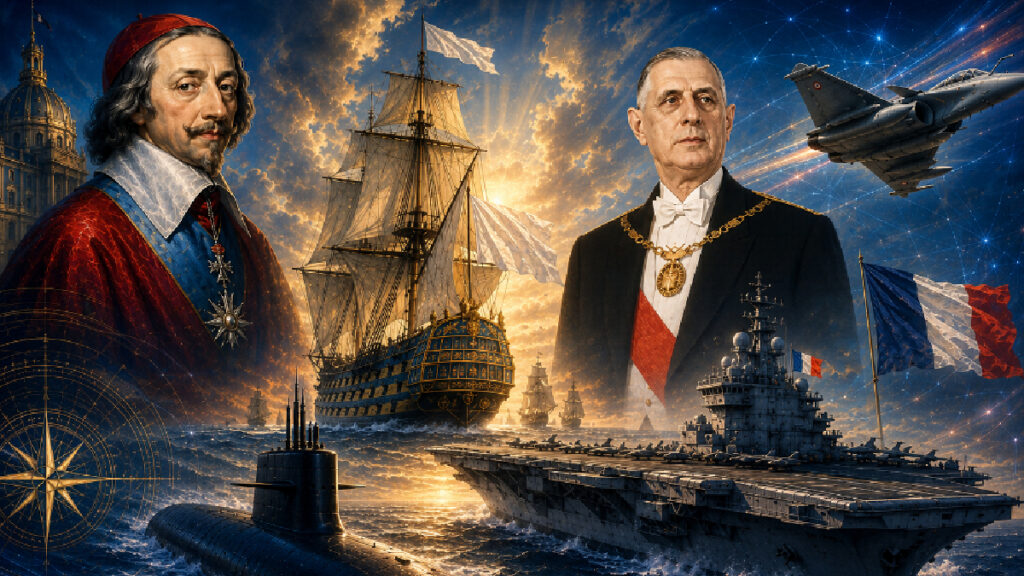
The publication of Admiral Nicolas Vaujour’s book Les guerres des mers. The French Navy, at the heart of the world’s new challenges,[3] is also taking place in a particularly symbolic context. The year 2026 marks the four-hundredth anniversary of the creation, by Cardinal de Richelieu, of a permanent navy in the service of the State.[4] Beyond its commemorative significance, this anniversary is a reminder that French naval strategy is part of a centuries-old tradition in which the permanence of national interests is combined with the continuous renewal of doctrines, technologies and forms of conflict.
This permanence of strategic thinking is not new. It has been irrigating French maritime history for several centuries and found, at the end of the eighteenth century, one of its most remarkable expressions with the Count of Kersaint. A sailor, reformer and theoretician, he had already sensed that naval superiority could not be based solely on the operational qualities of the crews, but presupposed a close link between technological innovation, the organisation of arsenals, maritime policy and a long-term strategic vision.[5] While contemporary challenges are profoundly different from those of his time, several of his intuitions retain a particular resonance at a time when naval power is more than ever based on the coherence between doctrine, industry, innovation and political will.
Nicolas Vaujour’s book is fully in line with this perspective. More than an excellent analysis of contemporary developments in naval warfare, it testifies to the maturation of a doctrinal reflection developed over more than two decades by a generation of general officers confronted with the transformations of the strategic environment. This article extends several works devoted to the geopolitics of maritime spaces, naval history and the transformations of the European naval industrial and technological base, which already highlighted the related doctrinal contributions of general officers such as Admirals Bernard Rogel, Christophe Prazuck or Pierre Vandier.[6]
However, the purpose of this article is not to offer a simple review of Nicolas Vaujour’s work. We intend to use this as a starting point for a more general reflection on the emergence of a contemporary French school of naval strategy as it has been found in our history. By this expression, we must not mean an institutionally constituted doctrine, but a coherent set of reflections developed since the beginning of the twenty-first century by the above-mentioned general officers whose work, nourished by operational experience, deterrence, joint responsibilities and international cooperation, is gradually contributing to renewing French maritime thinking, by placing it at the highest international level.
Beyond military issues, this reflection is in line with contemporary transformations in public action. Maritime power never proceeds from the accumulation of naval means alone; It is the result of the lasting convergence of political will, a strategic doctrine, an efficient industrial and technological base, active diplomacy and a national culture of the sea. Maritime affairs therefore do not only concern sailors; they are of interest to the entire nation.
This analysis will thus lead us to question the conditions that have favored the rebirth of French naval strategic thinking since the beginning of the twenty-first century and its place among the main Western schools. It will then make it possible to appreciate how the work of Admiral Nicolas Vaujour constitutes one of the most accomplished expressions of this doctrinal evolution, while opening up perspectives on the conditions for the exercise of French maritime power and on the cooperation likely to strengthen its capacity for action in the long term.
I. The return of the sea as a strategic space and the revival of French naval thinking
The history of naval strategies shows that military doctrines are never born in the abstract. They respond to changes in the geopolitical environment, technological developments and new forms of conflict. French naval strategic thinking is no exception to this rule. While it is part of an ancient tradition, illustrated in particular by the Count of Kersaint, Admiral Castex or, more broadly, by the great figures of the French Navy, its renewal since the beginning of the twenty-first century is above all the result of a profound change in international power relations.
The return of great power rivalries, China’s maritime assertiveness, the resurgence of Russian naval power, the renewed strategic importance of straits, submarine cables and the deep sea, as well as the lessons of recent conflicts have gradually put the sea back at the centre of strategic concerns. In this new environment, France has exceptional assets, but it must also adapt its employment concepts, its military capabilities and its doctrinal thinking in order to preserve its freedom of action and the protection of its interests.
This evolution is not the result of the sole initiative of an author or a military leader. It is the result of collective intellectual work carried out for more than twenty years by several generations of general officers who, through their operational responsibilities, their commands and their publications, have gradually renewed French naval strategic thinking. The work of Admiral Nicolas Vaujour is today one of the most accomplished expressions of this dynamic, without constituting its starting point but being part of a strong continuity.
In order to understand the scope of this doctrinal evolution, it is necessary to examine successively the transformations of the global maritime strategic environment, the way in which the French tradition of naval thought has been renewed since the beginning of the twenty-first century, and then the characteristics that distinguish this reflection today from the main Western strategic schools.
A. The return of the sea to the heart of global strategic competition
For a short period of time, roughly corresponding to the decade following the demise of the Soviet Union, the sea seemed to lose some of its centrality in international strategic thinking. The end of the bipolar confrontation, the unchallenged naval dominance of the United States, and the priority given to ground stabilization operations after the attacks of September 11, 2001, gradually shifted the attention of the great powers to continental theaters. The major Western navies were still capable of conducting high-intensity operations, but their employment focused more on force projection, maritime surveillance, anti-piracy or expeditionary operations than on the prospect of a major naval confrontation between comparable powers.[7]
This period is now over. Since the beginning of the twenty-first century, the sea has gradually become one of the main areas of global strategic competition. China’s economic and military development, the accelerated modernization of Russian naval capabilities, tensions around the main straits, the contestation of certain maritime areas and the growing vulnerability of underwater infrastructure have profoundly changed the international strategic environment.[8] The oceans are no longer just essential routes for global trade; they have once again become spaces of sovereignty, confrontation and demonstration of power.
The rise of China’s naval power is the most structuring evolution of this transformation. Within a few decades, the People’s Liberation Army Navy had evolved from a force primarily intended for coastal defense to one capable of conducting operations beyond its immediate approaches. This development responds to a global logic: to protect the trade routes on which the Chinese economy depends, to secure its energy supplies and to have a military instrument corresponding to its ambition as a world power. The development of aircraft carriers, nuclear submarines, amphibious ships, long-range anti-ship missiles, and space and cyber capabilities reflects an integrated conception of maritime power, combining control of near space and the ability to act far away.
This Chinese transformation has profoundly changed the strategic balances of the Indo-Pacific. The South China Sea, the Taiwan Strait, the approaches to the Indian Ocean and the major energy routes have become major areas of competition. China’s maritime strategy is not limited to the navy alone: it involves naval forces, coast guards, maritime militias, port infrastructure and economic instruments linked to the New Maritime Silk Roads. The sea thus appears as a space where military power, economic influence and the assertion of sovereignty are combined.
Russia’s return to the seas follows a different logic but confirms this general evolution. Despite the difficulties revealed by the war in Ukraine, Moscow retains significant submarine capabilities, particularly nuclear, as well as a strategic culture based on deterrence, the protection of national approaches and the presence in areas considered to be priorities, from the Arctic to the Mediterranean.[9] The Black Sea war, however, has taught us a major lesson: even large, modern naval units remain vulnerable to the combination of real-time intelligence, anti-ship missiles, and autonomous systems. The destruction of the cruiser Moskva, flagship of the Russian Black Sea Fleet, on April 14, 2022 after a Ukrainian attack using Neptune missiles, was a symbolic event reminding us that naval superiority can no longer be dissociated from the ability to survive in an environment saturated with threats.[10]
Recent events in the Red Sea and around the Strait of Hormuz have confirmed this new reality. Actors with limited military capabilities have demonstrated their ability to disrupt critical maritime flows through the combined use of aerial drones, missiles, and autonomous naval systems. These episodes remind us that mastery of the seas no longer necessarily means permanent and exclusive domination of a maritime space, but the ability to maintain sufficient freedom of action in a contested environment.
This evolution also concerns the less visible dimensions of maritime power. Submarine cables providing the bulk of international digital communications, offshore energy infrastructure, deep-sea resources and space capabilities essential to military operations are now major strategic issues. The sea of the twenty-first century thus goes far beyond the surface of the oceans: it is becoming a multidimensional space combining conventional naval warfare, underwater operations, protection of the seabed, cyber defence and data exploitation.[11]
This transformation led to a rethinking of the traditional criteria for evaluating naval power. The number of ships or the tonnage available alone are no longer sufficient to measure the effectiveness of a modern navy. Naval forces must now articulate large combat platforms, autonomous systems, intelligence capabilities, electronic warfare and support infrastructure. The strategic question is therefore no longer just that of sea control, but that of the ability to act sustainably in a maritime environment that has become more transparent, more contested and more complex.[12]
It is in this context that contemporary French naval strategic thinking is taking place. France cannot remain on the sidelines of this development: its overseas territories, its exceptional maritime domain, its economic interests, its nuclear status and its international responsibilities require it to have an autonomous capacity for assessment and action. The doctrinal renewal initiated since the beginning of the twenty-first century by several generations of general officers of the French Navy responds precisely to this need: to adapt an ancient maritime tradition to the new conditions of global strategic competition.[13]
B. A strategic tradition in perpetual renewal: from Richelieu to Admiral Vaujour
French naval strategic thinking has a singular characteristic: it combines remarkable historical continuity with a permanent ability to adapt. Contrary to a conception that would reduce maritime power to the volume of available fleets alone, the French tradition has considered for several centuries that the Navy constitutes a global instrument of sovereignty, based on the articulation between political will, administrative organization, industrial capacity, technical innovation and doctrinal reflection. French naval thinking is therefore not only the business of sailors; it expresses a broader conception of the power of the state.
This approach has its origins in the policy pursued by Cardinal de Richelieu in the seventeenth century. Appointed in 1626 Grand Master, Chief and General Superintendent of Navigation and Commerce of France, Richelieu was not a sailor in the professional sense of the term. But he was the true political founder and strategist of a permanent Navy placed at the service of the ambitions of the State, then personified by the King of France.[14] Its fundamental intuition remains highly modern: a continental power cannot defend its interests in the long term without having an autonomous maritime capability. This concept was extended by Colbert and his son Seignelay, who developed the arsenals, reorganized the naval administration and implemented a long-term industrial policy combining shipbuilding, infrastructure, officer training and management of strategic resources.[15]
French naval thinking was then enriched by the experience of the great maritime commands of the reign of Louis XIV. Admiral de Tourville embodied this period when the Royal Navy acquired a true operational culture, based on tactical mastery, squadron discipline and the search for freedom of action on the seas.[16] A few decades later, Admiral de Suffren demonstrated, in the Indian Ocean during the American War of Independence, the French ability to conduct a global maritime strategy and to challenge British domination in distant theaters.[17]
The end of the eighteenth century saw the emergence of a more explicitly theoretical reflection on the organization and purposes of naval power. The Comte de Kersaint – little known in the twenty-first century – belongs to that generation of sailors who are no longer satisfied with exercising operational command, but reflect on the political, industrial and technical conditions of maritime power. His writings and public speeches bear witness to a modern conception of the Navy as a global system combining the quality of ships, the organization of arsenals, the attention paid to crews, the training of men and the adaptation of ships – ships, frigates, corvettes – to technological developments.[18] This approach already announces an essential characteristic of contemporary naval thinking: the conviction that maritime superiority depends less on a one-off advantage than on the lasting coherence of a real value chain, an institutional, industrial and doctrinal whole.
The nineteenth century was then a period of profound transformation, probably comparable in scale to today’s naval changes. Steam, propeller, armour, modern artillery, then the submarine and the torpedo overturned the concepts inherited from the sailing navy. These technical breakthroughs stimulated intense strategic thinking carried out by officers and engineers who also became actors in the public debate. Admiral Edmond Pâris, the Inspector General of Maritime Engineering Dupuy de Lôme, Admiral Jurien de La Gravière and Admiral Chasseloup-Laubat participated in this reflection on naval modernization, while Admiral Aube developed at the end of the century the doctrine of the « Young School », in favor of the use of fast ships, torpedo boats and a strategy of denial of power in the face of large fleets of the line.[19]
Beyond the doctrinal controversies, this period is of particular interest for the twenty-first century. The nineteenth-century debates opposing large units and lighter means, battleships and torpedo boats, concentration and dispersion of forces are now echoed in contemporary questions about the balance between large combat ships, autonomous systems, drones and distributed capabilities. Each technological revolution thus forces naval thinking to re-examine the conditions of maritime superiority.
The First World War and then the interwar period led to a new phase of doctrinal synthesis with Admiral Raoul Castex, a great opponent of the Anglo-Saxon theories of Mahan or Corbett. He is probably the greatest French naval theorist of the twentieth century. In his Strategic Theories, published between 1929 and 1939, he developed an original reflection on the relationship between maritime strategy and general strategy, insisting on the need to adapt the use of naval forces to geographical, economic and political realities.[20] In the direct wake of Richelieu, Castex did not conceive of the Navy as an isolated autonomous force, but as an instrument integrated into the general power policy of the State. This approach explains the lasting influence of his thought up to contemporary general officers, of which Nicolas Vaujour is the very worthy representative.
After 1945, the nuclear revolution profoundly transformed the place of the French Navy. Under the impetus of General de Gaulle, then the military officials responsible for implementing national deterrence, the Navy became one of the essential pillars of French strategic autonomy with the creation of the Strategic Oceanic Force (FOST) in 1972.[21] This evolution introduces a new dimension into French naval thinking: the permanence of the nuclear strike capability becomes inseparable from the mastery of the oceans, underwater intelligence and industrial excellence.
Since the beginning of the twenty-first century, this tradition has undergone a new renewal under the impetus of several Chiefs of Staff of the Navy who have accompanied the return of power rivalries and the evolution of forms of conflict. Admirals Bernard Rogel, Christophe Prazuck, Pierre Vandier and Nicolas Vaujour have each contributed, through their responsibilities and publications, to adapting French naval thinking to contemporary issues: joint operations, the Indo-Pacific, hybrid warfare, global maritime space, the deep sea, cyberspace and autonomous systems.[22]
Understood in this way, French naval strategic thinking appears less as a fixed doctrine than as an intellectual tradition in motion. From Richelieu to Vaujour, each generation has had to answer the same question: how can we allow France, a global maritime power in terms of its interests but limited in its resources, to preserve its freedom of action in an international environment dominated by more powerful competitors? For four centuries, the French response has been based on the same conviction: naval power is only effective when it combines a political vision, an industrial capacity, technological excellence and strategic thinking capable of anticipating the transformations of the maritime world.
Box 1
1626-2026: four centuries of French Navy, exceptional strategic continuity
The four-hundredth anniversary of the French Navy is less an institutional celebration than an opportunity to measure a rare historical continuity. Few European military institutions can claim such temporal depth, during which the forms of maritime power have profoundly changed without the disappearance of the fundamental idea of a Navy as an instrument of sovereignty.
With Richelieu, France understood in the seventeenth century that mastery of maritime spaces was a condition of its international rank. With Colbert, this intuition became a real state policy: shipbuilding, arsenals, forest resources, maritime trade and the training of officers were integrated into a coherent strategy of power.
This ambition then underwent several successive transformations. Louis XIV’s Royal Navy developed a real doctrine of line combat with Tourville; the reconstruction undertaken in the eighteenth century allowed France to become a great naval power again during the American War of Independence; the nineteenth century saw the Navy enter the industrial age thanks to steam, armour and scientific progress; the twentieth century finally transformed the French fleet with nuclear propulsion and ocean deterrence.
This continuity does not mean immobility. The French Navy has constantly had to adapt its resources to successive technological and geopolitical breakthroughs. Even today, it remains based on a comprehensive model combining naval air capability, strategic submarine force, first-rate surface ships, a global presence thanks to the overseas territories and industrial autonomy.
The long history of the French Navy thus reveals one constant: maritime power is never just a question of ships or armaments. It is the result of a permanent interaction between political strategy, scientific innovation, national industry and operational capacity.
It is this tradition of the maritime strategic state that constitutes the historical framework in which Admiral Nicolas Vaujour’s thinking is inscribed today. See Appendix 2 for the main personalities of French naval strategic thinking between 1626 and 2026.
C. An original doctrine among the great Western strategic schools
The contemporary revival of French naval strategic thinking cannot be understood without placing it in the broader context of the various Western maritime cultures. While all major navies now share common concerns — the return of high intensity, the protection of maritime flows, submarine warfare, autonomous systems, cyberspace and mastery of the deep sea — their responses remain deeply influenced by their history, geography, national interests and conception of power.
The existence of several naval « schools » obviously does not mean that each navy develops a totally autonomous doctrine. Intellectual exchanges, joint operations and membership of structuring alliances, in particular NATO, have led to a growing convergence of concepts. However, behind this common strategic language remain profound differences in the way maritime power is conceived.
This pre-eminence, however, is not only based on an unparalleled material superiority; it is also based on a particularly rich doctrinal tradition. With The Influence of Sea Power upon History (1890), Mahan established a lasting link between mastery of the seas, economic power, international trade, the battle fleet and geopolitical influence, exerting a decisive influence on American naval strategy throughout the twentieth century. This thinking was later enriched by several generations of U.S. naval officers. Admiral Chester W. Nimitz, the architect of the American victory in the Pacific, developed an operational approach to the U.S. Navy based on ocean control, intelligence and joint integration. Admiral Hyman G. Rickover permanently transformed the capabilities of the fleet through the development of naval nuclear propulsion, while Admiral James Stavridis renewed the reflection on maritime power in the era of globalization, alliances and new spaces of conflict.[24]
This Mahanian tradition, however, has been nuanced by other schools of thought, notably that of Julian Corbett, who considered that the objective of a navy was not permanent possession of the sea, but the achievement of sufficient maritime superiority to achieve the political and military objectives set by the state. For his part, Raoul Castex fully recognizes the founding contribution of Mahan and Corbett; But he underlines its limits in the era of industrial, air and joint warfare. Where Mahan favoured the control of the seas and where Corbett was already integrating it into the political strategy of the state, Castex further broadens this perspective by making maritime strategy one of the typically Gaullist components of a general strategy combining the land, air, economic, industrial and diplomatic dimensions of power.
The opposition between global control of the oceans and temporary or localized control of maritime spaces thus remains one of the foundations of contemporary American strategic thinking.[25]
Since the Second World War, this doctrine has resulted in the creation of an unparalleled naval system, combining naval air groups, nuclear attack submarines and missile launchers, on-board aviation, global intelligence networks, space and cyber capabilities, as well as an exceptional network of bases and support points spread throughout the globe. This architecture reflects the unique situation of a power with simultaneous global interests, a vast network of alliances, and an industrial and technological base capable of sustaining a very long-term naval effort.[26]
The acceleration of China’s rise to power nevertheless led the U.S. Navy to evolve its employment concepts. The doctrines of Distributed Maritime Operations (DMO), Distributed Lethality and Multi-Domain Operations reflect the need to adapt the fleet to an environment characterized by the proliferation of long-range missiles, denial of access systems (A2/AD), space resources, drones and artificial intelligence. Without calling into question the central role of carrier strike groups, this evolution favours a greater dispersion of platforms, a better resilience of forces and an ever greater integration between manned buildings, autonomous systems and space, cyber and informational capabilities.[27]
The American model thus remains the most successful and influential in the world. It nevertheless constitutes the expression of an exceptional strategic situation, specific to a global maritime power with financial, industrial, technological and military resources which, to date, have no equivalent in any other State.
This tradition is also based on a leading doctrinal school. With Some Principles of Maritime Strategy (1911), Julian S. Corbett developed a conception of naval power that was significantly different from Mahan’s. Rather than systematically seeking the decisive battle or the destruction of the opposing fleet, Corbett insisted on the political dimension of maritime strategy, on the control of maritime communications, and on the search for relative control of the sea, adapted to the objectives pursued by the state. This approach has had a lasting influence on the Royal Navy, particularly in its conception of combined operations, overseas expeditions and the graduated employment of the naval force.[29]
During the twentieth century, this strategic culture was exemplified by several general officers, including Admiral Sir Caspar John, First Sea Lord from 1960 to 1963, and Admiral Sir John « Sandy » Woodward, commander of the British Task Force during the Falklands War in 1982. Both embody a naval tradition based on the ability to adapt, the mastery of joint operations and the optimal use of resources that are often limited in relation to the United Kingdom’s strategic ambitions.[30]
Since the end of the Cold War, however, the Royal Navy has seen a gradual reduction in its size. This evolution is less the result of a weakening of its operational or industrial know-how than of successive budgetary arbitrations aimed at reconciling objectives that have become difficult to finance simultaneously: maintaining an independent nuclear deterrent force, renewing strategic submarines, reconstituting a naval air capability, expeditionary commitments and a permanent presence in several theatres of operations. Certain ideological choices, very political, undoubtedly also weighed against the equipment of the Royal Navy by so-called « progressive » British governments.[31]
The commissioning of the two Queen Elizabeth-class aircraft carriers, the renewal of the oceanic component of the deterrent with the Dreadnought programme and the active participation of the United Kingdom in NATO arrangements nevertheless testify to the maintenance of a high maritime ambition. This is now largely based on close interoperability with the United States, reinforced by the AUKUS partnership and by unprecedented industrial, technological and operational cooperation between Washington, London and Canberra.[32]
The British model thus illustrates the evolution of the major Western maritime powers: the permanence of a very high-level strategic culture is no longer enough to guarantee complete naval autonomy when financial, industrial and technological constraints require an increasing pooling of capabilities within lasting alliances.
3. European naval powers: differentiated ambitions. At the European level, national situations remain much more contrasted. Germany has an important maritime history, but it has not developed in the twentieth century a naval strategic school comparable to those of the United States, the United Kingdom or France.
Admiral Alfred von Tirpitz naturally remains the great historical figure of German naval thought. His conception of the Risikoflotte (lit. « risk fleet »), intended to challenge British domination before 1914, is one of the great naval doctrines of the early twentieth century.[33] However, after 1945, the Bundesmarine and then the Deutsche Marine were conceived mainly in a logic of Western collective defence, regional control and contribution to NATO missions.
Officers such as Admirals Joachim Rühle, Rainer Brinkmann and Andreas Krause contributed to the renewal of German thinking on maritime security, the missions of the Deutsche Marine and European naval integration.[34] However, this doctrinal production remains mainly oriented towards the issues of collective defence, regional security and action within NATO; it has not yet given rise to a real oceanic school comparable to the British, American or French traditions. This difference explains why Berlin is more of a potential industrial partner than a truly autonomous centre of maritime strategic thinking, if the two countries can once again find a balanced political consensus. This seems very far from being the case at present, with a German desire for hegemony over the European institutions and the continent, but also with a growing imbalance in the respective defence spending in favour of Germany, which has been more controlled in its national debt and public spending over the past ten years.[35]
Italy is a particularly interesting case, as it is probably the European partner whose maritime culture is closest to France. His naval thinking is less theorized than that of the United States or the United Kingdom, but it is based on a strong Mediterranean operational experience and a tradition of technical innovation.
Admiral Giuseppe Fioravanzo, a major historian and naval theorist of the twentieth century, played an important role in the analysis of Italian maritime strategy, particularly in his study of naval power and Mediterranean operations.[36] More recently, Admiral Giuseppe De Giorgi, Chief of Staff of the Marina Militare between 2013 and 2016, defended a versatile conception of naval power, combining maritime presence, projection, amphibious and industrial cooperation.[37]
Contemporary Italian naval strategy is thus based on an original combination, with a long experience of navigation and mastery of naval practices often unknown in France: Mediterranean culture, efficient naval industry and close integration into the American maritime security system. It is perhaps this last point that raises questions in the European context.
Other European maritime powers also have specific competences. The Netherlands has a long-standing naval tradition and recognised expertise in certain specialised areas. Sweden and Norway have developed capabilities adapted to northern environments, particularly in the underwater domains, mine warfare and innovative systems. These countries can therefore be relevant partners in targeted cooperation, provided that these are based on genuine industrial and strategic complementarity.
This singularity is rooted in an ancient intellectual tradition, which closely associates political reflection, naval strategy and the organization of the state. From Richelieu and Colbert to the great officers of the Ancien Régime, France gradually developed an original conception of maritime power, based less on the search for absolute domination of the seas than on the ability to guarantee national interests, freedom of communications and the independence of political decision-making. The figures of Tourville, Suffren and Kersaint illustrate this first generation of sailors who were at the same time military leaders, reformers and thinkers of naval action.[39]
In the twentieth century, this tradition found its most accomplished doctrinal expression with Admiral Raoul Castex, who occupied a central place. His Strategic Theories undoubtedly constitute the major French contribution to modern strategic thought by integrating the maritime, land, air, economic and political dimensions into a global conception of the power of the state. After the Second World War, this reflection was extended by General de Gaulle, whose doctrine of national independence led to the creation of the oceanic nuclear deterrent force, before being enriched by several generations of general officers responsible for its development and implementation.[40]
Since the beginning of the twenty-first century, this school of thought has experienced a new boom under the impetus of Admirals Bernard Rogel, Christophe Prazuck, Pierre Vandier and Nicolas Vaujour, successive Chiefs of Staff of the Navy (CEMM). Their work demonstrates a remarkable doctrinal continuity while integrating the profound transformations of the strategic environment. Bernard Rogel highlighted the return of maritime power in a context of globalization of trade; Christophe Prazuck underlined the consequences of the extension of spaces of conflict; Pierre Vandier has developed an in-depth reflection on the return of high intensity, the contestation of common spaces and the preparation of naval forces for a confrontation between powers; Nicolas Vaujour is part of this continuity by analysing the new forms of maritime conflict, the acceleration of technological innovations and the conditions for maintaining French operational superiority.[41]
This doctrinal continuity explains the originality of the French naval strategy. Unlike hegemonic approaches based on permanent control of the oceans, France seeks above all the ability to preserve autonomous freedom of action in the maritime areas where its vital interests are engaged. This conception favours the balance between global presence and concentration of resources, between high intensity and crisis management, between national autonomy and cooperation with partners sharing converging strategic interests.
French doctrine thus combines the permanence of nuclear deterrence, a global intervention capability, a sovereign naval industry and a policy of selected cooperation, in particular with several European partners with a solid maritime culture, such as Italy, the Netherlands and Sweden. The objective is not the search for naval supremacy comparable to that of the United States, but the preservation of an independent capacity for decision-making, action and influence in accordance with France’s international rank.[42]
It is in this intellectual and strategic tradition that Admiral Nicolas Vaujour’s thinking is inscribed today. Its contribution does not lie in a doctrinal break, but in the updating of a constant in French naval thinking: adapting the instruments of maritime power to geopolitical, technological and operational changes while preserving national sovereignty, freedom of appreciation and autonomy of decision-making. We would like to emphasize this idea, which is characteristic of this French school today, probably matured from the thought of the German admiral Alfred von Tirpitz before 1914: a navy is never just a fleet; it is the product of a state, an economy, an industry and a strategic culture.[43]
Box 2
Armand-Guy de Kersaint (1742-1793): little-known precursor of naval strategy on the eve of the Revolution
The history of French naval strategic thinking does not begin with the great theoreticians of the twentieth century. Long before Admiral Castex, a naval officer had already understood that maritime power could not be reduced to the confrontation of squadrons alone. It was based on a broader combination of operational control, administrative organization, industrial capacity, scientific training and political will.
Armand-Guy Simon de Coëtnempren, Count of Kersaint, belongs to that exceptional generation of sailors who have taken the French Navy to its heights. And he sought to think about the Navy as a whole. An experienced officer in the naval warfare of the eighteenth century, praised by his successive commanders with the most prestigious names, he participated in the operations of the American War of Independence and commanded the frigate Iphigenia, with which he distinguished himself in the battles of the Atlantic and the Caribbean. But its historical importance goes far beyond its military successes and daring.
Kersaint understood that naval superiority depended first and foremost on a coherent national organization. Through his reflections and his political commitments, he defended a Navy capable of integrating scientific progress, modernising its arsenals and multiplying its resources. (he invented the maritime inscription) and to adapt his means to the technical transformations of his time. In particular, he perceives that the future of maritime power will depend less on the accumulation of ships alone than on the ability of a state to mobilize its human, industrial and scientific resources in the long term.
This conception foreshadows, more than a century in advance, modern analyses of the industrial and technological basis of defence. Kersaint thus appears as one of the first French representatives of a global maritime thought, in which the Navy is not only a military force, but also an instrument of innovation and sovereignty.
As such, as a captain and head of division under the monarchy and one of the first vice-admirals of the 1st Republic, he personified a particularly fruitful intellectual link between the Royal Navy of the eighteenth century, the naval engineers of the nineteenth century and even contemporary theorists of maritime power.
D. The Rise of the Navies of Emerging States: Towards a Multipolarization of Naval Power
Beyond the great Western naval traditions, the first two decades of the twenty-first century were marked by the rapid assertion of several emerging maritime powers. Without claiming to compete with the US Navy in the short term, states such as China, India, Turkey, South Korea, Brazil, Singapore, Indonesia and the United Arab Emirates are investing massively in their naval capabilities in order to protect their economic interests, secure their supply routes, strengthen their regional influence and support an increasingly competitive defence industry.[44]
This evolution reflects a profound transformation in the geography of maritime power. Long concentrated around a few major Western navies, the control of maritime spaces is now becoming an objective shared by many states whose economic growth depends closely on international trade, the safety of submarine cables, offshore energy resources and the protection of vast exclusive economic zones. The submarine, multi-purpose frigate, amphibious vessel, light aircraft carrier, naval drone and autonomous systems programmes are thus experiencing an unprecedented acceleration, supported by the development of increasingly efficient national naval industries.[45]
India exemplifies this dynamic through the implementation of its Security and Growth for All in the Region (SAGAR) doctrine, the development of national aircraft carriers, an oceanic deterrent force and a growing presence in the Indian Ocean. Turkey, for its part, is pursuing a « Blue Homeland » (Mavi Vatan) strategy, combining the modernisation of its fleet, the development of its naval industry and the assertion of its interests in the Eastern Mediterranean, the Black Sea and as far as the Horn of Africa. South Korea is pursuing the ambition of having a Blue Water Navy capable of protecting its maritime lines of communication and supporting its status as a global technological powerhouse. Brazil is developing, around its « Blue Amazon » concept, a naval policy focused on the protection of its immense maritime domain, its offshore energy resources and the South Atlantic.³[46]
These trajectories naturally remain different in terms of their means, their ambitions and their strategic environment. However, they have one essential point in common: naval power is no longer perceived exclusively as a military instrument, but as a lever for sovereignty, industrial competitiveness, economic security and diplomatic influence. This development contributes to a real multipolarisation of maritime spaces, in which regional powers are playing an increasing role alongside the historic navies.
This recomposition confirms that mastery of the sea is once again a central place in power relations. While the United States retains undisputed global superiority, the proliferation of high seas navies, the rise of autonomous technologies, the protection of critical infrastructure and competition for maritime spaces are leading to a much more complex strategic environment than in the aftermath of the Cold War. It is in this context of the diffusion of naval power that French reflection on the adaptation of the French Navy to the conflicts of the twenty-first century is taking place today.
China occupies a singular place in this maritime recomposition. In less than three decades, the People‘s Liberation Army Navy (PLAN) has evolved from a largely coastal fleet to a full-fledged Blue Water Navy, whose capabilities now rival those of the major Western navies. This increase in power has resulted in an exceptional industrial effort: the development of three aircraft carriers, the accelerated construction of new-generation destroyers, multi-purpose frigates, nuclear attack submarines and ballistic missile submarines, large-capacity amphibious ships, as well as a logistics fleet allowing for long-range deployments. This naval expansion is part of a global strategy aimed at securing China’s energy and trade supply routes, controlling the main maritime areas of East Asia and the strategic straits of the First and Second Island Chains, while gradually developing a network of logistics support points abroad, from Djibouti to Pakistan, from Cambodia to port infrastructures operated as part of the « New Silk Roads« , or even in South America and the Mediterranean. However, this strategy cannot be equated with a simple reproduction of the American model. While the United States has gradually built up a global network of permanent bases, integrated commands, and military alliances since World War II to ensure a capability to operate across the oceans, China is taking a more progressive and pragmatic approach.[47] This is based on the security of its maritime communication lines, the development of port facilities for dual military and civilian use, the conclusion of logistics support agreements and the integration of the « New Silk Roads » infrastructure into a global maritime presence strategy. Nicolas Vaujour describes China as a « hyperpower » in his chapter 8, stressing a « strategic patience » for « galloping modernization« .[48] As in terms of industrial strategy,[49] Beijing is thus seeking less to reproduce the American system than to build, at its own pace, a model of naval power adapted to its geopolitical priorities, based on the protection of its global economic interests, the control of its strategic supplies and the gradual extension of its projection capacity. This rise in power reflects less a logic of universal oceanic domination than a desire to have, in the long term, a navy capable of ensuring China’s freedom of action in all the maritime spaces deemed essential to its security and development.[50]
Thus, contemporary developments in naval warfare do not reflect a break with the historical foundations of maritime power, but rather a profound transformation of the conditions in which it is exercised. From Mahan to Corbett, from Castex to current naval doctrines, the same principle remains: mastery of the sea is less an end in itself than a means of preserving a state’s freedom of political, economic and military action. The protection of maritime communications, the ability to project forces, deterrence and control of strategic spaces thus remain at the heart of naval power. What is evolving, however, is the operational grammar of this power. Conflicts in the Black Sea and in the maritime spaces of the Middle East demonstrate that naval superiority is no longer based solely on the concentration of large combat platforms, but on the combination of manned and autonomous systems, space capabilities, real-time intelligence, electronic warfare, long-range missiles and resilient digital networks. Contemporary naval warfare is now less about constituted fleets than about integrated combat architectures, capable of producing effects in several environments simultaneously. This evolution requires a new strategic synthesis: to preserve the traditional instruments of maritime power while developing dispersion, agility, industrial resilience and the capacity for technological adaptation. The real break of the twenty-first century therefore does not lie in the disappearance of the warship, but in its insertion into a much broader combat system, where superiority depends as much on innovation, industrial production and information mastery (including all-out digitization with multi-connected objects) as on the number or tonnage of ships engaged.
II – Nicolas Vaujour and the new grammar of maritime warfare in the twenty-first century
The first part showed that French naval strategic thinking is part of an ancient tradition, but one that is constantly renewed by the transformations of the international environment, technologies and forms of conflict. The contemporary challenge is therefore not to break with this heritage, but to determine how a maritime power like France can adapt its instruments of action to a world marked by the return of competition between states, the spread of disruptive technologies and the multiplication of spaces of confrontation.
The work of Admiral Nicolas Vaujour, The Wars of the Seas. The French Navy at the heart of the world’s new challenges, published in 2026, comes precisely at this pivotal moment. It is not only the testimony of a military leader leaving his position as Chief of Staff of the Navy; It represents the expression of a strategic reflection developed in continuity, in direct contact with the operational, industrial and geopolitical developments of recent years.[51] Through his analysis of the transformations of maritime warfare, Admiral Vaujour sought less to describe an ideal Navy than to identify the conditions that allowed France to maintain its freedom of action in an environment that had become more uncertain and more contested.
The novelty of this reflection lies first of all in the very transformation of the notion of naval warfare. For several centuries, this was thought of mainly around the confrontation between organized fleets, the control of the great maritime routes and the ability to impose a balance of power on the oceans. While these dimensions remain essential, they are no longer sufficient to characterize contemporary maritime conflicts. The war in the Black Sea, attacks on commercial ships in the Red Sea, the development of naval and aerial drones, the vulnerability of underwater infrastructures and the growing importance of data show that maritime competition is now extending to multiple, sometimes invisible, spaces, where conventional forces, autonomous systems and digital technologies are combined.
This evolution requires a new conception of naval power. Large combat units — aircraft carriers, amphibious ships, first-rate frigates, nuclear submarines — remain indispensable instruments of sovereignty and projection. But they must now be integrated into broader architectures combining intelligence, space, cyber defence, drones, electronic warfare and underwater capabilities. The central question is no longer just the number of ships available, but the overall coherence of a maritime system capable of detecting, deciding, acting and lasting in a highly contested environment.
This transformation also raises the question of resources. A global navy cannot exist without a solid industrial and technological base, regular investments and an organization that can maintain the necessary skills over the long term. As the great periods of naval transformation since Richelieu have shown, maritime power still depends on a close articulation between political will, industry, innovation and strategy. The contemporary debate on the format of the French Navy, its capacity for renewal and its European industrial cooperation is therefore part of an old problem: how to reconcile maritime ambition and national sustainability?
The analysis of Nicolas Vaujour’s thought thus leads us to go beyond the military question alone. It refers more broadly to France’s place in the world, to its ability to exercise autonomous sovereignty and to the way in which a state can preserve decision-making margins in an international environment dominated by a few major naval powers. The French Navy then appeared as a global strategic instrument, at the crossroads of defence, industry, diplomacy and the control of common spaces.
This second part will therefore successively examine the strategic vision developed by Nicolas Vaujour in the face of the return of high intensity of conflicts, the profound transformations of contemporary maritime warfare and, finally, the industrial, budgetary and partnership conditions necessary to enable France to maintain a naval power consistent with its ambitions.
A. The wars of the seas according to Nicolas Vaujour: strategic thinking in the face of the return of high-intensity conflicts
Admiral Vaujour’s work comes at a particular moment in contemporary maritime history. After several decades marked by Western naval supremacy, the multiplication of expeditionary operations and the priority given to asymmetric land conflicts, maritime powers are confronted with the return of an issue long considered secondary: that of high-intensity naval warfare between states with advanced technological capabilities.
This evolution constitutes the starting point of the reflection developed in The Wars of the Seas. The French Navy at the heart of the world’s new challenges. The former Chief of Staff of the Navy does not propose a simple inventory of capabilities; he seeks to understand and explain how maritime warfare is transforming and what consequences this transformation implies for France.[52] His approach is thus in line with the French tradition of sailor-thinkers: to analyse the evolution of the world in order to adapt the naval instrument as closely as possible to the new conditions of power.
1. The return of the naval fact to the competition between powers. In the period following the end of the Cold War, American and Western naval superiority may have given the impression that conventional maritime warfare was a thing of the past. The operations conducted in the Gulf, in the Balkans or against maritime piracy had certainly demonstrated the permanent usefulness of naval forces, but in contexts where direct contestation of the control of the seas remained limited.
The strategic context of the first quarter of the twenty-first century breaks with this period. The rise of China, the return of Russia as a maritime military player, the tensions around the great straits and the multiplication of grey areas have put the oceans back at the centre of international rivalries.[53] The sea is once again becoming a space where the sovereignty of states, the security of trade, access to resources and the capacity for military projection are simultaneously at stake.
In this perspective, one of Nicolas Vaujour’s major contributions is to remind us that the sea is never a neutral space. It is an extension of political power. States that have a credible naval capability can protect their interests, influence regional balances and maintain diplomatic freedom. Conversely, nations that are entirely dependent on the protection of others accept a form of strategic limitation.
This analysis is in line with the great tradition of French maritime thinking: the Navy is not only a specialized military tool, but an instrument of political autonomy. From Richelieu to Castex, then to contemporary chiefs of staff, the fundamental question remains that of the ability of a state to act freely in a competitive international environment.
2. The end of the illusion of a totally controlled sea. One of the major developments highlighted by Admiral Vaujour concerns the gradual disappearance of the traditional distinction between controlled maritime spaces and disputed maritime spaces. For a long time, the major Western navies reasoned according to a relatively clear opposition between the high seas, an area of freedom of action, and coastal areas, which were more exposed to threats.
This separation is now tending to disappear. Advances in anti-ship missiles, drones, space assets and intelligence capabilities are making all maritime spaces more transparent and vulnerable.[54] A modern fleet can no longer consider that technological superiority is enough to guarantee its invulnerability.
The war in Ukraine is a revealing event in this regard. The destruction of the Russian cruiser Moskva in April 2022 showed that a major ship can be neutralized by relatively inexpensive means as long as they are integrated into a system combining intelligence, surveillance and remote strike.[55] This development does not mean the disappearance of large naval units, whose strategic value remains considerable, but it does require a new conception of their use.
The same lesson has been apparent in the Red Sea since 2023-2024. Actors with limited resources have managed to temporarily disrupt major trade routes through the combined use of drones and missiles. Maritime power is therefore no longer measured solely by the ability to deploy sophisticated vessels, but also by the ability to protect those vessels, resist saturation and maintain a sustainable presence.[56]
3. A new grammar of maritime warfare. Nicolas Vaujour’s thinking is thus part of a more profound transformation: naval warfare is gradually becoming a war of systems. The building remains essential, but it is no longer autonomous. Its value depends on its integration into a whole combining intelligence, satellites, aircraft, drones, digital networks, cyber capabilities and allied forces.
This evolution leads to overcoming a sometimes artificial opposition between « traditional navy » and « new navy ». Aircraft carriers, nuclear submarines, first-rate frigates and amphibious ships remain essential instruments of sovereignty. They allow presence, deterrence and projection. But they must now be supplemented by less visible means: surveillance and combat drones, autonomous underwater systems, electronic warfare capabilities and protection of the seabed.[57]
This approach is in line with the analyses developed by several Western navies, particularly the American and the United Kingdom, around the notions of force dispersion, resilience and multi-domain operations. But the French specificity lies in the way in which these developments are articulated with an ambition for strategic autonomy. Where the United States can envisage a global architecture based on considerable resources, France must seek a balance between technological excellence, sufficient mass and sovereign decision-making capacity.
This is probably one of the essential messages of Admiral Vaujour’s book: the French Navy must avoid two opposing pitfalls. The first would be to consider that tradition is sufficient to preserve maritime power; the second would be to seek to reproduce inaccessible foreign models. The French way consists rather in adapting an old maritime culture to the new realities of conflict.
4. Strategic thinking in the continuity of his predecessors. Nicolas Vaujour’s originality also appears when we place his words in the continuity of his predecessors. Bernard Rogel insisted on the global dimension of French maritime power and on the need to enhance the world’s second largest maritime domain that France has.[58] Christophe Prazuck had emphasized the rapid evolution of the spaces of confrontation, particularly in the cyber, space and submarine domains. Pierre Vandier had insisted more on the return of high intensity and on the need to prepare a Navy capable of confronting technologically advanced adversaries.[59]
Nicolas Vaujour synthesizes these different orientations by placing them in a broader vision: that of a world where the seas are once again becoming a central space for strategic competition. His contribution is therefore not a doctrinal break, but a new stage in a collective reflection undertaken over the last two decades.
The question now being asked goes beyond the French Navy alone and is addressed to the whole country: it concerns France’s ability to maintain a maritime power consistent with its diplomatic, industrial and strategic ambitions over the long term.
B. From the control of the oceans to the control of maritime environments: the new fields of naval conflict
One of the major additional contributions of Admiral Vaujour’s thinking is to show that the current transformation of maritime warfare does not correspond to a simple renewal of equipment, but to a more profound modification of the strategic environment. For several centuries, naval power was mainly thought of around the mastery of the surface of the seas: the ability to deploy fleets, protect maritime communications, impose a balance of power and, if necessary, conduct a decisive battle against an opposing fleet.
This conception remains essential, but it is no longer sufficient to characterize contemporary maritime conflictuality. The sea of the twenty-first century has become a multidimensional space where several fields of confrontation combine: surface, underwater depth, seabed, outer space, cyberspace and information field. Sea power now depends as much on the ability to control these different environments as on the possession of sophisticated warships.
This evolution is in line with the analysis developed by Admiral Vaujour: modern navies must no longer think of the fleet as a group of ships, but as an integrated system for controlling maritime spaces. The central question becomes that of the ability to see, understand, decide and act in an environment where the increasing transparency of the oceans reduces the traditional advantages of surprise and concealment.
1. The gradual disappearance of the border between maritime spaces. The first break is the erasure of the traditional separations between the different operational environments. For a long time, a warship was designed to act mainly in an identified environment: surface combat, submarine warfare or naval air projection. Contemporary conflicts, on the other hand, show a growing integration of resources, where each platform becomes an element of a much larger architecture.
Maritime warfare thus becomes a war of networks. A ship is no longer just an autonomous platform carrying weapons; It is a node within a group of satellites, surveillance aircraft, surface, air and submarine drones, intelligence systems, cyber resources and command capabilities. Superiority depends less on the individual power of a building than on the ability to quickly connect the different elements of a distributed force.[60]
This evolution explains the growing importance of the notion of « maritime knowledge ». A modern navy must be able to detect enemy movements early, identify threats and decide quickly. The mastery of information thus becomes a prerequisite for mastery of the sea.
The U.S. Navy has particularly developed this approach through the concepts of Distributed Maritime Operations and Joint All Domain Operations. The objective is no longer just to concentrate superior forces at a given point, but to build a resilient architecture capable of dispersing resources, maintaining communications and continuing to fight despite enemy attacks.[61]
For France, whose model is based on a high-tech navy but necessarily limited in volume, this evolution is particularly important. It involves compensating for relative quantitative inferiority through the quality of joint systems, intelligence, training, and integration.
2. The return of the asymmetric threat: drones, missiles and saturation. One of the major lessons of recent conflicts is the growing vulnerability of large platforms to relatively inexpensive but intelligently used means. This development does not mean the disappearance of aircraft carriers, nuclear submarines or first-rate frigates; It simply reminds us that no building can now be considered in isolation.
The war in Ukraine is a major strategic laboratory in this regard. The destruction of the Russian cruiser Moskva in April 2022 showed that a major ship could be neutralized by an adversary with means combining intelligence, anti-ship missiles and exploitation of operational vulnerabilities.[62] The event had a considerable symbolic significance: it reminded us that the value of a fleet is not only measured by the tonnage or the number of on-board systems, but by its overall capacity to survive in an environment saturated with threats.
The appearance of naval surface drones is an even more significant development. Ukrainian attacks on Russian ships in the Black Sea have demonstrated that an actor with limited resources can challenge a superior navy’s freedom of action locally through relatively inexpensive autonomous systems, just as in air-to-ground attacks.[63]
This evolution is reminiscent of the debates sparked at the end of the nineteenth century by the appearance of the torpedo and the French doctrine of the « Young School ». A technological innovation can allow a secondary power to partially compensate for its quantitative inferiority by seeking not symmetry with the adversary, but its vulnerability, or even to play on the asymmetry of the weak to the strong.
The issue of naval mines is also experiencing an unexpected return. Often considered a weapon of the past, mines remain one of the most effective means of slowing down or denying access to certain maritime areas. The difficulties encountered in the Black Sea and the tensions around the Strait of Hormuz are a reminder that mine warfare remains an essential element of freedom of navigation. Several analyses also underline the relative inadequacy of Western capacities in this area, particularly in the United States and Europe, with the relatively exception of France[64].
3. The return of the underwater world and the deep sea. Among the most important developments identified by Admiral Vaujour is the rise in power of the submarine domain. Since the beginning of France’s nuclear deterrent, submarines have occupied a central place in the national strategy. But their importance now goes far beyond the nuclear mission alone. In addition, France has been a historical pioneer of submarines, as already mentioned.
The underwater environment is becoming a major strategic space in the twenty-first century, for at least three reasons. First, it remains the area where stealth retains a decisive advantage. Second, it provides an essential space for monitoring adverse activities. Thirdly, it concentrates critical infrastructures on which contemporary societies depend: communication cables and the Internet, rare metals from the deep sea (polymetallic nodules), energy networks and scientific equipment.[65]
The protection of the deep seabed thus appears to be a new strategic frontier. Incidents affecting several submarine infrastructures in recent years have led the main Western navies to develop specific surveillance, intervention and protection capabilities. France has a particular advantage in this field thanks to its historical experience, its mastery of nuclear propulsion and the industrial skills developed around Naval Group.[66]
This French underwater culture is not only based on technology; it is also supported by a specific human and operational community. Rear Admiral François Guichard, a former submariner who commanded several emblematic ships of the French submarine forces and is now an admiral in charge of the Navy’s History function, embodies this continuity between operational experience, institutional memory and strategic thinking.[67] His many publications remind us that the submarine domain is less a technical speciality than a real strategic choice based on duration, discretion and the sovereign mastery of know-how.[68]
Thus, the question of the seabed does not constitute a break with French naval history, where the first operational submarine experiments in history took place, at the Rochefort arsenal, but a new extension of an old vocation: to preserve the ability to act in areas where national freedom of action is at stake.
4. The permanence of large units in a networked navy. Faced with these transformations, some observers have been able to announce the decline of the large naval platforms. Such a conclusion would be excessive, however. The real evolution does not lie in the opposition between large units and new systems, but in their complementarity.
An aircraft carrier, an amphibious ship or a modern frigate remain irreplaceable instruments of political presence, naval diplomacy and military projection. Their value goes beyond their capacity to combat alone: they embody sovereignty, allow autonomous action and give a state the capacity for international influence.
The challenge for modern navies is therefore to build hybrid forces combining major platforms, autonomous systems and digital capabilities. The question is not to choose between the ship and the drone, between the submarine and artificial intelligence, but to create an architecture capable of integrating these different means.
This approach is deeply in line with the French strategic tradition. French naval strategic thinking has never been built solely on doctrinal reflection. From Richelieu to Castex and beyond, it is the result of a permanent dialogue that always seeks a balance between the political ambition and the political vision of the State, the operational experience of sailors, the inventiveness of engineers and technical innovation, the capabilities of the naval industry and the national scientific effort with the adaptation to national constraints. The arsenals of Rochefort, Brest, Toulon or Cherbourg were not only places of construction of ships; they were also laboratories where, over the long term, the material instruments of French maritime sovereignty were developed.
Nicolas Vaujour’s thinking is part of this continuity: to prepare the French Navy not to reproduce the models of the world’s great naval powers, but to maintain a sovereign capacity for action in a maritime world that has become more complex, more transparent and more contested. Table 1 below shows the capabilities of the main Western navies in 2025-2026.
Table 1
The main Western navies of the high seas in 2025-2026: comparative capacities
| Criteria | United States | France | United Kingdom | Italy | Netherlands | Sweden | Germany |
| Aircraft carrier/CATOBAR* or STOVL | 11 CATOBAR | 1 CATOBAR | 2 STOVL | 2 STOVL | — | — | — |
| SSBN | 14 | 4 | 4 | — | — | — | — |
| SNA | 49 | 6 | 7 | — | — | — | — |
| Conventional submarines | — | — | — | 8 | 4 | 4 | 6 |
| First-rate frigates and destroyers | ≈ 100 | ≈ 15 | ≈ 17 | ≈ 16 | ≈ 6 | ≈ 7 | ≈ 11 |
| Amphibious Projection | Very strong | Strong | Strong | Strong | Medium | Low | Low |
| Oceanic nuclear deterrent | Yes | Yes | Yes | No | No | No | No |
| National submarine construction | Yes | Yes | Yes | Yes | Yes | Yes | Partial |
| National Construction of Major Buildings | Yes | Yes | Yes | Yes | Yes | Yes | Limited |
| Strategic vocation | Global | Global | Global Limited | Wider Regional | Regional | Baltic | Baltic/NATO |
* CATOBAR: Catapult Assisted Take-Off But Arrested Recovery
This table makes it possible to underline that France remains the only power in the European Union with simultaneously a catapult aircraft carrier, an oceanic nuclear deterrent, a complete fleet of nuclear submarines and an industrial base capable of designing all the components of an oceanic navy. This singularity probably explains the special place occupied by French naval strategic thinking within Europe.
Box 3
From Rochefort to the Strategic Oceanic Force: One Hundred and Sixty Years of French Submarine School
The importance that the French Navy currently attaches to the submarine domain is in no way an innovation of the twenty-first century. It is part of a long scientific, industrial and military tradition whose origins date back to the Second Empire and of which the Rochefort arsenal was one of the main laboratories.
The first milestone was set with Le Plongeur, built in Rochefort between 1860 and 1863 under the direction of Captain Siméon Bourgois and engineer Charles Brun. More than forty meters long and propelled by compressed air, it is generally considered to be the first large military submarine in the world. Although its operational performance was still limited, it demonstrated the technical feasibility of underwater navigation and opened up an entirely new field of experimentation.
This first success was part of a broader context of profound modernization of the Imperial Navy, of which Henri Dupuy de Lôme was one of the major figures. A marine engineer, designer of La Gloire, the first battleship with a wooden hull protected by an iron cuirass (1859), a pioneer of steam propulsion and a promoter of a navy based on technological innovation, Dupuy de Lôme contributed to spreading a real culture of scientific experimentation within the French Navy. His work and intellectual influence created a particularly favourable environment for research on underwater navigation and prepared the developments of the next generation.
This dynamic was extended by Le Gymnote (1888), conceived from the work initiated by Dupuy de Lôme and then developed by Gustave Zédé and Gaston Romazzotti. The first French submarine to truly maneuver thanks to its electric propulsion, the Gymnote demonstrates that the submarine can become an operational military vessel and no longer just an experimental prototype.
The movement continued with the Gustave Zédé (1893), the first French deep-sea submarine, and especially with the Narval (1899-1900), designed by Maxime Laubeuf, whose double-hulled design would have a lasting influence on the architecture of most submarines of the twentieth century. In the space of a few decades, France has thus placed itself among the world’s leading centres of underwater innovation, combining scientific research, naval engineering and tactical thinking.
In the twentieth century, this tradition was profoundly renewed with nuclear propulsion and the creation of the Strategic Oceanic Force, which became one of the two pillars of French nuclear deterrence. The nuclear-powered ballistic missile submarines (SSBNs), followed by the nuclear attack submarines (SSNs), give France a permanent presence, intelligence, projection and deterrence capability based on a complete mastery of critical technologies.
This technological continuity is also a human continuity. It is carried by several generations of officers, engineers and industrialists who have gradually built a real strategic culture of the underwater world. Rear Admiral François Guichard, former commander of nuclear submarines and now in charge of the French Navy’s History function, illustrates this transmission between operational experience, institutional memory and strategic thinking. His work reminds us that mastery of the depths is as much a professional culture as a technical skill.
Thus, contemporary reflections on the surveillance of the deep seabed, the protection of submarine cables, submersible drones or new forms of conflict do not constitute a doctrinal break. They continue a French strategic tradition of more than one hundred and sixty years, based on mastery of the depths, technological innovation and industrial autonomy.
Admiral Nicolas Vaujour is fully in line with this lineage when he shows that the submarine domain is becoming one of the main areas of strategic competition of the twenty-first century. In this respect, France has an exceptional heritage, combining scientific research, industrial excellence and operational experience, the preservation of which is a major sovereignty issue.
C. A maritime ambition commensurate with the means? The French Navy between sovereignty, industry and European cooperation
The reflection developed by Admiral Vaujour finally leads to an even more fundamental question. A maritime strategy, however coherent and brilliant it may be, can only produce its full effects if it is based on appropriate means. Naval power is not only measured by the quality of its doctrines, but also by the ability of a state to sustainably finance its ambitions, to preserve an efficient industrial base, to train the necessary skills and to ensure, over the long term, the coherence of its political choices.
French naval history confirms this constant. Periods of maritime renewal have always corresponded to a convergence between a clearly stated political will, a sustained budgetary effort and an industrial capacity of excellence. Richelieu, Colbert, the July Monarchy, the Second Empire and Charles de Gaulle’s creation of the Strategic Oceanic Force in the 1960s illustrate this permanent articulation between strategy, industry and public decision-making. Conversely, periods of maritime decline have often been marked less by military defeats than by the gradual weakening of the industrial base, the dispersion of budgetary priorities or the absence of a long-term strategic vision.[69] It was probably this lack of strategic vision, beyond the tool of a magnificent fleet undefeated despite the defeat of 1940, that led to the disaster of the Royal Navy’s attempt to annihilate Mers-el-Kebir and then the scuttling of the fleet on 27 November 1942 which had withdrawn to Toulon, in absolute strategic deficit and blindness of its command. instead of joining the fight of Free France.
Table 2
The foundations of French maritime power in the twenty-first century
| Pillar | Advantages | Weaknesses | Priorities |
| Doctrine | Strategic tradition (Richelieu, Castex, Vaujour) | Insufficient dissemination | Developing strategic thinking |
| Industry | Naval Group, Thales, MBDA, Safran | Long cycles, HR tensions | Maintaining critical skills |
| Technology | Nuclear, missiles, sonar, AI | Global acceleration | Investing in dual technologies |
| Budgets | LPM 2024-2030 | Cost inflation | Sustaining the naval effort |
| Human Resources | Training excellence | Retention | Recruitment and attractiveness |
| Cooperation | Italy, Netherlands, Sweden | European divergences | Targeted cooperation |
| Innovation | Drones, seabed, cyber | Chinese rise | Research and experimentation |
| Sovereignty | High strategic autonomy | Dependencies on certain supply chains | Consolidating the DTIB |
From this point of view, France retains several major assets today. It remains one of the few powers capable of designing, building, arming and maintaining all the components of a complete oceanic navy: aircraft carriers, nuclear ballistic missile submarines, nuclear attack submarines, first-rate frigates, carrier-based aviation, naval missiles, combat systems and nuclear propulsion. This technological autonomy constitutes a considerable strategic advantage in an international context marked by the return of industrial dependencies and technological rivalries.[70]
However, this autonomy is based on a fragile balance. Major naval programmes mobilise considerable investment and are part of industrial cycles that often exceed several decades. The preparation of the future new-generation aircraft carrier (PANG La France Libre), the renewal of the oceanic component of the deterrent, the modernization of frigates, the development of autonomous systems, the surveillance of the deep seabed and the integration of artificial intelligence are all simultaneous challenges that are exerting increasing pressure on financial resources. human and industrial resources available.[71]
From this perspective, the naval defence industry is much more than just a supplier of equipment. It is directly part of national sovereignty. Naval Group, Thales, MBDA, Safran and the many specialized subcontractors form a technological ecosystem whose preservation conditions France’s freedom of action in the long term. The loss of certain critical skills would be much more difficult to restore than to maintain.[72]They justify a bold conception of strategy, of industry.[73]
This reality also leads to a reconsideration of the question of European cooperation. In the naval field, these cannot be thought of solely from the point of view of budgetary pooling; They must respond to a logic of industrial efficiency, technological complementarity and strategic convergence. The experiences carried out with Italy, the Netherlands and Sweden show that balanced partnerships can make it possible to increase production series, share development costs and strengthen the international competitiveness of European manufacturers without calling into question the autonomy of the partner States.[74]
Box 4
FREMM: Franco-Italian cooperation, a European model of shared sovereignty
Franco-Italian naval cooperation around the FREMM programme is probably one of the most successful examples of European industrial cooperation in the field of defence. It is particularly interesting because it is based neither on the abandonment of national competences, nor on a simple juxtaposition of orders, but on a real industrial and operational convergence between two historical maritime powers.
Launched in the early 2000s, the European Multi-Mission Frigates program brings together France and Italy in a common approach aimed at renewing their first-rate surface fleets. The cooperation between Naval Group and Fincantieri makes it possible to distribute industrial skills while maintaining an autonomous design and production capacity in each country.
The FREMMs respond to a profound evolution in contemporary naval warfare. They are no longer designed as simple weapons platforms, but as integrated systems capable of acting in several environments: anti-submarine warfare, air defense, protection of naval forces, maritime intelligence and deep strike thanks to the French MdCN naval cruise missile.
Beyond their technical performance, the FREMMs illustrate a central question of European naval strategy: how to reconcile national sovereignty with the need to achieve mass effects in a context of increasing costs of military systems? The construction of a modern fleet now requires sufficient production volumes to amortize investments in research, engineering and industrial infrastructure.
The Franco-Italian success contrasts with the difficulties encountered in other European cooperation, where industrial, political or doctrinal divergences have sometimes limited the expected results. It shows that effective cooperation presupposes a balanced relationship between partners who share a similar strategic culture.
The example of the FREMM is thus directly in line with the thinking developed by Admiral Vaujour: maritime sovereignty in the twenty-first century does not mean isolation, but the ability to choose one’s partners, to preserve one’s essential skills and to build lasting industrial alliances.
Conversely, some forms of cooperation have sometimes revealed the limits of approaches based on insufficiently converging industrial interests or divergent strategic visions. Experience shows that the most sustainable armament programmes are generally those that bring together partners who share a comparable maritime culture and a common desire to preserve decision-making autonomy. From this point of view, naval cooperation cannot be dissociated from a true community of strategic interests.
This reflection is ultimately in line with one of the strong ideas that runs through all the recent work on European sovereignty. A maritime power cannot be reduced to the size of its fleet or the amount of its military budget. It is based on a much larger ecosystem combining scientific research, innovation, industry, training, diplomacy, energy policy and national will.
It is precisely this overall coherence that gives Nicolas Vaujour’s thinking its full scope. By recalling that the seas are once again becoming a major area of confrontation between powers, he also invites us to consider that naval strategy is never autonomous. It is the maritime expression of a broader national strategy, mobilizing all the political, economic, scientific and industrial resources of a State.
In this perspective, the French Navy appears not only as a military instrument, but also as one of the most demanding indicators of a nation’s ability to think about its future over the long term, with optimal efficiency when we compare the sums spent with the results, performance and versatility of men and equipment: France has entered a new maritime age with a great concern for economy, particularly in comparison with the United Kingdom and the Royal Navy in serious difficulties. At a time when the oceans are once again becoming the privileged theater of global strategic rivalries, the question is no longer just to know which Navy France wishes to keep; it is to determine which strategic state it intends to remain and not to reduce its efforts.[75]
Table 3
Approximate Comparative Evolution of the Naval Effort of the Major Western Powers (2025)
| Country | Military expenditure (€ billion or equivalent) | Marine (%) | Marine (€ billion) | Population (M) | Observations |
| United States | ≈,820 | ≈ 28% | ≈,230 | 340 | World’s first navy |
| France | ≈ 59 | ≈ 16% | ≈ 9.5 | 68 | Complete Ocean Marine Model |
| United Kingdom | ≈ 65 | ≈ 22% | ≈ 14 | 69 | Priority for SSBNs and aircraft carriers |
| Italy | ≈ 35 | ≈ 18% | ≈ 6 | 59 | Strong Mediterranean vocation |
| Germany | ≈ 90 (with special funds) | ≈ 8% | ≈ 7 | 84 | Mainly Baltic Navy |
| Netherlands | ≈ 22 | ≈ 15% | ≈ 3 | 18 | Technological Marine |
| Sweden | ≈ 14 | ≈ 18% | ≈ 2.5 | 10,5 | Baltic priority |
D. Contemporary conflicts: a laboratory for new naval strategies
The ongoing conflicts in the Black Sea and the Middle East constitute a veritable laboratory for the contemporary transformations of naval warfare. Since 2022, the war between Russia and Ukraine, and then the extension of regional tensions involving Iran, Israel, the United States and several Gulf powers, have demonstrated that control of maritime spaces is no longer based exclusively on the superiority of the large ocean-going fleets.
Naval operations are now profoundly influenced by the integration of autonomous systems, space capabilities, real-time intelligence, electronic warfare, long-range precision strikes, and the protection of critical underwater infrastructure.[76]
The war in the Black Sea is a particularly spectacular illustration of this development. Faced with a Russian navy that is vastly superior in tonnage, Ukraine has managed to sustainably challenge the Black Sea fleet’s freedom of action through an innovative combination of anti-ship missiles, surface and submarine drones, satellite intelligence and coordinated strikes against port and logistics infrastructure. Attacks on several major ships in the Russian fleet, as well as the gradual withdrawal of part of it to Novorossiysk after the strikes on Sevastopol, show that a technologically agile navy can challenge the apparent superiority of a more powerful adversary without seeking the classic naval confrontation.[77]
In the Persian Gulf, the Arabian Sea, the Strait of Hormuz and the Red Sea, tensions involving Iran, Israel, the United States and several coastal states strongly confirm a similar trend. Attacks on merchant ships, Houthi operations in the Red Sea, missile and drone interceptions, protection of energy routes, submarine cables, and port infrastructure highlight the growing importance of denial of access strategies, asymmetric capabilities, and multi-domain operations. Western naval forces are now required to simultaneously ensure freedom of navigation, the protection of trade flows, missile defence, the fight against drones and the security of critical infrastructure in an environment characterised by high technological density.[78]
These two theatres reveal several major lessons. On the one hand, large combat ships remain essential to ensure the permanence of power, deterrence and the projection of forces; On the other hand, their potential vulnerability to inexpensive autonomous systems, swarms of drones, hypersonic missiles or hybrid attacks requires a profound evolution of the concepts of use. The doctrines of Distributed Maritime Operations, collaborative combat, network resilience, dispersion of resources and integration between manned and unmanned platforms now appear to be operational responses to the changes observed in these theatres.[79]
Box 5
Drones, Mines and the Deep Sea: The New Grammar of Naval Warfare
Recent conflicts have profoundly renewed the perception of maritime power. For several decades, naval warfare seemed dominated by large surface ships, carrier strike groups, and nuclear submarines. The clashes in the Black Sea since 2022, as well as the tensions in the strategic straits, have shown that cheaper, more diffuse and sometimes autonomous means can challenge traditional balances.
The destruction of the Russian cruiser Moskva, flagship of the Black Sea Fleet, in April 2022 by Ukrainian missiles was a powerful symbol of this development. She recalled that even the most sophisticated buildings remain vulnerable when they operate in an environment saturated with sensors, missiles, drones and asymmetric means. The subsequent attacks by naval surface drones against Russian ships confirmed the growing importance of these new assets.
However, this transformation did not mean the disappearance of the large naval units. Rather, it requires a change in their use. The aircraft carrier, the nuclear submarine or the first-rate frigate remain essential instruments of power, but they must now be integrated into broader architectures combining intelligence, space, cyber defence, aerial drones, surface drones and underwater drones.
Mine warfare is also experiencing a major strategic comeback. Long considered a secondary capability, it is becoming particularly important in obligatory passage areas, straits and coastal areas. The difficulties encountered in securing certain maritime areas show that mastery of the sea depends as much on the ability to protect maritime routes as on the ability to project forces.
Finally, the deep seabed is a new strategic frontier. Submarine communication cables, energy infrastructure and potential resources are becoming sovereignty issues. The surveillance and protection of these spaces requires specific capabilities, particularly in the field of underwater drones and autonomous systems.
This new naval grammar confirms one of the central ideas of contemporary strategic thinking: the maritime power of the twenty-first century is no longer measured solely by tonnage or the number of ships, but by the ability to integrate multiple systems in a logic of informational and operational superiority.
Beyond technological innovations, these conflicts are also a reminder that naval power remains inseparable from industrial power. The ability to rapidly produce missiles, drones, munitions, autonomous systems, sensors or combat ships is once again becoming a determining factor of strategic superiority. Contemporary naval warfare thus confirms the return of a logic of war economy in which industrial, technological and logistical capacities condition the sustainable control of maritime spaces as much as the fleets themselves.[80]
All of these lessons directly shed light on the thinking developed by Admiral Nicolas Vaujour. Far from calling into question the traditional foundations of naval power, contemporary conflicts on the contrary demonstrate its permanence while imposing their adaptation to an environment characterized by the generalization of autonomous systems, the digitization of the battlefield, the contestation of common spaces and the permanent acceleration of technological innovation.
Table 4
The main non-Western high seas navies in 2025-2026: comparative capacities
| Criteria | China | India | Russia | Brazil | South Africa |
| Aircraft carriers (CATOBAR, STOBAR or STOVL) | 3 (2 STOBAR, 1 CATOBAR) | 2 STOBAR | 1 STOBAR* | — | — |
| SSBN | ≈ 6 | 2 | ≈ 12 | — | — |
| SNA | ≈ 8 | 1 | ≈ 26 | — | — |
| Conventional submarines | ≈ 50 | ≈ 16 | ≈ 16 | 4 | 3 |
| First-rate frigates and destroyers | ≈ 85 | ≈ 30 | ≈ 30 | ≈ 10 | 4 |
| Amphibious Projection | Very strong | Strong | Medium | Low | Low |
| Oceanic nuclear deterrent | Yes | Yes | Yes | No | No |
| National submarine construction | Yes | Yes | Yes | Yes | No |
| National Construction of Major Buildings | Yes | Yes | Yes | Yes | Limited |
| Strategic vocation | Global | Indo-Pacific | Global Limited / Arctic | South Atlantic | Regional |
*The aircraft carrier Admiral Kuznetsov has been unavailable for several years due to its modernization.
Conclusion
The reflection carried out in this article leads us to go beyond the framework of a simple analysis of the evolution of naval doctrines. Nicolas Vaujour’s latest book reveals the existence of a French strategic thinking that has gradually asserted itself since the beginning of the twenty-first century under the impetus of a generation of general officers confronted with the return of power rivalries and the profound transformations of the global maritime environment. Without constituting a doctrinal school in the institutional sense of the term, this reflection now presents sufficient coherence to be considered as one of the contemporary expressions of the French strategic tradition, in the extension of the legacy left by Admiral Castex and revisited by General de Gaulle, to whom Admiral Vaujour pays tribute in the epigraph of his book by quoting this speech delivered to the students of the French Naval Academy on February 15, 1965: » The Navy is made for war, that is to say, for great trials. In other words, it is made to fight, to prepare for it and, if necessary, to accomplish it. »
This development comes at a time when the sea is once again taking a central place in international balances. The rise of new high seas navies, first and foremost that of China, but also of India and other regional powers, is gradually changing a naval balance that has long been dominated by Western navies. The emergence of a true Chinese Blue Water Navy, combined with a naval industry of unprecedented scale and a strategy of global oceanic presence, is one of the major developments of the beginning of the twenty-first century. The conflicts in Ukraine, the Black Sea, the Strait of Hormuz, the Red Sea and more broadly in the Middle East confirm that the oceans have once again become spaces of permanent confrontation where conventional military confrontations, hybrid actions, protection of critical infrastructures, informational warfare, autonomous systems, space capabilities and new technologies are combined. Naval strategy can therefore no longer be thought of solely according to the models inherited from the end of the Cold War; It requires permanent adaptation to changes in conflict, without calling into question the fundamental principles of maritime power.
For France, the stakes go far beyond the military field. As the world’s second-largest maritime power in terms of the size of its maritime space, endowed with an oceanic deterrent, a leading naval industry and a permanent presence on all oceans, it has exceptional assets that give rise to a special responsibility. The lessons of contemporary conflicts remind us, however, that the credibility of a naval power now depends as much on the quality of its ships as on its ability to integrate autonomous systems, information superiority, digital technologies, the protection of the seabed and the resilience of its defence industrial and technological base. However, these strategic ambitions must be sustainably supported by coherent human, industrial and budgetary resources. The effectiveness of a doctrine is not measured only by its intellectual quality; it depends on the Nation’s ability to provide it with the necessary resources and to make this effort a long-term one.
Finally, this requirement opens up a broader perspective. In a context marked by the return of power politics and the recomposition of the global naval balance, France cannot alone preserve all the maritime balances to which it contributes. Without renouncing strategic autonomy, which is one of the foundations of its defence policy, it is in its interest to deepen selected cooperation with other European maritime powers with a genuine naval culture, an efficient industrial base and recognised operational experience. In this respect, Italy, the Netherlands and Sweden offer complementarities that can help strengthen European industrial, technological and operational capacities without calling into question national sovereignty, while representing an alternative to the clearly outdated alliance with Germany, which is confined to its coastal continentality.
Basically, French naval strategic thinking cannot be reduced to a military doctrine or an industrial policy. It is one of the most comprehensive expressions of the power of the state, because it articulates sovereignty, diplomacy, industry, innovation, deterrence and freedom of action in a single ambition. One of the main merits of Admiral Nicolas Vaujour’s book is precisely to show that the current technological and geopolitical transformations do not invalidate the teachings of Mahan, Corbett or Castex, nor the foundations of French maritime strategy: they require them to be adapted to an environment that has become more contested, more technological and more multipolar. At a time when the seas are once again becoming one of the main theatres of competition between powers, thinking about naval strategy means more than ever thinking about France’s place in the world, the conditions for its strategic autonomy and the means of preserving its freedom of action in the long term over all maritime spaces.
Appendix 1
Four Centuries of the French Navy: The Builders of Maritime Power and the Strategic State (17th-21st Century)*
| Historical cycle | Period of influence | Personality | Quality | Primary domain | Major contributions |
| I. Foundation of French maritime power (1626-1701) | |||||
| 1626-1642 | Armand Jean du Plessis, Cardinal de Richelieu (1585–1642) | Principal minister of Louis XIII; Grand Master, Chief and General Superintendent of Navigation | Status and policy | Founded a real national maritime policy and made the sea a permanent instrument of state power. | |
| 1661-1683 | Jean-Baptiste Colbert (1619-1683) | Controller-General of Finance; Secretary of State for the Navy | Maritime Administration and Economics | Sustainably organized the Royal Navy, arsenals, ports, trading companies and maritime infrastructure. | |
| 1672-1701 | Anne Hilarion de Costentin, Count of Tourville (1642–1701) | Vice-Admiral of France | Naval doctrine | Formalized the line combat and the maneuvering of the large squadrons; made the French Navy one of the best in Europe. | |
| II. The Golden Age of the Navy of the Enlightenment (1723-1831) | |||||
| 1723-1749 | Jean-Frédéric Phélypeaux, Count of Maurepas (1701–1781) | Secretary of State for the Navy | Administration | He gradually rebuilt the Navy, developed arsenals, schools, hydrography and scientific expeditions. | |
| 1739-1782 | Henri-Louis Duhamel du Monceau (1700-1782) | Academician; Inspector General of the Navy | Science and technology | Introduced science to shipbuilding, maritime forestry and arsenal management. | |
| 1746-1788 | Pierre André de Suffren (1729-1788) | Vice-Admiral of France | Operative Art | He renewed naval tactics through an offensive conception of manoeuvre and inspired French strategic thinking in the long term. | |
| 1756-1794 | Jean-Charles de Borda (1733-1799) | Squadron leader; mathematician | Navigation Science | Revolutionizes hydrography, cartography and navigational instruments. | |
| 1761-1766 | Étienne-François, Duke of Choiseul (1719–1785) | Principal Minister; Secretary of State for War and the Navy | Strategic State | Launched the reconstruction of the fleet after the Seven Years’ War and gave France back an oceanic ambition. | |
| 1766-1770 | César-Gabriel de Choiseul, Duke of Praslin (1712–1785) | Secretary of State for the Navy | Naval Administration | Consolidated Choiseul’s reforms and continued the major construction programs. | |
| 1774-1780 | Antoine-Raymond-Jean-Gualbert-Gabriel de Sartine (1729-1801) | Secretary of State for the Navy | Organization and logistics | Modernized military ports, accelerated shipbuilding and prepared for French intervention in the American War of Independence. | |
| 1780-1787 | Charles Eugène Gabriel de La Croix, marquis de Castries(1727-1801) | Secretary of State for the Navy | Strategic organization | Led the Royal Navy to its peak; reformed the officers, crews, logistics and general organization of the fleet. | |
| 1787-1790 | César Henri, Count of La Luzerne (1737–1799) | Secretary of State for the Navy | Continuity of the State | Preserved the gains of the naval reforms despite the financial and political difficulties of the end of the Ancien Régime. | |
| 1770-1793 | Armand-Guy Simon de Coëtnempren, Count of Kersaint (1742–1793) | Capitaine de vaisseau (Captain) under the monarchy; Vice-Admiral and Deputy of the 1st Republic | Strategic Vision | It prefigures a maritime policy integrating strategy, industry, innovation, infrastructure and economic power. | |
| 1774-1831 | Jacques-Noël Sané (1740-1831) | Marine Engineering Engineer | Shipbuilding | The « Vauban of the Navy »; standardized ships of the line and streamlined their construction. | |
| III. The naval industrial revolution (1830-1924) | |||||
| 1830-1846 | Victor Guy Duperré (1775-1846) | Admiral of France; Minister | Organization | Revived the Navy after the Empire and accompanied the transition to mechanical propulsion. | |
| 1843-1847 | Ange René Armand, Baron de Mackau (1788–1855) | Admiral; Minister | Administration | Modernizes the infrastructure and organization of the Navy. | |
| 1851-1867 | Justin Napoléon Samuel Prosper de Chasseloup-Laubat (1805-1873) | Minister of the Navy and the Colonies | Industrial policy | He led the naval modernization of the Second Empire and supported industrial innovations. | |
| 1858-1870 | Charles Rigault de Genouilly (1807-1873) | Admiral; Minister | Power projection | Develops distant naval operations, particularly in the Far East. | |
| 1840-1885 | Stanislas Charles Henri Dupuy de Lôme (1816-1885) | General Engineer of Marine Engineering | Industrial innovation | Revolutionized shipbuilding with steam, metal armor and the modern battleship. | |
| 1855-1892 | Jean-Pierre Edmond Jurien de La Gravière (1812-1892) | Admiral; Academician | Strategic thinking | Ensured doctrinal continuity between the sailors of the eighteenth century and Castex; major historian of naval warfare. | |
| 1860-1893 | François-Edmond Pâris (1806-1893) | Admiral; Hydrographer | Maritime culture | Preserves the scientific, technical and historical heritage of the French Navy. | |
| 1870-1910 | Louis-Émile Bertin (1840-1924) | General Engineer of Marine Engineering | Innovation | Modernized the French fleet and contributed to the birth of the modern Japanese Navy. | |
| 1878-1893 | Charles de Freycinet (1828-1923) | President of the Council; engineer | Infrastructure | Designed an integrated national policy for ports, canals and railways to serve economic and maritime power. | |
| 1886-1890 | Théophile Aube (1826-1890) | Vice-admiral; Minister | Doctrine | Developed the doctrine of the « Young School » based on torpedo boats and privateering. | |
| IV. The return of the maritime strategic state (1940-2026) | |||||
| 1940-1970 | Charles de Gaulle (1890-1970) | Brigadier General, Chief of France Libre; President of the Republic | Strategic Vision | Restored France’s strategic independence, founded nuclear deterrence and initiated the construction of the Strategic Oceanic Force. | |
| 1960-1980 | Pierre Messmer (1916-2007) | Minister of the Armed Forces and then Prime Minister | Defence policy | Supports the creation of the Strategic Oceanic Force and the modernization of the French Navy. | |
| 1929-1939 | Raoul Victor Patrice Castex (1878-1968) | Vice-Admiral | Strategic Theory | Develops the great French synthesis of the general strategy, integrating maritime power into a global vision of the State. | |
| 2011-2016 | Bernard Rogel(1956-) | Admiral; Chief of the Naval Staff | Strategic thinking | Reaffirms the oceanic navy model and the centrality of nuclear deterrence. | |
| 2016-2020 | Christophe Prazuck (1960-) | Admiral; Chief of the Naval Staff | Maritime sovereignty | Focuses on maritime spaces, overseas territories and new conflicts. | |
| 2020-2023 | Pierre Vandier (1964-) | Admiral; Chief of the Naval Staff | Operational innovation | Prepares the Navy for the return of high intensity, collaborative combat, and multi-domain operations. | |
| 2023-2026 | Nicolas Vaujour (1967-) | Admiral; Chief of the Naval Staff | Contemporary doctrine | Formalizes a strategic reflection integrating power competition, multi-domain warfare, seabed, technological innovation and strategic autonomy. |
* Note: this table does not list all the great French sailors, but the main personalities who have exerted a lasting influence on the construction of French maritime power, whether they are political leaders, strategists, engineers, scientists or military leaders.
Appendix 2
Dupuy de Lôme: when industrial innovation transforms maritime power
The industrial revolution of the nineteenth century was one of the decisive moments in world naval history. It demonstrates that a Navy cannot maintain its power without mastering the technological breakthroughs that transform the very conditions of combat at sea.
Stanislas Charles Henri Dupuy de Lôme embodies this change. A general engineer of the Marine Engineers, he understood before many others that the future of fleets rested on the combination of science, industry and public action. His work accompanied the definitive transition from a navy based on wood and sail to an industrial navy based on metal and steam.
The creation of La Gloire, launched in 1859, marked a worldwide breakthrough. The first truly operational oceanic battleship, this ship forced all the major naval powers to review their doctrines and armaments programs. But Dupuy de Lôme’s contribution was not limited to an isolated technical innovation. It reveals that a modern maritime power depends on a complete ecosystem combining engineers, arsenals, metallurgical industries, scientific centres and the financial capacities of the state.
This intuition remains remarkably relevant. Contemporary naval programs, whether nuclear submarines, new-generation frigates or integrated combat systems, are still based on the same logic: maritime superiority depends as much on the ability to design and produce complex systems as on their operational use.
The French Navy of the twenty-first century thus remains the direct heir to the naval industrial revolution initiated by Dupuy de Lôme, who understood that innovation was the first foundation of maritime power.
Appendix 3
Rochefort and the birth of French underwater culture
France occupies a special place in the world history of submarines. Long before nuclear propulsion transformed submarine warfare, French engineers and sailors were among the pioneers of this new strategic dimension.
The Rochefort arsenal plays an important role in this history. At the end of the nineteenth century, while all the major navies were exploring the possibilities offered by underwater navigation, France developed several prototypes that testified to a remarkable capacity for innovation.
The Gymnote, launched in 1888, was one of the first truly operational electric submarines in the world. The Gustave Zédé, commissioned in 1893, demonstrated the possibilities of a military submarine capable of prolonged operations. A few years later, the Narwhal, designed by the engineer Maxime Laubeuf and launched in 1899, brought a decisive innovation with its mixed propulsion system combining a combustion engine on the surface and electric propulsion on the submerge.
These achievements placed France among the pioneering nations of submarine warfare and created a real technical culture that would continue into the twentieth century. From this tradition oceanic submarines, nuclear propulsion, and then the oceanic component of French deterrence were gradually born.
The current mastery of nuclear ballistic missile submarines and nuclear attack submarines is therefore not a historical break, but the culmination of a long scientific, industrial and strategic continuity.
France’s uniqueness lies precisely in this ability to transform an old technical innovation into a sustainable sovereign competence, combining research, the naval industry and strategic doctrine.
Appendix 4
Glossary of key contemporary naval acronyms and concepts
| Acronym | Development | Strategic significance |
| A2/AD | Anti-Access / Area Denial | A concept that refers to strategies aimed at preventing or limiting an adversary’s access to a sea or air zone. They rely on the combination of long-range missiles, submarines, mines, drones, surveillance systems and electronic warfare. This is a central concept in contemporary Chinese and Russian strategies. |
| BMD | Ballistic Missile Defence | Ballistic missile defence. All systems for detecting, tracking and intercepting ballistic missiles. This is a major area of strategic competition between great powers. |
| DTIB | Defence Industrial and Technological Base | All the companies, research centres and industrial capacities necessary for the strategic autonomy of a State in terms of defence. For the French Navy: Naval Group, Thales, MBDA, Safran, Chantiers de l’Atlantique, specialized SMEs. |
| C4ISR | Command, Control, Communications, Computers, Intelligence, Surveillance and Reconnaissance | Integrated architecture combining command, communications, IT, intelligence, surveillance and reconnaissance. It is at the heart of modern naval warfare based on information superiority. |
| CATOBAR | Catapult Assisted Take-Off But Arrested Recovery | Aircraft carrier system using catapults for take-off and arresting strands for deck landing. It allows the use of heavier and more autonomous aircraft. The French Charles de Gaulle and American aircraft carriers use this system. |
| CEMM | Chief of the Naval Staff | Military authority responsible for the French Navy and advisor to the Chief of Staff of the Armed Forces on maritime issues. |
| DGA | Directorate General of Armaments | Organization in charge of the conduct of French armaments programs, research, testing and technological control of defense. |
| EMALS | Electromagnetic Aircraft Launch System | Electromagnetic catapult system equipping the new generation of American aircraft carriers (Gerald R. Ford). It gradually replaced the steam catapults. |
| FDI | Defence and intervention frigate | New generation French frigate developed by Naval Group. Highly digitised, it combines air defence, anti-ship warfare, anti-submarine warfare, electronic warfare and strike capabilities. |
| MSF | Anti-submarine frigate | A vessel specialized in the detection and fight against enemy submarines. An essential element in the protection of naval forces, particularly SSBNs. |
| FREMM | European Multi-Mission Frigate (European Multi-Mission Frigate) | Franco-Italian program launched in the 2000s. A first-rate multi-purpose frigate providing anti-submarine warfare, air defense, depth strikes by naval cruise missiles and maritime presence missions. A major example of successful European naval cooperation. |
| GAN | Carrier Strike Group | Operational group organized around an aircraft carrier, including escort ships (frigates, nuclear attack submarine), embarked aircraft, intelligence and support resources. The French GAN around the Charles de Gaulleconstitutes a complete power projection system. |
| SRI | Intelligence, Surveillance, Reconnaissance | Intelligence, surveillance and reconnaissance. All the means to know, monitor and anticipate the activity of an adversary. This domain has become central with satellites, drones and underwater sensors. |
| MCM | Mine Counter Measures | Mine Warfare and Countermeasures. This area has become major again after recent conflicts, particularly in the Black Sea and in the strait areas. It combines specialized vessels, surface drones and underwater drones. |
| MCO | Maintenance in operational condition | All the technical, industrial and logistical activities that make it possible to keep the buildings and weapons systems available. A determining factor in the real effectiveness of a navy. |
| MdCN | Naval cruise missile | French missile launched from surface ships or submarines. It allows conventional strikes in depth against ground targets. |
| NATO | North Atlantic Treaty Organization | Western military alliance constituting the main framework for maritime strategic cooperation between European and North American states. |
| SNA | Nuclear attack submarine | Nuclear submarine intended for offensive and intelligence missions: anti-submarine warfare, SSBN protection, special operations, intelligence and conventional strikes. The Suffren-class SSNs are gradually replacing the Rubis-class submarines. |
| SSBN | Nuclear ballistic missile submarine | Submarine carrying nuclear ballistic missiles. A fundamental element of the oceanic component of France’s nuclear deterrent. |
| SSBN 3G | Third-generation nuclear ballistic missile submarine | French program intended to replace the Le Triomphant-class SSBNs from the 2030s. |
| SLBM | Submarine-Launched Ballistic Missile | Ballistic missile launched from a submarine. The main weapon of the SSBNs of the major nuclear powers. |
| STOBAR | Short Take-Off But Arrested Recovery | Aircraft carrier system combining a ski-jump for take-off and arresting strands for deck landing. Used in particular by Chinese and Indian aircraft carriers. |
| STOVL | Short Take-Off and Vertical Landing | System allowing short take-off and vertical landing. Used in particular by F-35B aircraft embarked on certain British and American aircraft carriers. |
| UAV | Unmanned Aerial Vehicle | Unmanned aerial drone used for surveillance, intelligence and some offensive missions. |
| USV | Unmanned Surface Vehicle | Autonomous or remotely operated surface drone. Recent conflicts, particularly in the Black Sea, have shown their ability to threaten conventional warships at a reduced cost. |
| UUV | Unmanned Underwater Vehicle | Autonomous underwater drone used for deep-sea surveillance, mine warfare, underwater infrastructure protection and intelligence. |
| EEZ | Exclusive Economic Zone | A maritime area up to 200 nautical miles in which a state exercises sovereign economic rights. France has the second largest EEZ in the world thanks to its overseas territories. |
[1] Raoul Castex, Théories stratégiques, t. I,Généralités sur la stratégie – La mission des forces maritimes – La conduite des opérations Paris, Société d’éditions géographique maritimes et coloniales, 1929, 409 p., revised and enlarged edition: 1937.
[2] Amiral Nicolas Vaujour, Les guerres des mers. La Marine française au cœur des nouveaux défis du monde, Paris, Tallandier, April 2026, 238 p.
[3] Op.cit.
[4] Op.cit.
[7] International Institute for Strategic Studies, The Military Balance 2025 (London: Routledge/IISS, 2025), chap. « Middle East Security »; U.S. Department of Defense, Annual Report to Congress: Military and Security Developments Involving the People’s Republic of China, Washington, D.C., 2024, pp. 100-110.
[8] Wayne P. Hughes Jr. and Robert Girrier, Fleet Tactics and Naval Operations, 3<sup>e</sup> eds., Annapolis: Naval Institute Press, 2018, pp. 1-35.
[9] Michael Kofman et al., The Russian Way of Warfare: A Primer, Arlington, CNA, 2022, pp. 65-90.
[10] Sidharth Kaushal, « The Sinking of the Moskva: Lessons for Naval Warfare, » Royal United Services Institute (RUSI), 2022; International Institute for Strategic Studies, The Military Balance 2023, London, Routledge/IISS, 2023, pp. 175-180.
[11] Christian Bueger, « What is Maritime Security? », Marine Policy, vol. 53, 2015, pp. 159-164; International Cable Protection Committee, Submarine Cables and the Ocean, annual reports.
[12] Wayne P. Hughes Jr. and Robert Girrier, Fleet Tactics and Naval Operations, 3rd ed. (Annapolis: Naval Institute Press, 2018), pp. 1-35.
[13] French Navy, Concept d’emploi des forces navales françaises, Paris, Naval Staff, successive editions; Nicolas Vaujour, Les guerres des mers. La Marine française au cœur des nouveaux défis du monde, Paris, Tallandier, 2026, 238 p.
[14] Philippe Masson, Histoire de la Marine française. Des origines à nos jours, Paris, Lavauzelle, 1981, pp. 90-110; Michel Vergé-Franceschi, Histoire de la Marine française, Paris, Pygmalion, 1996, p. 180-205. On Richelieu, see the remarkable Arnaud Teyssier, Richelieu, Paris, Perrin, 2014-2021, 654 p.; Henry Hauser, Richelieu, l’argent et le pouvoir, Paris, 2018, Chronos, 304 p.; Sylvie Taussig, Richelieu, Gallimard, 2017, 343 p.; Philippe Erlanger, Richelieu, Perrin-Tempus, 2006, 857p.
[15] Jean Meyer and Martine Acerra, Histoire de la Marine française. Des origines à nos jours, Rennes, Ouest-France, 1994, p. 85-130.
[16] Michel Vergé-Franceschi, Abraham Duquesne, corsaire et grand marin du Roi-Soleil, Paris, Fayard, 1990, pp. 350-390; id., Tourville, Paris, Fayard, 2000.
[17] Rémi Monaque, Suffren, Paris, Tallandier, 2009, p. 250-330. Roger Glachant, Suffren et le temps de Vergennes, Paris, Editions France Empire, 431 p.
[18] François Souty, « Armand-Guy Simon de Coëtnempren, comte de Kersaint (1742-1793) », op. cit., v. note 4.
[19] Philippe Masson, La Marine française et sa stratégie au XIXe siècle, Paris, Economica, 1982, pp. 210-260; Martin Motte, Une éducation géostratégique. La pensée navale française de la Jeune École à 1914, Paris, Economica, 2004, p. 45-120.
[20] Raoul Castex, Théorie stratégiques, 5 volumes, Paris, Société d’éditions géographique maritimes et coloniales, 1929-1935; republished in Paris, Economica, 1997. For Admiral Raoul Castex, who died in 1968, an extraordinary thinker, naval power cannot be analysed in isolation, as Mahan mainly did, nor can it be limited to the relative mastery of maritime communications according to Corbett. In his Strategic Theories, he developed a global conception of strategy, integrating the land, sea, air, economic, industrial and political dimensions within a single reflection on the power of the state. He criticised the idea of a decisive naval battle as a universal principle and insisted on the need to constantly adapt military means to geographical, technological and political realities. The maritime strategy thus became one of the components of a general strategy, based on freedom of action, economy of forces and the search for decisive effect rather than on domination of the seas alone. Many intuitions of this can be found in Admiral de Kersaint, conceptualized and implemented in the Demerary-Essequibo operation in 1782, unfortunately overshadowed by the defeat of the Grasse squadron at the Battle of Les Saintes. This approach, which is particularly modern, foreshadows the contemporary doctrines of interarmization, multi-domain operations and global strategic competition.
[21] Hervé Coutau-Bégarie, Le meilleur des ambassadeurs. Théorie et pratique de la diplomatie navale, Paris, Economica, 2004, pp. 310-340; Bruno Tertrais, La France et la dissuasion nucléaire, Paris, Presses universitaires de France, 2017, p. 80-120.
[22] On the renewal of French naval strategic thinking since the beginning of the twenty-first century, see in particular Bernard Rogel, La France, une puissance maritime?, Paris, CNRS Éditions, 2016, 240 p. ; Christophe Prazuck, speeches, lectures and doctrinal articles published in his capacity as Chief of Staff of the Navy (2016-2020), notably in Cols bleus, at the French Institute of the Sea (IFM), the Centre for Strategic Studies of the Navy (CESM) and the Institute for Advanced National Defence Studies (IHEDN); Pierre Vandier, lectures, doctrinal articles and public interventions delivered in his capacity as Chief of Staff of the Navy (2020-2023), in particular at the CESM, the IHEDN and the Marine Academy, devoted to maritime superiority, high-intensity combat and the control of maritime spaces; Nicolas Vaujour, Les guerres des mers. Op. cit.
[23] Alfred Thayer Mahan, The Influence of Sea Power upon History, 1660-1783, Boston, Little, Brown and Company, 1890, 557 p.; Julian S. Corbett, Some Principles of Maritime Strategy, London, Longmans, Green and Co., 1911, 338 p.; Geoffrey Till, Seapower. A Guide for the Twenty-First Century, 4th ed., London, Routledge, 2018, 432 p. See also François Souty, « The geopolitics of the seas to the test of the straits in the 21st century: from Alfred Thayer Mahan to Raoul Castex and James Stavridis, between chokepoint mastery and arsenalisation of flows », Le Diplomate Média, 13 May 2026, 20 p.
[24] E. B. Potter (ed.), Nimitz, Annapolis, Naval Institute Press, 1976, 467 p.; Theodore Rockwell, The Rickover Effect. How One Man Made a Difference, Annapolis, Naval Institute Press, 1992, 441 p.; James Stavridis, Sea Power. The History and Geopolitics of the World’s Oceans, New York, Penguin Press, 2017, 384 p.
[25] See references to note 23 (Mahan, Corbett and Till).
[26] U.S. Department of Defense, 2022 National Defense Strategy of the United States of America, Washington, D.C., Department of Defense, October 2022, 80 p.; U.S. Navy, Navigation Plan for America’s Warfighting Navy 2024, Washington, D.C., Department of the Navy, 2024, 32 p.; U.S. Marine Corps, Force Design 2030, Washington, D.C., 2020, 26 p.
[27] U.S. Navy, Advantage at Sea. Prevailing with Integrated All-Domain Naval Power, Washington, D.C., Department of the Navy, December 2020, 16 p.; U.S. Navy, Distributed Maritime Operations. A Navy Concept for Distributed Fleet Operations, Washington, D.C., Department of the Navy, unclassified version, 2021, available at: https://www.navy.mil (accessed July 23, 2026); Joseph R. Biden, Anthony Albanese, and Rishi Sunak, Joint Leaders Statement on AUKUS, San Diego, March 13, 2023, available at: https://www.whitehouse.gov/briefing-room/statements-releases/2023/03/13/joint-leaders-statement-on-aukus/ (accessed July 23, 2026); Australia, United Kingdom, United States, The AUKUS Nuclear Powered Submarine Pathway: A Partnership for the Future, Canberra–London–Washington, 13 March 2023, 64 p.
[28] Paul Kennedy, The Rise and Fall of British Naval Mastery, London, Penguin Books, 2001 (1st ed. 1976), 464 p.; Geoffrey Till, Seapower. A Guide for the Twenty-First Century, 4th ed., London, Routledge, 2018, 432 p.; Global Britain in a Competitive Age. The Integrated Review of Security, Defence, Development and Foreign Policy, London, HM Government, March 2021, 114 p.
[29] Julian S. Corbett, Some Principles of Maritime Strategy, op.cit.; Andrew Lambert, The British Way of War. Julian Corbett and the Battle for a National Strategy, New Haven, Yale University Press, 2021, 472 p.
[30] David Brown, The Royal Navy and the Falklands War, London, Leo Cooper, 1987, 384 p.; Sandy Woodward and Patrick Robinson, One Hundred Days. The Memoirs of the Falklands Battle Group Commander, London, Harper Collins, 1992, 350 p.; Lawrence Freedman, The Official History of the Falklands Campaign, 2 vols., London, Routledge, 2005, 1,184 p.
[31] National Shipbuilding Strategy Refresh, London, HM Government, March 2022, 61 p.; Defence Command Paper 2023. Defence’s Response to a More Contested and Volatile World, London, Ministry of Defence, July 2023, 76 p.; House of Commons Defence Committee, We’re Going to Need a Bigger Navy, London, House of Commons, 2021, 48 p
[32] Ministry of Defence, Defence in a Competitive Age, London, HM Government, March 2021, 76 p.; Joseph R. Biden, Anthony Albanese, and Rishi Sunak, Joint Leaders Statement on AUKUS, San Diego, March 13, 2023, available at: https://www.whitehouse.gov/briefing-room/statements-releases/2023/03/13/joint-leaders-statement-on-aukus/(accessed July 23, 2026); Australia, United Kingdom, United States, The AUKUS Nuclear Powered Submarine Pathway: A Partnership for the Future, Canberra–London–Washington, 13 March 2023, 64 p.
[33] Alfred von Tirpitz, Politische Dokumente. Die Entstehung der deutschen Hochseeflotte, Berlin, Deutsche Verlags-Anstalt, 1924-1926, 3 volumes; Patrick J. Kelly, Tirpitz and the Imperial German Navy, Bloomington, Indiana University Press, 2011, 352 p. V. also ; F. Souty, » Franco-German Industrial Rivalry in the Naval Industries in the Twenty-First Century », op.cit. at note 6.
[34] Joachim Rühle, « Germany’s New Strategic Role, » NATO Review, Brussels, NATO, 2016, available at: https://www.nato.int (accessed July 24, 2026); Deutsche Marine, Zielbild Marine 2035+, Rostock, Marinekommando, 2023, available at: https://www.bundeswehr.de (accessed 24 July 2026); Sebastian Bruns, US Naval Strategy and National Security. The Evolution of American Maritime Power, London, Routledge, 2018, 246 p.; Sebastian Bruns and Sarah Kirchberger (eds.), Concepts and Consequences of Sea Power in the 21st Century, Annapolis, Naval Institute Press, 2024, 336 p. Sebastian Bruns‘ personality perhaps deserves even more credit than Admirals Rainer Brinkmann or Joachim Rühle: without having the experience of command and navigation at sea, he is today the leading German academic working on naval strategy, and he is widely recognized in NATO networks and by Western navies. This academic is arguably the best embodiment of an emerging German naval strategy school, still largely focused on European maritime security rather than a global ocean doctrine.
[35] Gerhard P. Groß, Mythos und Wirklichkeit. Geschichte des operativen Denkens im deutschen Heer von Moltke bis Heusinger, Berlin, Oldenburg Verlag, 2012, 500 p. (for the general framework of German military thought); International Institute for Strategic Studies, The Military Balance 2025, London, Routledge/IISS, 2025, Deutsche Marine records.
[36] Giuseppe Fioravanzo, La guerra sul mare. Studi e considerazioni, 3 vols., Rome, Ufficio Storico della Marina Militare, 1956-1960; Giuseppe Fioravanzo, Storia del pensiero navale, 2 vols., Rome, Ufficio Storico della Marina Militare, 1961; Marina Militare, Libro Bianco della Marina Militare. Il futuro della presenza marittima italiana, Rome, Stato Maggiore della Marina Militare, 2015, 138 p.; Enrico Cernuschi, « Giuseppe Fioravanzo e la cultura strategica navale italiana », Rivista Marittima, Rome, Stato Maggiore della Marina Militare, several articles, 2010-2020; Fabio Caffio, Manuale di diritto e geopolitica degli spazi marittimi, Rome, Aracne Editrice, 2016, 454 p.
[37] Marina Militare, Libro Bianco della Marina Militare. Il futuro della presenza marittima italiana, Rome, Stato Maggiore della Marina Militare, 2015, 138 p.; see, by the Chief of Staff of the Italian Marina Militare from 2013 to 2016, Giuseppe De Giorgi, « La marittimità quale fattore strategico per l’Italia », Rivista Marittima, Rome, Stato Maggiore della Marina Militare, 2015, available at: https://www.marina.difesa.it (accessed 24 July 2026).
[38] Code général de la propriété des personnes publiques ; Ministère des Forces armées, Revue stratégique nationale 2022, Paris, Secrétariat général à la Défense et à la Sécurité nationale, 2022, 76 p. ; Ministère des Forces armées, Stratégie nationale pour la mer et la côte, Paris, 2024, available at: https://www.mer.gouv.fr (accessed on 25 July 2026); Hervé Coutau-Bégarie, Traité de stratégie, op.cit..
[39] Armand de Richelieu, Testament politique, ed. Louis André, Paris, Robert Laffont, coll. « Bouquins », 1995, 1,248 p.; Patrick Villiers, Tourville, Paris, Fayard, 2002, 548 p.; Michel Vergé-Franceschi, Suffren. Le dernier chevalier de la marine, Paris, Fayard, 2002, 634 p.; François Souty, « Armand-Guy Simon de Coëtnempren, Comte de Kersaint (1742-1793) », Le Diplomate Média, op.cit.; F. Souty, « Armand-Guy Simon de Coëtnempren, comte de Kersaint (1742-1793). Marin, stratège et réformateur de la Marine Royale », Le Mérite, forthcoming, August 2026.
[40] Raoul Castex, Strategic Theories, Volume I, op.cit., especially pp. 45-110. Admiral Raoul Castex remains the major French reference for understanding the intellectual continuity between maritime strategy and general strategy. His reflection on the relationship between geography, economics, politics and the use of naval forces further sheds light on contemporary debates on maritime freedom of action and strategic autonomy. See also Charles de Gaulle, Le Fil de l’épée, Paris, Plon, 1932, 188 p (republished by Perrin-coll. Tempus, 2010); Hervé Coutau-Bégarie, La pensée navale, Paris, Economica, 2007, 471 p.
[41] Bernard Rogel, La France, une puissance maritime?, Paris, CNRS Éditions, 2016, 232 p. ; Christophe Prazuck, « La Marine française face à de nouveaux domaines conflictuels », in particular lectures given at the IHEDN and interventions published in the Revue Défense Nationale et Cols Bleus, 2017-2020; Pierre Vandier, speeches, conferences and articles on the return of high intensity, naval superiority and new forms of maritime conflict, in particular in the Revue Défense Nationale, 2021-2024; Nicolas Vaujour, Les guerres des mers. Op.cit., analysed further in this article. This work testifies to the gradual constitution of a true contemporary French school of naval strategy, without, however, constituting at this stage a homogeneous doctrinal school in the academic sense. They reflect the emergence of a coherent strategic corpus, articulating maritime power, strategic autonomy, deterrence, high intensity and adaptation to technological change, in the extension of the legacy of Raoul Castex and the Gaullist tradition, despite successive budgetary restrictions. This represents a notable difference from the old British rival that is the Royal Navy, which is going through an existential crisis in the current decade.
[42] Ministère des Armées, Revue stratégique nationale 2022, supra; Emmanuel Macron, Speech at the Assises de l’économie de la mer, Montpellier, 3 December 2019; Ministère des Armées, Marine française. Vision stratégique du chef d’état-major de la Marine, Paris, available at:https://www.defense.gouv.fr/marine (accessed July 24, 2026).
[43] Geoffrey Till, Maritime Strategy and the Nuclear Age, London, Macmillan, 1982, 270 p.; Jean Meyer and Martine Acerra, Histoire de la Marine française. Des origines à nos jours, op. cit., 420 p
[44] Geoffrey Till, Seapower. A Guide for the Twenty-First Century, 4th ed., London, Routledge, 2018, 432 p.; International Institute for Strategic Studies, The Military Balance 2025, London, Routledge for the International Institute for Strategic Studies (IISS), 2025, 546 p.; Organisation for Economic Co-operation and Development (OECD), The Ocean Economy to 2050, Paris, OECD Publishing, 2016, 256 p.
[45] International Institute for Strategic Studies, The Military Balance 2025, op.cit. U.S. Office of Naval Intelligence, The World Factbook of Navies, Washington, D.C., Department of the Navy, latest editions; NATO, Alliance Maritime Strategy, Brussels, North Atlantic Treaty Organization, 2025, available at: https://www.nato.int(accessed July 24, 2026).
[46] Ministry of Defence (India), Ensuring Secure Seas: Indian Maritime Security Strategy, New Delhi, Integrated Headquarters, Ministry of Defence (Navy), 2015, 216 p.; Republic of Turkey, Mavi Vatan (Blue Homeland), doctrine and publications of the Deniz Kuvvetleri Komutanlığı, Ankara, available at: https://www.dzkk.tsk.tr(accessed July 24, 2026); Republic of Korea Navy, Navy Vision 2045, Seoul, Ministry of National Defense, available at: https://www.navy.mil.kr (accessed 24 Jul 2026); Marinha do Brasil, Plano Estratégico da Marinha 2040, Brasília, Ministério da Defesa, available at: https://www.marinha.mil.br (accessed 24 Jul 2026).
[47] Office of the Secretary of Defense, Military and Security Developments Involving the People’s Republic of China 2025. Annual Report to Congress, Washington (D.C.), U.S. Department of Defense, 2025, 220 p. ; U.S. Office of Naval Intelligence, The PLA Navy. New Capabilities and Missions for the 21st Century, Washington (D.C.), Office of Naval Intelligence, 2015, 47 p. ; Andrew S. Erickson, Chinese Naval Shipbuilding. An Ambitious and Uncertain Course, Annapolis, Naval Institute Press, 2023, 336 p. ; International Institute for Strategic Studies, The Military Balance 2025, London, Routledge for the International Institute for Strategic Studies (IISS), 2025, 546 p. ; Geoffrey Till, Seapower. A Guide for the Twenty-First Century, 4th ed., London, Routledge, 2018, 432 p.
[48] Nicolas Vaujour, op. cit., chap. 8, p 145-165.
[49] François Souty, « Industrial policy and competition policy in China since 2001: a strategic convergence at the antipodes of the European model? », Le Diplomate Média, 03 June 2026, 44 p.
[50] The United States is devoting major, priority, essential attention to the development of the Chinese navy and its doctrines. Andrew S. Erickson and Joel Wuthnow (eds.), China’s Maritime Strategy, Annapolis, Naval Institute Press, 2021, 312 p.; Andrew S. Erickson, Chinese Naval Shipbuilding. An Ambitious and Uncertain Course, Annapolis, Naval Institute Press, 2023, 336 p.; Ryan D. Martinson, China’s Civilian Army. The Making of Wolf Warrior Diplomacy, or more directly his work on the People’s Armed Forces Maritime Militia, Newport (R.I.), U.S. Naval War College, China Maritime Studies Institute, several studies, 2019-2024; Office of the Secretary of Defense, Military and Security Developments Involving the People’s Republic of China 2025. Annual Report to Congress, Washington, D.C., U.S. Department of Defense, 2025, 220 p.; International Institute for Strategic Studies, The Military Balance 2025, London, Routledge for the International Institute for Strategic Studies (IISS), 2025, 546 p.
[51] Admiral Nicolas Vaujour, op. cit.
[52] Nicolas Vaujour, Les guerres des mers. Op. cit. cited in footnote 13. In this book, Admiral Nicolas Vaujour, Chief of Staff of the Navy from 2023 to July 2026, develops a reflection on the transformation of contemporary maritime conflict: the return of competition between powers, the extension of spaces for confrontation, the importance of submarine capabilities, autonomous systems and technological mastery. The book is less a doctrinal treatise than a strategic synthesis resulting from direct operational and institutional experience.
[53] Geoffrey Till, Seapower: A Guide for the Twenty-First Century, 4th ed., London-New York, Routledge, 2018, 458 p., especially pp. 1-35; Ronald O’Rourke, China Naval Modernization: Implications for U.S. Navy Capabilities (Washington, Congressional Research Service, 2025 edition), pp. 3-20. Geoffrey Till, a former professor at the British Joint Services Command and Staff College and a recognized expert on contemporary maritime strategy, analyzes naval power as a combination of military, economic, political, and diplomatic means. Its approach goes beyond the mere notion of the combat fleet to integrate the protection of flows, alliances and global maritime governance. Ronald O’Rourke, an analyst with the Congressional Research Service in Washington who specializes in U.S. naval issues, has been following the modernization of the Chinese navy for more than twenty years. Its work constitutes a major institutional reference for measuring the quantitative and qualitative evolution of the PLAN (People’s Liberation Army Navy). We have recently devoted a reflection to the new geopolitics of straits and chokepoints: F. Souty, « Géopolitique des détroits », op. cit.
[54] Wayne P. Hughes Jr., Fleet Tactics and Naval Operations, 3rd ed. with Robert Girrier, Annapolis, Naval Institute Press, 2018, 528 p., especially pp. 345-390. Captain Wayne P. Hughes Jr. (U.S. Navy), a professor at the Naval Postgraduate School in Monterey and one of the leading American theorists of contemporary naval warfare, renewed the tactical study of maritime operations. He insists on the importance of networking, intelligence, maneuvering and the combination of platforms and weapons systems. His analyses shed light on the current transition from a navy organized around large, isolated units to a distributed naval architecture.
[55] International Institute for Strategic Studies, The Military Balance 2023, London, Routledge/IISS, 2023, pp. 180-185; Sidharth Kaushal, « The Sinking of the Moskva: Lessons for Naval Warfare, » Royal United Services Institute (RUSI), op.cit.
[56] International Institute for Strategic Studies, The Military Balance 2025 (London: Routledge/IISS, 2025), Middle East Security chapter; U.S. Department of Defense, Annual Report to Congress: Military and Security Developments Involving the People’s Republic of China 2024 (Washington, D.C., Department of Defense, 2024), pp. 100-110. These two documents illustrate two major developments in contemporary maritime conflict. The first analyzes the attacks carried out in the Red Sea by the Houthis and the growing difficulty of protecting global trade routes against cheap but technologically effective means. The US Department of Defense report presents the rise of China as the main long-term maritime challenge for the United States, particularly in the Indo-Pacific.
[57] U.S. Navy, Navigation Plan 2024, Washington, Department of the Navy, 2024, 40 p. This doctrinal document published under the authority of the Chief of Naval Operations defines the orientations of the US Navy in the face of the return of strategic competition with China. He insists on the notions of Distributed Maritime Operations, integration of autonomous systems, force resilience and multi-domain operations. It is one of the most accomplished expressions of the current American doctrinal transformation.
[58] Bernard Rogel, La France, une puissance maritime?, Paris, CNRS Éditions, 2016, 240 p. In this book, Admiral Bernard Rogel, Chief of Staff of the Navy from 2011 to 2016, develops a reflection on France’s place as a global maritime power. He insists on France’s specific assets — the world’s second largest maritime domain, overseas, presence in several oceans — but also on the need for a global maritime strategy combining defence, economy and international influence.
[59] Christophe Prazuck, « La Marine française face à de nouvelles zones de conflit », Revue Défense Nationale, n° 817, February 2019, p. 21-28; Pierre Vandier, La dissuasion au XXIe siècle, Paris, Odile Jacob, 2022, 240 p. Admiral Christophe Prazuck, Chief of Staff of the Navy from 2016 to 2020, particularly insisted on the expansion of maritime confrontation spaces: cyberspace, outer space, seabed and grey zones. Admiral Pierre Vandier, Chief of Staff of the Navy from 2020 to 2023, further developed the reflection on the return of high intensity and the need for the French Navy to prepare to face technologically advanced adversaries in a context of competition between powers.
[60] Wayne P. Hughes Jr. and Robert Girrier, op.cit..
[61] U.S. Navy, Navigation Plan 2024, Washington, Department of the Navy, 2024, 40 p. This doctrinal document presents the American concepts of Distributed Maritime Operations and multi-domain integration in the face of the return of strategic competition between great powers.
[62] Sidharth Kaushal, op. cit.
[63] International Institute for Strategic Studies, The Military Balance 2024, London, Routledge/IISS, 2024, chapters on naval forces and autonomous systems. See also International Institute for Strategic Studies, The Military Balance 2025, London, Routledge/IISS, 2025, chapters on naval forces and mine warfare capabilities; DGA, « Franco-British Maritime Mine Counter Measures (MMCM) Programme », Paris, Directorate General of Armaments, 2023. Mine warfare, long considered a secondary capability, is regaining a major strategic importance, with the return of high-intensity conflicts and the multiplication of threats to sea lanes. The MMCM programme, conducted in Franco-British cooperation, illustrates the doctrinal evolution towards counter-mining systems based more on surface and underwater drones than on the direct use of specialised vessels in dangerous areas. This evolution reflects a more general transformation: naval warfare tends to move man out of the lethal zone while maintaining the ability to control maritime spaces.
[64] NATO, NATO Maritime Unmanned Systems and Mine Countermeasures Concepts, Brussels, Allied Command Transformation (ACT), 2023, available at: https://www.act.nato.int (accessed 2 July 2026); see also NATO, REPMUS/Dynamic Messenger 2023 Fact Sheet, Brussels, Public Diplomacy Division, September 2023, available at: https://www.nato.int (accessed July 24, 2026); International Institute for Strategic Studies, The Military Balance 2025, London, Routledge for the International Institute for Strategic Studies (IISS), 2025, 546 p.
[65] Ministère des Armées, Stratégie ministérielle pour le contrôle des fonds marins, Paris, Ministère des Armées, 2022, 40 p.
[66] Naval Group, Yearbook 2023-2024, Paris, Naval Group, 2024, 156 p., available at: https://www.naval-group.com/sites/default/files/2024-05/Yearbook%20Naval%20Group%202023-2024%20FR.pdf ; Naval Group, « Submarines », institutional file, available at: Submarines | Naval Group (accessed July 24, 2026); Ministère des Armées, « Fond marin : pour la Marine, le défi des 6 000 mètres », Esprit défense, 27 November 2023, available at: Seabeds: for the Navy, the 6,000-metre challenge (accessed on 24 July 2026).
[67] François Guichard and Jean-Benoît Héron, Ces bateaux qui ont écrit l’histoire de la Marine, Grenoble, Glénat, 2026, 160 p.; see also François Guichard, Premières plonges, Paris, Glénat, 2020, 192 p. Rear Admiral François Guichard, a former submariner who commanded the nuclear attack submarines La Glorieuse and L’Améthyste as well as the nuclear ballistic missile submarine Le Terrible of the Strategic Oceanic Force, currently admiral in charge of the Navy’s History function for the 400th anniversary of the foundation of the French Navy, embodies this continuity between operational experience, Naval memory and strategic thinking. His work with Jean-Benoît Héron, published as part of the 400th anniversary of the French Navy, shows that French maritime power is based as much on a professional culture accumulated over several centuries as on its contemporary material capacities. The branch of the Musée National de la Marine de Rochefort at the Hôtel de Cheusses, includes several models of the first French submarines at the end of the nineteenth century, which François Guichard brings back to life in his novels.
[68] Ibid.
[69] On the relationship between maritime power, political decision-making and industrial power, see in particular Hervé Coutau-Bégarie, Traité de stratégie, 8th ed., Paris, Economica, 2011, 998 p., spec. pp. 589-664 (maritime strategy); Raoul Castex, Théorie stratégiques, t. V, Paris, Charles-Lavauzelle, 1935, 438 p. The two authors emphasize that naval superiority stems less from the quality of the ships alone than from the permanence of the national effort, the continuity of public investment and the ability of a State to maintain, over several decades, a coherent maritime policy.
[70] Law No. 2023-703 of 1 August 2023 on military programming for the years 2024 to 2030 and containing various provisions relating to defence; Ministère des Armées, Revue stratégique nationale 2022, Paris, Secrétariat général à la Défense et à la Sécurité nationale, 2022, 74 p. France, along with the United States and the United Kingdom, remains one of the very few Western states that controls the entire chain of design, construction, armament, support and nuclear propulsion of ocean-going vessels. This industrial autonomy is a strategic advantage that would be extremely long and costly to rebuild in the event of a loss of skills.
[71] Cour des comptes (Court of Auditors), Le maintien en état opérationnel du matériel militaire. Efforts pour poursuivre, thematic public report, Paris, Court of Auditors, December 2023, 180 p., available at: https://www.ccomptes.fr (accessed July 24, 2026). Sénat, Commission des affaires étrangères, de la Défense et des forces armées, Projet de loi sur la programmation militaire pour les années 2024 à 2030 contenant diverses dispositions relatives à la défense. Rapport n° 739 (2022-2023), presented by Christian Cambon, Paris, Senate, 14 June 2023, 485 p., available at: https://www.senat.fr/rap/l22-739/l22-739.html (accessed July 24, 2026). The rapporteurs insist on the exceptionally long nature of naval industrial cycles, often between twenty and forty years, which requires a remarkable stability of political and budgetary choices. The simultaneous renewal of the third-generation SSBNs, the New Generation Aircraft Carrier (PANG), the Defence and Intervention Frigates (FDI), mine warfare vessels and autonomous systems represents an unprecedented challenge for the French defence industrial and technological base.
[72] Nicolas Vaujour, Les guerres des mers. Op cit. ; Strategic Committee for the « Security Industries » sector, Strategic Contract for the Security Industries Sector 2024-2027, Paris, Conseil national de l’industrie, 2025, 48 p., available at: https://www.entreprises.gouv.fr/files/files/Entites/CNI/2025/contrat-filiere-industries-securite.pdf (accessed July 24, 2026). Maritime sovereignty is not only based on the possession of a fleet; it also implies the maintenance of an industrial base capable of preserving critical know-how, mastering sensitive technologies and ensuring the operational availability of equipment for several decades. In the naval field, this continuity is one of the main factors of strategic autonomy.
[73] See François Souty, « The strategic state in Europe and France since China’s accession to the WTO (2001-2026) – Reindustrialisation, competitiveness, economic sovereignty and effectiveness of public action », Le Diplomate Média, 23 July 2026, 63 p.
[74] François Souty, « Franco-German Competitive Rivalry in the European Naval Industries (2001-2025) »; op.cit.; European Commission, European Defence Industrial Strategy (EDIS), Brussels, 5 March 2024. European cooperation appears all the more solid because it is based on a real convergence of industrial and strategic interests. Recent experience shows that the most effective partnerships generally involve States that share a long-standing maritime culture, comparable capability needs and a common desire to preserve their sovereign industrial competences. In this respect, the cooperation developed with Italy, the Netherlands and Sweden has characteristics that are significantly different from the major industrial projects carried out in other defence sectors
[76] Geoffrey Till, Seapower. Op.cit.; International Institute for Strategic Studies, The Military Balance 2025, London, Routledge for the International Institute for Strategic Studies (IISS), 2025, 546 p.; NATO, Alliance Maritime Strategy, Brussels, North Atlantic Treaty Organization, 2025, available at: https://www.nato.int (accessed 24 July 2026).
[77] Michael Kofman and Rob Lee, « Lessons from the Black Sea Campaign, » War on the Rocks, Washington, D.C., 2024, online article, available at: https://warontherocks.com (accessed July 24, 2026); Sidharth Kaushal, Lessons for the Royal Navy’s Future Operations from the Black and Red Sea, London, Royal United Services Institute (RUSI), online study, available at: https://www.rusi.org. (accessed 24 Jul 2026); International Institute for Strategic Studies, The Military Balance 2025, op.cit.
[78] U.S. Naval Forces Central Command (NAVCENT), Operation Prosperity Guardian, Bahrain, 2024; International Maritime Organization (IMO), Red Sea Maritime Safety Reports, London, 2024-2025; International Energy Agency (IEA), World Energy Outlook 2024, Paris, 2024, chapters on maritime energy routes.
[79] .S. Department of the Navy, Advantage at Sea: Prevailing with Integrated All-Domain Naval Power, Washington, D.C., 2020; U.S. Navy, Navigation Plan 2024, Washington, D.C., Department of the Navy, 2024; NATO, NATO Maritime Uncrewed Systems Initiative, Brussels, Allied Command Transformation, 2024.
[80] Cour des comptes, Entretien en état opérationnel du matériel militaire. Des efforts à pursuivre, Paris, December 2023, 180 p.; Sénat, Commission des affaires étrangères, de la Défense et des forces armées, projet de loi sur la programmation militaire pour les années 2024 à 2030. Rapport No. 739 (2022-2023), Paris, 14 June 2023, 485 p.; Ministère des Armées, Revue stratégique nationale 2022, Paris, Secrétariat général à la Défense et à la Sécurité nationale, 2022, 76 p.
#MarineNationale, #StratégieNavale, #Géopolitique, #Défense, #PuissanceMaritime, #France, #MarineFrançaise, #NicolasVaujour, #RaoulCastex, #Richelieu, #Océans, #IndoPacifique, #Mer, #SécuritéMaritime, #ForcesNavales, #DissuasionNucléaire, #SousMarins, #PorteAvions, #IndustrieDeDéfense, #NavalGroup, #OTAN, #EuropeDeLaDéfense, #GuerreNavale, #InnovationMilitaire, #DeepSea, #SousMarin, #Géostratégie, #HistoireMilitaire, #Puissance, #RelationsInternationales, #France2030, #MarineDeGuerre, #DéfenseEuropéenne, #CyberDéfense, #DronesNavals, #MerDuSud, #MerNoire, #SécuritéInternationale, #ThinkTank, #AnalyseStratégique