ANALYSIS – 2026 MIDTERMS – U.S. Senate: Seniority Versus the Extremes
By Angélique Bouchard
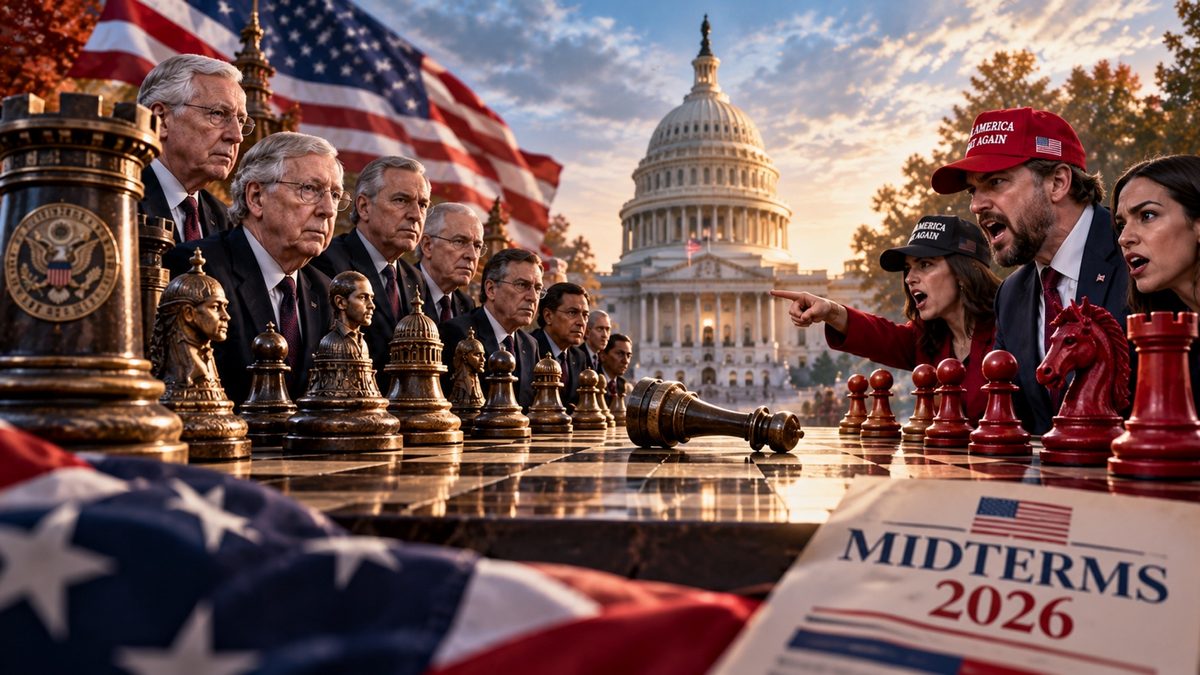
Five days before the November 3 vote, control of the Senate comes down to a dozen races, most of them within the margin of error. For conservative columnist Hugh Hewitt, the decisive question is not merely partisan: it is whether a senator can actually deliver for his or her state over the next six years. In a chamber where seniority remains the most valuable currency, replacing an influential incumbent with a newcomer — all the more so one from the fringes of his party — comes at a cost. Democrats have nonetheless made that bet in four states.
The Currency of the Senate
"Which candidates for Senate are in a better position to help their state and, by extension, their citizens in the six years ahead?" That is the question Hugh Hewitt, Fox News contributor and radio host, urges every voter to ask in his latest column. His answer comes down to one word: seniority, "the currency that matters the most in the Senate." Committee gavels, access to budget decisions and the ability to shape a farm bill or a defense contract are measured in years served. A newcomer, especially one joining the minority, starts with nothing in the bank.
Maine offers the clearest illustration. Susan Collins chairs the Appropriations Committee, which holds the federal purse strings, and has cast more than 10,000 consecutive roll call votes, making her, in Hewitt’s words, "the most powerful woman inside the Beltway." Her opponent, Troy Jackson, was chosen not by voters but by the state Democratic committee, after Graham Platner, the candidate backed by the Democratic Socialists of America, withdrew on July 10. Jackson had finished third in the Democratic primary for governor on the same day Platner won his. Polls describe a close race; but in 2020, Hewitt recalls, they had Collins trailing by at least four points, and she won by more than eight. Jackson, he writes, was beaten in all four debates, stumbling over the difference between Medicare and Medicaid, and grunted "Oh shut up!" into the microphone as Collins joked about a heckler. Trading the Appropriations chair for a first-year senator would be, he concludes, an "enormous ‘own goal’" for Maine.
The same logic applies elsewhere. In Alaska, Dan Sullivan, a retired Marine colonel on the Armed Services Committee, is seeking a third term; his rival Mary Peltola would be, if Republicans hold the majority, a freshman in the minority — "a terrible trade," in Hewitt’s view. In Kansas, where farmers are squeezed by diesel prices, Roger Marshall has the seniority to weigh on the next farm bill; the same holds for Pete Ricketts in Nebraska. In South Carolina, Darline Graham, appointed in July after the sudden death of her brother Lindsey, has a head start on any newly elected senator in a state Donald Trump carried by nearly 18 points in 2024. In Texas and Iowa, Ken Paxton and Ashley Hinson, newcomers themselves, hold an argument their opponents lack: they would join the majority.
The Democrats’ "Fanatic Four"
The other variable is the nature of the candidates. In an earlier column, Hewitt labels four Democratic candidates he considers extreme the "Fanatic Four": Abdul El-Sayed in Michigan, Peggy Flanagan in Minnesota, Troy Jackson in Maine and James Talarico in Texas. The basic rule of politics, he reminds readers, is "50% of the vote plus one"; yet both parties have occasionally forgotten it. Republicans paid the price in 2010 with Christine O’Donnell in Delaware, Sharron Angle in Nevada and Ken Buck in Colorado, then in 2012 with Todd Akin in Missouri and Richard Mourdock in Indiana. All five lost. In three of the four 2026 races, Republicans are this time fielding candidates from the center: Mike Rogers in Michigan, Michele Tafoya in Minnesota and Susan Collins in Maine. In Texas, Ken Paxton, the state’s attorney general, is "a flawed candidate," Hewitt concedes, "but he will be a reliable GOP vote."
Michigan is the most closely watched race. Rogers and El-Sayed would both be freshmen, but Hewitt describes an El-Sayed whose "white-hot radicalism will put him in a corner of the Senate that is empty except for Bernie Sanders," against Rogers, "a mainstream, moderate Republican" with 14 years in the House and a career as an FBI agent and Army officer. The columnist points to the Democrat’s "reflexive attitude of grievance," illustrated in his view by his interview with Bret Baier, which he calls "hostile and rude," and by repeated attempts to dodge the cost of Medicare for All with "semantics and word puzzles." He also recalls El-Sayed’s remark after an attack on a Michigan synagogue, "hurt people hurt people" — "his biggest blunder," according to Hewitt. The race now reaches beyond the Republican camp: Jason Turkish, fiancé of Representative Haley Stevens, whom El-Sayed beat in the primary, has announced he will vote for Rogers, arguing that the candidate’s rhetoric on Israel endangers Michigan’s Jewish community. "Every time he talks about genocide (in Gaza), Jews get death threats," he told The Detroit News. El-Sayed replied that people are free to set their own priorities: "That’s the beauty of democracy."
The numbers remain tight. The Fox News poll conducted September 24-28 gave El-Sayed a narrow edge, 50% to 49% among likely voters and 51% to 48% among registered voters, reversing August, when Rogers led by four points. The concerns offset each other: 39% of voters say they are extremely concerned that Rogers is too close to Trump, 36% that El-Sayed’s views are too liberal. Two findings temper the Democratic advantage: 18% of Rogers’ supporters say they could change their minds, and 11% of Haley Stevens’ primary voters plan to vote Republican. Rogers also leads by 26 points among the 44% of voters who put immigration first.
In Minnesota, Hewitt sees the biggest possible upset. Peggy Flanagan has been lieutenant governor since 2019; her eight years in office, he writes, coincided with "the massive fraud scandals in Minnesota and soaring violence among gangs of Somali-American youths." Michele Tafoya, a former sportscaster, presses the point without hesitation: the fraud, which she says runs into the billions, "happened under her watch. You don’t get a promotion when that happens, you get a pink slip." In Texas, Talarico, rooted according to Hewitt in the "woke" left, "weirdly vanished from the campaign trail for a dozen days and blamed the flu" while Paxton climbed in the polls. Maine, finally, lost its DSA-backed nominee in July to a replacement nobody had voted for.
Alaska, Ohio and South Carolina: The Final Week’s Surprises
Alaska has become the story of the campaign’s closing days. According to a New York Times investigation based on twelve interviews and dozens of text messages, reported by Fox News, aides to Mary Peltola’s campaign and senior officials of the Democratic Senatorial Campaign Committee (DSCC) spent months discussing a "ballot composition project," whose initial directive, in the summer of 2025, was to find as many men named Dan Sullivan in the state as possible. A retired teacher from Petersburg, Daniel J. Sullivan Jr., now appears on the ranked-choice ballot alongside the incumbent senator. Peltola’s former campaign manager, fired in August, says the candidate was "definitely aware." The Peltola campaign and the DSCC deny any involvement.
The response was immediate. Donald Trump denounced a "TOTAL DEMOCRAT SCAM meant to confuse the Voter," called for Peltola to withdraw and face criminal prosecution. The U.S. Attorney’s Office in Alaska is conducting, according to two sources cited by Fox News, an "aggressive criminal investigation" into a possible deprivation of voters’ rights, with grand jury subpoenas expected in the coming days. Republican Senator Lisa Murkowski, hardly known for indulging Trump, denounces "a pattern of lies and coverups." The Justice Department has gone to court to block certification of the result if the second Sullivan costs the real one the race. The incumbent has summed up his message to voters in three words: "Don’t rank Mary."
In Ohio, the trend runs the other way. Jon Husted, a senator since January 2025, faces Sherrod Brown, ousted two years ago after, in Hewitt’s words, "collecting government paychecks for almost 50 years," in a state Trump carried by more than eleven points. A Suffolk University/USA Today poll conducted October 21-26 nonetheless puts Brown ahead, 47% to 44%, within the margin of error, and Fox News’ final Power Rankings moved the race from toss-up to Lean Democrat. Trump traveled to Chillicothe for his third visit of the month, pledging to consider placing a Space Academy in the state "if John Husted wins" and noting that the Navy has chosen it for its future submarine component repair center, secured, he said, thanks to Husted and Bernie Moreno. In South Carolina, a New York Times/Siena poll has Darline Graham leading Annie Andrews by less than a point, and Fox News moved the race from Likely R to Lean R, in a state that has elected no Democratic senator this century.
Polls, Turnout and War
Hewitt puts little faith in surveys. American polling is, he writes, "as broken as Israeli polling," which failed to see Benjamin Netanyahu’s victory in Tuesday’s elections coming, and betting on prediction markets on that basis would be "as foolish as using the Farmers’ Almanac to plan your vacation in an El Niño year." Legacy media and pollsters, he argues, are "almost all openly tilted toward Democrats." If the so-called toss-ups turn into blowouts in red states, he warns, no one should be surprised.
Turnout will do the rest. Donald Trump is holding rallies daily, sometimes two a day, betting that the left’s hostility is already priced into his image and that all that matters now is getting his own voters to the polls. Democrats, for their part, have dispatched Bernie Sanders, Alexandria Ocasio-Cortez, Kamala Harris and Barack Obama, whom Hewitt considers counterproductive with centrist voters. They have also made the war with Iran an issue on the ballot: for Senate Minority Leader Chuck Schumer, eight months of conflict, twenty-one service members killed and soaring prices are weighing on families, while Trump accuses Tehran of dragging out negotiations in the hope of gaining leverage after the midterms. The campaign is also being fought on less visible ground: according to the Associated Press, AI-generated fake videos attributed to the Russian network Storm-1516 have targeted Sherrod Brown and James Talarico in the final days.
Fifty Plus One
Control of the Senate will not be decided by party labels alone, but by the combination of incumbents’ seniority, the profile of their challengers and the ability to turn out voters. Replacing experienced senators who hold key posts with newcomers, especially from the fringes of their party, carries a structural cost for the states concerned, and the gap between polls and ballots has been significant before, from Maine in 2020 to Israel this week. Republicans learned from their Tea Party years that you cannot win without your base, but also that you cannot win with the base alone; Democrats, Hewitt writes, have forgotten the lesson that brought them back to the center under Bill Clinton in 1992. "Fifty percent plus one" remains the only rule. November 3 will show who remembered it.
#HughHewitt, #DonaldTrump, #FanaticFour, #SusanCollins, #TroyJackson, #DanSullivan, #MaryPeltola, #RogerMarshall, #PeteRicketts, #DarlineGraham, #KenPaxton, #AshleyHinson, #AbdulElSayed, #PeggyFlanagan, #JamesTalarico, #MikeRogers, #MicheleTafoya, #SherrodBrown, #JonHusted, #BernieSanders, #AlexandriaOcasioCortez, #KamalaHarris, #BarackObama, #AI, #FakeNews, #GOP, #Vote