ANALYSIS – David Lisnard, a Chainsaw on the Croisette: The French Right’s Milei Gamble
By Angélique Bouchard
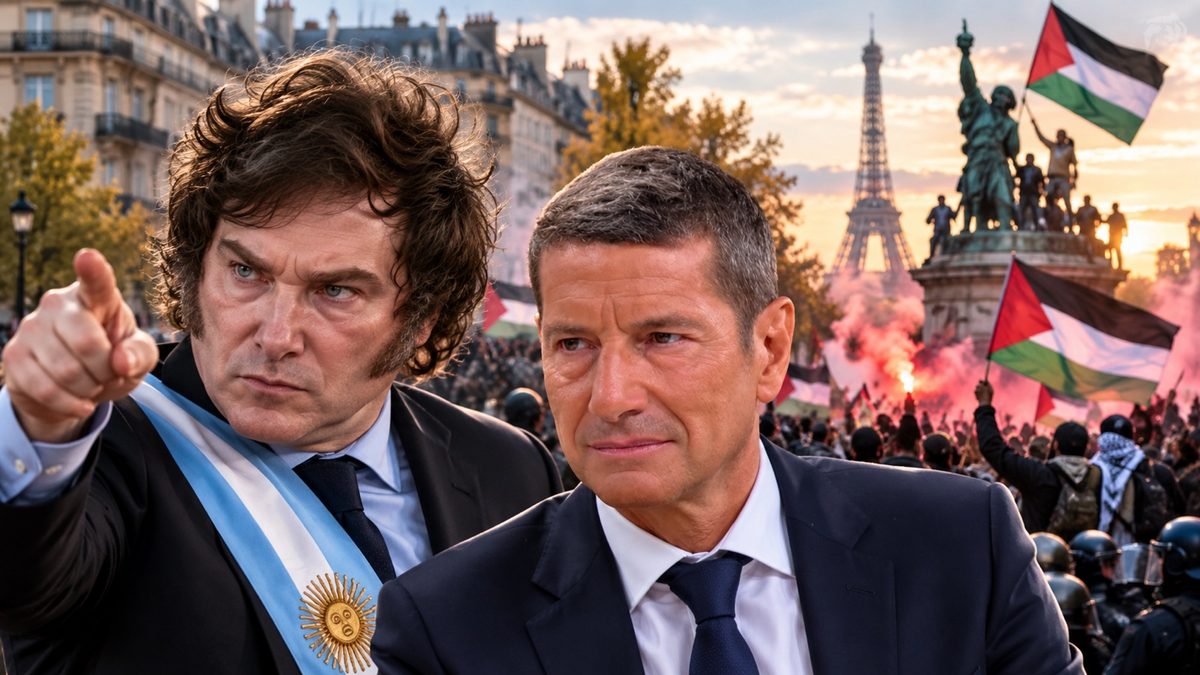
In a matter of weeks, the mayor of Cannes has carved out a place in the 2027 race through viral videos, self-mockery and open references to Javier Milei. Behind the digital phenomenon lies the most coherent free-market platform on the French right. Yet it runs up against the question Argentina itself has not settled: the social cost of a clean break, and whether it can work in a country that is experiencing neither hyperinflation nor collapse.
"Something is happening"
The sequence took even his own camp by surprise. Since the beginning of October, the slogan "Il se passe quelque chose" ("something is happening") has spread across X, then TikTok and Instagram, carried by an avalanche of mostly parodic content, including images and videos generated by artificial intelligence by his supporters. Whether it began with spontaneous activists or a well-drilled team is disputed. The mayor of Cannes, for his part, played along at once, all the way to self-mockery: "Stop wasting your time trying to convince me: I’m going to vote for myself," he wrote on X on 5 October. The staging had begun earlier: at his season-opening rally in late August, he bounded onto the stage to an Elvis Presley remix. The result is measured first in followers, some 400,000 on Instagram and nearly 80,000 on TikTok, figures that are hard to verify, AFP cautions. It is now measured in points as well. The latest Ifop-Fiducial barometer for LCI and Sud Radio, conducted from 12 to 14 October, puts him at 6% of voting intentions against 5% for Bruno Retailleau, in the only scenario in which he is tested. Two weeks earlier, the same survey gave him just 3.5%.
None of this is accidental. The virality serves an ideological offer that Lisnard openly lays claim to: a free-market rupture inspired by the Argentine president. In a long interview published on 11 May 2026 by the Argentine website Primero Argentina, conducted by the political scientist Julio Burdman and still little used in the French debate, he puts it bluntly: "Javier Milei has demonstrated in concrete terms that liberalism can work." The two registers reinforce each other. The digital campaign gives visibility to a programme of rupture; the Argentine reference supplies it with a narrative of results, from falling inflation to restored public accounts, which lends legitimacy to the "performance state" championed by his movement, Nouvelle Énergie. It remains to be seen what this narrative is worth once tested against the figures, and what would become of it if transplanted from Buenos Aires to Paris.
Cannes, laboratory of a method
Lisnard opens the interview with Cannes. Re-elected in the first round of the municipal elections on 15 March 2026 with 81.1% of the vote, far ahead of the Rassemblement National (11.7%) and united-left (7.2%) lists, he attributes the result to a method he sums up in a single phrase: "work, work, work, deliver on our commitments to Cannes and be accountable." A programme designed as a roadmap rather than a catalogue, a presence on the ground down to house meetings, the duty to know how to say no and to apply to oneself what one demands of others: the mayor describes less an ideology than a discipline.
The record he claims follows from it: €82 million less debt since 2014 according to the city, local tax rates cut by 3.6% in 2025, spending kept in check. Along the way he rejects the image of a town of festival-goers and yachts, pointing out that Cannes has historically high levels of poverty and immigration. The argument goes beyond a municipal case study. It underpins his conviction that a mayor, answerable for a budget, for staff and for immediate results, holds a legitimacy that Paris profiles from the same schools and the same circles lack. Local authorities, in their overwhelming majority, would be better run than a state that "has locked itself into an infernal spiral of unproductive spending", to the point of draining ever more from the municipalities to fund its lifestyle. Local elected officials, by contrast, remain "within range of a good telling-off".
From this springs a radical territorial reform: replacing regions and departments, deemed unreadable and redundant, with forty to fifty provinces rooted in historical and cultural realities, within a three-tier architecture (state, province, municipal bloc) to be approved by constitutional referendum. The idea has a pedigree. Michel Debré was already arguing for a redrawing of the administrative map at the Liberation, the Balladur committee proposed reducing the number of regions in 2009, and Manuel Valls announced in 2014 the abolition of departmental councils by 2021, before the project ran into the sand. The thirteen-region map produced by the 2015 law has never really convinced. Lisnard adds an attack on the "inbreeding" of the elites and a "spoil system" meant to bring fresh air into the senior civil service and the judiciary, a project that would collide with the general civil-service statute and, for magistrates, with the independence the Constitution guarantees them.
The end of three cycles and the "performance state"
The diagnosis is built in three stages. France is said to be living through the simultaneous end of three cycles of unequal length: the Europeanisation of the world, which sees the continent’s power, and France’s with it, recede; the welfare state, "an outdated model of redistribution that is ruining the country and impoverishing its inhabitants"; and finally Macronism, a parenthesis that has allegedly accompanied, even aggravated, decline in every field. The tasks of the next presidential term follow: restoring the public finances to give the state back its authority in its sovereign functions, restoring competitiveness by freeing work and initiative, and above all making the younger generations want to build their lives in France rather than leave it.
Lisnard makes "de-bureaucratisation and deregulation" the great cause of the next five-year term and condenses his ambition into a formula: "put an end to this fiction of the welfare state in order to build a performance state". The state would be refocused on security, justice, defence and a demanding school system, and would loosen its economic and administrative grip. Nouvelle Énergie puts a figure on the effort: some €80 billion in savings in the first year, then "at least €200 billion a year by the end of the term", 60% of which would go back to working people as take-home pay. On top of this come a legal retirement age raised to 65, a pay-as-you-go pension floor topped up by a minimum old-age pension of €1,000 a month, a gradual shift towards funded pensions, a single employment contract merging permanent and fixed-term contracts with progressive severance pay, and negative employer contributions for hiring people who have been on the RSA, France’s minimum income benefit, for more than two years.
The order of magnitude deserves to be taken seriously. Two hundred billion euros represent about 12% of total public spending and nearly seven points of GDP, more than the annual budgets for national education and defence combined. No government of the Fifth Republic has come close to such a squeeze. That is what makes the programme distinctive, and fragile.
Milei, read closely
This is where Javier Milei enters the picture. Lisnard sees in the Argentine president, first of all, "a clear vision of the principles of respect for freedom, responsibility and life", and praises his courage in having attacked, in a country "corrupted, in both senses of the word, by collectivism", excessive spending, bureaucracy and crony capitalism. He draws concrete effects from it: millions of Argentines lifted out of poverty, and falling rents after the abolition of a rent control he deems "inept and ineffective", and which, he notes, still obsesses a good part of the French political class.
The figures bear out part of the picture. Inflation, which reached 211.4% in 2023, its highest level since 1990, fell to 31.5% in 2025, and monthly increases now hover around 2%. As early as 2024, the state posted a primary surplus of 1.8% of GDP and its first overall surplus in fourteen years, and it maintained a surplus in 2025, at 1.4%. The poverty rate, which had peaked at 52.9% in the first half of 2024 under the impact of devaluation and the end of utility subsidies, fell back to 28.2% in the second half of 2025, its lowest level since 2018.
Yet the narrative leaves part of the bill in the shadows. Poverty rose again to 32.3% in the first half of 2026, and year-on-year inflation, at 33.4% in September, is once again above its 2025 level: the slowdown cannot be taken for granted. The economy contracted in 2024, by 1.3% to 1.7% depending on the estimate, before rebounding by 4.4% in 2025. According to CEPA, a research centre critical of the government, the minimum pension has lost nearly a fifth of its purchasing power, and national public-sector salaries more than a third. On rents, supply surged and advertised prices fell, but the rents tenants actually pay rose far faster than inflation. Finally, stabilising the peso required a new $20 billion IMF programme in April 2025, then, in October, a currency swap line of the same amount granted by the US Treasury on the eve of the midterm elections, which Milei’s party won with some 40% of the vote. Argentina’s recovery owes as much to outside support as to shock therapy. Lisnard, for that matter, does not treat Milei as a model to be copied but as a lesson in method, proof that deliberate budgetary restraint and simplification deliver more than over-administration and welfare dependency.
Above all, this reading allows him to put his own political family on trial. The French right is said to be "bogged down" in social statism, condemned to imitate the left in order to be respectable, even on economic matters. Against this conformism he invokes Ronald Reagan and Margaret Thatcher, but also Jean Chrétien in Canada and Gerhard Schröder in Germany, as a reminder that free-market reforms have been carried out by right-wing and social-democratic majorities alike. The rupture would consist in trusting the French to create wealth. In short, in "letting them live in peace".
French, European, Western
On the international stage, Lisnard recognises himself in Milei’s doctrine: a Western anchoring, open Atlanticism, unreserved support for the existence of the State of Israel. He distances himself, by contrast, from Viktor Orbán, whom Hungarian voters had just sent packing, and whose ambiguities towards Moscow he considers problematic. Vladimir Putin is in his eyes a declared adversary of the West, and Milei was right to back Ukraine resolutely against Russian aggression. France, he argues, should break with the "buffoonery" of its recent foreign policy and face up to the return of the old empires: Russia, a declared adversary; China and Turkey, challenges "to a certain extent"; and finally Iran, which he hopes will one day swing to the side of freedom.
His line fits into three words: French, European, Western. French, because a country must first answer for itself; European, because power comes through reinforced cooperation; Western, because there is a common base of values and interests that it would be irresponsible to deny. Neither automatic alignment nor equidistance. On a right torn between a sovereigntism tempted by withdrawal and a Western anchoring, Lisnard chooses the latter, while calling for industrial and technological sovereignty in the face of American platforms and Chinese successes. He defends a universalism that refuses to assign individuals to their origin, skin colour or community, and points out that power also depends on the attractiveness of a model.
The synthesis has its fragility. The Argentine model he invokes was built in close proximity to the Trump administration, to the point of depending on its financial support, whereas Lisnard advocates European autonomy in the face of the American giants. Between Milei’s Atlanticism and Lisnard’s technological sovereignty, the fit remains to be demonstrated, in a year when Washington settles its choices, on Ukraine as elsewhere, according to its domestic priorities.
A right in search of an offer
Lisnard sees the French right as a sociological majority represented by political minorities. The problem, he argues, is one of supply, not demand: the French who long to see their country put back in order through freedom and responsibility are said to be a very large majority, but they face a right that is often "left-wing, conformist and sometimes intellectually lazy", damaged by the games of local notables. His own line aims to be simple: less state, more freedom, more authority where it is needed. To this he adds artificial intelligence, quantum technology and space, which he presents as the drivers of an anthropological revolution that France must not watch from the sidelines.
Hence his plea, repeated since his declaration of candidacy on 31 March, the day he left Les Républicains, for a large open primary of the right and centre, on the model of 2016, which drew more than four million voters in each round and chose François Fillon against the predictions of the party machines. Without one, he sees a high risk of elimination in the first round against the Rassemblement National and La France Insoumise. With or without a primary, he insists, he will carry his free-market, security and education platform. The precedent he cites has its downside, though: the 2016 winner finished third in the following presidential election, with 20% of the vote. A primary decides between candidates; it does not guarantee their resilience in a campaign.
With Bruno Retailleau, the convergence on the need to cut spending is real: the president of Les Républicains presented on 12 October a plan for €197 billion in cumulative savings by 2032, most of which would go to reducing the deficit. Lisnard stands out through a higher annual ambition, a stronger insistence on the scope of the state and the advantage of not having served in any recent government, whereas Retailleau held the Interior Ministry. With Édouard Philippe, the gap lies less in direction than in pace. The founder of Horizons also wants to raise the retirement age to 65 and to replace only two out of every three departing civil servants, but along a more gradual path, whereas Lisnard embraces a break with the welfare state and a harder line on immigration and authority.
With the Rassemblement National, the dividing line is economic. The RN combines migration restrictions, protectionism and the use of state levers for purchasing power and industry; Lisnard bets on freeing the economy and refocusing the state. They converge on sovereign matters, control of migration flows and firmness on crime, but geopolitics separates them, part of the RN keeping its nuances towards Moscow. With Éric Zemmour, the overlaps concern immigration, criticism of the welfare state and some cultural issues; Lisnard differs in his emphasis on economic freedom and decentralisation, without closing the door to a primary that would extend as far as Reconquête.
France is not Argentina
There remains the essential point: France is not Argentina. Milei was elected by a country in hyperinflation, on the brink of default, which gave him a mandate for shock. France suffers from a slower malady: public spending among the highest in the OECD, at 57.3% of GDP in 2025, debt that reached 119% of GDP at the end of the second quarter of 2026, and weak potential growth. Attachment to the welfare state runs deep, and the checks and balances, from the Constitutional Council to the European courts and the trade unions, slow down any rupture. Shock therapy is a hard sell in the absence of a shock.
Several measures in the programme are matters of law rather than management. Asserting by referendum the primacy of national law over certain European and international norms would require a constitutional revision, which Article 89 first submits to a vote in both chambers of Parliament and which the Article 11 route cannot achieve without major challenge; it would moreover put France in open conflict with the treaties. Extending administrative detention to twenty-four months exceeds the eighteen-month ceiling set by the 2008 European Return Directive, which Brussels has admittedly proposed to raise. Abolishing the state medical aid (AME) available to undocumented migrants and ending the automatic acquisition of citizenship through birth on French soil would come under the scrutiny of the Constitutional Council and the European Court of Human Rights. Calling into question the 1968 Franco-Algerian agreement requires renegotiation or denunciation, at a certain diplomatic cost. As for dividing the number of residence permits by eight, it would run up against the weight of students, family reunification and economic permits.
Lisnard offers three answers to these constraints: explaining the inefficiency of spending, the promise to return part of the savings as purchasing power, and institutional reform, from decentralisation to the spoil system. His Cannes experience and his presidency of the Association of Mayors of France, which he puts back on the line from 23 to 25 November, entitle him to speak of management rather than theory. They do not yet explain how a parliamentary majority, elusive since 2022, would vote for the largest contraction of the state in the history of the Fifth Republic.
Coherence put to the test of the ballot box
The 11 May interview sketches a coherent Lisnard: a local record he stands on, a clear-cut diagnosis, a reading of Milei that keeps the method rather than the folklore, an assertively Western geopolitics. Few programmes on the right link the economic, the institutional and the sovereign so clearly. The digital campaign, viral and self-mocking, did the rest by giving him a visibility no party machine would have offered.
Coherence is not yet a majority. The Argentine example shows that a free-market rupture can break inflation and restore the public accounts; it also shows that it is paid for in recession, transitional poverty and financial dependence, and that it presupposes a country willing to accept the shock. To turn six points in the polls into momentum, David Lisnard will have to convince voters that France has reached that point, and rally far beyond those whom his videos make smile. "Something is happening": the slogan has worked. It remains for him to say how far the French are willing to follow him.
#PolitiqueFrançaise, #DavidLisnard, #JavierMilei, #NouvelleÉnergie, #France, #Cannes, #DroitFrançais, #Économie, #Décentralisation, #PerformanceState, #Régions, #Provinces, #Dérégulation