OP-ED – Nice: The Revival of a Key Strategic Role for France and Italy in Europe
By Henri de Grossouvre, Essayist
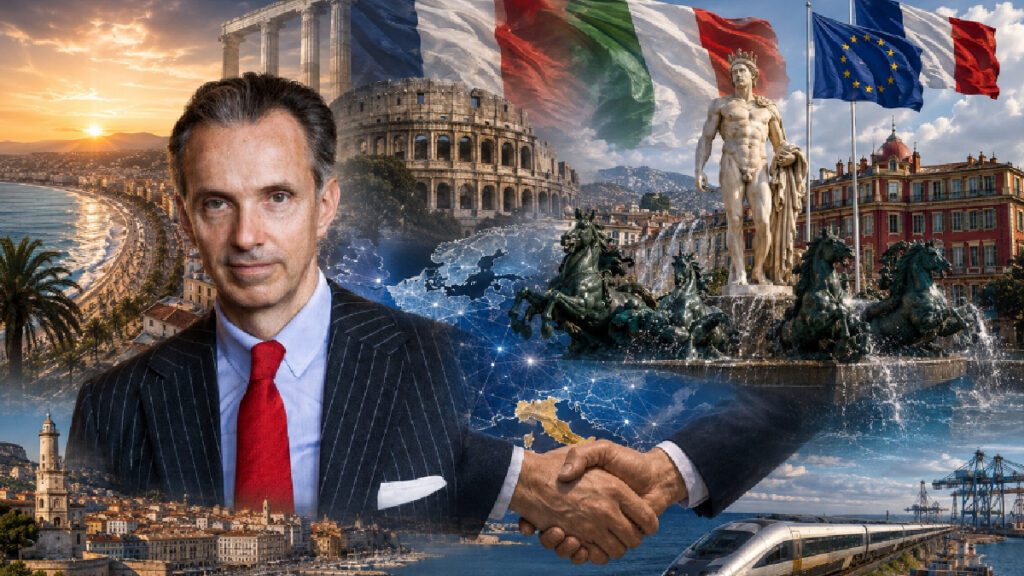
In this op-ed, Henri de Grossouvre argues that Nice should become the cornerstone of a renewed strategic partnership between France and Italy. Through the role of Éric Ciotti, the ambitions of Professor Bernard Asso as head of the Mediterranean University Centre (CUM), and the changing balance of power within Europe, he makes the case for a Paris–Rome axis capable of giving fresh momentum to a Europe of Nations.
Since its foundation by the Greeks in the third century BC, Nice has played a key international role in the Mediterranean. A Greek city, then Roman, and later part of the Kingdom of Piedmont-Sardinia, it remained culturally Italian for several centuries before being annexed by France in 1860. It embodies the Greco-Roman roots of Europe while also serving as a magnet for Northern Europe. During the eighteenth century, and even more so in the nineteenth century, Nice became the preferred winter destination of Europe’s aristocracies, particularly the British, Russian, and German elites.
France has two principal European vocations. The first is continental and Franco-German, symbolized by Strasbourg. Since the time of Charlemagne, France has shared a common history with its eastern neighbour. The second is Mediterranean, extending beyond Europe’s cultural and geographical boundaries, and is symbolized by Nice and Marseille.
Following Algeria’s independence, General Charles de Gaulle made a clear strategic choice to build Europe upon the Franco-German partnership. This model proved effective until the reunification of West and East Germany. Since reunification, however, Germany has progressively emancipated itself from close cooperation with France, increasingly pursuing its own national interests at the expense of European solidarity, while continuing to benefit from the advantages of both the European Union and, above all, the euro.
Germany outsourced its defence to the United States, its energy security to Russia, and its economic growth to China. Although this model has largely become obsolete following Germany’s shift in policy towards Russia under Angela Merkel, a transformation reinforced by the war in Ukraine and further accelerated since Donald Trump’s return to the White House, Berlin continues to place its own interests ahead of those of its European partners, particularly France. Its refusal to cooperate with Dassault Aviation—the only European company capable of designing and manufacturing a complete combat aircraft without relying primarily on Anglo-Saxon technologies—provides an archetypal example of this approach.
At the same time, France and Italy have steadily drawn closer together. On 26 November 2021, French President Emmanuel Macron and Italian Prime Minister Mario Draghi signed the Quirinal Treaty in Rome, whose ambition is comparable to that of the Élysée Treaty signed by General de Gaulle and Chancellor Konrad Adenauer. The Quirinal Treaty came two years after the Treaty of Aachen (22 January 2019), which sought to adapt the Élysée Treaty to the realities of the twenty-first century. Yet it is clear that the latter has failed to halt the gradual decline of the so-called « Franco-German couple »—an expression used almost exclusively by the French, and one that invariably amuses my German friends.
Today, just as France and Germany once did, France and Italy together account for nearly half of the European Union’s budget. Paris and Rome, working alongside allies within the EU, particularly in Central Europe, could therefore, if they chose to do so, exert decisive influence over Europe’s strategic direction. Such cooperation would become even easier should France and Italy enjoy greater political alignment following the 2027 French presidential election.
À lire aussi : TRIBUNE – Nice : Le renouveau d’un rôle stratégique clé pour la France et l’Italie en Europe
A strong Europe—a Europe as a global power—but above all a Europe of Nations, as envisioned by General de Gaulle, is therefore not only a possible scenario but, I would argue, a highly desirable one.
Professor Bernard Asso, Professor of Public Law in Nice, has been entrusted, during his term as a municipal official under Éric Ciotti, with the leadership of the Mediterranean University Centre (CUM). In doing so, he succeeds Paul Valéry at the head of what may be described as a regional equivalent of the Collège de France, combining academic and literary excellence with openness to the general public.
Professor Asso has developed an ambitious programme for the CUM, aimed at restoring Nice to the heart of Mediterranean and European affairs. We are undoubtedly living through a period of crisis, yet crises are all the more significant because they are also rich in opportunities.
Professor Asso has also developed a theory on the specificity and meaning of the future perfect tense in European languages: what has happened could have unfolded differently—« provided that we know how to will it, » to borrow General de Gaulle’s famous expression.
From the nineteenth to the twenty-first century, during periods of upheaval, Nice has consistently played a discreet—sometimes even secret—strategic role. Under Roman rule, the region became essential for controlling the routes linking Italy and Gaul. The site of Cemenelum (modern-day Cimiez, where reflection on Nice’s strategic role continues today), situated on the hills overlooking the city, became the capital of the Alpes-Maritimae province, ensuring the connection between Rome, the Mediterranean, and the Alps.
In 1858, Napoleon III and Count Cavour concluded a secret agreement whereby France agreed to assist Piedmont in expelling Austria from northern Italy in exchange for the annexation of Nice, which became French in 1860. In this paradoxical way, Nice contributed to the achievement of Italian unification.
During the 1930s, arms supplies destined for neighbouring Italy also transited through Nice.
Since March 2026, Nice’s new mayor, Éric Ciotti—whose father came from Treviso—has emphasized the importance of strengthening economic ties and transport links between the Nice metropolitan area and neighbouring Liguria. At the national level, he also advocates the establishment of a close strategic alliance between Paris and Rome.
The Franco-Italian rapprochement initiated by Emmanuel Macron and Mario Draghi is not a partisan project but rather a structural trend in the evolution of European geopolitics. It is a development that deserves to be encouraged because it serves the well-understood interests of France, Italy, and Europe as a whole. Nice possesses every asset required to become both the conceptual and operational heart of this new strategic partnership.
À lire aussi : ANALYSE – Pourquoi le premier voyage de Léon XIV pourrait redéfinir l’unité chrétienne
This article was originally published in the Italian daily newspaper Le Cronache.
#Nice, #France, #Italy, #FranceItaly, #FrancoItalianRelations, #FranceItalyRelations, #ParisRomeAxis, #Europe, #EuropeanUnion, #EuropeanGeopolitics, #Geopolitics, #EuropeanStrategy, #StrategicAutonomy, #EuropeanSovereignty, #EuropeOfNations, #Mediterranean, #MediterraneanEurope, #MediterraneanStrategy, #MediterraneanGeopolitics, #QuirinalTreaty, #TreatyOfQuirinal, #Paris, #Rome, #FrenchPolitics, #ItalianPolitics, #EuropeanPolitics, #EuropeanDefense, #EuropeanSecurity, #FranceGermany, #FrancoGermanRelations, #CentralEurope, #Liguria, #FrenchRiviera, #CotedAzur, #NiceFrance, #EuropeanHistory, #CharlesDeGaulle, #EricCiotti, #BernardAsso, #HenriDeGrossouvre