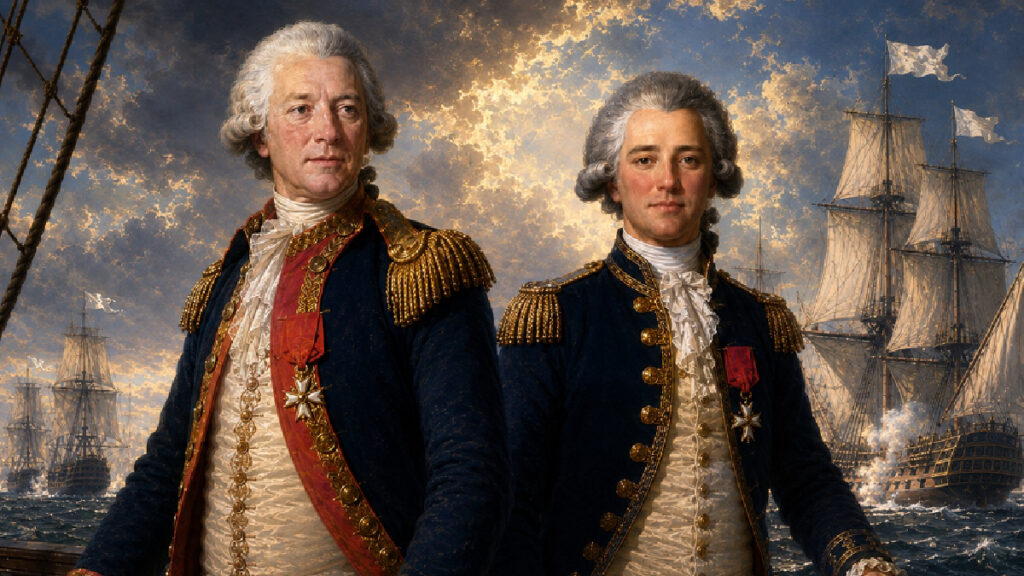
PORTRAIT – Bougainville and La Pérouse in the American War of Independence (1778-1783)
By François Souty, PhD (Economic History), is a former Antitrust Rapporteur on financial markets (2018-2021) and then International Affairs Officer (2021-2024) at the European Commission’s Directorate-General for Competition. Author of a dozen books and numerous academic articles, he is lecturing on European institutions, European, Water Geopolitics and Global Geopolitics at the Excelia Business School Group (La Rochelle-Paris Cachan) as well as European Competition Law and Policy at the Faculty of Law of the University of Nantes. He is in charge of the economics section at Diplomate Média.
Two emblematic naval officers between the two great French circumnavigations of the eighteenth century
« L’épée est l’axe du monde et la grandeur ne se divise pas. »
— Charles de Gaulle, Vers l’armée de métier, 1934.[1]
Executive Summary
French participation in the American War of Independence (1778-1783) was one of the last great moments of assertion of French maritime power before the Revolutionary upheavals. While historiography has largely retained the names of Louis-Antoine de Bougainville and Jean François de Galaup de La Pérouse because of their famous voyages around the world, these two figures were first and foremost naval officers engaged in naval operations against Great Britain in America and the Atlantic.
This article proposes to place their military trajectories in the context of French naval reconstruction after the Seven Years’ War. Bougainville appears to be an accomplished squadron officer, capable of participating in the major operations of the world maritime war, from the Chesapeake campaign to the Battle of the Saintes. La Pérouse reveals another form of excellence: that of autonomous command, of distant mission and of the representation of French sovereignty in distant spaces.
Their comparison takes on its full meaning when it is placed in the context of the generation of officers formed after 1763, of which Armand Guy de Kersaint is another major figure. All three raised to Flag Officers positions and illustrate complementary dimensions of French maritime power: squadron combat, reflection on naval organization and strategic projection overseas.
The American war thus shows that the French Navy at the end of the Ancien Régime had regained a global capacity for action and had an exceptional generation of officers. But this success remained fragile: revolutionary upheavals brutally interrupted these careers and prevented the monarchy from transforming this maritime renaissance into lasting strategic continuity.
Bougainville and La Pérouse thus appear less as two explorers separated from their time than as representatives of a French Navy of the Enlightenment, capable of fighting, exploring and thinking about maritime power on a global scale.
Key words : Bougainville – La Pérouse – Louis XVI – Castries – Choiseul – d’Estaing – de Grasse – Suffren – Vaudreuil – Kersaint – Montcalm – Rodney –Washington – La Boudeuse – L’Étoile – Le Guerrier – Ville de Paris – L’Amazone – L’Astrée – La Boussole – L’Astrolabe – American War of Independence –Royal Navy – Circumnavigation – Maritime Strategy – Scientific Exploration – Naval Power – Enlightenment – France – Brittany – Brest – Atlantic – NorthAmerica – Boston – Newport – Rhode Island – Chesapeake – Yorktown – Savannah – Georgia – West Indies – Martinique – Guadeloupe – Grenada – Saint Kitts –Saintes – Guyana – Demerary – Essequibo – Berbice – Cape of Good Hope – Pacific – Hudson Bay – Grenada – Rochefort
Introduction
This timeless reflection of General de Gaulle, which came out of the depths of the History he carried, can also be wonderfully applied to the naval officers of the end of the Ancien Régime. Posterity has often artificially separated the explorer Louis-Antoine de Bougainville from Bougainville the sailor, or Jean-François de Galaup de La Pérouse, the humanist and explorer, from La Pérouse the officer of the French Navy.[2] Despite their twelve-year age difference, they made a common contribution to a turning point in civilization. On the contrary, their respective careers demonstrate that French maritime power rested on the unity of these functions of sailors and explorers. Louis-Antoine de Bougainville and Jean-François de La Pérouse now belong to the pantheon of the great French explorers of the eighteenth century. Nineteen years apart, the former remains associated with the voyage of the frigates La Boudeuse and L’Etoile the first French circumnavigation between 1766 and 1769; the second, with L’Astrolabe and La Boudeuse, embodies the great scientific expedition launched by Louis XVI in 1785, whose mysterious and ultimately tragic disappearance in the Pacific on the eve of the French Revolution helped to make his name an enduring symbol of the French maritime adventure. However, this exceptional posterity contributed to erasing an essential dimension of their respective careers: before being explorers, Bougainville and La Pérouse were naval officers engaged in the greatest naval confrontations of their time.
In this respect, the American War of Independence was a decisive moment, but paradoxically very little studied in the collective memory attached to the role played by these two figures in the sequence of attached events. Between France’s entry into the war on the side of the American Insurgents in 1778 and the signing of the peace of 1783 at the Palace of Versailles, they both participated in the last great maritime confrontation of the Ancien Régime, on an equal footing, between France and Great Britain. This war, which took place simultaneously in the Atlantic, the West Indies, North America and colonial areas, offered the French Marine Royale the opportunity to demonstrate the progress made since the defeats of the Seven Years’ War.[3]
For Bougainville, the American episode represents a return to a primary vocation: that of a naval officer. After gaining international fame through his trip around the world, he returned to the Navy and took part in operations conducted by the French squadrons, notably under the orders of the Comte d’Estaing and then the Comte de Grasse. His role in the campaign of 1781, and particularly in the Battle of the Chesapeake, placed him at the heart of a naval victory whose consequences went far beyond the tactical framework: the temporary control of the seas by the French fleet made the capitulation of Yorktown possible and was one of the determining factors of American independence.
La Pérouse’s trajectory is different. When he took part in American operations, he was not yet the famous navigator who would be chosen a little later by Louis XVI and his Minister of the Navy, the Marquis de Castries, to lead the scientific expedition from 1785 onwards. He is above all an experienced naval officer, recognized for his leadership qualities and his ability to conduct difficult missions in distant spaces. The Hudson Bay Expedition of 1782 revealed another model of military excellence: that of an autonomous commander capable of preparing and conducting an amphibious operation away from the major naval bases, combining intelligence, navigation, land action and political mastery of victory. Another aspect: the Hudson Bay expedition is strongly reminiscent of the operational aspects of the perfectly mastered amphibious expedition led to Demerary-Essequibo in Dutch-British Guiana by Armand-Guy de Kersaint in January-February 1782, which we recently mentioned on this two hundred and fiftieth anniversary of the American Declaration of Independence and the war that followed.[4]
The interest of a comparative study of the actions of Bougainville and La Pérouse during the War of Independence lies precisely in this contrast. Both belonged to the same Marine Royale, formed by the reforms undertaken after the Seven Years’ War and engaged in a policy of rebuilding its maritime power. Both took part in the American War, but they revealed two complementary conceptions of the profession of naval officer. Bougainville embodies the experienced squadron officer, integrated into the great naval manoeuvres and subject to the collective discipline of the battle line. La Pérouse is more representative of the young captain and autonomous mission leader, called upon to make decisions in uncertain environments and to exercise global responsibility.
The study of their American campaigns thus allows us to renew the approach of two personalities often reduced in our collective memories to their sole careers as successive explorers. In 1776 or 1782, a historical turning point, Bougainville’s first French voyage around the world and La Pérouse’s future expedition should not be considered as isolated episodes relating solely to the history of discoveries. They were part of a military and naval continuity: that of a generation of officers trained by war, capable of combining the traditional requirements of maritime combat with the scientific, diplomatic and imperial ambitions of the French monarchy, carried by a philosopher king who was particularly enlightened and open to the innovations of his time.
Far from being a simple parenthesis between two major scientific undertakings, the American War of Independence thus appears to be the real melting pot where the military qualities of Bougainville and La Pérouse were asserted. One reached full maturity in command within the French Navy’s large squadrons; the other reveals the skills that would soon make him the leader of one of the most ambitious maritime expeditions of the Age of Enlightenment. To return to their campaigns in America is therefore not to add a little-known episode to two famous biographies: it is to restore to these two naval officers their rightful place in the French naval revival at the end of the Ancien Régime and to better understand how the experience of the war prepared, in both of them, the great French circumnavigations that left a lasting mark on the maritime history of the eighteenth century.
A. Bougainville: From New France to the First French Circumnavigation
When France entered the war against Great Britain in 1778, Louis-Antoine de Bougainville was no longer an officer in training. His career had already gone through several stages that explain the singularity of his profile: the imperial land war in North America, the apprenticeship of the naval trade and the direction of the first French circumnavigation. The American War of Independence was therefore not the beginning of his military career, but the moment when the experience acquired over more than twenty years was fully mobilized.
This trajectory explains Bougainville’s special place in Louis XVI’s Marine. Unlike many officers who built themselves exclusively in the practice of naval warfare, he belonged to a generation of sailors whose training combined military action, navigational sciences and knowledge of colonial spaces. This versatility corresponded precisely to the needs of a monarchy which, after the defeats of the Seven Years’ War, sought to restore its maritime and imperial power.
1. New France: the school of imperial war for Louis-Antoine de Bougainville. Bougainville’s first decisive experience was that of the Seven Years’ War. But before becoming an army officer, the young Louis-Antoine had already distinguished himself by an exceptional scientific training. Like many young people from good families, he received a solid classical education, but showed a particular aptitude for mathematics and the exact sciences at an early age. He deepened them in particular with Alexis Clairaut and Jean Le Rond d’Alembert, before publishing, in 1754 and 1756, the two volumes of his Traité du calcul intégral. This work brought him the attention of the Comte d’Argenson, Minister of War, and helped to introduce him to Parisian scientific circles. His election on 12 Jan. 1756 to the Royal Society of London, even before his departure for Canada, testifies to this intellectual precocity and already to a real international influence.[5]
This scientific training was not a parenthesis in his military career: it was even one of its foundations. It introduced the young Bougainville to mathematical reasoning, measurement, geometry and observation, all of which would later find their full expression in artillery, fortifications, astronomical navigation, hydrography and exploration. The future circumnavigator was thus already, before becoming a sailor, a man trained in a scientific culture that far exceeded that which was usually expected of a young officer in the French Royal Army. And his scientific competence continued to grow with his later rise in the ranks of naval officer.
However, his entry into the military career came quite late. In 1750, at the age of twenty-one, he enlisted in the Black Musketeers, before becoming, in 1753, adjutant of the Picardie regiment. He then served as aide-de-camp to Lieutenant General François de Chevert, an experience that allowed him to familiarize himself with the functioning of a staff and with the concrete realities of command. In October 1754 he accompanied Marshal de Lévis-Mirepoix to London, who had been appointed Ambassador Extraordinary to the British court in the context of growing tensions in North America. This diplomatic mission, which put him in direct contact with France’s main adversary, singularly complemented his military and political training. Returning to France in February 1755, he resumed his duties with Chevert and soon received a commission as lieutenant in the regiment of Dragoons of the Comte d’Apchon.
Bougainville then took an important step by receiving, on February 27, 1756, a commission as captain in the Apchon-Dragoons regiment.[6] This early career in the ground troops gave him first-hand experience in military command and operations, while his mathematical training gave him an unusual intellectual profile among young army officers. It was precisely this combination of qualities—scientific culture, reasoning skills, military experience, and familiarity with staff duties—that partly explains the choice he enjoyed when, that same year, Lieutenant of the King’s Armies Louis-Joseph de Montcalm-Gozon de Saint-Véran, Marquis de Montcalm (1712-1759), was appointed commander of the French regular troops in Canada.
Bougainville thus reached New France in April 1756, aboard La Licorne, as captain of Apchon-Dragons and aide-de-camp to Marquis de Montcalm. The government of the colony was then under the control of the Lieutenant General of the Naval Armies, Pierre de Rigaud de Vaudreuil de Cavagnial, Marquis de Vaudreuil (1698-1763), Governor General of New France from 1755 to 1760 (who, alas, did not get along well with Montcalm), father of one of the quality general officers of the Comte de Grasse’s squadron, whom we will find again in 1782 at the battles of the Chesapeake and the Saintes. This configuration placed the young Louis-Antoine as close as possible to the higher command and allowed him to observe the complex relations between military command, colonial administration and imperial interests.[7]
Above all, this position gave him a very concrete first experience of combined operations, reconnaissance, logistics and communications in a huge colonial theatre. Montcalm’s own Journal shows that his role was by no means limited to a ceremonial function of aide-de-camp. In July-August 1756 Montcalm entrusted him with operational and even strategic missions concerning supplies, ovens, boats, and the logistical preparation of the expedition against Chouaguen (Oswego).[8] The young army officer was thus confronted, from his first overseas campaign, with a fundamental reality of imperial warfare: military power depended as much on the ability to move, feed and supply men as on engaging them in combat.
He took part in the capture of Chouaguen (Oswego) on Lake Ontario in 1756, then in William Henry’s siege on Lake George in 1757, both operations that took him along the main hydrographic routes of the Franco-British war in North America,[9] and in the Carillon operations in 1758.[10] Following the victory at Carillon, Bougainville was sent to France to explain the needs of the colony to the Minister. Promoted to the rank of Colonel of the Army and made a Knight of the Order of Saint-Louis early in 1759, he returned to Quebec on 10 May 1759 with a supplyconvoy, but the reinforcements were very inadequate in view of the military situation. He was then given command of the Beauport camp andplayed an essential role in the defence of Quebec during the remaining campaign of 1759.[11] In the meantime, he had acquired first-hand knowledge of a war in which the boundary between land and naval operations was particularly porous: control of waterways, watersheds and currents, movement of reinforcements, transport of food and ammunition, reconnaissance, fortifications and cooperation of land troops with ships at sea were all inseparable elements of the conduct of war.
For Bougainville, New France was thus a veritable school for the application of imperial warfare. There he discovered that land operations depended directly on maritime communications, the movement of reinforcements and the ability of the European powers to keep their possessions far away. The fall of Quebec in 1759 and the capitulation of Montreal in 1760 were a major defeat for France; they did, however, give Bougainville an irreplaceable experience of the Franco-British rivalry overseas, which would still dominate his career two decades later.
This experience helped guide his subsequent evolution towards the French Navy. In Canada, as already remarked, Bougainville learned about the particular constraints of imperial warfare: land operations depended on waterways, supplies, communications, and the ability to move men and equipment over great distances. His activity as aide-de-camp also led him to observe and survey the spaces he crossed, while his memoirs addressed to the Court testify to the importance he attached to the naval means necessary for the defence of the colony.[12] His scientific training thus found a first practical extension in a culture of geographical observation and measurement that would fully blossom after his time in the Navy. It is not yet a formulated doctrine of maritime power, but a concrete experience of the interdependencies between geography, logistics, land forces and naval means. This experience will help to give the future Navigator a particularly broad conception of overseas operations. His transfer from the Dragoons to the Navy after the loss of New France was therefore less a break than a reorientation in the service of the monarchy. The Navy officer who would fight in Louis XVI’s squadrons against the British Royal Navy was already a veteran of the first phase of the Anglo-French imperial rivalry. Between the two wars, he did not really change his universe: he changed his tool. The Army had taught him imperial warfare; the Navy gave him the means to travel through the spaces with a baggage of rare quality and diversification of experience and skills.
2. From the colonial experience to the maritime vocation. After the capitulation of Montreal and the collapse of New France, Bougainville did not immediately join the Navy: on his return to Europe, he served again in 1761-1762 in the Army in Germany as aide-de-camp to General de Choiseul-Stainville. The Peace of Paris was over, but his career changed in nature: on 13 June 1763, he received his first commission as Capitaine de Vaisseau (Captain) and thus entered the Marine Royale with a high rank equivalent to his Army rank, without having followed the traditional and initial training path of the Marine Guards usually followed by young French Navy Ensigns. A few months later, he was given command of the expedition to establish a French colony in the Falkland Islands and set sail from Saint-Malo in September 1763 at the head of a small division composed of the frigate L’Aigle, armed with twenty guns — twenty-four according to other sources — accompanied by the corvette or flute Le Sphinx, armed with eight guns.[13] This choice is less a reconversion than a logical extension of his previous experience. This further confirms the atypical nature of his naval career. The King and the Navy offered this officer, trained in imperial realities, a framework corresponding to his scientific and technical qualities. As soon as he entered the Marine Royale, with the command of the Falklands expedition, Bougainville was indeed given general command of a maritime expedition with a small division, but not the more demanding nautical command of a large ship of the line.
The period following the Seven Years’ War was one of profound French naval reconstruction. Under the impetus of Choiseul and then his successors, the monarchy undertook to restore a fleet capable of seriously competing with Great Britain’s Royal Navy.[14] Naval officers must now combine the mastery of traditional naval combat with new skills: hydrography, astronomy, cartography, scientific observation and the ability to administer deep spaces.[15]
Bougainville corresponds particularly well to this model of an enlightened officer.[16] His interest in science, his qualities as an organizer and his colonial experience designated him for missions beyond simple tactical command. This combination explains why he was chosen to head a new maritime enterprise, which this time would be exceptional: the first French circumnavigation.
3. The first French Circumnavigation: scientific glory and maritime affirmation. Bougainville’s voyage around the world (1766-1769) began with a mission that was first and foremost diplomatic and imperial. Leaving Nantes on 15 November 1766 aboard La Boudeuse, accompanied by the flute L’Étoile, Bougainville first had to go to the Falkland Islands in order to hand over to the Spanish the French establishment founded in 1764, France having ultimately recognised the rights of the Spanish Crown over the archipelago.[17] This first stage was already marked by the difficulties of navigation: the delay of L’Étoile, loaded in particular with the provisions necessary for the long expedition, delayed the junction of the two ships by several months and considerably lengthened the campaign. After the surrender of the Falklands, Bougainville reached Montevideo and then the Strait of Magellan, whose crossing begun at the end of 1767, proved particularly delicate because of the winds, currents, fog and narrow passes. The cold weather experience of Canada was useful and did not surprise the new Capitaine de Vaisseau. The expedition nevertheless managed to cross the strait and enter the Pacific in January 1768.[18]
Then begins the most trying part of the journey. After a difficult voyage, the two ships reached Tahiti in April 1768, where the welcome of the islanders and the natural conditions offered the crews an unexpected respite and new fresh supplies; Bougainville named the island Nouvelle Cythère or « New Cythera ».[19] But the stay was brief and the crossing of the Western Pacific soon subjected the men and ships to new trials: storms, navigation difficulties in the archipelagos, sometimes tense contact with the populations encountered, exhaustion of food supplies and the appearance of scurvy put the crews to the test. The discovery of several islands, notably in the New Hebrides archipelago and the Solomon Islands, as well as the astronomical and hydrographic observations of Veron, however, gave the expedition a real scientific and geographical significance.[20] After crossing the dangerous waters of New Guinea and the Moluccas, the ships reached Batavia, where the crews could finally refuel and heal themselves before embarking on the last part of the journey through the Indian Ocean. The return, via the Ile de France and then the Cape of Good Hope, was made without major incident and La Boudeuse reached Saint-Malo on 16 March 1769.[21] L’Étoile, which hadaccompanied the expedition since its rallying to Rio de Janeiro in June 1767, returned to France a few weeks later, to Rochefort, on April 24,1769. The success was all the more remarkable because, despite the difficulties encountered and the diseases, the expedition brought back its two ships, its men, its scientific observations and a considerable mass of new information on the seas and lands of the Pacific. Bougainville’s success is all the more remarkable when compared to previous military circumnavigations. Twenty-five years earlier, for an equivalent crossing, the British expedition of Commodore George Anson, which set out in 1740 with eight ships and about 1,854 men, had brought back to England only 188 survivors and only one ship, the Centurion. The contrast, without being mechanically transposable, underlines the progress made in the preparation and conduct of great oceanic expeditions: in 1769 Bougainville brought back La Boudeuse and L’Étoile and their crews, after having crossed the Strait of Magellan, crossed the Pacific and the Indian Ocean and accomplished the first French circumnavigation under the royal flag[22]. It was thus less a simple feat of navigation – attributable to the obvious intrinsic quality of the expedition’s leader, Louis-Antoine de Bougainville, than a true demonstration of French capabilities in conducting a maritime enterprise combining diplomacy, exploration, cartography, natural sciences and nautical mastery.
The publication of the Voyage autour du monde in 1771 transformed Bougainville into a European public figure admired far beyond the Marine Royale. His story fully participates in the dissemination of the spirit of the Enlightenment and contributes to building the image of a learned navigator, curious about the peoples and territories he encountered. But this scientific dimension should not mask the profoundly maritime and strategic nature of the company. Bougainville himself recalls, in the preface to his account, the national dimension of this success: » I was not the first to undertake a voyage around the world, but I was the first Frenchman who executed it. »[23] This sentence is essential to understand his own view of the expedition. He did not only present his voyage as an individual or scientific adventure: he inscribed it in the history of French maritime power.
Box 1 Bougainville and Cook: two complementary contemporary perspectives on the Pacific
When Louis-Antoine de Bougainville reached Tahiti in April 1768, he was not only discovering for France an island that would become one of the greatsymbols of the exploration of the South Seas.[24] It was part of a story that had already begun: Tahiti, sighted by the Dutch Rear-Admiral Jacob Roggeveen in1722, was found and visited by Commander Navy Samuel Wallis, R.N. in June 1767, then by Bougainville in April 1768 and by Cook in April 1769.Bougainville stayed there from 6 to 15 April 1768 and gave it the name « New Kythera », before his story contributed powerfully to popularising Tahiti inEurope.
A year later, almost to the day, on April 13, 1769, James Cook anchored off Tahiti, during his first voyage to the Pacific (1768-1771), ordered by the BritishAdmiralty in particular to observe the transit of Venus in front of the Sun. Cook was then aware of the results of Bougainville’s voyage and compared his ownobservations with the French discoveries. However, the two navigators never met: their voyages in the Pacific followed one another,[25] Bougainville havingleft Tahiti nearly a year before Cook’s arrival. The rapprochement between the two men is nevertheless particularly significant.
Bougainville and Cook belonged to the same scientific generation of the Enlightenment and helped transform circumnavigation: the explorer was no longer justa discoverer of new lands, but became an observer, a cartographer, a hydrographer and a collector of astronomical, natural and ethnographic data. Bougainvilletook on board the naturalist Philibert Commerson and the astronomer Pierre-Antoine Véron; Cook, on his first voyage, benefited from the presence of naturalistJoseph Banks and a remarkable scientific team.
However, it cannot be said that there was a personal « correspondence » between the two men: no ongoing correspondence between Bougainville and Cook isknown to date. Their relationship is rather indirect, through their publications, to the scientific circles of the Royal Society of which they are both members, tonaval administrations and to European scholarly networks. Cook reads and uses the information left by French browsers; Bougainville, for his part, followedwith interest the British voyages that extended the French discoveries. Their dialogue is thus less that of two correspondents than that of two great navigatorswho respond to each other through their maps, their newspapers and their observations.
This succession was symbolic: Bougainville opened a new page in the exploration of the Pacific for France; A few months later, Cook undertook to systematizethe geographical and scientific inventory. Between the two, a new conception of maritime power emerged, in which knowledge of the seas, lands and peoplesitself became an instrument of power.
Circumnavigation thus constitutes a second or third school for Bougainville (after Army service in Continental Europe and then Army service and Senior Officer in Continental New France). It teaches him how to command a crew over a long period of time, how to organize a mission in unknown spaces, how to make decisions in a situation of uncertainty and how to manage the material constraints of a distant company. These qualities were also those required of commanders engaged in the world maritime war that accompanied the American Revolution.
As Étienne Taillemite has shown, Bougainville’s career illustrates this original figure of the eighteenth-century sailor, at once an officer, a scientist and an actor in French imperial politics.[26] His voyage around the world was therefore not a distant interlude from the war: he completed a training that already combined military action, ocean navigation and an understanding of imperial rivalries.
When Bougainville returned to active service in 1778, he returned to the war with an exceptional profile. He knew Britain as a diplomat, an adversary and briefly a prisoner since the Seven Years’ War, had experience in maritime command, and enjoyed an international scientific reputation gained through exploration. The American campaigns would now reveal a final dimension of his career: that of the Navy Squadron Commanding Officer.
B. La Pérouse: the formative years of a naval officer in the XVIIIth Century
Unlike Bougainville, whose scientific and maritime reputation was already considerable at the outbreak of the American War of Independence, Jean-François de Galaup de La Pérouse still belonged to the category of officers whose reputation was built mainly within the Marine Royale. As the known account of his future voyage did not occur before the operations of the War of Independence, this part will escape the present reflections. In 1778, Jean-François de La Pérouse was not yet the famous navigator associated with Louis XVI’s great scientific expedition; He was above all an already experienced sailor though a junior Captain, recognized by his superiors for his courage, his sense of decision and his ability to lead difficult operations. His career before the American War was that of a combat officer gradually trained in the maritime confrontations between France and Great Britain in the eighteenth century.
This difference in trajectory with Bougainville is essential to understand the responsibilities that would be entrusted to the two men during the conflict. Bougainville returned to war with the reputation acquired by his voyage around the world and had to confirm his qualities in the command of a squadron; La Pérouse, on the other hand, arrived with essentially operational experience that would allow him to gradually access autonomous missions and commands. For him, the American war was therefore less a break than an accomplishment, as well as for Armand-Guy de Kersaint, already mentioned.
1. The training of a combat sailor during the Seven Years’ War. Born in 1741 into a noble family in Albi, Jean-François de Galaup de La Pérouse entered the Marine royale in 1756, just as the Seven Years’ War began. His training and first active service duties thus took place directly in a period of global confrontation between France and Great Britain. Like many officers of his generation, he discovered very early on the realities of a conflict that was being played out simultaneously in Europe, the Atlantic, North America and colonial areas, including the India Ocean areas.[27]
The Seven Years’ War was a real school of command for this generation of officers. The French Navy emerged from the conflict profoundly weakened, but the experience acquired by some of its cadres contributed to the reforms undertaken after 1763. Young officers are now called upon to master not only naval manoeuvres, but also logistical constraints, long sailings and operations in distant spaces.[28]
La Pérouse’s first campaigns gave him precisely this experience. He took part in operations against British interests and learned the requirements of naval combat where individual initiative could play a decisive role. Unlike Bougainville, whose career very early combined the military, diplomatic and scientific dimensions, La Pérouse was first trained in the practice of the profession of combatant sailor.
This initial training explains part of his future leadership style. He develops a particular ability to act in uncertain situations, to assess risks quickly and to make decisions without necessarily waiting for detailed instructions. These qualities would be decisive during American operations, especially when he was placed in command of missions far from the major squadrons.
2. An officer recognized in the Franco-British naval rivalry. After the Seven Years’ War, La Pérouse continued his career in a Marine Royaleengaged in a vast reconstruction movement. The French monarchy intended to learn from previous defeats and restore a naval capability capable of competing with Great Britain. The officers called upon to serve in this new phase must be both combatants and representatives of a more ambitious maritime policy.[29]
In this respect, La Pérouse belonged to the same generation as the Comte de Kersaint, studied in a previous and recent paper, that of officers trained in the wake of the trauma of the Seven Years’ War and called upon to participate in the maritime recovery of France under Louis XVI. Both share the same conviction: the power of a state is necessarily based on the control of maritime spaces, on the quality of its ships and on the ability of its officers to act in distant theatres.[30]
However, their trajectories reveal two fairly different profiles. Kersaint was above all a naval officer who combined combat experience with practical thinking about the instruments of naval power. His reports to the ministry, particularly on the basis of his colonial experiences and his commands, show a particular interest in the nautical qualities of ships, the manoeuvrability of ships, the organization of forces and the link between the Navy and imperial sovereignty. His experience in the West Indies, Guyana and African Coasts, as well as his integration into colonial circles through his marriage to a member of the very influential family of the Marquis d’Ennery, Governor General of the American Islands, helped to broaden his conception of maritime power beyond naval combat alone.[31]
La Pérouse, on the contrary, appears at first as a naval officer and a chief of operations. His reputation is based less on general institutional or technical thinking than on his ability to conduct difficult missions, command crews and take initiatives in areas where autonomy is an essential quality. Where Kersaint presented the profile of an officer naturally called upon to think about the organization of a Navy and the command of important units, La Pérouse possessed the qualities that would eventually make him the preferred choice for an exploration and navigation enterprise conducted with limited means but requiring a strong capacity for adaptation.
A comparison with the Comte de Kersaint, an officer who had also been trained during the operations of the Seven Years’ War, allows us to better measure La Pérouse’s singularity. The two men shared the same maritime culture inherited from the Enlightenment: they considered the Navy not only as an instrument of combat, but also as a means of asserting the French presence in the world. However, their paths lead them to two different forms of naval excellence.
Kersaint appears more like a war officer called to operational command. His career before and during the American Revolutionary War revealed a highly skilled sailor capable of wielding broad autonomy, commanding naval divisions and conducting operations against the British Royal Navy. His nautical qualities, his interest in the technical characteristics of ships and his reflections stemming from his colonial experiences also led him to consider the Navy as a global instrument of sovereignty, combining military power, imperial administration and control of overseas areas.[32]
La Pérouse is following a different trajectory. He is not inferior in autonomy or decision-making capacity; on the contrary, his campaigns demonstrate a remarkable ability to command in isolated situations. But his profile is that of a mission officer rather than that of a Squadron commander. He excels in distant cruises, independent operations and missions where navigation, observation and the relationship with the populations encountered are essential. This orientation corresponded perfectly to the monarchy’s ambition when it prepared the Pacific expedition of 1785.
The two men thus embody two complementary figures of the sailor of the Enlightenment. Kersaint represents more the officer who transforms his experience at sea into a reflection on maritime power and the organization of an empire; La Pérouse represents the officer who puts his qualities as a navigator and humanist at the service of an enterprise of knowledge of the world. The first is naturally led to the higher military command; the second towards the great scientific and diplomatic exploration.
This difference also sheds light on their respective conceptions of the relationship with the populations encountered overseas. La Pérouse belongs fully to the universalist ideal of the Enlightenment and has a deep confidence in dialogue with the peoples discovered. Kersaint, just as marked by his time, showed more of a colonial administrator’s approach: his interest in populations and territories was part of a reflection on governance and sovereignty. These two attitudes are not opposed; they reveal two different ways for French naval officers of the eighteenth century to assume the legacy of the Enlightenment.
This difference probably explains, at least in part, the choices made by the monarchy in the 1780s. When Louis XVI was preparing the great expedition to the Pacific, he was looking less for a commander of a squadron capable of conducting a military operation than for an experienced navigator, an autonomous commander and a man capable of representing France in spaces that were still largely unknown. La Pérouse corresponds to this mission with remarkable evidence; Kersaint, whose qualities of excellence recognized by his superiors made him more suited to naval command and war responsibilities, responded to a different type of maritime ambition.
This difference also sheds light on their respective conceptions of the relationship with the populations encountered overseas. La Pérouse belonged fully to the universalist ideal of the Enlightenment and had a deep faith in dialogue with the peoples he had discovered: he went so far as to refuse to take possession of the islands of Hawaii in the name of the King of France, out of respect for the population that welcomed him. Kersaint, just as marked by his time, showed more of a colonial administrator’s approach: his interest in populations and territories was part of a reflection on governance and sovereignty, with abolitionist conceptions ahead of his time and his in-laws. These two attitudes are not opposed; they reveal two different ways for French naval officers of the eighteenth century to assume the legacy of the Enlightenment.
When France decided to intervene in the American War of Independence in 1778, it had a generation of officers trained by several decades of rivalry with Great Britain. La Pérouse belonged to this intermediate generation between the great figures of the Seven Years’ War and the future – though probably less efficient – commanders of the Revolutionary Navy.[33]
3. A commander in the making before the expedition of 1785. The period preceding the American War therefore makes it possible to understand why La Pérouse was chosen a few years later to lead one of the most ambitious maritime expeditions of the Age of Enlightenment. His choice by Louis XVI in 1785 was not only based on his qualities as a navigator: it was also the consequence of a long military experience, a practice of command and a concrete knowledge of ocean spaces.
Contrary to a vision that would have La Pérouse as an explorer that suddenly appeared in the 1780s, his career shows a profound continuity between the officer of the war and the leader of a scientific expedition. The Great Pacific Expedition extended a career already marked by distant navigation, confrontation with European powers and the management of complex missions.
The American War of Independence, however, was to be the decisive test. It allowed La Pérouse to demonstrate that he possessed not only the qualities of a courageous officer, but those of a true leader of an operation. The Hudson Bay campaign of 1782 revealed this ability to combine naval action, land operation, autonomy of decision-making and political mastery of victory. It was this experience that helped to make him, a few years later, the natural choice of the monarchy for the great circumnavigation of 1785.
Thus, when Bougainville and La Pérouse find themselves engaged in the same conflict in the service of France, they embody two complementary trajectories within the same Navy. The first was already an international figure whom the war brought back to the command of the squadron; the second was another up-and-coming officer whose military reputation was transformed into world fame during the American campaigns.
II. The American campaigns (1778-1783): two trajectories in the maritime war against Great Britain
France’s entry into the American War of Independence profoundly transformed an initially colonial conflict into a full-blown world war. By choosing, in February 1778, to recognize the independence of the United States and to conclude a military alliance with the Insurgents, Louis XVI was not only seeking to support a new political cause: he intended above all to take advantage of the opportunity offered by the American revolt to weaken British power in the long term and erase the consequences of the defeat of 1763.[34]
This decision was based on a conviction widely shared within the Versailles government and the Navy: revenge against Great Britain could only be obtained by controlling maritime spaces. The American war thus became the decisive test of the naval reconstruction that had been underway for fifteen years. Modernised arsenals, newly constructed ships and a new generation of officers trained in the memory of the Seven Years’ War must now prove their effectiveness against the British Royal Navy.[35]
It was in this context that Bougainville and La Pérouse entered fully into the military history of the French Navy. Both belong more or less to the same generation of officers, but they approach the war with different experiences and reputations. Bougainville, already famous for his Circumnavigation of 1766-1769, returned to combat as an experienced squadron officer, called upon to serve with the great French naval commands. La Pérouse, less known to the public, gradually established himself by his qualities as a war sailor, his aptitude for autonomous missions and his ability to act far from large concentrations of forces.
The American war was therefore to be a revealing test for everyone. It does not create their maritime personality; it puts to the test qualities already acquired. Bougainville had to transform his scientific prestige and his experience of distant navigation into military authority within the major squadrons. La Pérouse would have to demonstrate that a cruise and special mission officer has the necessary qualities to command complex operations in remote spaces.
The conflict also offers a privileged observatory of the different forms of naval power in the eighteenth century. Line battles, convoy protection, amphibious operations, independent cruises, and actions against British colonial settlements required different skills. Through the careers of Bougainville and La Pérouse, the diversity of the functions assumed by the officers of the Marine Royale on the eve of the Revolution thus appears.
Their involvement in the American war finally prepares two very different destinies. For these two men, the war was a decisive passage between their first maritime experiences and the two great French circumnavigations of the eighteenth century.
A. 1778: France’s entry into the war and the first naval campaign
France’s official entry into the American War of Independence in the spring of 1778 opened a new phase in the Franco-British maritime confrontation. After fifteen years devoted to rebuilding its naval forces, the French monarchy finally had the opportunity to measure the effectiveness of the reforms undertaken since the catastrophe of the Seven Years’ War. The American conflict immediately became a world war: the West Indies, the Atlantic, the American coasts, the Indian Ocean and the British colonial areas became theatres where France sought to force Great Britain to disperse its forces.
This strategy corresponds to a profound evolution of the French conception of maritime power. The revenge sought since 1763 could not be obtained by the defence of the coasts alone or by limited operations: it required the recovery of a capacity for oceanic action. As Jonathan R. Dull has shown, the French objective was not only to promote American independence; it was also a question of taking advantage of a conflict that offered the possibility of challenging the British supremacy acquired during the first half of the eighteenth century.[36]
The decision of Louis XVI and his ministers thus placed the Marine Royale at the centre of the conflict. The treaty of alliance with the United States, signed on 6 February 1778, was followed by a rapid mobilisation of French squadrons. The Comte d’Estaing was given command of a large naval force intended to carry the war to the Western Atlantic. Among the officers under him was Louis-Antoine de Bougainville, now a Capitaine de Vaisseau, who joined the squadron with the experience of a recognized navigator and an officer who had already served against the British during the Seven Years’ War as we saw.[37]
The d’Estaing Fleet left Toulon in the spring of 1778 and crossed the Atlantic with the ambition of surprising the British forces. The campaign immediately revealed the difficulties of a war fought at great distances: coordination with the American allies, supply problems, uncertainty of information and weather constraints. The operations in Newport and then Rhode Island showed the limits of a still hesitant cooperation between French and American forces.[38]
Bougainville then observed the realities of squadron command. His experience gained during circumnavigation is useful, but it does not replace the practice of naval combat, as would unfortunately be revealed or confirmed at a later stage, at the battle of the Saintes. He now had to deal with the constraints of a large fleet, where collective discipline, the transmission of orders and the rapid coordination of movements were as important as the individual value of the ships commanders.
This first campaign, however, confirmed an essential characteristic of his career: Bougainville was an officer capable of linking the different dimensions of French maritime power. He was familiar with colonial warfare, ocean exploration and now the functioning of a large squadron engaged against the British Royal Navy.
Kersaint’s action illustrates another form of French naval efficiency: that of an officer capable of exploiting a local situation, manoeuvring with autonomy and making the most of the nautical qualities of his ships. This ability was particularly apparent during his subsequent operations, notably in January 1782, when he led a remarkable offensive operation against British interests in South American space. However, this success was eclipsed a few months later by the French defeat at Les Saintes (12 April 1782), an important event in the naval war that had long dominated the memory of the conflict, even though it was subsequent to the French strategic victory of the Chesapeake Bay, which allowed the essential land victory of Allied French-American Troops and Engineers at Yorktown.[39]
The comparison with Kersaint thus allows us to better understand the diversity of the officers of the French Navy at that time. Bougainville belongs to the world of the great squadron commands; Kersaint excelled in autonomous offensive action and technical mastery of the ship as well as with his little Squadron in Guyana; in his turn, La Pérouse began to distinguish himself in missions where individual initiative and the ability to adapt were decisive.
3. La Pérouse gradually entered the war. La Pérouse’s place in this first phase of the conflict was different. Unlike Bougainville, he did not immediately enter the light of the large squadrons. His career progressed through special missions, cruises and operations requiring a high degree of autonomy.
This situation corresponds to his profile. La Pérouse was not yet the commander of a large naval force; He is a trusted officer, chosen for missions where his personal qualities can be fully utilized. The American war gradually transformed this professional reputation into military fame.
Thus, from 1778, the trajectories of the two men began to differ. Bougainville returned to the Navy of the Line and the world of the large squadrons; La Pérouse entered into a logic of independent command. However, both participated in the same historical movement: that of a French Navy that had returned to world competition and was now capable of contesting, at least temporarily, British domination of the seas.
The American War did not immediately give victory to France, but it demonstrated from its first campaigns that the reconstruction undertaken after 1763 had produced a new generation of officers with new engagement rules. Bougainville and La Pérouse were two emblematic figures; Kersaint, Suffren, La Touche Treville, La Motte Picquet and of course de Grasse, among many others, were alternative expressions of this, in quite different areas of maritime command.
B. Bougainville in the operations of 1779: from line combat to amphibious operations
The year 1779 was a decisive moment in Bougainville’s military career. After gaining international fame thanks to his trip around the world, he would now have demonstrate that he had the qualities of a true officer of war. His return to the active Navy came in a particularly demanding context: France was no longer seeking only to support the American Insurgents, but to impose a world maritime war on Great Britain.
The previous year had shown the difficulties of a first campaign conducted over a long distance. In 1779, French strategy shifted to the West Indies, an area considered to be the economic centre of gravity of the British and French Empires. The sugar islands represented a major stake at the time: their possession directly affected British and French commercial interests and indeed offered France the possibility of exerting decisive pressure on its adversary.[40]
In this new phase of the conflict, Bougainville still served under the orders of the Comte d’Estaing. His experience as a distant navigator gave him a particular ease in ocean operations, but he now had to take part in the complex discipline of a squadron of the line, not only in navigation but also in coordinated combat. The campaign of 1779 thus reveals a lesser-known facet of his career: that of a combat officer capable of evolving in the highly codified world of the great naval war of the eighteenth century.
The Battle of Grenada was one of the first major naval clashes of the American War. The two fleets were comparable in power, and the commitment showed that the French Navy restored after 1763 was now able to withstand direct confrontation with the British Navy.[41]
Bougainville took part in this battle as a Captain. Of course, he did not exercise the general command of the manoeuvre, which belonged to d’Estaing, but he found himself in the very situation that made it possible to evaluate an officer of the line: to hold his post in the formation, to carry out the admiral’s orders, and to contribute to the cohesion of the squadron.
This experience is essential in his career. It marked a break with the public image of the explorer of the 1760s. At the battle of Grenada, the Pacific Navigator became a naval officer integrated into a large naval formation. The quality of a naval commander is measured not only by his personal courage, but by his ability to understand the collective logic of squadron combat.
The assessments of the officers of this generation show the importance given to these qualities of manoeuvre and discipline. The French Navy of Louis XVI was no longer only looking for daring men; it was looking for commanders who could effectively and successfully use ships built to take on the British Navy in major engagements.[42]
2. Savannah: the limits of a combined war. After the victory of Grenada, French attention turned to continental America. The Savannah Expedition, led in the autumn of 1779 by the Comte d’Estaing in cooperation with the American forces of General Benjamin Lincoln, was an ambitious attempt to reconquer Georgia and, more broadly, to break with British strategy in the South. The French Fleet, which arrived in front of Savannah in September, landed several thousand men and established a siege with the American forces of the city, which was solidly fortified by the British under General Augustine Prévost. French ships were also engaged on the Savannah River, while the fleet’s artillery was gradually landed to reinforce the land batteries.[43]
The operation, however, revealed the difficulties inherent in amphibious and inter-allied warfare. The constraints of the terrain and communications, the difficulty of coordinating the French and American forces, the impossibility for French ships to sail effectively up the river after the British scuttling of HMS Rose and, as well as the resistance of the defensive works led d’Estaing and Lincoln to finally favour the assault.[44] On October 9, 1779, the Franco-American attack on the redoubt of Spring Hill was repulsed in less than an hour by the British defenders. D’Estaing himself was wounded twice. The losses were very heavy: American sources give about 63 French killed and 639 wounded, to which were added 58 Americans killed and 181 wounded; the siege was lifted a few days later and the French re-embarked.
Savannah was thus the flip side of Grenada’s victory: the French Navy mastered the sea enough to project a considerable force thousands of miles away, but this superiority did not automatically turn into land success. The failure underlined the need for true integration between naval command, dismounted forces, artillery, intelligence, communications and Allied command. In this regard, Savannah announced both the difficulties of the Yorktown operation and the decisive progress that would make it possible, two years later, to transform French control of the Chesapeake into a strategic victory.
This experience complements his training as an officer. The former explorer discovers the political and military realities of a world war where the Navy is a diplomatic instrument as much as a tool of combat.[45] It also reinforces a characteristic already perceptible in his career: his ability to link the military, geographical and political dimensions of French action overseas.[46]
This evolution also allows us to better understand the diversity of this generation’s careers. At the same time, Kersaint developed a profile more focused on autonomous command, naval technique and the offensive exploitation of the qualities of ships. Bougainville, on the other hand, appears more as an officer integrated into the major wing operations, capable of assuming the demands of collective combat.
The American war thus confirms less a transformation than a revelation. It shows that the man of the voyage around the world also possesses the qualities necessary for maritime warfare. Bougainville was certainly not destined to become one of the great naval strategists of the conflict; but it shows that he belongs fully to that generation of officers who allow France to temporarily challenge British domination of the seas.
C. La Pérouse: from the cruising officer to the commander of an autonomous operation (1778-1782)
La Pérouse’s trajectory during the American War of Independence was different from that of Bougainville. While the latter quickly returned to the world of large squadrons and line combat, La Pérouse gradually built his reputation in another register: that of autonomous missions, distant cruises and operations conducted with limited means but significant freedom of decision.
This difference does not constitute a mark of inferiority. On the contrary, it corresponds to an important evolution of the maritime warfare of the eighteenth century. Faced with British power, the French Navy could not limit itself to seeking the classic confrontation between large fleets; it must also be able to protect its communications, attack enemy colonial interests and conduct operations far from the main theatres of confrontation.[47]
La Pérouse belongs precisely to this category of officers capable of exercising an important responsibility in a decentralized framework. The American war reveals in him less a tactician of line battle than an operation leader, capable of assessing a situation, using available intelligence and taking initiatives in distant spaces.[48]
1. The frigate, school of independent command for Jean-François de La Pérouse. When France entered the war in 1778, La Pérouse already had a long maritime experience acquired during the Seven Years’ War and in the following years. However, unlike Bougainville, he was not yet associated with a major scientific enterprise or a prestigious command. His reputation was gradually built in the missions entrusted to the officers considered to be the safest.
The frigate was then a privileged instrument of this form of warfare. Faster and more manoeuvrable than a ship of the line, entrusted to young officers considered to be of the future, it allowed reconnaissance, surveillance of enemy movements, war against trade and independent operations. It also requires the commander to have a greater capacity for appreciation: far from the immediate support of a squadron, he must decide alone whether to pursue, engage or withdraw.[49]
It was in this context that La Pérouse gradually asserted its qualities. His superiors noticed his ability to command, his courage and his nautical mastery. He does not seek the brilliance of a great victory in the line; Its effectiveness is based more on the precision of decisions taken in situations where individual initiative is essential.
This characteristic allows us to better understand his place among the officers of his generation. Kersaint, his contemporary, who made the frigate his combat weapon of choice, nevertheless represented more the sailor capable of commanding a naval division, of reflecting on the technical qualities of ships and of developing a global conception of French maritime power. La Pérouse is distinguished by a remarkable ability to lead autonomous missions and to represent France in areas where the officer has a wide margin of action.[50]
2. Hudson Bay (1782): an exemplary military operation. The peak of La Pérouse’s American military career came in 1782 with the Hudson Bay Expedition. This operation perfectly illustrates the new forms of maritime warfare that France wanted to resort to against Great Britain: to strike at opposing colonial and economic interests with targeted operations, without necessarily seeking the decisive battle between large squadrons.[51]
The choice of La Pérouse by the Minister of the Navy, Marshal de Castries, is particularly revealing. He did not entrust him with a simple surveillance mission, but a real operation combining naval and land forces. The commander had to prepare for navigation in a difficult region, conduct the action against the British settlements and ensure the return of the expedition.[52] The Hudson Bay operation in 1782 marked a decisive stage in La Pérouse’s career. As a captain of a ship, and not yet a squadron commander, he was given command of a veritable small naval division, composed of the Sceptre, a 74-gun ship of the line, and the two frigates L’Astrée and L’Engageante, commanded respectively by Fleuriot de Langle (his future second-in-command of the Pacific expedition, then commanding L’Astrolabe) and de La Jaille. It also had a detachment of Marine troops and artillery intended for action on land. The mission was therefore neither a simple cruise nor an exploratory enterprise: it was a naval and amphibious operation, autonomous and daring, against the British settlements on Hudson Bay, but without a map or pilot familiar with the Hudson River. The success of this enterprise, conducted with relatively limited means and far from the large squadrons, revealed in La Pérouse qualities of decision, audacity, organization and command that largely explain the confidence that Louis XVI would later place in him for the Pacific expedition and would gain him great respect from the British, whom he would meet a little later during his navigation to the Pacific, in Australia.[53]
The focus was primarily on the Hudson’s Bay Company settlements, which played a major role in the British fur trade in North America. The two main posts targeted were Fort Prince of Wales and York Factory, located in an area that was particularly difficult for a European force to access.[54]
The French flotilla reached Hudson Bay – an absolutely gigantic territory that covered half of recognized Canada and northern Quebec – during the particularly icy summer of 1782, with the need to complete operations in order to get out of the river before September and the return of the ice. Despite the difficulties associated with the harsh climate, difficult hydrographic conditions, and poor knowledge of the theatre of operations, La Pérouse led the expedition successfully: despite the suffering of his crews, who were equipped with tropical clothing (they had left Saint Domingue without appropriate winter clothes and were buying furs from the trappers there) in a bitter Canadian pre-winter, he took care to leave the defeated British with all the means to survive despite the imperative destruction of fortifications and dwellings. The British settlements were occupied, their installations neutralized and the French forces then returned to the Atlantic to avoid being caught in the ice.[55] In the essay he dedicated to him, Jules Verne observed much later: « he had fulfilled this task as a consummate soldier, as a skilful sailor, as a man who knew how to combine the feelings of humanity with the demands of professional duty« .[56]
The military interest of this operation goes beyond its immediate result. First of all, it testifies to a great nautical mastery: navigation in northern waters requires rigorous discipline and a perfect knowledge of the human and material limits of the crews. It then revealed the leadership qualities of La Pérouse, who was able to organize a complex operation without the permanent support of a large squadron.
Finally, it demonstrates its ability to exercise French authority in a distant space. This dimension would be essential a few years later when he was chosen to command the Pacific expedition. Louis XVI was not only looking for an experienced navigator as already remarked; he chose an officer capable of exercising political, military and diplomatic responsibility far from the metropolis.[57]
However, this ability to conduct an autonomous operation is not an absolute singularity of La Pérouse. More broadly, it characterizes a new generation of French naval officers trained by the Seven Years’ War and engaged in the American war. Moreover, a comparison deserves to be made here with Armand Guy de Kersaint, who belonged to the same generation of officers and whose career path has several similarities with that of La Pérouse. In 1782, the two men conducted amphibious operations that testified to the same evolution of the French maritime war: the ability to project a naval force against an enemy land objective, to coordinate ships, landed troops and intelligence, and then to exercise an important initiative away from the main command.
Kersaint’s operation in January 1782 and La Pérouse’s Hudson Bay expedition a few months later were based on similar principles. In both cases, relatively small French forces were engaged against distant British positions, with the aim of undermining the colonial and economic interests of the adversary. These successes again confirmed the French Navy’s new ability to conduct several decentralized operations, characteristic of a maritime power that no longer seeks only squadron battles but also strategic action against the vulnerable points of the enemy empire.
This closeness between the two officers sheds all the more light on their subsequent trajectories. Kersaint would probably have belonged to the great cadres of the French Navy at the end of the eighteenth century and in Napoleon’s Empire if he had not been swept away by the Revolutionary Executions. La Pérouse, thanks precisely to this capacity for autonomy demonstrated during the American War, was chosen for a mission of a different type: no longer to fight rival empires, but to carry the scientific and diplomatic prestige of the French monarchy far and wide.
It is precisely this quality that explains the royal choice of 1785. The monarchy was looking for an officer capable of navigating unknown spaces, maintaining the discipline of distant crews in potentially difficult conditions or environments, conducting negotiations with foreign populations, and representing France in an enterprise where science and politics were closely associated.[58]
The American war thus constituted the link between La Pérouse’s two lives. It reveals the war officer behind the future explorer and diplomat. His interest in peoples, territories and new knowledge is not separate from his military experience: it is an extension of it.
The comparison with Bougainville then becomes particularly enlightening. Both belonged to the generation of Navy officers of the Enlightenment, but their trajectories diverged. Bougainville returns from his voyage around the world to naval command; La Pérouse would leave the naval war command for the great exploration. The participation of the Marine Royale to the American war of Independence was thus a decisive stage for each of them between their first maritime experiences and the two great French circumnavigations of the eighteenth century.
III. Two Styles of Command: From Squadron to Autonomous Expedition
For Bougainville and La Pérouse, the American War of Independence was much more than a succession of military engagements. It represents a test of truth that reveals two different, but complementary, conceptions of the naval officer at the end of the eighteenth century. As already said, both belong to a generation formed after the Seven Years’ War, in a French Navy engaged in a vast effort to rebuild, modernize and regain its maritime influence, as we have noted. Both share the same ambition: to restore France’s ability to act on the oceans and defend its interests in an imperial space that has become global.[59]
However, their qualities and trajectories diverge profoundly. Even if he did not follow the course starting in the Marine Guard Corps at the age of 16 or 17 or even younger, Bougainville is first and foremost a senior officer, both on land and at sea, a sailor in a large squadron. His experience of travelling around the world, far from taking him away from war, was extended by a real experience of naval combat. He knows the discipline of the battle line, the coordination of a fleet’s movements, and the constraints of collective command. But this military career was also marked by the ordeal of Les Saintes, which was a reminder of how much an officer’s reputation depended as much on visible results as on the controversies surrounding major battles.
La Pérouse follows a different path. Without reaching the rank or exercising the same responsibilities as the great squadron commanders of his time, he reveals another form of excellence: that of the autonomous commander experienced in all the disciplines of the sea, from the command of a flute to that of a ship of the line, capable of conducting a distant mission with limited means, to make decisions in uncertainty and to represent France in spaces far from the central power, which once again surprisingly brings him closer to the profile of an operations sailor that Armand-Guy de Kersaint was at the same time. For Jean-François, the American war was thus the real intellectual and military preparation for the 1785 expedition.
Comparing Bougainville and La Pérouse is therefore not the same as pitting an officer of war against an explorer. Such a reading would be anachronistic and reductive. The two men were fighting sailors before being figures of exploration. What distinguishes them is less due to their objectives than to the nature of the responsibilities they are called upon to exercise: one in the great mechanics of the squadrons, the other in the freedom of action of isolated missions while serving scientific exploratory as well as imperial ambitions of the Sovereign.
This fruitful opposition also makes it possible to place their careers in a wider generation, that of officers who, from Kersaint to Suffren, La Touche Tréville, La Motte Picquet and de Grasse and many others, gave the French Navy at the end of the Ancien Régime its strong characteristics as well as a new capacity for innovation, initiative and projection. The American war is therefore not only the story of a few naval victories or defeats; It was one of the last moments when the French monarchy had a coherent set of men capable of thinking and practising a real world maritime war.
The following three developments will examine these two models of command in turn. The first will show how Bougainville, an experienced squadron officer, saw his military career both confirmed and weakened by the ordeal of major battles. The second will analyse how La Pérouse transformed his war experience into an aptitude for autonomous command, a prelude to his great scientific journey. Finally, the last will broaden the perspective in order to understand how these two trajectories fit into the same French maritime culture, whose gradual disappearance accompanied the political upheavals of the end of the century.
A. Bougainville: the Squadron officer between combat experience and the limits of military recognition
Among the French officers engaged in the American War of Independence, Bougainville occupied a singular position. His later fame was long based on his trip around the world between 1766 and 1769, which made him one of the great representatives of the French exploration of the Enlightenment. However, to reduce his career to this scientific and geographical dimension would lead to misunderstanding the essential: when France entered the war against Great Britain in 1778, Bougainville was already an experienced naval officer, with a complete military career and an exceptional knowledge of ocean spaces behind him.
The American War was thus less a break than a return to the primary vocation that had mainly been its own: to serve French maritime power. His itinerary reveals a particular form of naval excellence, that of the officer capable of understanding war on the scale of a squadron and participating in major collective operations. Where La Pérouse gradually asserted his qualities in the autonomy of distant command, Bougainville belonged fully to the world of the fleet of the line, coordinated manoeuvres and squadron combat. [60]
1. From the Pacific explorer to the sailor of war. Bougainville’s (1766-1769) voyage around the world should not be considered as a parenthesis foreign to military concerns. On the contrary, it was part of the French maritime policy of the post-Seven Years’ War: to better understand the oceanic spaces, identify the resources available, strengthen the French presence in the world and prepare for a possible reconquest of the influence lost after 1763.[61]
On his return, Bougainville naturally resumed his military career. His experience as an explorer was even an additional asset: he was familiar with the constraints of long-distance navigation, the realities of ocean communications and the difficulties of a French presence in distant areas.
When France entered the American War of Independence, he was not a novice officer but an accomplished sailor. He already has exceptional experience in world navigation, command and representation overseas. This dual competence explains why it was quickly integrated into the major naval operations conducted against Great Britain.
His career thus contrasts with that of La Pérouse. The latter has yet to demonstrate his ability to command in independent missions; Bougainville, on the contrary, is already recognized as a senior officer called upon to serve in the great naval formations, as we have observed.
His role then corresponded to that of a squadron officer. He does not seek the isolated action of a frigate commander. He acts within the complex framework of a fleet where every movement depends on the coordination between several dozen ships. This form of warfare requires collective discipline, a fine understanding of signals, an ability to anticipate the admiral’s intentions and a perfect mastery of manoeuvre. This experience is one of the great lessons of the American war: naval power is based not only on the quality of individual ships or crews, but on the ability of an organized whole to act as a single force. Bougainville is fully part of this squadron culture.
In 1781, he participated in the decisive campaign that led to the Franco-American victory at the Chesapeake and the surrender of Yorktown. Commanding the ship of the line Le Guerrier in the squadron of the Comte de Grasse, he took part in one of France’s most important naval successes in the eighteenth century.[62] This victory confirmed the value of the French officers trained since the naval reconstruction begun after 1763. However, we must avoid an excessive reading of his role. Bougainville was neither the designer of France’s American strategy, nor the supreme commander of the operation. His merit lies in his membership of the enlarged staff of a victorious squadron and in his ability to hold his rank in the demanding conditions of high-intensity naval combat, despite a weakness probably inherent in his origin as a cavalry officer before becoming a naval officer, unlike La Pérouse or Kersaint.
3. Les Saintes, « he doesn’t know how to manoeuvre, it’s not his fault« : the battle that darkens a fine military reputation. The Battle of Les Saintes, fought on 12 April 1782 between the French Fleet of the Comte de Grasse and Rodney’s British fleet, was the most controversial moment in Bougainville’s military career. Commanding the French vanguard aboard the Auguste, Bougainville first executed the movements prescribed by the Comte de Grasse. When the French line was disorganized under the effect of the rupture made by Rodney, his vanguard, far from the centre of action, did not however rally the battle corps with the expected speed.
It was this lack of manoeuvre, more than the conduct of the first phase of the engagement, that was mainly reproached to him at the council of war of 1784. This council of war did not declare him » irreproachable « : it considered his conduct as such until noon, but then reproached him for not having sufficiently particularized his signals and manoeuvred his squadron to allow him to rally quickly to the battle corps.
The defeat of the Saintes cannot be reduced to the action or inaction of a single officer. It was the result of a combination of factors: British tactical superiority that day, communication difficulties within the French squadron, progressive disorganization of the line and Rodney’s smart initiative.[66] The episode nevertheless reveals a fundamental reality of naval command in the eighteenth century: in a squadron war, an officer’s reputation often depends on a single moment. A success like the Chesapeake could consecrate a career; a defeat like Les Saintes could permanently alter a reputation that had been founded on several decades of service, despite the tribute paid to the Comte de Grasse and the French victory in the Chesapeake by the enemy commander of the British Fleet, Admiral George Rodney in person: « France has won the greatest victory and nothing can save America anymore. »[67]
Under the Empire, Bougainville was elevated to the dignity of Count of the Empire and became a most respected figure in the French Navy as well as Scientific Academies and a Senator of the Empire. This belated recognition confirms a more balanced judgment: Bougainville may not have been the great commander of the squadron that some would have imagined, but he remains one of the most complete and praised Navy officers of his time. His career thus illustrates a paradox specific to the French Navy at the end of the Ancien Régime. The generation formed after 1763 possessed exceptional qualities, but individual careers depended as much on political circumstances as on military talents. As already remarked, Bougainville, La Pérouse and Kersaint belong more or less to the same maritime generation; their divergent destinies bear witness less to radical differences in value than to the diversity of functions to which the monarchy could employ its best officers. All reached Flag rank.
B. La Pérouse: the officer of distant missions and strategic autonomy.
The American War of Independence was precisely the moment when this reputation was affirmed. It does not make La Pérouse a great commander comparable to de Grasse, nor a theoretician of naval power and the role of the colonies like Armand Guy de Kersaint or certain officers of his generation. It does, however, reveal a quality that has become essential in the conduct of a world war: the ability to command alone with great autonomy, far from the political and military centre, in spaces where individual initiative becomes the condition for success, which was also Kersaint’s but little demonstrated in other officers.[68]
This aptitude explains the special place he occupied among the French officers of his time. Bougainville demonstrated in the large squadrons his understanding of collective naval combat; Kersaint manifested a broader conception of maritime power, associating technical thinking, command and administration; La Pérouse embodies a third way, that of the expedition leader capable of extending military action with a political and scientific mission.
The war against Great Britain offered him precisely the opportunity to demonstrate his qualities. The missions entrusted to frigate commanders require a particular combination of nautical competence, military judgment and autonomy. In this type of warfare, success depends less on material power alone than on the ability of the commander to interpret a changing situation and to act quickly.
This evolution corresponds to the transformations of maritime warfare in the eighteenth century. The French Navy no longer sought only direct confrontation between large squadrons; It also developed a strategy based on the dispersion of British forces, the attack on communications and the threat to colonial establishments.[69]
In this perspective, the Hudson Bay Expedition of 1782 was a decisive moment. The choice of La Pérouse by the Minister of the Navy, Marshal de Castries, testifies to a particular confidence. It is not a question of entrusting him with a simple execution mission, but an operation in which the preparation, the interpretation of the circumstances and the decision-making are largely based on his judgment.
The success of this campaign transformed his position in the naval hierarchy. La Pérouse now appears as an officer capable of assuming responsibilities far from the direct control of the central administration. This quality would be decisive a few years later.
Bougainville belongs to the world of the constituted fleet. Its effectiveness is based on its ability to participate in a collective work: manoeuvring in a battle line, understanding the admiral’s intentions, coordinating his ship with several dozen other units. This skill is that of the traditional great war sailor.
La Pérouse developed another form of excellence. His domain was that of the autonomous mission, where the officer had to combine several functions: military commander, navigator, diplomat, administrator and representative of French sovereignty. Remoteness is not only a geographical constraint; it transforms the very nature of command.
This difference explains why La Pérouse was not chosen to replace a commander of a classical Fleet squadron, but to accomplish a mission of a new nature. The French monarchy was not only looking for a sailor capable of defeating a European adversary; it was looking for an officer capable of embodying France in regions where his presence had to be at the same time military, scientific, diplomatic and political, in accordance with the exploratory, scientific and humanist vision of Louis XVI, which was part of the intellectual and technical movement announcing the profound transformations of the late eighteenth century. The coincidence of dates is remarkable in this respect: while La Pérouse was finishing the American War, France was itself experimenting with new forms of navigation technologies for the next two centuries. On the Doubs River, in 1776, then on the Saône River, in 1783, the Marquis Claude François-Dorothée de Jouffroy d’Abbans successively sailed the Palmipède and the Pyroscaphe, among the world’s first actually seaworthy achievements of steam propulsion.[70]
The comparison with Kersaint is also enlightening. The two men share a desire to assert French maritime power. Both demonstrate their ability to conduct remote and complex operations. But their profiles differ on this point. Kersaint had more of the profile of a naval division chief: like a true engineer, he thought about the qualities of the ships, their manoeuvrability, their equipment and the (relative) comfort of the crews, but also about the overall organization of the Navy, its operations, its support to maritime Trade, its missions to develop the Empire Overseas and its crews (he invented maritime conscription) or the French presence throughout the imperial space in an overall strategic vision. La Pérouse, without developing the same institutional reflection, reveals an exceptional ability to act in an uncertain environment and to represent the State in unknown spaces, implementing with tact and moderation the imperial maritime policy designed by Louis XVI and the offices of Versailles.[71]
Louis XVI’s project had a multiple dimension. It was a question of increasing geographical and scientific knowledge, but also of maintaining the French presence in world competition with the other European powers, especially the British rival. La Pérouse’s expedition was thus part of a broader conception of maritime power, in which knowledge of the seas and peoples became an instrument of sovereignty.[72]
The American war prepared La Pérouse for this mission. It taught him how to navigate difficult spaces, waters with unknown depths and drafts or draughts, how to manage crews under severe constraints, how to negotiate with local authorities and how to make decisions without waiting for standard operating procedures.
The contrast with Bougainville is particularly interesting. When Bougainville set out around the world in 1766, his voyage was a pioneering maritime exploration enterprise. When La Pérouse left France in 1785, he inherited this experience but he transformed it: exploration became a much more ambitious state mission, integrating science, diplomacy and the assertion of French power. The deep esteem that Louis XVI had for theexpedition appears in a tradition that has remained famous: on the very morning of his execution, January 21, 1793, the Sovereign is said to haveinquired about La Pérouse’s fate again, asking: « Have we heard from M. de La Pérouse? » This sums up in one sentence the very personal linkbetween Louis XVI, the Marine Royale and the great scientific enterprise of the Enlightenment. It constitutes an almost symbolic conclusion ofthe period under our scrutiny: while the monarchy disappeared, the memory of an expedition that embodied France’s maritime, scientific anduniversal ambition would remain.[73]
This conception explains his attention to the populations he encountered, his concern to observe foreign societies – his experience in Hudson Bay is enlightening in this respect – and his refusal of a purely conquering logic (here again, he demonstrates this when he leaves his detailed exploratory maps to the British officer commanding the Hudson Bay region, whose forces he had defeated, simply against the formal promise to have them published on the officer’s return to London).[74] It corresponded to the intellectual ideals of his time and contributed greatly to his later popularity.
But this openness is also a fragility in certain environments. The tragic fate of the 1785 expedition reminds us of the limits of a model based on trust in encounter and dialogue. However, it would be anachronistic to see this as a simple personal error: La Pérouse acted in accordance with the intellectual and political values of part of his century and consistent with the King’s own instructions to respect all encountered peoples.
The American War therefore remains the founding moment of this trajectory. It transformed an experienced officer into a trusted man of the Monarchy. It explains why Louis XVI entrusted him with an undertaking that went far beyond simple geographical exploration or individual lives.
In the end, Bougainville and La Pérouse thus appear not as two opposing figures, but as two different expressions of French maritime power at the end of the Ancien Régime: one demonstrates that France can still compete in global naval combat; the other that it can still carry its flag to unknown spaces and places.
C. An exceptional maritime generation facing the global challenge
The comparison between Bougainville and La Pérouse only takes on its full historical significance when it is placed in the broader context of the generation of naval officers formed after the Seven Years’ War. It includes of course Kersaint, largely presented in a previous article already cited. France in 1763 emerged profoundly weakened from the conflict with Great Britain. It has lost much of its first colonial empire, but it retains a global maritime ambition. The reconstruction undertaken under Louis XV and then continued under Louis XVI did not only aim to restore a fleet; it seeks to train men capable of giving it a new strategic employment.
The generation that came of age in the years 1770-1780 benefited from this transformation. It combined a more scientific training, increased experience of colonial spaces and a broader conception of maritime power. Bougainville, Kersaint and La Pérouse belonged to this generation, even if their careers and temperaments led them to different positions and actions. They do not represent three variants of the same model, but three complementary expressions of a French Navy that is seeking to become a world power again.[75]
The monarchy then undertook a lasting effort to rebuild. Arsenals were modernised, shipbuilding was relaunched, innovative ships design was strongly supported, maritime education was strengthened and the Navy became more open to scientific knowledge. The goal is not only to have more ships, but to create a force that can operate on a global scale.[76]
Bougainville, La Pérouse and Kersaint are the products of this evolution. All three belonged to a Navy that no longer completely separated the officer of war from the navigator, the engineer or the colonial administrator. Mastery of the ocean became a global knowledge, which in many respects prepared the officers of the French Navy of the following century, who would build French Indochina and explore Africa.
This characteristic explains the diversity of their backgrounds. In a Navy exclusively oriented towards the battle of Fleets and Squadrons, careers would probably have been more homogeneous. In the French Navy of the Enlightenment, several forms of excellence could coexist.
2. Three complementary expressions of French maritime power. Bougainville embodies first and foremost the figure of the universal sailor. His career brought together almost all the dimensions of the eighteenth-century officer: intellectual training, exploration, long-distance navigation, command of ships and participation in major naval operations. His journey around the world did not take him away from war; on the contrary, it broadens its understanding of the oceanic spaces in which French power must act. During the American war, he belonged fully to the world of the squadron. His skill is that of a sailor capable of integrating into a collective force, understanding the logic of the battle line and executing the movements necessary for a large-scale operation. His career illustrates the permanence of the classic naval warlord model. Before concluding, it is appropriate to return to the family and networks of naval officers because they underline again a common dimension. Bougainville and La Pérouse married in 1781 and 1783 respectively. Kersaint, to whom they have been related, had married earlier with a young woman of high lineage from the aristocracy of the French West Indies, in 1772.
Bougainville’s marriage and his personal networks also have a strong maritime and War of Independence period colouring, with no close correlation other than the dates. On 25 January 1781, in Brest, Louis-Antoine de Bougainville married Marie-Joséphine Flore de Longchamps-Montendre, daughter of Claude-Charles de Longchamps-Montendre, lieutenant of the King’s ships, who died in action in 1760, and Yvonne du Botdéru; his father-in-law, Augustin de Silans, was then captain of the King’s ships.[77] This alliance thus placed Louis-Antoine in a family environment deeply linked to the Marine Royale and the Breton naval aristocracy. In this respect, Bougainville was situated between Kersaint, whose marriage rooted him in the colonial networks of the West Indies, and La Pérouse, whose union with Éléonore Broudou linked him more closely to the merchant and administrative circles of the Mascareignes Islands (to day La Réunion, Mauritius and Rodrigues in the Indian Ocean).
Armand Guy de Kersaint represents another dimension of this generation. A bit younger than Bougainville and belonging to the same maritime culture as La Pérouse (the one starting out in the Marine Guard corps), it is distinguished by a particular combination of operational and technical qualities. A recognized combat officer, he also developed a keen interest in the characteristics of ships, their manoeuvrability and the practical organization of naval power. His observations and reports bear witness to a reflection on the concrete means of maintaining an effective French presence in imperial spaces.
His family and colonial experience also contributes to this sensitivity. His marriage, celebrated in Martinique in 1772, to Claire Louise Françoise de Paule d’Alesso d’Éragny, from a very wealthy and influential noble Creole family, directly linked him to an environment closely linked to French colonial interests. His in-laws also maintained particularly close ties with the Comte d’Ennery, governor of the French islands in the West Indies, of whom his wife was first cousin.[78] This insertion into the family, economic and administrative networks of the colonial world probably helps to explain the particular attention paid by Kersaint to the concrete conditions of French sovereignty overseas and to the role of the Navy in its preservation. This insertion into a wealthy Martinican family and into the networks that linked the aristocracy, the administration and French colonial interests explains all the better his conception of the Navy as an instrument of imperial sovereignty.
For his part, La Pérouse married a young woman whose family was located between the French islands of the Indian Ocean and mainland France: his marriage to Éléonore Broudou, celebrated in 1783, was part of a social milieu of a different nature: indeed the marriage that his family would have liked to achieve was with a prospective aristocrat; Jean-François would finally have to receive the approval of the Minister of the Navy in person, Charles-Eugène de la Croix, Marquis de Castries, Albigensian like himself. Daughter of Abraham Broudou, a shipowner from Nantes who became a naval administrator in the Île de France, the young woman had met La Pérouse in the Indian Ocean, where her family was settled. Without belonging to the nobility, it thus rather linked him to the circles of the great maritime trade and the colonial administration of the Mascareignes Islands, while retaining, through his Nantes origins, a strong attachment to the Breton maritime world.[79]
Kersaint thus had more of the profile of a future head of division or a senior official of the Navy than La Pérouse. Where La Pérouse was chosen to represent France in a distant scientific and diplomatic mission, Kersaint seemed more destined to contribute to the organization and command of a naval war force.
Finally, La Pérouse embodies the third expression of this maritime power. Its originality does not lie in the mastery of the great naval battle, but in its ability to act alone in the name of the State. The American war revealed its ability to conduct distant operations, to decide in uncertainty, and to combine military action with political representation.
These three men do not really compete with each other. They met the different needs of the same maritime power: Bougainville fought in the large naval formations; Kersaint thought and acted like a superior officer of war; La Pérouse projected French authority into spaces where the presence of the state had to be recreated.
This global dimension explains the historical importance of the period. The victory of the Chesapeake, the West Indian operations, Suffren’s campaigns in the Eastern Atlantic and Indian Ocean and the missions entrusted to officers such as La Pérouse were all part of the same logic: to use the Navy as an instrument of global power politics.
The role of Marshal de Castries appears essential here. Minister of the Navy from 1780, he had a generation of officers capable of carrying out complex operations in distant theatres. He knew how to use the particular skills of each one: de Grasse for the command of a large fleet, Suffren for the war in the Indian Ocean, La Pérouse for a mission of strategic exploration, while officers such as Kersaint and Bougainville demonstrated their respective qualities in naval combat.[80]
The French Navy of 1783 did not therefore suffer from a lack of valuable men. On the contrary, it had an exceptional group of experienced sailors. The problem is not so much one of individual skills as that of the political and institutional continuity necessary to exploit them in the long term.
4. A brilliant but interrupted generation. The final paradox of this generation lies in its destiny. At the very moment when it reached full maturity, revolutionary upheavals brutally interrupted the careers and the ascential pursuit of French maritime power, well illustrated by Robespierre’s formula at the dawn of the French Revolution: » Perish the colonies ! », the latter exclaimed from the rostrum of the Constituent Assembly on 13 May 1791, affirming that colonial interests could not prevail over the « happiness, glory, freedom of the Nation”.[81]
La Pérouse disappeared even before experiencing the political crisis that swept away the monarchy. Bougainville went through the revolutionary period with caution, after a relatively short and worrying imprisonment and finally regained recognition under the Empire. Kersaint, whose qualities as an officer and his reflections on maritime power could have led him to the highest responsibilities[82], was carried away by the bloodthirsty and short-sighted leaders of the Revolution.
This dispersion of a naval elite constitutes a profound break in the history of France. The French Navy of the Ancien Régime had succeeded in producing a generation capable of competing with the world’s leading maritime power. But it could not transform this military success into historical continuity.
Bougainville, Kersaint and La Pérouse thus embodied the last splendour of a French Navy of the Enlightenment: a Navy capable of fighting, exploring and thinking about the maritime world as a whole. Their fate is a reminder that naval power is not only based on ships and arsenals, but also on the quality of the men responsible for driving them.
Conclusion
The American War of Independence was an essential moment for Bougainville and La Pérouse, long masked by the fame of their extraordinary undertakings to discover the Pacific Ocean. Posterity has remembered the former as the discoverer of Tahiti and the author of a great voyage around the world; it retained the second as the navigator who disappeared in the Pacific with his crews and a retinue of brilliant officers and scientists, whose tragic fate has nourished the collective imagination. However, these two figures of French exploration were first and foremost naval officers engaged in a world conflict in which the return of France among the great maritime powers was at stake.
Between 1778 and 1783, Bougainville and La Pérouse did not follow the same trajectory, but they participated in the same dynamic. The American war revealed two complementary conceptions of naval command. Bougainville embodies the squadron officer, trained in collective manoeuvring and capable of evolving in the great war of the line. His experience of American operations, from the Chesapeake to the Saintes, shows the mastery of a sailor who fully belongs to the culture of the great fleets of the eighteenth century. The controversies arising from the defeat of the Saintes should not erase an exceptional military career, based on a rare knowledge of the oceans and the realities of maritime warfare.
La Pérouse follows a different path. The American war allowed him to demonstrate a quality that would become decisive for his future: autonomy. His ability to conduct distant operations, to decide with limited means and to represent the French authority in difficult areas explains the choice he enjoyed in 1785. The monarchy is not only looking for an experienced navigator; It chose an officer capable of combining military command, diplomacy and scientific knowledge.
However, their comparison takes on its full meaning when it is extended to Armand Guy de Kersaint and, beyond that, to a whole generation of officers trained after the Seven Years’ War. This generation benefited from the naval reconstruction undertaken by the monarchy and gave France, at the time of the American war, men capable of confronting the world’s leading maritime power. Bougainville, Kersaint and La Pérouse represent three different expressions of this ambition: the sailor of the squadron, the warlord and the thinker of maritime power, the officer of distant mission responsible for embodying France in the world.
One of the major lessons of the period is therefore that the French Navy of 1783 did not suffer from a lack of men or skills. On the contrary, it has a remarkable generation, capable of waging a world maritime war. The victories of the Chesapeake, Suffren’s campaigns in the Indian Ocean, the West Indian operations and the missions entrusted to La Pérouse testify to a rediscovered ability to act on several oceans.
But this success carries with it a fragility. The French monarchy managed to rebuild an efficient Navy and to train officers of exceptional quality; However, it had only a few years to transform this military renaissance into lasting strategic continuity. The Revolution abruptly interrupted this development. Kersaint disappeared in the political struggles, La Pérouse perished even before experiencing the upheavals that were to transform France, while Bougainville only later regained official recognition.
Thus, the story of Bougainville and La Pérouse as Naval Officers during the American War goes far beyond that of two individual careers. It reveals the last great moment of a French Navy of the Enlightenment capable of thinking of the ocean as a global space of power, commerce, science and sovereignty. Before personal destinies were dispersed by French political crises, this generation will have demonstrated that France still possessed the men capable of flying her flag with the greatest success on all the seas of the globe.
Appendix 1 — Louis-Antoine de Bougainville: dates, functions and commands
| Date | Event / Function | Vessel(s) and Commanding Officer(s) |
| November 11, 1729 | Born in Paris | — |
| 1754-1760 | Career in the army; captain of Dragoons; then aide-de-camp to Montcalm | — |
| 1756-1760 | Seven Years’ War in New France | Aide-de-camp to the Marquis de Montcalm, Lieutenant General and Chief of the French Armies in Canada. |
| 1761-1762 | German Campaign | Army |
| 1763 | Joined the Marine Royale as a Captain of a ship of the line (Capitaine de vaisseau) | — |
| 1763-1765 | Expedition to the Falklands; Negotiation and evacuation of the French colony | L’Aigle — commanded by Nicolas-Pierre Duclos-Guyot; The Sphinx— commanded by Bernard de Marigny; Bougainville was the leader of the expedition |
| 1766 | Preparing for the Circumnavigation | La Boudeuse — initially commissioned by Nicolas-Pierre Duclos-Guyot; L’Étoile — François Chenard de La Giraudais |
| December 5, 1766 | Departure from Brest for the Circumnavigation | Bougainville took effective command of La Boudeuse; L’Étoile remained under the orders of Chenard de La Giraudais |
| 1767-1769 | First French trip around the world | La Boudeuse — Bougainville; L’Étoile — Chenard de La Giraudais |
| 1769 | Return to France | — |
| 1771 | Publication of the Voyage autour du monde | — |
| 1775-1776 | Return to active duty in the Navy | La Terpsichore — under the orders of Captain de Guichen; then Le Solitaire — under the orders of Charles de Ternay; Bougainville served there as a senior officer |
| 1777 | Taking Personal Command | Le Bien-Aimé, a 74-gun ship |
| 1778-1779 | Command during the American War | Le Guerrier, a 74-gun ship |
| 1779 | Promoted to Chef d’escadre (Rear-Admiral) | — |
| 1780 | Command of a Division | Languedoc; Bougainville exercises the command of a Division |
| 1781 | Command of a Division in de Grasse’s fleet | L’Auguste, a ship of 80 guns; Bougainville commands his Division |
| September 5, 1781 | Participation at Battle of the Chesapeake | L’Auguste |
| January 1782 | Operations in the Caribbean | Bougainville remains Chief of Division |
| April 12, 1782 | Participation at Battle of the Saintes | L’Auguste; Bougainville commands the rearguard division |
| 1782-1783 | Continuation of the war and court martial | — |
| 1784 | Examination of his conduct at Les Saintes | — |
| 1790 | Command of the Brest Squadron | — |
| 1791-1792 | Latest naval functions | — |
| January 1, 1792 | Promoted to Vice-Admiral | — |
| 1811 | Death in Paris | — |
Appendix 2 — Jean-François de Galaup de La Pérouse: dates, functions and commands
| Date | Event / Function | Vessel(s) and Commanding Officer(s) |
| August 23, 1741 | Born near Albi | — |
| 1756 | Joined the Marine Guards | Brest |
| 1757 | First campaign | Le Célèbre, squadron of Comte Dubois de La Motte |
| 1758 | Louisbourg Campaign | Le Zephyr, squadron of the Comte du Chaffault |
| August 1758 | Change of building | Le Cerf |
| May 16, 1759 | Boarding | Le Formidable, commanded by Louis de Saint-André du Verger |
| November 20, 1759 | Battle of the Cardinals; wounded and prisoner | Le Formidable |
| 1763-1764 | Resumption of service | Le Robuste |
| October 1, 1764 | Promoted to Ensign | — |
| 1765-1766 | Campaigns and navigation | L’Adour, then Le Gave |
| 1767 | First Commandment | L’Adour |
| 1768 | Command | La Dorothée |
| 1769 | Command | Le Bugalet |
| 1771-1772 | Campaigns in the West Indies and Santo Domingo | La Belle Poule |
| 1773-1777 | Service in the Indian Ocean | La Seine, then Les Deux-Amis |
| April 4, 1777 | Promoted to Lieutenant | — |
| 1777 | Knight of Saint-Louis | — |
| 1779 | Frigate command during the American War | L’Amazone |
| 1779 | Combat of Grenada and operations in the West Indies | L’Amazone |
| 1780 | Promoted to Capitaine de Vaisseau | — |
| 1780-1781 | Frigate Command | L’Astrée |
| July 21, 1781 | Fighting off Cape Breton | L’Astrée, with L’Hermione, commissioned by Latouche-Tréville |
| 1782 | Hudson’s Bay Mission | Le Sceptre — La Pérouse; L’Astrée — Fleuriot de Langle ; L’Engageante — André-Charles de La Jaille |
| May 31, 1782 | Departure from Cap-Français | Division de La Pérouse |
| July-September 1782 | Destruction of the British settlements in Hudson Bay | La Pérouse commanded the division |
| September 6, 1782 | Letter to the Minister of the Navy | La Pérouse described himself as « Captain of a ship, commanding a division of the King », aboard the Sceptre |
| 1783 | Marriage to Éléonore Broudou | — |
| 1785 | Promoted to Brigadier of the naval armies (Rear Admiral) | — |
| June 26, 1785 | Receives his instructions for the journey around the world | La Boussole — La Pérouse; L’Astrolabe — Fleuriot de Langle |
| August 1, 1785 | Departure from Brest | La Boussole and L’Astrolabe |
| November 2, 1786 | Promoted to Chef d’escadre | — |
| 1786-1787 | Exploring the Pacific and Asia | La Boussole — La Pérouse; L’Astrolabe — Fleuriot de Langle |
| December 1787 | Death of Fleuriot de Langle | L’Astrolabe comes under the command of Clonard |
| 1788 | Last known movements | La Boussole / L’Astrolabe |
| 1788 | Disappearance of the expedition in Vanikoro | — |
[1] « The sword is the axis of the world and greatness is not divided. » Charles de Gaulle, Vers l’armée de métier, 1934.
[2] The forms and titles used in this article take into account their chronology. Louis-Antoine de Bougainville (1729-1811) was not yet a count during the American War of Independence: he did not receive this title until 1808, under Napoleon I; he was appointed chef d’escadre in December 1779. Jean-François de Galaup de La Pérouse (1741-1788) was also not a count during the American campaigns: Louis XVI conferred on him the title of Comte de La Pérouse in 1785, when he entrusted him with the preparation of the expedition around the world. For the period 1778-1783, the names Bougainville and La Pérouse will therefore be used simply, in accordance with contemporary usage. V. Bibliothèque nationale de France, authority records « Bougainville, Louis Antoine de (1729-1811) » and « La Pérouse, Jean-François de Galaup (1741-1788; Comte de) »; Château de Versailles, « Le comte de La Pérouse, 1741-1788 », entry devoted to Jean-François de Galaup. This difference in social and nobility status deserves to be noted by comparison with Armand-Guy Simon de Coëtnempren, Comte de Kersaint (1742-1793), who came from an old Breton nobility and already held a county during the period under consideration. On the latter, see François Souty, « Armand-Guy Simon de Coëtnempren, comte de Kersaint (1742-1793): un marin des Lumières dans le renouveau de la puissance navale française pendant la guerre d’Indépendance américaine », Le Diplomate Média, 2026, 56 p., a study devoted to his naval career, his technical innovations, his colonial action and his strategic thinking.
[3] Jean Meyer and Martine Acerra, Histoire de la Marine française: des origines à nos jours, Rennes, Éditions Ouest-France, 1994, 427 p., in particular pp. 175-207, for the situation of the French Navy after 1763, the reforms undertaken under Louis XV and Louis XVI and the rise in power preceding the American War of Independence.
[4] See the above-mentioned article in note 1, F. Souty, op.cit. See also, François Souty, Trois Rivières et l’Histoire. La Guyane néerlandaise occidentale (Demerary, Essequibo, Berbice) au XVIIIe siècle (1790-1796), doctoral thesis, prepared under the direction of Frédéric Mauro, professor at the University of Paris X-Nanterre and at the Institut des Hautes Études de l’Amérique latine (Université Paris III-Sorbonne Nouvelle), Paris, 1995, 2 vol., 519 p. This research, devoted to the political, economic and administrative history of the colonies of Demerary, Essequibo and Berbice, already included several developments relating to the expedition of 1781 and to the government exercised by the Comte de Kersaint. Souty, « Le comte de Kersaint et la fondation de Longchamp en Guyane hollandais (1750-1810) », in L. Vidal and É. D’Orgeix (ed.), Les villes françaises du Nouveau Monde, des premiers fondateurs aux ingénieurs du roi (XVIe-XVIIIe siècles),coéd. Somogy Éditions d’Art – Centre international de la Mer – Centre des archives d’outre-mer – Archives nationales – FLASH, Paris-Rochefort-Aix-en-Provence-La Rochelle, 1999, p. 130-135.
[5] Louis-Antoine de Bougainville, Traité du calcul intégral, pour servir de suite à l’Analyse des infiniment petits de M. le marquis de l’Hôpital, Paris, Desaint & Saillant, 1754-1756, 2 vols.; sur sa formation scientifique, v. John Dunmore, Storms and Dreams: Louis de Bougainville: Soldier, Explorer, Statesman, Sydney, University of New South Wales Press, 2005, pp. 15-30; Étienne Taillemite, Bougainville et ses compagnons autour du monde, 1766-1769, Paris, Imprimerie nationale, 1977, t. I, p. 9-18.
[6] The Apchon-Dragoons regiment was a regiment of dragoons in the royal army whose name came from the name of its owner mestre de camp, the Count of Apchon, according to the custom of the Ancien Régime. In the eighteenth century, dragoons, originally mounted infantrymen, were a versatile troop capable of fighting on horseback or on foot. On the organization and names of the regiments of dragoons, v. Pierre Lemau de La Jaisse, Plans des principales places de guerre et postes de France, Paris, 1736-1738; Louis Susane, Histoire de la cavalerie française, Paris, Hetzel, 1874-1875, t. III, p. 102-105.
[7] On the respective functions of Montcalm and Vaudreuil in New France, see Louis-Joseph de Montcalm, Journal du marquis de Montcalm pendant ses campagne en Canada de 1756 à 1759, text established and published by Abbé H.-R. Casgrain and L.-J. Demers, Quebec, L.-J. Demers, 1895, Collection des manuscrits du maréchal de Lévis, t. VII, p. 17-118; John Dunmore, Storms and Dreams, op. cit., pp. 28-45.
[8] Louis-Joseph de Montcalm, Journal du marquis de Montcalm pendant ses campagne en Canada de 1756 à 1759, op. cit., t. VII, especially pp. 17-31.
[9] Chouaguen (Oswego) refers to the British fortification complex established at the mouth of the Oswego River, on the southeastern shore of Lake Ontario, in present-day New York State, and not in the immediate vicinity of New York City. This strategic point commanded one of the main communication routes between the St. Lawrence, the Great Lakes and the interior of North America. In August 1756, Montcalm led the French expedition that captured the forts of Chouaguen and destroyed the British settlements, temporarily consolidating French control of Lake Ontario. Bougainville, then Montcalm’s aide-de-camp, took part in the operation and was in charge of reconnaissance and transmission missions. Fort William Henry, also known to the French as Fort George, was a British structure built in 1755 at the southern end of Lake George, in present-day New York State. It controlled, with Fort Edward on the Hudson, the important communication axis linking the Hudson Valley to Lake Champlain. Montcalm laid siege to it from 3 to 9 Aug. 1757, and the British garrison under Lieutenant-Colonel George Monro surrendered on 9 August. Bougainville took part in the expedition and was instructed by Montcalm to carry the news of the capitulation to Vaudreuil
[10] Carillon’s operations took place in 1758 around Fort Carillon (now Ticonderoga, N.Y.), a French structure commanding the passage between Lake Champlain and Lake George. In July 1758, British General James Abercrombie engaged a much larger army against the French position, about 15,000 to 16,000 strong. Montcalm, with about 3,600 men at his disposal, organized the defense of the work and repulsed the British assault on July 8, inflicting considerable losses on the enemy. Bougainville, then Montcalm’s first aide-de-camp, took a direct part in the defence and was wounded during the battle. The victory at Carillon was the last great French success in North America before the British offensive of 1759. The archives of the Service historique de la Défense hold the reports of the battle of Carillon as well as several letters and memoirs from Montcalm, Vaudreuil and Bougainville relating to the campaign of 1758.
[11] On the role of Bougainville in the campaigns of 1756-1759, v. Archives nationales d’outre-mer, « Louis Antoine, comte de Bougainville », biographical note; Répertoire du patrimoine culturel du Québec, « Bougainville, Louis-Antoine de, » biographical note; Dictionary of Canadian Biography, « Louis-Antoine de Bougainville. » Étienne Taillemite, Dictionnaire des marins français, Paris, Tallandier, 2002, 573 p., entry « Bougainville », p. 63-64; John Dunmore, Storms and Dreams, op. cit., pp. 28-57.
[12] On Bougainville’s activities as aide-de-camp to Montcalm and on his memoirs to the Court concerning the defence of New France, see Louis-Joseph de Montcalm, Journal of the Marquis de Montcalm during his campaigns in Canada from 1756 to 1759, text established and published by H.-R. Casgrain and L.-J. Demers, Quebec, L.-J. Demers, 1895, Collection des manuscrits du maréchal de Lévis, t. VII, p. 17-118; H.-R. Casgrain, Guerre du Canada, 1756-1760: Montcalm et Lévis, Québec, 1891-1892, in particular the account of Chouaguen’s expedition, in which Bougainville appears as the aide-de-camp responsible for observing and recording the places and information gathered during the march; Archives nationales d’outre-mer, « Louis Antoine, comte de Bougainville », biographical note, which recalls his role as captain of dragoons and aide-de-camp to Montcalm. Bougainville‘s Memoirs and his Voyage autour du monde also allow us to follow the permanence of this culture of geographical and scientific observation after his time in the Navy and throughout his career in this new weapon.
[13] Service historique de la Défense, Bibliothèque de la Marine, « Admission de Bougainville dans la marine en qualité de capitaine de vaisseau, ‘à partir du 13 juin 1763 qu’il a eu son premier brevet de capitaine de vaisseau pour la campagne' », Brest, 6 April 1770, cote C 7; Dictionary of Canadian Biography, « Bougainville, Louis-Antoine de, » biographical note; Senate, « Louis-Antoine Bougainville – Comte d’Empire (1729-1811) ».
[14] Olivier Chaline, The Navy of Louis XV. Une politique navale au milieu du XVIIIe siècle, Paris, Presses de l’Université Paris-Sorbonne, 2014, in particular p. 365-410, on the consequences of the Seven Years’ War, naval reconstruction and the training of a new generation of naval officers.
[15] Martine Acerra and Jean Meyer, La puissance maritime française au XVIIIe siècle: de la guerre de Succession d’Autriche à la fin de l’Ancien Régime, Paris, SEDES, 1997, p. 189-220, on the link between naval reconstruction, imperial expansion and the development of great oceanic expeditions.
[16] Étienne Taillemite, Dictionnaire, op.cit. ; Étienne Taillemite, Les hommes qui ont fait la Marine française, Paris, Perrin, 2008, p. 271-280; Michel Verge-Franceschi, La Marine française au XVIIIe siècle, Les espaces maritimes, Paris, SEDES, 1996, 251 p., notice « Bougainville », p. 415.
[17] Louis-Antoine de Bougainville, Voyage autour du monde, par la frégate du Roi La Boudeuse et la flûte L’Étoile, en 1766, 1767, 1768 et 1769, Paris, Saillant & Nyon, 1771, chap. I-III. Bougainville himself specified that the delay of L’Étoile « lengthened [his] campaign by nearly eight months ».
[18] Louis-Antoine de Bougainville, Voyage autour du monde, op. cit., chaps. VI-VIII; see also Étienne Taillemite (ed.), Bougainville et ses compagnons autour du monde, 1766-1769. Journals de navigation, Paris, Imprimerie nationale, 1977, 2 vols. The BnF presents this edition as the restitution of the expedition’s navigation logs.
[19] Louis-Antoine de Bougainville, Voyage autour du monde, op. cit., chaps. IX-XI, devoted to Tahiti, its geographical position and departure from the island; see also Anne Salmond, The Trial of the Cannibal Dog: The Remarkable Story of Captain Cook’s Encounters in the South Seas, New Haven, Yale University Press, 2003, for the perspective of the first European contacts with Polynesian societies.
[20] Louis-Antoine de Bougainville, Voyage autour du monde, op. cit., chap. XII-XIV, notably on navigation after Tahiti, the difficulties encountered in the archipelagos and the Moluccas. The table of the original edition distinguishes in particular the chapters devoted to the « difficulties of navigation in the Moluccas » and to the exit from the Sunda Strait
[21] Étienne Taillemite (ed.), Bougainville and his companions around the world, 1766-1769. Journals of navigation, op. cit.; Louis-Antoine de Bougainville, Voyage autour du monde, op. cit. The trip was the first French circumnavigation of the world under the royal flag and lasted nearly two and a half years.
[22] On the expedition of Commodore George Anson (1740-1744), its preparation, the composition of the squadron, the difficulties of rounding Cape Horn, the considerable losses due in particular to scurvy, the successive loss of several ships and the capture of the Spanish galleon Nuestra Señora de Covadonga, v. George Anson, A Voyage Round the World in the Years 1740, 1, 2, 3, 4, compiled and published under his direction by Richard Walter, London, John and Paul Knapton, 1748, especially chaps. I-VII; critical ed., Glyndwr Williams (ed.), Documents Relating to Anson’s Voyage Round the World, 1740–1744, London, Navy Records Society, 1967, Publications of the Navy Records Society, vol. CIX, xiii-303 p., especially pp. 34-39 (instructions given to Anson), 199-207 and 230-232; George Anson, Anson’s Voyage Round the World in the Years 1740-44, with an introduction by Percy G. Adams and preliminary notes by G. S. Laird Clowes, New York, Dover Publications, 1974, xiv-lxiv-402 p., especially pp. 1-70 and 155-205; Stephen R. Bown, Scurvy: How a Surgeon, a Mariner, and a Gentleman Solved the Greatest Medical Mystery of the Age of Sail, New York: Thomas Dunne Books/St. Martin’s Press, 2003, especially pp. 37-51 and 68-73, for the health catastrophe of Anson’s expedition and its role in the gradual awareness of the seriousness of scurvy; see also Eleanora C. Gordon, « Scurvy and Anson’s Voyage Round the World: 1740-1744. An Analysis of the Royal Navy’s Worst Outbreak », Bulletin of the History of Medicine, vol. 58, no. 2, 1984, pp. 155-168.
[23] Louis-Antoine de Bougainville, Voyage autour du monde, par la frégate du Roi La Boudeuse et la flûte L’Étoile, en 1766, 1767, 1768 et 1769, Paris, Saillant et Nyon, 1771, « Préface », p. I-XVI (pagination according to the original edition); see also Étienne Taillemite (ed.), Bougainville et ses compagnons autour du monde, 1766-1769 : journals de navigation, Paris, Imprimerie nationale, 1977, 1056 p., in particular introduction, p. 9-52.
[24] On Bougainville’s voyage and his encounter with Tahiti, see Etienne Taillemite, Bougainville et ses compagnons autour du monde, 1766-1769, Paris,Imprimerie nationale, 1977, 2 vols., in particular t. I, p. 45-120 and t. II, p. 9-55; Louis-Antoine de Bougainville, Voyage autour du monde par la frégate du roi LaBoudeuse et la flûte L’Étoile, en 1766, 1767, 1768 & 1769, Paris, Saillant & Nyon, 1771, especially p. 202-225 for Tahiti.
[25] On Cook’s first voyage and the comparison of his observations with those of his predecessors, see J. C. Beaglehole (ed.), The Journals of Captain James Cookon His Voyages of Discovery, vol. I, The Voyage of the Endeavour, 1768-1771, Cambridge, Cambridge University Press for the Hakluyt Society, 1955, especiallypp. 87-110 and 170-210; John Gascoigne, Captain Cook: Travelling Between Worlds, Cambridge, Cambridge University Press, 2007, pp. 82-125. On thecomparative scientific dimension of the two expeditions, see John Dunmore, Storms and Dreams: Louis de Bougainville, Soldier, Explorer, Statesman, Sydney,University of New South Wales Press, 2005, pp. 189-240.
[26] Étienne Taillemite (ed.), Ibid. : read in particular the general introduction devoted to Bougainville’s military training, his time in the Royal Navy and the political and scientific objectives of the expedition of 1766-1769.
[27] Étienne Taillemite, Dictionnaire, op.cit., notice « Jean-François de Galaup, comte de La Pérouse », p. 313-316; see also Étienne Taillemite, Les hommes qui ont fait la Marine française, Paris, Perrin, 2008, p. 297-301.
[28] M. Vergé-Franceschi, op. cit.
[29] Olivier Chaline, La Marine de Louis XV, op.cit., in particular pp. 337-372 on « Naval reconstruction after 1763 and the new generation of naval officers ».
[30] Jean Meyer and Martine Acerra, Histoire de la Marine française, op.cit., pp. 145-170; see also Martine Acerra and Jean Meyer, La Grande-Bretagne et la mer. Les enjeux maritimes de la puissance Britannique au XVIIIe siècle, Paris, Economica, 1990, p. 201-220.
[31] On the generation of officers resulting from the Seven Years’ War and on the new conceptions of French maritime power: François Caron, Histoire de l’exploitation industrielle des mers, Paris, Presses de l’École nationale des Ponts et Chaussées, 2007, p. 85-96; Olivier Chaline, op. cit., pp. 373-405. See also Michel Verge-Franceschi, La Marine Française, op. cit.
[32] François Souty, « Armand-Guy Simon de Coëtnempren, comte de Kersaint (1742-1793), op.cit.
[33] On La Pérouse’s military career before 1785 and its integration into Louis XVI’s maritime policy: John Dunmore, Monsieur de La Pérouse, 1741-1788. The Great French Pacific Expedition, Fairfield, Ye Galleon Press, 1985, pp. 21-45; see also Jean-François de Galaup, comte de La Pérouse, Voyage de La Pérouse autour du monde, edited by M. L.-A. Milet-Mureau, Paris, Imprimerie de la République, an V (1797), t. I, introduction, p. I-XVIII.
[34] Jonathan R. Dull, The French Navy and American Independence: A Study of Arms and Diplomacy, 1774-1787, Princeton, Princeton University Press, 1975, 410 p., especially pp. 121-155; see also Marie-Jeanne Rossignol, Le gouvernement français et la guerre d’Indépendance américaine, Paris, Economica, 1991, pp. 45-72.
[35] Martine Acerra and Jean Meyer, La France et l’Atlantique op.cit., pp. 115-150 ; Olivier Chaline, The Navy of Louis XV. Op.cit., pp. 365-405.
[36] Jonathan R. Dull, The French Navy and American Independence: op.cit.., in particular pp. 121-155.
[37] Louis-Antoine de Bougainville, Voyage autour du monde, par la frégate du Roi La Boudeuse et la flûte L’Étoile, en 1766, 1767, 1768 et 1769, Paris, Saillant et Nyon, 1771; Étienne Taillemite (ed.), Bougainville et ses compagnons autour du monde, 1766-1769, op.cit., pp. 9-52.
[38] Jean-Christophe Chaumery, Chesapeake, the French naval victory that changed the world, preface by Admiral Nicolas Vaujour, Chief of Staff of the Navy, Paris, Editions Pierre de Taillac, 2024, 351 p. On the crucial naval battle of the Chesapeake, see in particular the very beautiful chapter « The Estocade of the Count of Grasse at the Chesapeake » p.166-188.
[39] François Souty, « Armand Guy de Kersaint (1742-1793), op.cit.; see also Jonathan R. Dull, op. cit., pp. 280-305.
[40] Jonathan R. Dull, The French Navy and American Independence, op.cit.; p. 155-190.
[41] Claude Farrère, Histoire de la Marine française, Paris, Flammarion, 1934, pp. 395-405; see also Jonathan R. Dull, op. cit., pp. 177-183.
[42] Étienne Taillemite, Dictionnaire op.cit., « Bougainville » and « d’Estaing » notices; Étienne Taillemite, Les hommes qui ont fait la Marine française, Paris, Perrin, 2008, p. 271-280.
[43] On the Savannah expedition and Bougainville’s role in the Comte d’Estaing’s squadron, v. R. de Kérallain, « Bougainville à l’escadre du Cte d’Estaing, guerre d’Amérique, 1778-1779 », Journal de la Société des américanistes, t. XIX, 1927, p. 155-206, spec. pp. 180-206 for the campaign of 1779 and the Savannah expedition; Alexander A. Lawrence, Storm over Savannah: The Story of Count d’Estaing and the Siege of the Town in 1779 (Athens: University of Georgia Press, 1952, reprinted 2009); Jonathan R. Dull, The French Navy and American Independence. A Study of Arms and Diplomacy, 1774-1787 (Princeton: Princeton University Press, 1975), pp. 183-194; Dominique Le Brun, Bougainville, Paris, Éditions de l’Archipel, 2014, 303 p., for Bougainville’s trajectory between naval career, exploration and culture of the Enlightenment.
[44] The deliberate scuttling of the sixth rate HMS Rose, an outdated 20-gun vessel, and the brig-sloop HMS Savannah in the channel of the river, was intended to prevent French vessels from exercising their fire support at the access to the city.
[45] Étienne Taillemite, La Marine de Louis XVI, Paris, Éditions Ouest-France, 1982, p. 75-105.
[46] Anne Pons, Lapérouse, Paris, Gallimard, 2010, coll. Folio, 306 p.
[47] Jonathan R. Dull, The French Navy and American Independence, op.cit., esp. pp. 190-250.
[48] Étienne Taillemite, Dictionnaire des marins français, Paris, Tallandier, 2002, 575 p., notice « La Pérouse (Jean-François de Galaup, comte de) », p. 313-316.
[49] Olivier Chaline, Philippe Bonnichon and Charles-Philippe de Vergennes (eds.), Dictionnaire d’histoire maritime, Paris, Robert Laffont, coll. « Bouquins », 2002, notice « Frégate », p. 635-637.
[50] François Souty, « Armand Guy de Kersaint (1742-1793) », op.cit.; Étienne Taillemite, Les hommes qui ont fait la Marine française, Paris, Perrin, 2008, 470 p., p. 297-301.
[51] Jonathan R. Dull, The French Navy and American Independence, op. cit., pp. 250-275.
[52] Ibid.
[53] Jonathan R. Dull, Ibid., Esp. pp. 190-250.
[54] Anne Pons, La Pérouse, le gentilhomme de la mer, Paris, Gallimard, 2012, 464 p., chapters devoted to the American campaigns and the Hudson Bay expedition.
[55] Jean-François de Galaup, comte de La Pérouse, Voyage de La Pérouse autour du monde, published in accordance with the decree of 22 April 1791 and written by M. L.-A. Milet-Mureau, Paris, Imprimerie de la République, year V (1797), t. I, historical pieces and account of the campaigns prior to the Pacific expedition. See Letter from La Pérouse to the Marquis de Castries, 6 September 1782, published in the Gazette de France, supplement, 1782, where La Pérouse is designated as « captain of a vessel, commanding a division of the King »; see also Étienne Taillemite, Dictionnaire des marins français, Paris, Tallandier, 2002, entry « La Pérouse (Jean-François de Galaup, comte de) »; Anne Pons, La Pérouse. Le voyage sans retour, Paris, Gallimard, 2015, passages devoted to the Hudson Bay expedition; Dominique Le Brun, Bougainville, op.cit., for the comparison with the naval careers of the same generation.
[56] Jules Verne, La Pérouse, Paris, Magellan, 2008, quoted by Anne Le Brun, op.cit., p 64.
[57] Anne Pons, La Pérouse, le gentilhomme de la mer, op. cit., in particular the developments devoted to the royal choice of 1785.
[58] Étienne Taillemite, La Marine de Louis XVI, Paris, Éditions Ouest-France, 1982, 240 p., p. 150-175.
[59] Étienne Taillemite, Dictionnaire des marins français, Paris, Tallandier, 2002, 575 p., entry « Bougainville (Louis-Antoine de) », p. 67-69; Étienne Taillemite, Les hommes qui ont fait la Marine française, Paris, Perrin, 2008, 470 p., p. 113-119.
[60] Jonathan R. Dull, The French Navy and American Independence, op.cit., spec. pp. 17-46 on French naval reconstruction after the Seven Years’ War, pp. 96-126 on the preparation of the French Navy for war against Great Britain and pp. 190-250 on the organization of French naval campaigns during the American War of Independence; Étienne Taillemite, La Marine de Louis XVI, op.cit., spec. p. 11-42 on the French naval renaissance after 1763, p. 87-116 on the reforms, construction and training of officers; Olivier Chaline, The Sea and France. Quand les Bourbons veux dominer les océans, Paris, Flammarion, 2016, 456 p., spec. p. 257-320 on the French Navy on the eve of and during the American War.
[61] Dictionary of Canadian Biography, vol. V, 1801-1820, entry « Bougainville »; Dominique Le Brun, op.cit.; Mary Anne Thompson, The Voyage of Louis-Antoine de Bougainville, Oxford, Oxford University Press, 2010.
[62] Jonathan R. Dull, op.cit., pp. 260-290.
[63] Samuel Eliot Morison, The Great American Naval Battle of the Revolution: The Battle of the Chesapeake Bay (New York: Oxford University Press, 1969), pp. 185-230; Jonathan R. Dull, op. cit., pp. 300-325.
[64] Jean-Christophe Chaumery, Chesapeake, the French Naval Victory that Changed the World, op.cit. at note 29., p. 171. Louis-Philippe de Rigaud, Marquis de Vaudreuil (1724-1802), son of the Governor General of New France Philippe de Rigaud de Vaudreuil, entered the Royal Navy at a young age where he participated in the War of the Austrian Succession and then in the Seven Years’ War. Promoted to commander of the squadron in 1781, he commanded the vanguard of the squadron of the Comte de Grasse during the West Indies campaign. At the Battle of Les Saintes (12 April 1782), he took command of the French fleet after the capture of the Ville de Paris and managed to rally part of the squadron, thus saving several ships of the line from destruction or capture. His testimony is of particular importance since he was both one of the main actors in the battle and one of the officers called upon to assess Bougainville’s conduct at the council of war of 1784. On his career, v. Étienne Taillemite, Dictionnaire des marins français, Paris, Tallandier, 2002, p. 557-559; Jonathan R. Dull, The French Navy and American Independence. Op.cit., pp. 295-306 ; Michel Vergé-Franceschi, The General Officers of the Royal Navy (1715-1774). Op.cit., t. II, p. 1518-1523 (biographical note of the Rigaud de Vaudreuil family).
[65] Ibid., pp. 170-171.
[66] Olivier Chaline, La mer et la France, op.cit., p. 340-360.
[67] George Rodney quoted by Rear-Admiral François Caron, La Victoire volée, bataille de la Chesapeake, Pars, Service historique de la Marine, 1989, 611p., see in particular p.413. This essential sentence of Admiral Rodney is quite rightly placed in the chapter « In the wake of the Chesapeake », by Jean-Christophe Chaumery, op.cit. p. 191.
[68] Étienne Taillemite, Dictionnaire des marins français, op.cit., notice « La Pérouse (Jean-François de Galaup, comte de) », p. 313-316.
[69] Jonathan R. Dull, op.cit., pp. 190-250.
[70] On the experiments of Claude François-Dorothée de Jouffroy d’Abbans (1751-1832) and the first French achievements of steam navigation, v. C.-F.-D. de Jouffroy d’Abbans, Des bateaux à vapeur, par M. le Mis de Jouffroy, Paris, Le Normant, 1816, 40 p., especially pp. 5-16, where the author retrospectively exposes his work and the experiences of navigation; Louis Figuier, Les Merveilles de la science, ou Description populaire des inventions modernes, t. I, Paris, Furne, Jouvet et Cie, 1867, « Les bateaux à vapeur », p. 149-261, spec. p. 158-163 for the first experiments and p. 163-168 for Jouffroy’s work on the Doubs, in particular the Palmipède experimentin June-July 1776; ibid., pp. 168-172, for the transformation of the device and the construction of the wheeled boat; pp. 172-174, for the experiment of the Pyroscaphe on the Saône at Lyons, on 15 July 1783 and the report drawn up on this occasion. See also H. W. Dickinson, A Short History of the Steam Engine, Cambridge, Cambridge University Press, 1938, XVI-255 p., especially pp. 185-206, on the pioneers of the steam engine and its first applications, as well as Jacqueline Mologni, Claude-Dorothée de Jouffroy d’Abbans, Paris, Imprimerie nationale, 2006. For the authority record and the different forms of the name, see. Bibliothèque nationale de France, « Jouffroy d’Abbans, Claude François (1751-1832) », authority record, which gives him in particular as the director of the Pyroscaphe.
[71] Olivier Chaline, op. cit.
[72] Anne Pons, La Pérouse, le gentilhomme de la mer, Paris, Gallimard, 2012, 464 p., chapters devoted to the royal choice of 1785 and the preparation of the expedition; Étienne Taillemite, La Marine de Louis XVI, Rennes, Ouest-France, 1982, 240 p., p. 150-175.
[73] This word is traditionally reported by several memorialists of the Revolution; it has become one of the most famous episodes in the memory of Louis XVI.Although its authenticity cannot be established with absolute certainty, it is generally considered plausible in view of the king’s personal interest in the preparationof La Pérouse’s expedition. See in particular John Dunmore, Where Fate Beckons: The Life of Jean-François de La Pérouse, Sydney: Allen & Unwin, 2006, pp.291-293; Anne Pons, Lapérouse. Un destin français autour du monde, Paris, Perrin, 2006, p. 393-396; John Robson, The Captain Cook Encyclopedia, London,Chatham Publishing, 2004, pp. 317-318 (entry « La Pérouse »).
[74] Dictionary of Canadian Biography, op.cit. at note 45. Anne Pons, op.cit.
[75] Étienne Taillemite, La Marine de Louis XVI, op.cit., p. 11-42; Olivier Chaline, La mer et la France. op.cit.., pp. 257-320.
[76] Jean Meyer and Martine Acerra, History of the French Navy from the Origins to the Present Day, op.cit., pp. 225-275; Étienne Taillemite, The Men Who Made the French Navy, op.cit.., p. 95-145.
[77] Dictionary of Canadian Biography, « Bougainville, Louis-Antoine de, » biographical note, n.d., which states that Bougainville married in Brest on 27 Jan. 1781 Marie-Joséphine de Longchamps-Montendre, daughter of Claude-Charles de Montendre, a lieutenant who had died in action; Louis Antoine de Bougainville, marriage certificate, parish of Saint-Louis de Brest, 25 January 1781, genealogical transcription reproducing the parish act, which describes Bougainville as » chef d’escadre des armées navales, maréchal des camps et armées du Roi » and gives as the father of the wife Claude de Longchamps-Montendre, lieutenant of the King’s ships; the latter served as first lieutenant, acting as second captain, aboard the Diadème, a 74-gun ship commanded by the Comte de Breugnon, when he was killed in action at sea in 1760 during the Seven Years’ War; see also Anne Pons, Bougainville. Navigator and Explorer, Paris, Gallimard, coll. « Découvertes », 2005, for Bougainville’s place in the Navy and his family environment.
[78] On the marriage of Kersaint to Claire Louise Françoise de Paule d’Alesso d’Éragny, celebrated in Martinique in 1772, and on the maternal ancestry of their daughter Claire de Kersaint, future Duchesse de Duras, see Philippe de Chastellux, « Bicentenaire de l’exécution du convention Armand de Kersaint », Généalogie et Histoire de la Caraïbe, n° 51, July-August 1993, p. 835, which gives: « x Martinique 1771 Claire Louise Françoise de Paule d’Alesso d’Eragny »; Doris Y. Kadish, « Voices of Daughters and Slaves: Claire de Duras », in Fathers, Daughters, and Slaves: Women Writers and French Colonial Slavery, Liverpool, Liverpool University Press, 2012, pp. 103-126, esp. pp. 103-104, who presents Claire-Louise-Françoise de Paul d’Alesso d’Eragny as coming from a wealthy and influential Martinican family and as a first cousin of the Comte d’Ennery, governor of the French islands of the West Indies; see also Odile Métais-Thoreau, Une femme rare, la duchesse de Duras, Paris, Éditions Télémaque, 2010, passages devoted to the family of Claire de Duras. See also F. Souty, « Armand Guy de Kersaint (1742-1793) », op.cit. ; Étienne Taillemite, Dictionnaire des marins français, Paris, Tallandier, 2002, entry « Kersaint », p. 289-291
[79] On Louise-Éléonore Broudou (1755-1807), her family background, her meeting with La Pérouse on the Île de France and their marriage in Paris on 8 July 1783, v. Anne Pons, La Pérouse, Paris, Gallimard, coll. « Folio Biographies », n° 73, 2010, in particular the developments devoted to La Pérouse’s stay in the Île de France and his relationship with Éléonore Broudou; Stéphane de La Nicollière-Teijeiro, « Madame de La Pérouse, Louise-Éléonore Broudou », Revue de Bretagne et de Vendée, 1892, 2nd semester, p. 133-143, an old study devoted to his family and his Nantes origins; see also Association des Tarnais de Paris, « Éléonore Broudou, l’femme de notre célèbre compatriote Lapérouse », Journal L’Autan. Le journal des Tarnais de Paris, n° 5, December 2021, p. 3, which recalls that Abraham Broudou, his father, was a shipowner in Nantes before becoming administrator of the Port-Louis hospital in the Ile de France and reports the initial opposition of Father de La Pérouse to this union, considered a social misalliance. The three autograph letters of La Nicollière-Teijeiro relating to the Broudou family are kept in the Municipal Library of Nantes, Ms 3536.
[80] Jonathan R. Dull, The French Navy and American Independence, op.cit., pp. 250-340.
[81] Maximilien Robespierre, « Discours sur les droits politiques des hommes de couleur », session of the Constituent Assembly of 13 May 1791, in Œuvres de Maximilien Robespierre, Paris, Phénix Éditions, 2000, t. VII, p. 365; see also Archives parlementaires de 1787 à 1860, t. XXVI, Paris, Librairie administrative P. Dupont, 1887, p. 46-47.
[82] Just prior to his arrest in 1793, Kersaint was considered for the major position of Minister of the Navy, which was also proposed to Bougainville afterwards, who declined.
#Bougainville, #LaPerouse, #GuerreIndependanceAmericaine, #GuerreDAmerique, #MarineRoyale, #MarineFrancaise, #HistoireNavale, #HistoireMaritime, #HistoireDeFrance, #LouisXVI, #RoyalNavy, #Chesapeake, #Yorktown, #BatailleDeChesapeake, #BaieDHudson, #HudsonBay, #ExplorateursFrancais, #ExplorationMaritime, #Circumnavigation, #PuissanceNavale, #PuissanceMaritime, #StrategieNavale, #StrategieMaritime, #Geopolitique, #GeopolitiqueMaritime, #XVIIIeSiecle, #SiecleDesLumieres, #MarineDesLumieres, #HistoireMilitaire, #HistoireAmericaine, #IndependanceAmericaine, #FranceEtatsUnis, #DeGrasse, #Kersaint, #Suffren, #Brest, #Atlantique, #HistoireAtlantique, #EmpireBritannique, #DiplomatieNavale