ANALYSIS – Brazil: Flávio Bolsonaro Leads Lula — Is Latin America’s Left on the Brink?
By Angélique Bouchard
Widely tipped to win, Luiz Inácio Lula da Silva finished second in the first round on October 4, behind Flávio Bolsonaro, the eldest son of a former president serving twenty-seven years in prison. More than two million votes separate the two men ahead of the October 25 runoff. In Washington, Beijing and Tel Aviv, the stakes are well understood: will Latin America’s largest country join the conservative wave that has swept the continent, or remain its last counterweight?
Almost no one had written this script. On the eve of the vote, Datafolha’s final poll still gave the incumbent a five-point lead (38% to 33%). By the night of October 4, with nearly all ballots counted, Flávio Nantes Bolsonaro, a senator from Rio de Janeiro, had taken about 47% of valid votes against 45% for Lula; Fox News, with 99% of polling stations reporting, put the figures at 47.2% and 44.9%. Neither candidate cleared an absolute majority, and the runoff will be held on October 25.
Yet the order of finish carries the weight of a provisional verdict. From his headquarters in Brasília, the Liberal Party (PL) candidate saluted his roughly fifty-six million voters — more than his father won in the first round of 2022 — before proclaiming "the end of the PT era." A stump-speech flourish, no doubt. The fact remains that a president who has served three terms and is seeking a fourth has come second in an election he was promised, and that the question bluntly put by the American network — should he have run again? — is now circulating even within his own camp.
An Heir Anointed from a Prison Cell
Nothing in Flávio’s career has been improvised. Born on April 30, 1981, in Resende — home of the Agulhas Negras Military Academy, where his father trained as a cadet — the eldest son of Jair Bolsonaro and Rogéria Nantes Braga, a law graduate of Candido Mendes University, he entered Rio de Janeiro’s state legislature in 2003 at the age of twenty-one, its youngest member, with just over thirty-one thousand votes. He would serve four terms there until 2019, devoted to the family’s signature themes: public security, the death penalty, moral conservatism — his father’s repertoire, minus the bluster. In 2018, the year Jair won the Planalto Palace, Flávio captured a Senate seat with 4.38 million votes and became one of the administration’s informal go-betweens.
The name opens doors; it also comes with baggage. The so-called rachadinha affair — the alleged skimming of part of his aides’ salaries at the Rio legislature — has dogged him even after parts of the evidence were thrown out. In 2026, a strand linked to Dark Horse, the biopic about his father, reopened the case.
Nor was he the right’s first choice. Conservatives had hoped for Tarcísio de Freitas, the governor of São Paulo, who ruled himself out. In December 2025, Jair Bolsonaro settled the matter from his cell in favor of his eldest son. Flávio, then forty-four, called the decision "irreversible," saying he accepted "with great responsibility" the mission entrusted to him by "the greatest political and moral leader in Brazil": to carry on their "national project."
Since September 2025, the father has been serving a sentence of twenty-seven years and three months for attempting to cling to power after his 2022 defeat (conspiracy, leading an armed criminal organization, attempting to abolish the democratic rule of law), and he remains barred from office until 2030. The son inherits less a program than an imprisonment — and an electorate that has never accepted the verdict.
Eduardo, the third son, put it plainly in February at Mar-a-Lago, on the sidelines of the Hispanic Prosperity Gala: his father had "made a big decision" in acknowledging that he could not run, "because he’s in prison. Unjustly, but he’s there." The roadmap came down to two issues, the economy and security, and one charge: "Everyone is fed up with Lula supporting Hamas, with crime going up, and with him not doing a good job on the economy." The splintering of candidacies on the right did not worry him: "Against Lula, everyone will come together." As for the polls forecasting a first-round re-election, they were, in his words, "a lie." On that point at least, October 4 proved him right.
Pollsters Caught Off Guard Again
Datafolha, Brazil’s benchmark pollster, released its final survey on October 3: 38% for Lula, 33% for Flávio and, in a runoff, a 46–44 split that the institute itself described as a statistical tie within its two-point margin of error. Augusto Cury, a psychiatrist and best-selling author, had climbed to 8%. Quoted by Fox News Digital, strategist Roberto Reis voiced a grievance the Brazilian right has nursed for a decade: that Datafolha tends to understate support for candidates opposed to Lula and the PT. There are precedents. In the first round of 2022, the institute credited Jair Bolsonaro with 36% of valid votes; he won 43%.
This year’s miss, however, is of a different order. It is no longer a challenger underestimated by a few points, but an order of finish turned upside down. The right will add it to its case against polling firms it accuses of working for the PT. The pollsters, for their part, will have to explain how a vote of this magnitude slipped through their samples — three weeks before a runoff in which their numbers will face unprecedented scrutiny.
The Brazil That Produces Versus the Northeast That Holds Out
The map mirrors that of 2022, only more sharply drawn. Flávio carried the South, the Southeast and the Center-West. On a still-partial count, Fox reported 52% to 38% in São Paulo, the country’s largest electorate, 48% to 43% in Minas Gerais, the historic bellwether of presidential races, and 53% to 39% in Rio, the family’s stronghold. Lula held Bahia, Pernambuco, Ceará, the interior of the Northeast and part of the Amazon, but that bastion no longer offsets the son’s surge in agricultural and industrial Brazil.
Eduardo had predicted that this firewall would collapse, insisting that the Northeast was "no longer a region under Lula’s control" and denouncing assistencialismo — the welfare programs the right equates with vote-buying. The prophecy did not come true. Yet the firewall has given way enough that it is no longer sufficient.
Behind the two finalists, Augusto Cury (Avante), Renan Santos (Missão), Ronaldo Caiado (PSD) and Romeu Zema (Novo) reportedly took close to 8% of the vote between them, according to early counts relayed by Fox. Three of them lean right, Cury sits in the center, and Caiado, Santos and Cury are not expected to endorse anyone. In Brazil, withholding an endorsement is anything but neutral: it releases a pool of voters, and that pool lies closest to Flávio. The bet on multiplying conservative candidacies, championed by Eduardo, paid off in the first round. It now has to be cashed in on October 25 against a Lula who remains one of the finest campaigners of his generation, backed by a party machine that is still intact.
The Last Domino: What Washington, Beijing and Tel Aviv Expect from October 25
This election reaches far beyond a family affair. Chile, Argentina, Peru, Ecuador, Bolivia, Colombia: within a few years, the right has retaken capitals the left believed were safely its own. Still on the left, or outside the orbit Washington regards as its own, are Cuba, Nicaragua, Mexico, Uruguay and Jamaica. None carries Brazil’s weight: the world’s eleventh-largest economy according to the IMF, tenth according to the World Bank, an agricultural powerhouse, a trove of critical minerals and the Atlantic seaboard of a continent the Trump administration means to realign. October 25 will show whether this last great domino falls.
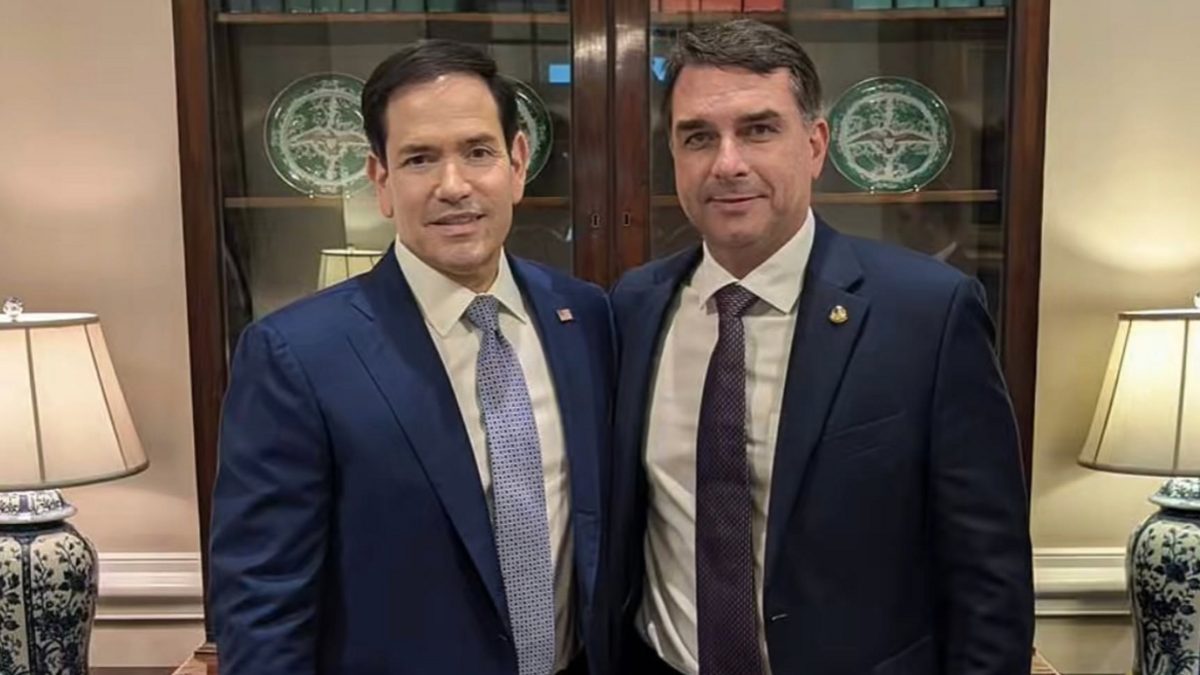
Flávio waged part of his campaign abroad. In May, he was received at the White House. On the agenda: organized crime, tariffs and rare earths, the materials for which Washington is trying to reduce its dependence on Beijing. He pressed for the Primeiro Comando da Capital (PCC) and the Comando Vermelho to be designated as foreign terrorist organizations. The State Department agreed on May 28, with effect in June, under Section 219 of the Immigration and Nationality Act. Lula’s camp called it blatant interference, a blank check handed to the opposition candidate in the middle of a campaign; the right saw it as Washington’s admission that the outgoing government was not doing what was needed against the gangs.
Flávio’s foreign-policy platform fits in a few lines, each heavy with consequences: a free-trade agreement with the United States, possibly extended to the wider Americas; cooperation on critical minerals, as reported by Folha de S. Paulo; an openly pro-Israel alignment; and a harder line on Beijing. Lula, by contrast, champions the partnership with China and a strategic autonomy that readily sours into resentment toward Washington and its allies, Israel first among them — so much so that Eduardo has turned it into a slogan: Lula "supports Hamas."
The paradox is economic. China is Brazil’s largest trading partner; according to Reuters, Brazilian agricultural exports to China topped $55 billion in 2025. Soybeans, iron ore, beef: this is the income that sustains the Center-West and part of the South — precisely the regions that have just voted for Flávio. Washington, for its part, has wielded the stick. In 2025, Donald Trump raised tariffs to 50% on a broad range of Brazilian goods, citing the "witch hunt" against Jair Bolsonaro, before exempting civil aviation, orange juice and energy, among others. In July 2026, a new surcharge of about 25% hit some $7 billion in exports, along with restrictions on new applications for permanent visas.
A Bolsonarist government would promise a way out of this rut; a fourth Lula term would prolong it. But a campaign pledge is not a decree: agribusiness and the mining sector will have to go through Congress, and soybeans sold to Beijing cannot be rerouted by press release.
Eduardo, meanwhile, has already set the regional course. Nicolás Maduro "is no longer president," he says; Daniel Ortega had opponents who dared to run arrested; between these leaders and El Chapo or Pablo Escobar, he sees no difference beyond their capture of state institutions. Maduro’s arrest "brings hope," and not only to Venezuela. A President Flávio would therefore be no ally of convenience: a pardon for his father, gangs designated as terrorists, minerals opened up to American investors, Israel rather than Lula’s line on Gaza. The continent’s largest state would cease to be a counterweight to the conservative wave, and Beijing would lose its main agricultural partner in the hemisphere. If Lula holds on, Latin America will remain an archipelago whose center of gravity still faces, at least in part, toward China.
Moraes, the Pardon and the Clan: The Real Campaign
For part of the Bolsonarist electorate, the opponent was never Lula but the Supremo Tribunal Federal. Flavio Morgenstern, quoted by Fox, put it bluntly: the election pitted "all of freedom-loving Brazil" against a Supreme Court that supposedly concentrates "all the power." Justice Alexandre de Moraes is its most reviled face. The day after the conviction, Marco Rubio denounced the "political persecution" waged by this already-sanctioned judge and promised an American response to the "witch hunt." Brazil’s Foreign Ministry, Itamaraty, retorted that the threat "attacks Brazilian authority" and ignores the "overwhelming evidence" in the case file. Donald Trump, who says he followed the trial, likened it to what "they tried to do" to him, before summing up: "He was a good man."
From the United States, Eduardo is waging a maximum-pressure campaign: sanctions against Brazil and the application of the Magnitsky Act to Moraes, already secured with the backing of Scott Bessent and Marco Rubio. He says he is himself being prosecuted for speaking to American officials, which Brasília, by his account, treats as an attack on national sovereignty, and he accuses the judge of lacking "the courage" to go after Trump, Bessent and Rubio. Flávio’s promised pardon would cover his father, his brother and "more than 400 conservatives."
On January 8, 2023, the day government buildings in Brasília were ransacked, Jair Bolsonaro was in Florida; the argument, endlessly repeated, is a political one and settles nothing in legal terms. Congress has passed a bill that would sharply reduce his sentence; Lula vetoed it in January; lawmakers may attempt an override, and the Court could still rule on the law’s constitutionality. Eduardo sees it as "one more chapter" in the judiciary’s "invasion" of politics.
Meanwhile, the family name is turning into seats. According to Fox, Michelle Bolsonaro, Jair’s wife, and Carlos, his second son, are headed for the Senate, and Jair Renan for the Chamber of Deputies. The PL was reportedly on track for twenty-nine senators against nine for the PT, and 121 deputies against 78 for the left-wing Brasil da Esperança federation. These are election-night figures, to be handled with care; the trend, however, is hardly in doubt. A President Bolsonaro would have a base in Congress, whereas a re-elected Lula would be more isolated there than ever.
As for Dark Horse — shot with Jim Caviezel as the father, directed by Cyrus Nowrasteh from a screenplay by Mário Frias, a former culture secretary — it will have no bearing on October 25. It does, however, reveal the story the clan intends to tell about itself: Carlos thanked the actor for "one of the most beautiful gifts" of his life, in the name of "God, Jesus and freedom."
Lula: One Fight Too Many?
Lula remains the only figure capable of holding the left together. In 2022, he had pledged to serve a single term; he has gone back on his word. Freed in 2019 after the Supreme Court reversed its own case law, his convictions annulled in 2021, he defeated Jair Bolsonaro by a hair in the closest election since Brazil’s return to democracy in 1985. The machine is intact, and so is the Northeast. The legend of the political comeback is far less so. At eighty, seeking a fourth term after a broken promise was already a gamble; the first round has raised the stakes.
On October 25, Lula will have the PT machine, the loyalty of the Northeast and a campaigning talent no one disputes. Flávio will arrive with first-round momentum, productive Brazil behind him, reserves of votes that lean right, Donald Trump’s patronage and, among his own supporters, the conviction that the judges have gone too far. Nothing is settled. The rebuke to the pollsters, however, is already on the record: the son of a man sentenced to twenty-seven years in prison enters the runoff in the lead, where his father, a free man, lost by a whisker.
#FlávioBolsonaro, #Lula, #JairBolsonaro, #Washington, #Beijing, #TelAviv, #Datafolha, #PT, #PL, #Chine, #Israël, #Hamas, #PCC, #ComandoVermelho, #AlexandreDeMoraes, #MarcoRubio, #DonaldTrump, #EduardoBolsonaro, #NicolasMaduro, #DanielOrtega, #Venezuela, #Cuba, #Nicaragua, #Uruguay