ANALYSIS – Hunting Jews 2.0: From Milan to London, the Return of the Lists and the Globalized Intifada
By Angélique Bouchard
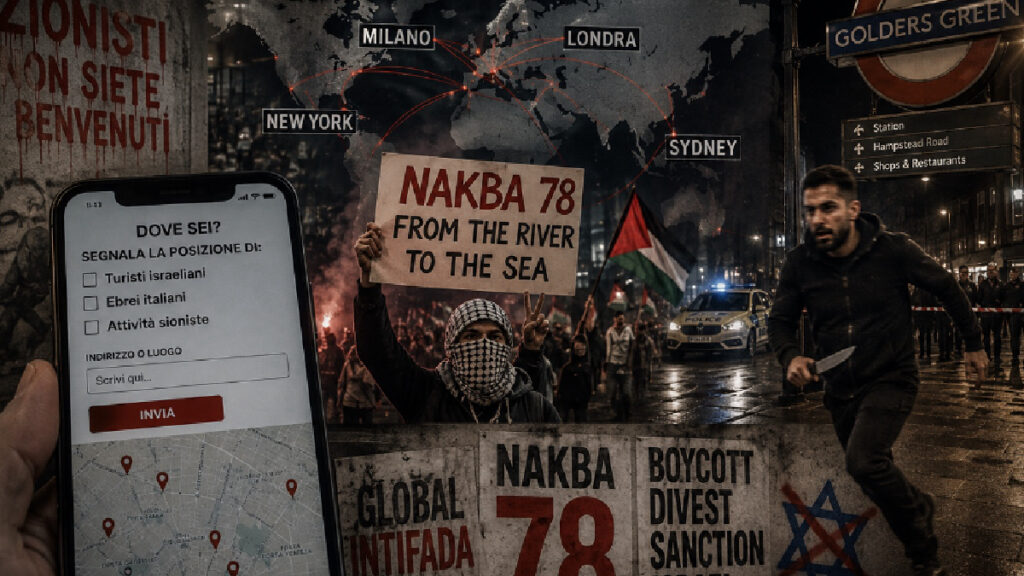
In Italy, an anonymous online form invited the public to report the locations of Israeli tourists, Italian Jews, and businesses deemed “Zionist.” In London, a man ran through the streets of Golders Green, knife in hand, looking for Jews to stab. In the United States, a transnational network of some 425 organizations is mobilizing hundreds of “Nakba 78” protests. From Milan to Florida, from Sydney to Detroit, the same logic is at work: map, harass, demonize — and, at times, strike.
Milan: “We’re Going Back to the 1930s”
Italian authorities shut down an anonymous online effort that asked the public to “map Zionist tourism,” property purchases, and what it called “Zionist neo-colonization” in Italy. The questionnaire invited users to identify Jews, Israelis, and people believed to be connected to Zionism at hotels, vacation rentals, businesses, and other public places. According to La Repubblica, later sections asked respondents to name locations where Jewish or Israeli visitors had been seen and to indicate whether local organizations or activist groups were already “managing the phenomenon.” The information collected was to be received by the Global Sumud Movement — an activist network associated with flotilla efforts to reach Gaza — remain confidential, and be used to coordinate unspecified “initiatives,” after sources provided by respondents had been verified.
“I think we’re going back to the 1930s, to hunting Jews,” Walker Meghnagi, president of the Jewish Community of Milan, said after the Google form began circulating on social media and messaging platforms.
Italian Senate President Ignazio La Russa responded with unusual severity: “The online mapping of so-called ‘Zionist tourism,’ rightly denounced by the president of the Jewish Community of Milan, Walker Meghnagi, is an aberrant initiative, in direct violation of fundamental human rights and the constitutional principles on which our nation is founded.” He added: “No form of cataloguing of persons on the basis of their religious belief or their connection with Israel is acceptable or justifiable. Behind all this lies a profound anti-Semitism that must be unanimously, firmly, and determinedly rejected. We cannot remain motionless in the face of such serious facts that recall the ghosts of the past. To the Jewish Community all my closeness.”
The form was removed following the intervention of Gen. Pasquale Angelosanto, Italy’s national coordinator for the fight against antisemitism. The Global Sumud Movement denied commissioning it, telling La Repubblica: “Zionism is one of the issues we work on, but we do not hunt Jews, and we know nothing about this questionnaire. We did not commission it and had not even seen it before it was taken offline.” The organization said it learned of the form through news reports and reserved the right to take further action, including a formal statement.
Meghnagi warned of the concrete danger: “What is happening today shows that there are unbalanced individuals out there, and if this kind of message spreads widely enough, you are certain to find someone willing to act on it. For this reason, mapping where Jews are is extremely serious.” Alessandro Morelli, an Italian deputy secretary of state, called the form “abhorrent” and said those responsible should not go unpunished.
The Milan case is not an isolated accident: it fits a climate in which, in Italy itself, flash mobs and protests in support of Gaza flotilla activists (Global Sumud Flotilla) have marked recent months — in Milan, at Piazzale Loreto and elsewhere — against a backdrop of activist detentions and anti-Israel tension. Italy also ranks explicitly among the most mobilized countries of the “Nakba 78” weekend, behind the United States and the United Kingdom: the Milan form is not a local anomaly, but a symptom of a European front already plugged into the same transnational network.
À lire aussi : Global Antisemitism in 2025 : Trump Calls for Jewish Pride Amid Bondi Beach Tragedy
Nakba 78: A Global Network, a Billion Dollars, a “Red-Green” Alliance
A Fox News Digital investigation identified roughly 425 organizations — communist groups, Muslim advocacy organizations, and anti-Israel activist coalitions — operating within a coordinated transnational protest network with a combined funding footprint of about $1 billion in annual revenues. Some 736 events across 39 countries were logged for the “Nakba 78” weekend, the anniversary of Israel’s founding framed as “catastrophe.” The United States leads (187 events), followed by the United Kingdom, Italy, Germany, Canada, Spain, France, Ireland, and Australia — countries with organized Muslim and Palestinian diaspora communities.
Dalia Ziada, a Middle East scholar and Washington, D.C.-based coordinator at the Institute for the Study of Global Antisemitism and Policy, who fled Egypt after criticizing the October 7 attacks, sees a “sinful marriage between the radical left and radical Islamism, the groups that hate Western liberal democracies and desire to destroy them.” In her view, Islamist movements, including groups tied to the Muslim Brotherhood, have for years used the Palestinian cause to build alliances with other activist movements in the West — what some analysts call a “red-green alliance.”
The Singham money trail. Over nearly a decade, Marxist tech mogul Neville Roy Singham has, according to the Fox News Digital investigation, funneled $278 million into a network of nonprofits — including the People’s Forum (a pro-communist activist hub in Manhattan), CodePink, and BreakThrough BT Media — that have organized a steady wave of anti-Israel protests in the United States, especially after the October 7, 2023, massacre, and that are now backing this year’s “Nakba 78” mobilizations. The investigation traced the flow of that money into structures that also promote Chinese Communist Party propaganda. The U.S. Treasury, Justice, and State departments are examining funding structures and operations on American soil; in Congress, the Judiciary, Oversight, and Ways and Means committees are investigating possible violations of laws requiring agents of foreign interests to register with the Justice Department (FARA) and other improprieties. Sen. Marsha Blackburn (R-Tenn.), a member of the Senate Judiciary and Finance Committees, warned: “One of the things we know about the Singham group and about the Chinese Communist Party is they are going to look for a fellow bad actor… and they’re going to try to partner with them in causing chaos in our cities.” She added: “There is no limit to what the Chinese Communist Party will do to create chaos in the United States.”
The language and the IHRA definition. A large-language-model analysis of “Nakba 78” mobilization materials found that 85% of the protest language repeatedly parrots the vocabulary of U.S. adversaries: America as a “fascist” and “imperialist” nation; Israel as a “genocidal settler state,” a “Zionist entity,” a “Zionist project,” and part of a “grand settler-colonial design” — often erasing the country’s name altogether. The other 15% frame the protests as “solidarity with Palestine.” Organizers’ slogans call for “Unity, Liberation, Return,” an arms embargo, an end to U.S. aid to Israel, and the “right of return” for millions of Palestinians in the diaspora — a demand Israel’s defenders argue would demographically end Israel as a Jewish state. The chant “from the river to the sea” runs through social media.
Under the working definition of antisemitism adopted by the International Holocaust Remembrance Alliance (IHRA) — not legally binding, but widely used by governments, law enforcement, and civil society as an educational and analytical tool — criticism of Israel as such is not antisemitic. Antisemitism may, however, include “denying the Jewish people their right to self-determination,” including by claiming that the existence of Israel is a “racist” endeavor, applying double standards to Israel not expected of other democracies, or comparing contemporary Israeli policy to that of the Nazis. “Nakba 78” organizers reject that framework: they call themselves “anti-Zionist,” “anti-colonial,” “anti-imperialist.” The gap is precisely there: what the IHRA definition allows one to distinguish — political criticism versus denial of the right to exist — is what the network’s dominant discourse erases, turning Israel into an “entity” to be dismantled rather than a state whose policies can be contested.
At the core of the North American network: the Palestinian Youth Movement (a central node with the People’s Forum in midtown Manhattan), the Party for Socialism and Liberation, Freedom Road Socialist Organization, Democratic Socialists of America chapters, American Muslims for Palestine, CAIR, the Muslim American Society, and Students for Justice in Palestine. Three parallel tracks: street protest, ideological education, and “agitprop” — the Soviet-era term for agitation propaganda. In New York, a “Nakba Week of Action” followed clashes near synagogues (Park East, Young Israel of Midwood); in Los Angeles, a rally at the Israeli Consulate rebranded the “Zionist Consulate”; in Boston, a teach-in with the National Iranian American Council; in Detroit and Dearborn, a fusion of geopolitical grievances and cost-of-living anger.
Brooke Goldstein, executive director of The Lawfare Project, warned: “When there is assault, vandalism, trespass, obstruction, targeted harassment, discriminatory denial of access, or coordinated conduct that creates a hostile environment in schools, workplaces, or federally-funded institutions, this is action. Not protected speech.” Jewish communal spaces are increasingly treated “as proxies for the Israeli government.” Applied to the Italian case, that framework is clear: a form that maps Jews, Israelis, and “Zionist” businesses to feed “initiatives” is not a debate of ideas — it is the methodical fabrication of a hostile environment, the first step toward the passage to violence that Meghnagi fears. Goldstein summed up the broader alliance: “What we are seeing is the spread of jihadist radical Islamist racist ideologies married to extreme-left Marxism. […] They don’t agree on anything other than destroying America and killing Jews.”
Ziada drew the lesson of 1979 in Iran: the Islamists allied with the communists, then sacrificed them once power was secured. “They agree on one thing, that they need to destroy the West as we know it today and replace it with something else. For the radicalists, they want to replace it with the Marxist system. For the Islamists, they want to replace it with an Islamist system.” The war in Gaza, she argued, has provided a “moral umbrella” to accelerate that process.
Florida, London, Auschwitz: From Rhetoric to the Knife
In Florida, Rep. Randy Fine, the only Jewish Republican in the state’s congressional delegation, is being targeted in a primary by Dan Bilzerian, a far-right candidate trafficking in openly anti-Jewish tropes and references to Hitler. Fine called it a “political pogrom”: “This is an open Nazi who transported himself from Las Vegas to Florida in order to target me. This isn’t an organic campaign. It’s an organized pogrom against the Jews. It’s a political pogrom.” An AI-generated video depicted Fine with horns — a classic Nazi trope — and a post declared: “District 6 understands the Jewish problem.” Fine: “I’ll be honest, never in my wildest nightmares did I think I would start the week with a swastika painted on one of my yard signs and end the week with a video from a Republican congressional candidate with horns coming out of my head.” Mike Johnson and Hakeem Jeffries condemned it with one voice; Josh Gottheimer called it a “Nazi platform” and stressed that “when someone runs for the United States Congress on Jew-hatred, every one of us, Democrat and Republican, has an obligation to say so out loud.”
In London, a man stabbed two Jewish men — one in his seventies, one in his thirties — outside a synagogue in Golders Green. Ambulances belonging to a Jewish charity had been firebombed in the same neighborhood; a memorial to the victims of October 7 had been burned. The British government raised the national threat level from “substantial” (an attack is likely) to “severe” (an attack is highly likely in the next six months) — last at that level in November 2021. Nitsana Darshan-Leitner, president of the Shurat HaDin Law Center, argued that the United Kingdom had allowed a climate in which calls to “globalize the intifada” echo through the streets, in which incitement is tolerated, and in which Jewish life is increasingly treated as expendable. “We had been told not to overreact. Marches were just marches. Words were just words. The marches had become arson. The rhetoric had become violence. And that morning, it had become a man with a knife hunting Jews outside a synagogue in Golders Green.” Keir Starmer has promised concrete measures and £25 million to improve security for the Jewish community; Darshan-Leitner warned: “Statements without arrests are theater. Threat-level upgrades without prosecutions are paperwork.” A growing number of British Jewish families are quietly weighing emigration to Israel.
At Auschwitz, some 130 police leaders from across the globe convened for the “Not on Our Watch – The Democratic Policing Initiative,” aligned with the March of the Living. Paul Goldenberg, a 37-year law-enforcement veteran: “What is striking is that these are not foreign entities — they are integral parts of the societies in which they exist. A synagogue in Belgium is Belgian. A synagogue in London belongs to London. A synagogue in New York City is part of the fabric of that city. […] From a policing perspective, what is deeply concerning is the erosion of safety and security for vulnerable communities. It is a deeply alarming scenario — one that, in some respects, echoes patterns seen in the 1930s.” A transnational memorandum of understanding was signed in Berlin to strengthen early threat detection and cross-border intelligence-sharing.
*
* *
From the Google form in Milan to the 736 “Nakba 78” events, from the Florida candidate with AI horns to the knife in Golders Green, the through-line is not criticism of an Israeli policy: it is the listing, the demonization, and, at times, the hunting of Jews as such. Meghnagi said it without varnish: mapping where Jews are is already preparing the passage to action. La Russa recalled the “ghosts of the past.” Italian authorities took the form down — proof that a state can act quickly when it names the problem and decides. In London, the threat level was raised and funds announced; the results remain to be proven. Blackburn and Congress are probing Singham’s $278 million and possible FARA failures. The IHRA offers a compass to separate criticism from denial of the right to exist — a compass the “Nakba 78” network refuses. Police leaders march at Auschwitz under the banner “Not on Our Watch.”
Between the billion-dollar network, the red-green alliance, the nominal lists, and the return of the knife outside synagogues, the question is no longer whether antisemitism is “rising.” It is whether Western democracies will still treat the protection of Jews as a non-negotiable obligation — or as an adjustable variable in the face of the street and of networks that, from Milan to Manhattan, have turned hatred into a coordinated, funded program.
À lire aussi : ANALYSIS – Trump Warns China of ‘Big Problems’ Over Iran as Xi Summit Nears: Washington Hardens Its Stance
#Antisemitism, #JewishSecurity, #JewishCommunity, #JewishNews, #Israel, #IsraelNews, #AntiZionism, #GlobalIntifada, #GlobalizeTheIntifada, #Nakba78, #Milan, #London, #GoldersGreen, #Europe, #UnitedStates, #MiddleEast, #Gaza, #Palestine, #JewishLife, #HateCrime, #HateSpeech, #PoliticalExtremism, #Radicalization, #Islamism, #RadicalIslamism, #FarLeft, #FarRight, #Extremism, #PoliticalViolence, #Terrorism, #JewishHistory, #IHRA, #HumanRights, #WesternDemocracies, #October7, #AntisemiticViolence, #JewishSafety, #Geopolitics, #GlobalSecurity, #BreakingNews