ANALYSIS – October 17 Riots: The Gulf as a Scapegoat and France Confronts Its Domestic Crisis
By Angélique Bouchard
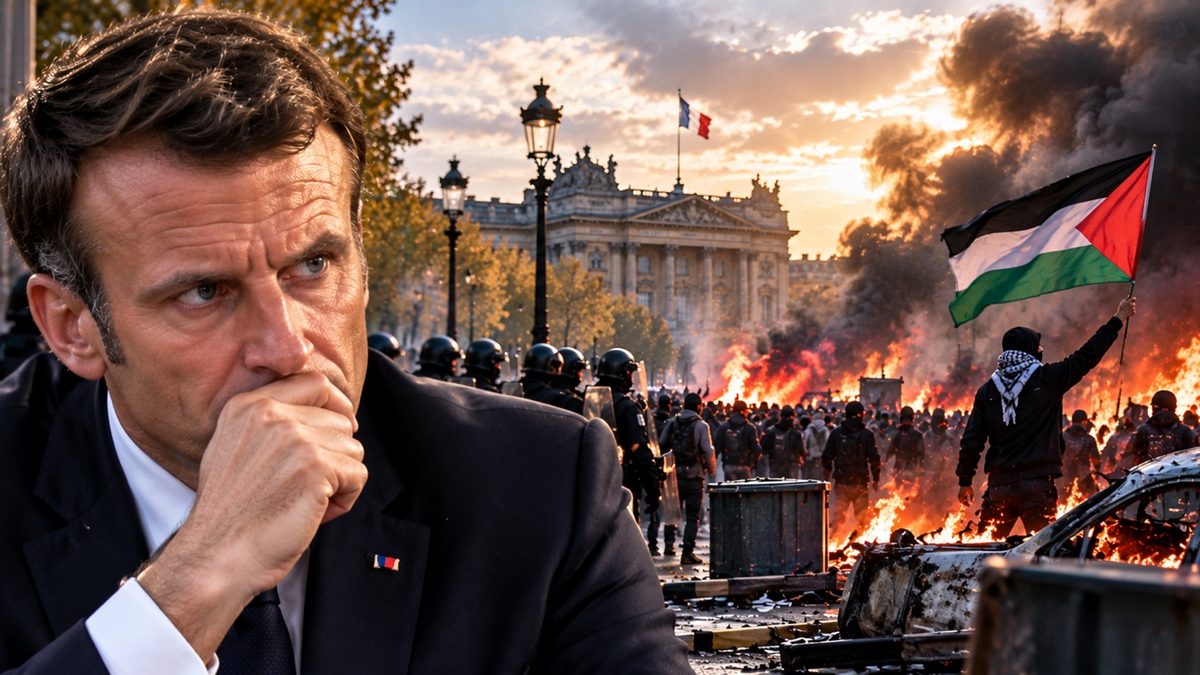
On October 17, the high school revolt that had shaken France since late September merged with a national day of protest against the cost of living. That same evening, public buildings burned and shops were looted in several cities. Emmanuel Macron blamed part of the anger on the conflict in the Persian Gulf and surging fuel prices; his own government blames the ultra-left; from Washington to Budapest, leaders see the fruit of immigration. Each of these narratives explains part of the crisis. The first, above all, serves to avoid looking at the other two.
In early October, these pages described a high school street that had already started the presidential campaign. Three weeks later, the movement has changed scale. Born of documented grievances about schools — overcrowded classrooms, unreplaced teachers, crumbling buildings — it tipped into arson and looting before dissolving, on Saturday, October 17, into a nationwide day of action against the cost of living. As early as October 6, Interior Minister Laurent Nuñez told the National Assembly’s law committee that 6,629 people had been arrested since the student movement began. On the eve of the 17th, he warned on France 2 of "damage by the ultra-left" around some 250 planned actions and 80 marches.
Turnout estimates diverge: around 200,000 demonstrators, including 40,000 in Paris, according to an AFP caption; more than half a million according to Bloomberg. Arrest figures vary just as widely. Authorities reported 1,800 arrests, including more than 800 in Paris, according to Fox News, while analyst Lisa Daftari cites nearly 2,400 arrests in a single day. Limoges city hall was gutted by fire. On Monday the 19th, Sébastien Lecornu asked prefects to impose partial curfews, while Emmanuel Macron ordered a security review after what Fox News describes as a major intelligence failure: 60,000 police officers overwhelmed, senior officials admitting that control had been lost in several major cities, and an interior minister who offered the president his resignation.
The Gulf, a Convenient Explanation
In his televised address on Sunday, October 18, Emmanuel Macron tied part of the discontent to the war in the Gulf. Demonstrators, he said, had expressed concern about the cost of living and the price of fuel, "both driven by the conflict launched in the Persian Gulf, a conflict in which France has taken no part but whose consequences we are suffering." He said he understood a concern shared "in several other European capitals," announced international initiatives to secure fuel and gas supplies, and a three-nation tour of the Gulf devoted to the energy crisis. Those who had tried "to bring down the Republic," he added, would be held accountable.
That reading was immediately challenged. Speaking to Fox News Digital, Lisa Daftari, an Iran expert and editor-in-chief of The Foreign Desk, first turned the argument around: fuel is expensive because the Iranian regime closed the Strait of Hormuz and held the world’s energy supply hostage. Above all, the facts do not fit the presidential narrative. Infrastructure and landmarks set ablaze, shops looted across the country, nearly 2,400 arrests in a day: none of it, she argues, looks like a protest over the price of diesel, but rather like organized lawlessness that the government itself acknowledges when it blames ultra-left groups and criminals. France is in a domestic crisis, she concludes, and current geopolitics cannot serve as its alibi. The Fox News correspondent notes, moreover, that it is hard to identify which demonstrators the president had in mind when he attributed fuel-price concerns to them.
The government, indeed, does not confine itself to the energy explanation. The prime minister accuses the "ultra-left movement" of orchestrating "profound disorder" ahead of the presidential election. Early in the month, according to Le Monde, Education Minister Édouard Geffray had accused LFI of fueling the first demonstrations before describing a movement "taken hostage by ultra-left groups." Jean-Luc Mélenchon and his party’s lawmakers reject any responsibility and accuse the executive of politicizing the crisis. Marine Le Pen, for her part, is calling for an anti-rioter law: "This is no longer about high school student protests. It is about riots organized by professionals and overseen by deputies from La France Insoumise." The executive thus speaks in two registers: when it addresses the country, it talks about the Gulf; when it names culprits, it talks about the ultra-left.
Fifty-Four Organizations Behind the Street
On October 19, a Fox News Digital investigation by Asra Q. Nomani identified 54 organizations and movements at work in October’s mobilization, from direct organizing to media amplification, within what she calls a "Chaos Inc." with international branches. The figure that matters is this: only sixteen of these groups, barely a third, are student or high school organizations. The other thirty-eight are adult-led: communist and revolutionary parties (the French Communist Party, the New Anticapitalist Party, Révolution Permanente, the Socialist Equality Party, the International Communist League), La France Insoumise, the major union confederations and their education federations (CGT, FO, FSU, SUD, Solidaires, CNT), the Yellow Vests, Les Soulèvements de la Terre, the Party of the Indigenous of the Republic, Palestine-solidarity groups such as Urgence Palestine, and several outlets tied to the network of Neville Roy Singham, the American tech tycoon based in Shanghai: the Tricontinental institute, CodePink and the New York-based BreakThrough News. On the youth side: the Union of Communist Youth, Le Poing Levé, the Student Trade Union Federation (FSE) with its red flags, the High School Students’ Union, UNEF, and the Muslim Students of France, whose exact role on October 17 the investigation notes remains to be confirmed.
The inventory has its limits, which its author herself flags: several entities appear only for public solidarity or media coverage, and a few — Amnesty International, the Human Rights League, the FCPE parents’ federation — are listed for calling people onto the streets or denouncing the police, not for organizing anything. But the backbone is there. A mobilization presented as a high school movement rests, for two-thirds, on adult, partisan or union machines, some of them with long experience of street confrontation. It is this backbone that broadened the initial school grievances into a general confrontation with the government, austerity, the police and, for some, military spending. LFI lawmaker Louis Boyard waving a Palestinian flag alongside students at Paris-Est-Créteil University, Fabien Roussel marching in Paris under PCF banners, FSE activists in Bordeaux chanting "only one solution, the Revolution": the photographs of the marches, where hammers and sickles, keffiyehs, Palestinian, Algerian and Moroccan flags mingle with CGT vests and yellow vests, bear the imprint.
The Singham network, for its part, gives the mobilization a global echo chamber. Vijay Prashad, executive director of Tricontinental, hailed on X an uprising linking Paris, New Delhi and Buenos Aires. BreakThrough News broadcast a montage of clashes filmed from Montpellier to Saint-Étienne under the headline "Anti-Macron protests rock France." Jodie Evans, CodePink co-founder and Neville Roy Singham’s wife, urges Americans to "look at France, Spain and India" ahead of a November campaign in Washington against military spending. Finally, a coalition of 28 communist and socialist youth organizations, from Britain to Greece, is calling a European strike on November 20 across twelve countries under the slogan "Fight for Our Future, Not Their Wars!", with walkouts, blockades and occupations. France is not the end of the story; it is the model.
The day after the investigation, Barak Seener, an associate research fellow at the Henry Jackson Society, drew a broader reading for Fox News: that of a "Red-Green alliance" in which illegal immigration serves as a Trojan horse, and whose existence Macron continues to ignore. Nomani’s inventory does not go that far — it lists only one Muslim organization, a student one, whose role is unconfirmed — but it documents what the Élysée refuses to name: a convergence of machines that have nothing to do with high school. The authorities have also opened investigations into allegations of police violence, and Amnesty International has warned against disproportionate force against minors.
Milan, Liège, Brussels, Madrid: The European Echoes
France is not alone, as Emmanuel Macron himself pointed out. That same weekend, protests over the cost of living, education or housing degenerated in several neighboring countries, with one common feature: marches made up of very young people, often minors, a fraction of whom tip into violence and looting.
In Italy, the "Italia in piazza" protests against the high cost of living and deteriorating public services turned into riots on October 17 and 18. On the Saturday, according to Euronews, a march of some 5,000 people in Milan was overrun by groups of hooded youths who stormed Piazza Duomo and the Galleria Vittorio Emanuele II: 25 injured, including ten police officers, and 50 detained, half of them minors; twelve detentions in Turin, ten of them minors, found carrying petrol bombs and cobblestones; seven in Bologna. On the Sunday, the street fighting resumed in central Milan in small mobile groups: a Carrefour supermarket and a Decathlon store looted, shop windows smashed from Via Torino to the Castello Sforzesco, and 271 people taken to police headquarters, 220 of them minors. Thirty-two were formally arrested, 23 of them minors, and 174 were held under the new "preventive detention" created by the latest security decree. Over two days, more than a hundred police officers were injured. "Demonstrating is a right, setting our cities on fire is not," responded Giorgia Meloni, who called a public-order meeting for Monday and urged the opposition not to be "ambiguous," since "any reticence becomes a justification." Matteo Salvini denounced "social centers, maranza and rotten left-wing riff-raff"; the League is calling for preventive detention of minors. The left-wing mayor Giuseppe Sala, who called the violence "unjustifiable" while understanding the reasons for the anger, promptly clashed with the interior minister over the shortage of officers. In Italy as in France, October’s street is already a campaign issue.
In Belgium, the protests predated October 17. High school students in Liège took to the streets as early as October 1 against reforms in French-speaking education and the increase in tuition fees at colleges and universities, demands quickly broadened to austerity and "police repression." Smashed windows, burning bins and scooters, projectiles thrown at police: in one week, Liège police made 194 arrests, 114 of them of minors, and the socialist mayor Willy Demeyer banned gatherings of more than three people. Interior Minister Bernard Quintin sent federal units, accused antifa groups of manipulating minors and rebuked mobilized teachers for not keeping their pupils in class. On October 17 in Brussels, 500 to 600 demonstrators who had set off from Central Station were blocked at Gare du Midi, where water cannon and tear gas answered projectiles and barricades; police detained 150 people, including 32 judicial arrests, and counted five officers injured; the youngest detainee was twelve. In Liège, the same day, 45 arrests, 12 of them minors. "Pure and simple violence," Bernard Quintin ruled.
In Spain, the context differs but follows the same mechanics. The eviction in late September of Maricarmen Abascal, 87, from the Madrid apartment she had lived in for seventy-one years, after an investment fund bought the building and sought to raise her rent by 275%, crystallized the housing crisis. A camp sprang up at Puerta del Sol, which the Madrid courts refused to clear. On October 3, demonstrations drew between 70,000 and 500,000 people in Madrid and up to 50,000 in Valencia, where police charged; Barcelona followed on the 5th with tens of thousands. On October 2, Congress had rejected the government’s two housing decrees; on the 5th, Pedro Sánchez dissolved parliament and called early elections for November 29. Maricarmen Abascal died on October 7 without seeing her home again. In Spain, the street toppled an electoral calendar; in France, it is preparing one.
These episodes answer to no central coordination, but they feed on one another, and the activist networks say so — Jodie Evans does not cite France, Spain and India by accident. The leaders, meanwhile, converge on vocabulary: the distinction Giorgia Meloni draws between the right to protest and wrecking, Péter Magyar repeats almost word for word from Budapest, about France. France is therefore not an isolated case; it stands out for the intensity of the violence and its politicization, six months before a presidential election.
Washington and Central Europe Read the Crisis Through Immigration
The American reactions were immediate. Donald Trump says he warned Emmanuel Macron at their very first meeting: "I said, you got to close up your borders. You’re going to ruin your country. And they’ve ruined their country. It’s going to be hard to get it back. But hopefully France will come back." He pressed the point the next day: "the migrants have taken over France." On X, Vice President JD Vance accused "Western liberals" of having "imported the third world into France and other countries in the name of diversity and compassion": "They ignored fundamental questions of assimilation and compatibility. They were told it would lead to this and they didn’t listen."
House Speaker Mike Johnson sees in the riots a "chilling warning" for Americans. France, he writes, is descending into chaos because it wanted open borders, "just like the socialist Democrats in America," and the United States is "not merely in a battle of political ideologies" but in "a battle for the preservation of our civilization." The statement comes two weeks before the midterm elections, and Mike Johnson draws the lesson explicitly: a Democratic victory would mean open borders and illegal immigrants overrunning the country. France serves here as a campaign argument as much as a subject of analysis.
The same mechanism is at work in Central Europe. Hungarian Prime Minister Péter Magyar declared that "Europe can count on Hungary" and that such destruction showed why Budapest advocates "the strictest possible approach" to migration. His Polish counterpart, Donald Tusk, promised that Poland "will not repeat the mistakes of other European countries, nor will it pay for them," that it was firmly defending its border against illegal migration and deporting those who break Polish law. His predecessor and possible challenger, Mateusz Morawiecki, went further: "France is burning, and we must be wise before the harm is done." According to Eurostat figures cited by Fox News, France had nearly 10 million foreign-born residents in 2025 and Italy about 7 million, against roughly one million in Poland, half of them from Ukraine, and fewer than 700,000 in Hungary, mostly from other EU countries. In 2024 France posted one of the highest totals of recorded offenses in the Union; Poland and Hungary, among the lowest.
The analysts Fox News consulted supply the key. For political scientist Daniel Schatz, images of chaos carry more weight than a hundred policy speeches, and the leaders’ message is simple: this is what we intend to prevent. The streets are French or Italian, he sums up, but the voters being addressed are Hungarian or Polish. Boštjan Udovič of the University of Ljubljana recalls that these countries tie their EU membership to a national identity forged in struggles for independence, and cannot be expected to adopt the model of a multiethnic society; Donald Tusk, he adds, is entering a pre-campaign in which migration will weigh. The Élysée invokes the Gulf; Washington, Budapest and Warsaw invoke France. But the electoral motive does not invalidate the finding: the Algerian and Moroccan flags in the marches, the neighborhoods where the first blockades began, the profile of those arrested that the authorities take care not to publish — all of it raises the question of integration that successive French governments have preferred to set aside.
A Crisis That Alibis Cannot Explain
October’s unrest cannot be reduced to a flare-up of anger over fuel prices or a mechanical consequence of the war in the Gulf. It springs from the meeting of legitimate school grievances, a far-left activist ecosystem seasoned in street mobilization and equipped with international relays, and a pre-election calendar that favors every kind of exploitation. The energy explanation accounts neither for the scale of the damage, nor for the coordination observed, nor for the intelligence failure the Élysée has had to acknowledge. The American and Central European readings, however self-interested, raise a question the French authorities have largely dodged: that of the cumulative effects of migration policy and assimilation.
The echoes seen in Italy, Belgium and, to a lesser extent, Spain confirm that several European societies face comparable tensions over the cost of living and public services, with violent turns involving a majority of minors — 220 of 271 in Milan, 114 of 194 in Liège, 87% of those prosecuted in France. Six months before the presidential election, clear-sightedness will require separating what stems from failures of public management, what proceeds from organized political networks, and what flows from the migration and security choices of past decades. Otherwise each camp will go on reading the crisis through the alibi that suits it: the Gulf for the Élysée, repression for La France Insoumise. And the crises to come will be read the same way, at the risk of once again masking their real causes.
#France, #EmmanuelMacron, #PersianGulf, #UltraLeft, #DomesticCrisis, #CostOfLiving, #HighSchoolProtests, #FuelPrices, #EuropeanPolitics, #SecurityReview, #IntelligenceFailure, #Protests, #PublicDisorder, #EnergyCrisis, #SocialUnrest, #YouthProtests, #MacronSpeech, #GulfConflict, #FrenchGovernment, #EuropeanUnion, #CentralEurope, #MigrationPolicy, #PublicServices, #ElectionCampaign, #PoliticalNarratives, #MediaCoverage, #SocialMovements, #UnionProtests, #PoliticalParties, #LeftWingPolitics, #RightWingPolitics, #EuropeanSociety, #PublicManagement, #SecurityChoices