ANALYSIS – Smithsonian: “Bile” in Place of History — the Battle for the American Story
By Angélique Bouchard
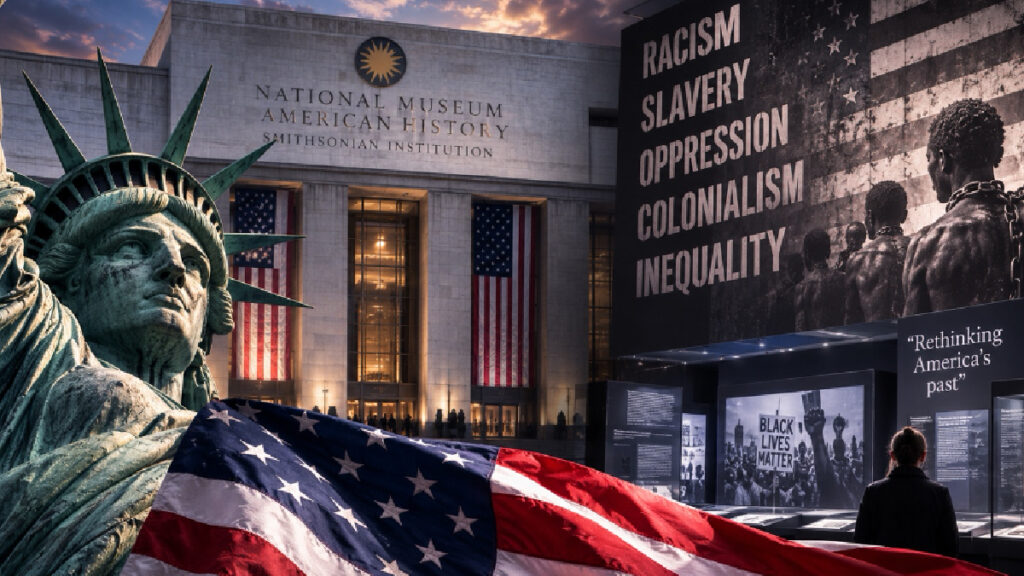
The National Museum of American History, a flagship of the Smithsonian Institution, is accused of turning the national narrative into “bilious self-flagellation.” After a White House report and heated congressional hearings, legal expert Cully Stimson is calling for a change of leadership. A descendant of enslaved people, Bishop Earl Walker Jackson, speaks of anti-American “indoctrination.” As the country marks its 250th anniversary, the question is no longer merely curatorial: who writes America, and for what political project?
“It’s Bile”: Cully Stimson’s Assault
Cully Stimson, a senior legal fellow at the Heritage Foundation and former assistant U.S. attorney for Washington, D.C., told Fox News Digital that the museum has embraced a “self-loathing” view of the nation’s past.
“I think this is part of a broader effort by radicals on the left to redefine the history of the United States and reframe it in an oppressor-versus-oppressed narrative,” he said. “Instead of looking at American history chronologically with all the triumphs and tragedies, including slavery, and then the things that our country did to eradicate the vestiges of slavery — the 13th, 14th and 15th Amendments, the Civil Rights Acts — they take a very pro-reparations, ‘we’re a bad country,’ oppressor-versus-oppressed narrative.”
The comments come after a July 2026 report by the White House Domestic Policy Council, titled Saving America’s Story(162 pages), which accuses the Smithsonian of having undergone “ideological capture” and of advancing DEI and left-wing agendas. The document includes images of exhibits and placards and information about museum curators and leaders. This is no mere internal memo: at 162 pages, the report mounts a documented indictment of the National Museum of American History, drawing on photographs of installations, wall-text language, and profiles of officials. Its central thesis — the museum’s “ideological capture” — supplied the political framework for the parliamentary hearings that followed. Signs were even installed outside the museum on the National Mall directing visitors to the White House report: the conflict over the national story thus moved out of the galleries and into public space, at the very moment of the 250th-anniversary celebrations.
On July 21, 2026, Anthea Hartig, who has led the museum since 2019, appeared before a subcommittee of the House Oversight and Government Reform Committee in a hearing titled Rewriting American History: Examining the Smithsonian’s Efforts to Reshape the Past, tied to work on government efficiency. Lawmakers accused her of allowing political activism to seep into exhibits and to shape how history is presented; Hartig maintained that the museum is nonpartisan and “does not take sides in America’s political debates.” It was during this same sequence that Rep. Brandon Gill (R-Texas) confronted her over materials associating politeness with “White supremacy culture,” culminating in the question that went viral: “Is Mickey Mouse racist?”
Stimson said she should have been fired “the minute after the hearing” for what he called “smug and self-righteous” behavior and for failing to take accountability. “Her little writing the question down and her smugness was really evincing of what she really thinks of the American people and congressional oversight,” he said.
“If the head of the Smithsonian had any shame whatsoever, she would have resigned in disgrace already and she doesn’t have any shame because she’s perfectly happy with what she’s done,” Stimson said. “She’s just the pointy end of the radical spear that’s out there trying to force this thing down the throats of Americans.”
In his view, the hearings are exposing “bile that they’re trying to pass off as history,” and “sunlight’s a good disinfectant.”
Stimson criticized exhibits featuring sexually explicit material, focused on race, gender and sexuality, and portraying the Founding Fathers chiefly through their ties to slavery rather than their role in building the country. “There should be an entire section dedicated toward the Founding Fathers and the Constitutional Convention of 1787 and the Reconstruction Amendments and all the things that happened, the Civil War, but no.”
Looking back to the 250th-anniversary celebrations in July, when hundreds of thousands of people came to Washington, Stimson said families and children were instead greeted with “all sorts of disgusting things, bondage, and all sorts of other nasty things” at the museum — at the very moment the country was supposed to be celebrating two and a half centuries of existence.
“We should not have a museum dedicated to flagellation and self-loathing,” he said. “That is not how you celebrate your country. […] Celebrating doesn’t mean whitewashing history. Every civilization throughout mankind has had slavery. That doesn’t make it right, it makes it reality.”
To those who accuse Republicans of trying to “whitewash” the past, he replies that acknowledging the darker chapters does not require turning the national museum into a permanent site of penance. America, he said, has gone through many ups and downs “to get beyond the ugly parts of our history,” which gives Americans reason to celebrate the country as it has become.
He broadened the diagnosis beyond the museums: “You see this in higher ed, you see this unfortunately in high school and even below in lower schools, and unfortunately at our premier national museums, including the American History Museum.” He compared the parental awakening during Covid — when families isolated at home got a firsthand look at what their children were being taught — to the explosion of the school-choice movement and homeschooling across the country. “Parents are the first educators of their children,” and it is up to them “to present American history” the right way.
His conclusion is blunt: “That’s all it is. It’s bile. It needs to be ripped out, root and branch, and redone.”
À lire aussi : EXCLUSIVE – Le Diplomate’s Grand Interview with Hermann Kelly, Champion of Irish Sovereignty
A Descendant of Slaves Against “Indoctrination”
Bishop Earl Walker Jackson, a pastor, author, and great-grandson of enslaved ancestors, shares the anger. In his view, to be born an American is to have “hit the proverbial lottery,” because the country offers “more opportunity and hope than any people living anywhere else on the planet.”
Although the White House report is recent, Jackson says he has been warning for years about what he describes as woke ideology at the Smithsonian, as well as in the broader education system, the entertainment industry, journalism, and sports.
A video of Hartig from a February 2025 presentation to University of California, Los Angeles students shows her calling “history as a practice” a “prime tool of social justice,” asserting that the “United States’ long and violent racial history continues to be present in our reckoning,” and that “redress in the form of reparation, of course, goes beyond acknowledgement of wrongdoing; it should leverage responsibility, it should think about the act of correction, as we pursue restorative justice and, for us, restorative justice through history.”
Jackson replied: “She talks about how history should be a tool of social justice. No, history should be facts about what has happened in the past and leave others to draw their own conclusions about what those facts mean. But no, she wants to use history to try to get people to think a certain way and respond a certain way and, namely, to be somewhat angry and bitter and resentful of our country because of our past.”
Against the narrative of an irredeemably guilty America, he offers another reading: “There is no place on earth that has been more affirming of human dignity, offered more opportunity for human flourishing. And frankly acknowledged in spite of the apparent differences that we have, that we are ultimately one nation under God.”
Himself a product of a broken home and foster care, he concluded: “I think loving America is easy because, you’re right, I’m the great-grandson of slaves, I am a product of a broken home and foster care, and yet my life has just been wonderfully blessed. First, of course, by the grace of God, but also because I live in a country where anything is possible, where you’re free, where you can dream, you can strive to fulfill your God-given gifts and talents and abilities.”
Howard Zinn, the Zinn Education Project, and the Making of the Narrative
Jackson attributes a decisive share of this drift — at the Smithsonian as in schools, entertainment, journalism, and sports — to the influence of Howard Zinn’s book A People’s History of the United States.
“Howard Zinn was a professed anarchist,” he said. “He wrote that book as a polemic against America.” He said he is “amazed at how few Americans understand that book has been more influential in teaching American history than any other book that the public schools or colleges have ever used,” emphasizing, “And it’s still being used.”
The Zinn Education Project extends that line into the classroom. Jackson pointed to materials currently promoted that draw a line between deportation operations today and Great Depression-era deportations, which the materials present as a program of “racial expulsion,” rooted in racism. The interpretive grid is consistent: the American state appears less as a framework of progressive emancipation than as the continuation of a logic of racial exclusion. Contemporary deportations are no longer discussed first as immigration policy or law enforcement, but as the latest avatar of a continuous racial history — the same pattern Stimson denounces in the museum’s galleries, where slavery overshadows the sequence of the amendments, the Civil War, and the Civil Rights Acts.
From that, in Jackson’s view, follows a clear causal chain. “If you’re learning that from the very beginning of your education, my goodness, by the time you’re an adult and you’ve been through 20,000 hours of that, no wonder we’ve got people protesting outside of ICE facilities, and no wonder you’ve got people at the Smithsonian talking about America as if we’re the worst place on earth to live. They frankly have been brainwashed and indoctrinated into it.” School shapes the gaze; the national museum consecrates it; the street draws the political consequences.
This criticism does not date from the 2026 report. As early as 2015, Jackson confronted the Smithsonian’s National Portrait Gallery over the inclusion of Planned Parenthood founder Margaret Sanger in its exhibit on civil rights leaders. In his view, Sanger was “an elitist, she was a eugenicist, she was racist, she admired Adolf Hitler [and] she spoke for the Ku Klux Klan.” To cast her as a heroine of social justice was already, to his mind, to invert the meaning of the facts in service of a militant narrative — the same mechanism he believes he recognizes today when history becomes a “tool of social justice” rather than an ordered presentation of the facts.
Thus the present debate over the National Museum of American History is not an isolated incident: it belongs to a longer battle over textbooks, curricula, and cultural institutions that, for decades, have made a polemical reading of America the dominant lens. From Zinn’s book to the Zinn Education Project worksheets, from the 2015 Portrait Gallery to the 2026 hearings, the thread is the same: who has the right to say what America has been, and what it must become.
In Congress: Gill, Mickey Mouse, and “Democratic Socialism”
At the July 21, 2026 hearing, Rep. Brandon Gill (R-Texas) confronted Hartig over materials associating politeness with “White supremacy culture,” up to the question that went viral about Mickey Mouse. He summed it up on Hannity: “We have gone so long letting the left say the most crazy, outlandish things. […] These things are genuinely insane and objectively offensive, I think, to a lot of Americans.”
Gill broadened the diagnosis: rank-and-file Democrats have allowed socialist and anti-capitalist ideas to become the heart of their base. “I think your average rank-and-file Democrat in the House right now recognizes that the Democratic socialists are no longer the fringe in their party. That is the mainstream. That’s where their base is, and they’re not going to speak out against that, because they don’t want the backlash from their base. […] They’re reaping what they’ve been sowing for so long.”
Mike Rowe: Pride, History, and Socialism
On the occasion of the nation’s 250th anniversary, Mike Rowe noted that a Gallup poll found only 53% of Americans “very proud” of the country. His reading: “If you’re not proud of the country, then it’s possible you might not be up to speed on where the country came from and how the country evolved or maybe how the rest of the countries and the world function.”
“Nobody wants a lecture or a sermon or a history lesson, but it’s hard to appreciate who and what we are today unless you really remember who and what we were 251 years ago — back when the American dream was really just a dream.” The Founders, he recalled, effectively signed their own “death warrant” when they declared independence in pursuit of “life, liberty and the pursuit of happiness.” That dream became reality with the Treaty of Paris in 1783: “We’re living in the American reality. And it’s not perfect. It will always be a work in progress, but to look at the country and say, ‘Ah, I’m not that impressed,’ I would suggest maybe visit some other countries and look back at our own history and reimagine your worldview.”
On socialism, recently successful in several local races: “Personally, I rack my brain to think of all the instances where socialism paid off. I got nothing, man. […] History is a wheel. […] We kicked [socialism] to the curb every time it reared its head.”
*
* *
The debate over the National Museum of American History goes beyond the display cases of Washington. Stimson sees “bile” that must be ripped out “root and branch” — an oppressor-versus-oppressed narrative that, in his view, obscures the chronology of American recoveries and should have cost the director her job on the spot. Jackson, a descendant of slaves, sees an indoctrination that prevents people from recognizing “the greatest nation on earth” — an indoctrination he traces back to Howard Zinn, the Zinn Education Project, and earlier curatorial choices such as elevating Margaret Sanger to the rank of a civil-rights figure. From the classroom to the national museum to protests outside ICE facilities, the chain he describes is one of a gaze formed, consecrated, then politicized. Gill reads the normalization of ideas he calls “objectively offensive” and the price paid by a Democratic Party that allowed its base to shift. Rowe reminds us that without the memory of 1776 and 1783, national pride erodes — and that socialism, for its part, has always ended up “kicked to the curb.”
At the center of this battle now stand a 162-page document, Saving America’s Story, and the July 21, 2026 hearing — Rewriting American History — which moved the conflict out of the galleries and onto the National Mall and under the cameras of Congress. The question put to the country on its 250th anniversary is simple: should a national museum tell America as a sequence of crimes to be atoned for, or as a history of tragedies and recoveries, of slavery and amendments, of failures and freedom? So long as the answer remains captured by a single ideological grid — that of a polemic turned school curriculum and permanent exhibition — the conflict over the American story will only deepen.
À lire aussi : PARTIE 2 – Le Grand Jeu Vert – Impensé stratégique : l’enfer est pavé de bonnes intentions
#Smithsonian, #AmericanHistory, #NationalMuseumOfAmericanHistory, #SmithsonianControversy, #SavingAmericasStory, #RewritingAmericanHistory, #AntheaHartig, #CullyStimson, #EarlWalkerJackson, #BrandonGill, #MikeRowe, #HowardZinn, #ZinnEducationProject, #AmericanStory, #USHistory, #HistoryWars, #CultureWar, #DEI, #WokeIdeology, #AmericanIdentity, #Patriotism, #FoundingFathers, #Constitution, #CivilRights, #Slavery, #Reparations, #SocialJustice, #PoliticalIndoctrination, #MuseumPolitics, #HistoricalNarrative, #AmericanHeritage, #America250, #USPolitics, #Congress, #TrumpAdministration, #WhiteHouse, #HeritageFoundation, #NationalMall, #AmericanExceptionalism, #HistoryDebate