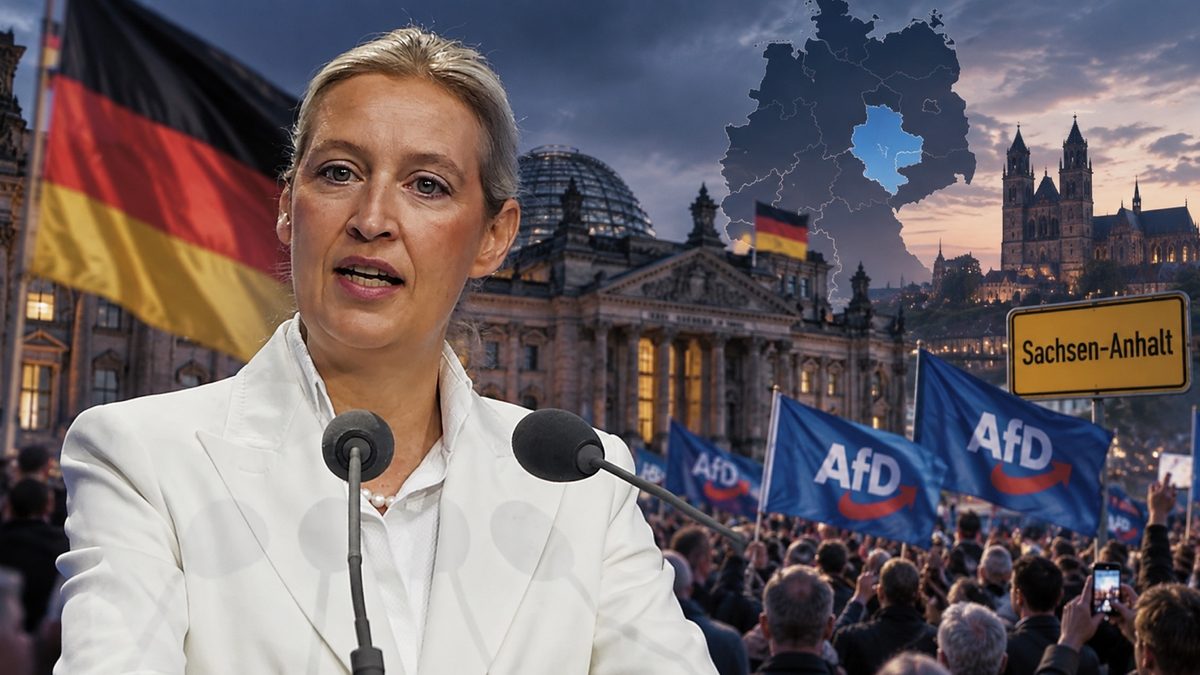
PORTRAIT – Alice Weidel, the AfD’s presentable face: after the Saxony-Anhalt earthquake, Germany’s “firewall” wavers
By Angélique Bouchard
In Saxony-Anhalt on Sunday, Alternative for Germany secured what postwar Germany had never conceded to a party outside the SPD–CDU/CSU pairing: a victory of such scale that ARD and ZDF projections put it a little above 44 percent of the vote—more than double its result of five years ago—in a state of 2.1 million people west of Berlin. Ulrich Siegmund, the 35-year-old anti-migration lead candidate, did not reach for understatement. “We have written history.” Voters, he told ARD, had sent the message that “things cannot go on like this”—and that the message also counted as “a signal toward Berlin.” Behind him, however, it is not merely a regional operative who steps forward. It is Alice Weidel, national co-chair, 2025 chancellor candidate, a figure her opponents still underestimate and whom the German-British historian Katja Hoyer describes as “the AfD’s most presentable face,” and therefore “the one her opponents should fear most.”
The Magdeburg earthquake: a signal toward Berlin
Daniel Schatz, who holds a doctorate in political science from Berlin’s Humboldt University, had put it this way even before the polls opened: “The reason Saxony-Anhalt matters is that the AfD is no longer just knocking on the door of power. It may be close to kicking it open.”
Never since the Federal Republic was refounded in 1949 had a party outside the historic duopoly obtained, on its own, the prospect of a governing majority in a Land. Contemporary Germany has likewise never seen a far-right or right-wing populist formation at the head of a national government, a federated state, or a major city. The CDU had governed Saxony-Anhalt for twenty-four years. On Sunday the AfD aimed to break that continuity—the first rupture of that kind since 1945.
Projections put the party a little above 44 percent, far ahead of Friedrich Merz’s CDU, cut to about 18 percent, half its previous score, while Die Linke, the SPD and the Greens hover around 9 percent each. The BSW remains on the edge of the 5 percent threshold. An absolute majority was not yet locked in as counting continued—the AfD intended to govern alone precisely in order to smash the “firewall”—but the symbol no longer needed the last precincts. Before the vote, Wahlrecht.de already had the party ahead, 41 percent to 23 percent against the CDU. As soon as the first projections landed, counter-protesters in Magdeburg held up a sign: “Anti-social, fascist, stupid!!!”
Janek Treiber, a researcher at the Technical University of Dresden, cautions against confusing German federalism, which would constrain the practical reach of an AfD executive, with the political effect of the gesture. “The political symbol should not be underestimated. That a single party, and a party of the right, could govern a German Land… The parties that have run Germany since 1949, or the East since 1990, are losing control. They are losing power.”
Siegmund, for his part, named the author of his campaign with unapologetic bluntness: “A very good campaigner for us in this campaign was Friedrich Merz. Every day that man spends in the chancellery is one day too many.” His priorities come down to three formulas: a “deportation offensive,” an end to incentives to come to Germany and “exploit our social system,” and a process to pull Saxony-Anhalt out of the regional public broadcaster, accused of “disinformation.” The party promotes “remigration”—the expulsion of immigrants. An AfD leader in a neighboring state has appealed two convictions for deliberately using a Nazi slogan.
Who is Alice Weidel? Portrait and private life
The Weidel paradox begins with the résumé. An economist by training, she has lived and worked in Canada, Japan, Singapore, then five years in Beijing, where she finished learning the Mandarin she had begun studying alone, from cassette tapes, at fourteen. She worked for Goldman Sachs and advised the Bank of China: a globalized executive’s path, the opposite of the provincial tribune. She lives in a civil partnership with the filmmaker Sarah Bossard, who is from Sri Lanka, and together they are raising their two sons in a small Swiss town. Elon Musk, who backed the AfD in the federal election and called the party, in Die Welt am Sonntag, Germany’s “last spark of hope,” had joked with that union specifically in mind: “Does that make you think of Hitler?”
Hoyer notes it in a dry line: “No, that does not sound particularly radical.” Weidel calls herself “liberal-conservative” rather than far right. A poll had even ranked her the most popular candidate if Germans could elect the chancellor by direct vote. Yet at the party congress the same woman demanded “large-scale repatriations,” the demolition of the “windmills of shame,” and an end to “queer-woke madness.” Despite her own situation—a same-sex couple, a partner born abroad, children raised outside Germany—she accepted the AfD’s narrowing of the family to “father, mother and children.” The discrepancy is not a biographical accident. It is the price paid to hold together the presentable wing and the identitarian base.
Her team had first had the word “remigration” removed from the manifesto—a term that denotes mass expulsions, including of people already settled. Facing the hall, she reversed course with a speed that is itself a method. “If it has to be called remigration, then that is what it will be: re-mi-gra-tion.” Syllable by syllable, to applause. With her at the helm, Hoyer notes, the party has reached its hardest line to date. “Ideological flexibility is Weidel’s hallmark.”
The same flexibility applies to men. She long sought to sideline Björn Höcke, the Thuringia state leader judged too toxic, twice convicted for the Nazi slogan “Alles für Deutschland”—“Everything for Germany.” Too powerful to be removed, Höcke became the condition of her leadership: his current supports her hold on the party; she tolerates his extremism in order to keep a fractured organization together. At the congress the hall chanted “Alice für Deutschland,” a transparent echo of the SA slogan. Weidel did not object. Hoyer again: “Embracing Höcke’s extremism is the price Weidel pays to stay at the top of the AfD.”
The same logic runs between Washington and Moscow. The AfD manifesto sets out an anti-American diagnosis—“the interests of the United States are diverging more and more from those of Germany”—and favors a rapprochement with Russia. Weidel nonetheless “warmly congratulated President Donald Trump on his successful inauguration.” She made it known that she had been invited to the ceremony but did not attend: the message, Hoyer writes, is one of powerful American backing without displayed Atlanticism. JD Vance had met her before the federal election and said that free speech was under attack in Europe.
On ZDF she argued for closed borders and an exit from Schengen. “Illegal migration, uncontrolled open borders, anyone can enter. Our internal security is suffering. People have really had enough.” On Syrians: “All Syrian refugees must have their protection status revoked, because the reason for flight no longer exists. These people must return to their homeland. If they do not leave voluntarily, they must be deported by force.” And, of the 1.3 million Syrians in Germany, many of them naturalized: “We must stop naturalizing people who should in fact leave our country. We have an Islamization.”
In a public conversation with Musk on X, followed by more than 200,000 people, she asserted among other things that “Hitler was a communist.” German public media judged the exchange “very, very weak” on substance. Hoyer warns: the liberal public is not the target. Many comments praised an “unrestricted” style. To underestimate Weidel because she laughs at Musk’s jokes would be a diagnostic error. “Whoever the real Alice Weidel is, she is nothing if not ambitious.”
Ceuta, Schengen, the euro: Weidel’s program in the open
On August 23, 2026, two weeks before the Saxony-Anhalt vote, Weidel hardened the frame still further on ZDF—and named Ceuta. In mid-August, tens of thousands of migrants, mainly from Morocco, had crossed the border of that Spanish enclave in North Africa. Madrid spoke of tens of thousands of entries in a matter of days, some already sent back, against the backdrop of an interpretation of a Spanish Supreme Court ruling and images of crowds overflowing fences and shoreline. For Weidel this was no longer an Iberian episode. It was proof that Schengen turns every Mediterranean breach into a door into Germany.
If she governs, she said, Germany will leave the Schengen area to prevent “episodes like the mass entry of migrants recorded in Ceuta in mid-August.” The wording leaves nothing implied. “We are going to close it. We are going to withdraw from Schengen so that people like those from Ceuta cannot come here.” Then: “This agreement (Schengen) must end.”
She accused Friedrich Merz’s conservative government of failing to exercise effective control. “There are open borders. Anyone can enter.” The security register follows without transition. “Women are afraid to go out in the streets. There are knife attacks everywhere.” All Syrians—“about 1.3 million”—“will all be sent back to their country.” In the same vein she demanded an end to “giving citizenship to people who should leave our country.”
The tone toward Berlin is no longer merely programmatic. It is personal. She called those in charge “idiots.” “I do not want those idiots sitting there lying to me and promising one thing and then doing exactly the opposite. Either you are incompetent, or it is deliberate. Merz is incompetent. Mr. (Lars) Klingbeil is incompetent too.” Klingbeil, vice-chancellor and finance minister in the CDU-SPD government, thus becomes, with Merz, the named target of incompetence.
On the economy Weidel set a federal horizon. If the AfD wins a majority in the 2029 elections, she would “eliminate the euro,” judged an “unstable” and “weak” currency. “There is an enormous redistribution of wealth, but with an unstable currency.” In her view Germany “was significantly better” before the single currency; today one would observe “a generalized impoverishment of the working segments of the population.” This is no longer only the slogan of the “windmills of shame.” It is an explicit monetary project, timed to 2029, that gives full weight to Franziska Hoppermann’s warnings after Magdeburg.
Economic impact: euro, investors, the green agenda, the East
The Saxony-Anhalt vote comes as the federal government has failed to convince voters it can revive a sluggish economy. Schatz defines the AfD as “a far-right anti-migration nationalist party that has become a powerful vehicle for voter anger against the establishment—especially in the former East Germany. It campaigns for much stricter immigration, a stronger German national identity, rejection of much of the green agenda and a more conciliatory line toward Russia.”
It is precisely on those levers that the economic effect plays out. Hoppermann, the CDU’s secretary-general, summed up the indictment after the vote. “The AfD is a far-right party. It wants to leave the euro; that would be an economic shipwreck… it works closely with Russia, it wants an entirely different social model. We will not work with them.” Leaving the single currency, in a Land already among the Federation’s least prosperous, would mean breaking the monetary anchor of German export industry—a shock Berlin describes as systemic, even if Magdeburg alone has no power to exit the euro. The August 23 ZDF interview confirms that the charge is not a presumption of intent: Weidel herself tied a 2029 federal majority, abolition of the euro and the “impoverishment” of workers.
Merz targeted investment. On ARD: “I cannot imagine international investors attending a groundbreaking with an AfD minister-president to plant new factories and create new businesses in Saxony-Anhalt. […] It is, however, a decision for the voters. The Land will suffer considerable damage if things turn out as we fear.” The chancellor is betting on reputational risk: even without a definitive seat majority, merely associating an AfD regional executive with a factory inauguration would, in his view, be enough to divert capital.
The green agenda is the other front. Weidel has called for the demolition of the “windmills of shame.” In a country where the energy transition structures electricity costs and industrial choices, the slogan is not decorative: it promises a reversal of climate policy, and therefore a different calculation for energy, automobiles and chemicals—sectors already under pressure. Siegmund, for his part, speaks of cutting off the “incentives” that would “exploit our social system.” The AfD’s economic line in Saxony-Anhalt mixes protection of the safety net for “those who are from here” with closure to arrivals, a “deportation offensive” at the top of the list.
Treiber notes that the economy is already pushing the young toward the AfD—rising costs, unemployment—in a poorer East, while polarizing the other half toward Die Linke. The Center for Strategic and International Studies describes the “us versus them” narrative: the AfD presents itself as the only party “there for you.” Some 60.5 percent of its voters share a far-right worldview; more than two in five nonetheless think the party does not distance itself enough. Eighteen- to twenty-five-year-olds have tripled their AfD vote compared with 2021.
Federalism still constrains the immediate effect. Saxony-Anhalt is the sixth-smallest Land; Treiber stresses that local schools or universities would not flip overnight. The real short-term economic impact is therefore less budgetary than signaling: investor confidence (Merz), euro risk (Hoppermann, now confirmed by Weidel for 2029), the Russia line and rejection of the green agenda (Schatz, Weidel), pressure on the social model (Siegmund). It is that cocktail—more than Magdeburg’s demographic weight—that makes Sunday a test for markets as much as for the Brandmauer.
The “Brandmauer,” TikTok and the electoral trap
The “firewall”—governing parties’ refusal to ally with the AfD—still holds in Berlin. Hoppermann slammed it shut again after the vote. But the Brandmauer is no longer only a coalition rule. It has become the stake of the election itself. The AfD sought an absolute majority precisely in order to govern alone and render the cordon sanitaire useless. Without that majority the party remains first, isolated—and the symbol, Treiber argues, is nonetheless that of an establishment “losing control.” The two weeks until September 20 will show whether the Magdeburg shock stays East German or spreads: Mecklenburg–Western Pomerania, where Wahlrecht.de had the AfD ahead of the incumbent SPD, 35 percent to 32 percent, and Berlin, where Die Linke and the CDU hover around 20 percent, the AfD at 18 percent, Greens and SPD near 15 percent. A firewall that yields in one Land and holds in the capital no longer has the same political meaning.
None of this has dented Siegmund. In a state of just over two million people he has more than 700,000 TikTok followers. CSIS describes a “polite,” “professional” tone that “lends respectability,” mixing radical demands with images of a local official answering questions. “The AfD’s physical presence in the street and its media ubiquity drive the populist ‘us versus them’ narrative.” No other German party has matched that hold on TikTok, Telegram and X: the CSIS report and campaign coverage show a generation reached first by the phone, not the rally. Siegmund is the local product of that machine; Weidel, with Musk and the 200,000 viewers of their exchange, is its national face.
Germany’s electoral system can turn 42 or 43 percent of the vote into a seat majority: any party under 5 percent is excluded, its votes “effectively thrown away.” Schatz: “Saxony-Anhalt could wake up with an AfD majority government even though a clear majority of voters chose someone else. That would be a first in postwar Germany.”
In May 2025 the Federal Office for the Protection of the Constitution classified the AfD as a “confirmed right-wing extremist” organization, after an 1,100-page report, on the basis of an “ethnic and ancestral” conception of the people that, the office said, “devalues entire sections of the population and violates their human dignity.” That designation opens the way to close surveillance and the interception of communications. A court later suspended the classification for the party as a whole, while still noting potentially unconstitutional statements. The AfD called it a “blow against democracy,” “clearly politically motivated.” Marco Rubio spoke of “tyranny in disguise”: “What is truly extremist is not the popular AfD—which came second in the last election—but the establishment’s open-border immigration policies.” Musk: “Banning the centrist AfD, Germany’s most popular party, would be an extreme attack on democracy.” The Saxony-Anhalt state branch remains among those still classified as extremist by domestic intelligence, notably for the denigration of migrants from Muslim countries.
What comes next: Mecklenburg, Berlin, and Weidel’s face
On September 20, Mecklenburg–Western Pomerania—the land where Angela Merkel grew up and began her career—goes to the polls. Wahlrecht.de had the AfD ahead of the governing SPD, 35 percent to 32 percent. The same day, Berlin: Die Linke and the CDU neck and neck around 20 percent, the AfD at 18 percent, Greens and SPD near 15 percent. The party already sits in 14 of 16 Landtage and holds 15 of Germany’s 96 seats in the European Parliament. In the February 2025 federal election the AfD took 20.8 percent—the Bundestag’s second force, official opposition.
Hoyer puts it this way: Weidel may well embody the AfD’s “more moderate” wing; she also has “a steely determination to do and say whatever it takes to reach the top.” It is not Höcke her opponents should fear most. It is her.
*
* *
Saxony-Anhalt does not yet, at this stage of the count, offer the certainty of an AfD majority government. It offers something else, more lasting: proof that an anti-migration party, classified as extremist by part of the state apparatus, can become the first force in a Land and shake the firewall that has structured German political life since 1949. Siegmund spoke of history. Weidel has already set the national frame: borders, an end to Schengen in Ceuta’s name, remigration, the return of 1.3 million Syrians, “Islamization,” abolition of the euro in 2029. Merz promises “considerable damage” to investment; Hoppermann an economic “shipwreck” if the euro is abandoned; Weidel answers that Merz and Klingbeil are “incompetent” and that Germany “was significantly better” before the single currency.
Between Magdeburg TikTok and Beijing Mandarin, between “Alice für Deutschland” and the civil partnership in Switzerland with Sarah Bossard, between the missed invitation to Trump’s inauguration and the manifesto turned toward Moscow, the Weidel paradox is not a contradiction. It is a strategy. The East has voted, including out of economic anger. Berlin will receive the signal on September 20. The question is no longer whether the AfD is knocking at the door. It is how long the Brandmauer—and the confidence of capital—will hold once the party’s most presentable face has, on Sunday, written a page that postwar Germany had never known.
#Europe, #AliceWeidel, #AfD, #SaxonyAnhalt, #FriedrichMerz, #Élections, #Migration, #Schengen, #Remigration, #Euro, #DonaldTrump, #TikTok, #Musk, #Höcke, #WindmillsOfShame, #Ceuta, #SarahBossard, #Brandmauer, #Berlin, #MecklenburgWesternPomerania