ANALYSIS – Data Centers: The Internal War That Could Cost America the AI Race With China
By Angélique Bouchard
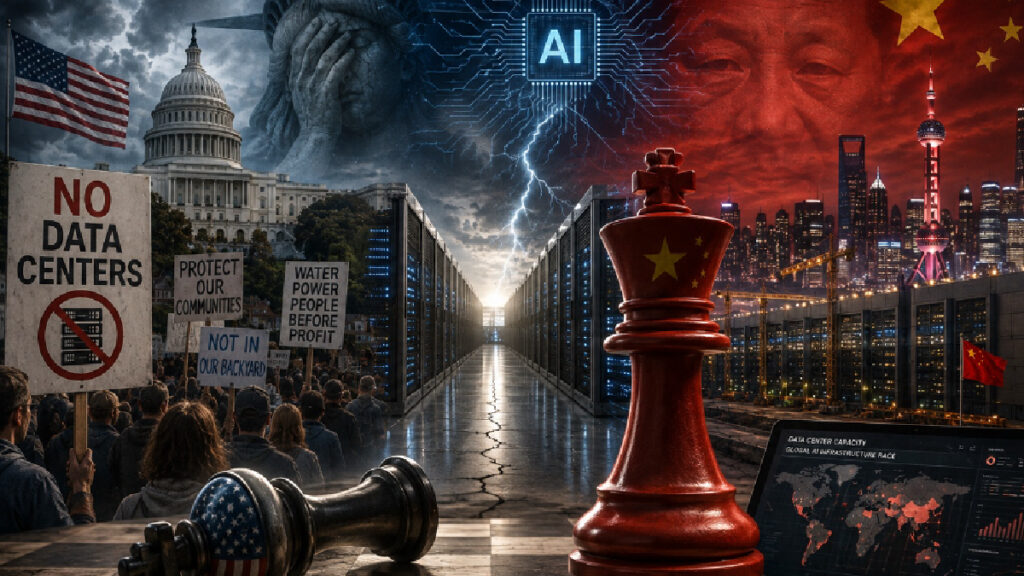
While Washington and Beijing compete for dominance in artificial intelligence, an unexpected front has opened… inside the United States itself. Shyam Sankar, chief technology officer of Palantir, sums it up with a sharp line: the real danger is not Chinese “homicide,” but American “suicide.” Local resistance to data centers, fear of Big Tech, the rise of “affordability socialism” among the young, and suspicions of foreign influence in the opposition campaigns: the record shows an America that risks slowing the very infrastructure on which its technological supremacy depends.
“Suicide, Not Homicide”: Palantir’s Warning
Shyam Sankar, whose company builds software for the Pentagon, intelligence agencies and industry, told Fox News Digital that the “proximate issues” in the AI race are “power and the backlash against data centers.”
“The only threat to AI generating prosperity for America is suicide, not homicide,” he said.
The United States and China are pouring billions into AI, seen as the lever of growth, military power and geopolitical influence. Together the two countries control 90% of global AI compute capacity: 75% for the United States, only 15% for China. America still leads in generative AI and innovation, while Beijing has focused on industrial and military applications. But that American edge rests entirely on a massive buildout of data centers, power generation and transmission networks.
Those projects now face growing opposition: electricity demand, water use, noise, traffic, and fear that utility customers will end up paying for grid expansion. Some projects have been delayed or canceled. Lawmakers have proposed restrictions or moratoriums. The issue has even entered the 2026 midterm campaigns, with ads in swing states such as Pennsylvania focused on the economic and environmental effects of the projects: what was still a technical file has become a local electoral argument capable of slowing or accelerating deployments depending on the ballot box.
Sankar argues these debates are slowing industrial gains that are already within reach. He points to a submarine-parts manufacturer that cut production planning from two weeks to less than an hour, freeing enough capacity to add a third shift. “There is no one on that shift who thinks, ‘Hey, I got my job because of AI,’ but that’s actually what happened,” he said.
In his view, the industry has become overly focused on AGI—artificial general intelligence, still theoretical, capable of matching or surpassing humans across a broad range of intellectual tasks—at the expense of deploying the AI already available. “The AI we have is powerful enough that it should have created more prosperity and value,” he said. “The only reason it hasn’t yet is not a failing of the technology, it’s a lack of our national will to push and invest in diffusing the technology through our economy. We shouldn’t lose the plot in pining away for a machine god.”
He compares the current moment to the early days of electricity: the technology exists, but businesses have not yet reorganized themselves around it. And he asks a direct question: “How many people have actually, at the front line, experienced AI and how it’s changed their job versus how many people are imbibing the fear-mongering from the social media feed, which is partially a Chinese psyop as well?”
Big Tech, the New Public Enemy No. 1
A June 2026 Fox News poll confirms the shift in public opinion. For the first time in years, voters see Big Tech—not Big Government—as the greater threat to the country’s future: 52% versus 47%. That is a 28-point reversal from 2019, when government concerned 58% of respondents and tech only 35%.
“As AI integrates into daily life, voters are reevaluating where power resides,” says Democratic pollster Chris Anderson of Beacon Research. “Concerns about government overreach are shifting toward tech companies, as voters question whether rapid growth has concentrated too much power in institutions largely outside of public accountability.”
Feelings about AI remain mixed: equal shares describe it as “innovative or helpful” (14%) or “a bad idea” (14%). Twelve percent are cautious; 10% say they are afraid or find it dangerous (down from 16% in 2023). Daily usage is rising: 18% of voters say they use AI every day, up from 11% a year earlier. The increase is especially marked among men (+10 points) and independents (+13).
At the same time, two-thirds of voters (67%) oppose having data centers built in their area, including 43% who strongly oppose it. Opposition is stronger among women, White voters, those 65 and older, and Democrats (roughly 70% or more). Only those who find AI innovative (68% in favor) or who use it at least weekly (54%) are majority supportive. Republican pollster Daron Shaw notes: “AI data centers emerging as a political issue is one of the most intriguing storylines of 2026. Opposing them is a short-term win, but attitudes about AI efficacy and regulation remain fluid.”
Despite these fears, 79% of voters still believe they control technology rather than technology controlling them—unchanged from nearly 30 years ago.
À lire aussi : ANALYSE – Data centers : La guerre intérieure qui peut faire perdre aux États-Unis la course à l’IA face à la Chine
Economic Impact: The Numbers the Anti-Data-Center Movement Obscures
Arthur Herman, historian and Pulitzer Prize finalist, lays out an alarming picture and puts numbers on the stakes. At least 78 local jurisdictions have already imposed temporary bans or moratoriums on new data centers. New York is the only state to have enacted a construction moratorium, but 14 others—including red states such as Florida, Oklahoma and Georgia—are considering similar measures.
In Georgia alone, a ban would threaten 552,000 jobs and $850 million in tax revenue. Nationally, estimates converge: AI and the data centers that support it could add between 1.5% and 3.7% of annual U.S. GDP growth—trillions of dollars.
A study by the Brookings Institution (an institution generally regarded as left-leaning) finds that when a new data center arrives in a community:
• construction employment jumps 11%;
• information-sector employment (IT services, telecommunications, software) grows by 22%;
• wages rise 3% to 4% for both existing workers and new hires.
Herman contests the environmental and economic arguments of opponents point by point:
• Electricity: far from systematically raising bills, new data centers can lower them by spreading costs over a larger volume of sales. Some developers are now pairing facilities with dedicated power generation rather than relying solely on the grid.
• Water: many data centers use virtually no potable water 96% of the time; others use none at all. Those that do consume far less than golf courses, which use more than 500 billion gallons a year nationally compared with about 230 billion for data centers overall.
• Taxes and growth: tax revenues rise with the additional economic activity. The benefits are not limited to tech billionaires: AI enables startups and small businesses, including in a resurgent U.S. manufacturing sector, to compete with the giants.
Herman compares the situation to deliberate sabotage in wartime: “Imagine if during World War II, protesters had gathered outside factories making tanks and planes, and tried to shut them down. Or that just before Pearl Harbor, when American industry was ‘hyperscaling’ its defense infrastructure in order to make the country ready for war, cities and counties had placed restrictions on new plant and shipyard openings. […] The only clear winner will be China, just as banning building defense plants in 1940–1941 would have benefited Nazi Germany and imperial Japan.”
On the military side, AI is already used for combat drones (as Ukraine shows), cyber-threat detection, analysis of vast intelligence data, readiness logistics, and efficiency in the defense industrial base facing China.
Foreign-Influence Probe: Singham, PSL and Chinese Accounts
Republican lawmakers led by Rep. Lance Gooden of Texas have urged acting Attorney General Todd Blanche to investigate alleged foreign influence in these campaigns. Their letter cites reports from OpenAI and the Bitcoin Policy Institute.
OpenAI said that “two clusters of ChatGPT accounts likely originating from China” were “banned after they used our models in support of apparent covert influence operations that promoted narratives in an attempt to manipulate a legitimate debate about American AI and wider tech policies.”
The Bitcoin Policy Institute found that the Party for Socialism and Liberation (PSL) has organized anti-data-center campaigns in at least 14 states, opposing roughly $23.6 billion in AI investments. PSL presents itself as “the political arm of the Singham network” and maintains ties to socialist governments such as Cuba and Venezuela.
Neville Roy Singham, a 72-year-old American who sold his tech company for $785 million in 2017 and now lives in Shanghai, is known for funding pro-Chinese Communist Party groups operating in the United States. According to a Fox News Digital investigation, he has funneled $278 million into a broad network of nonprofits since 2017. He faces a grand-jury investigation in the Southern District of New York authorized by Todd Blanche. Singham has not been charged with any crime to date.
Gooden said: “We believe that the Chinese and also the Russians are colluding and working to make sure that the United States of America is not the leader when it comes to AI policy and development. They are so sophisticated with respect to disinformation and manipulating our processes here in the United States against us. […] We know historically that they have funded NGOs and nonprofits that don’t disclose donations. And then they use these foreign funds against us and against our policy in a way that benefits them.”
In January 2026, Jack Tensley, describing himself as an “organizer” for PSL, testified before the Frederick County Planning Commission in Maryland against a data-center project in Virginia, citing security and cyberattack risks. PSL Boston posted that “workers are rising up across the country in a growing movement against the tech billionaires—from fights against data centers in hundreds of cities, to labor organizing at the world’s biggest tech corporations.”
Gen Z’s “Affordability Socialism”
At the same time, Diogo Costa, president of the Foundation for Economic Education (FEE), America’s oldest free-market think tank, warns of another ideological front. In his view, the cost-of-living crisis is providing ideal ground for socialist ideas to return among the young.
Young people want to live in a market economy, he says, but still demand rent freezes, free bus rides and price controls on groceries. “They don’t want to move to Venezuela or Cuba, but they want price controls in everything. […] This is not just a phenomenon in New York City or California. This is something that’s happening globally.”
Costa, who grew up in Brazil during the hyperinflation of the 1990s (more than 1,000% a year), argues that sound economic ideas must be “re-taught every generation,” or prosperity slides into poverty. He cites Joseph Schumpeter: capitalism is economically powerful yet culturally weak, because it makes things more abstract until people stop seeing how they are part of that complexity. Hence FEE’s pencil exercise: understand the production chain of a simple pencil, and you begin to understand the market.
On AI, Costa observes a paradox: “We’re in a golden age for technology, not necessarily for the ideas behind it. […] When you talk about AI, people are thinking all the jobs are going to be gone. Humanity is on the verge of extinction. So there is a lot of pessimism at the same time that you have these wonderful technologies. So the ideas that help us explain and help us work with technology are what’s missing.”
*
* *
The AI race with China is no longer fought only in laboratories and defense budgets. It is fought in city councils, in midterm ads in Pennsylvania, in an electorate that now ranks Big Tech as the top threat (52%), in 78 jurisdictions that block or slow data centers, and among a generation tempted by price controls. Sankar speaks of “suicide.” Herman evokes sabotage worthy of 1940. Republican lawmakers see the hand of Singham, PSL and Chinese accounts. Costa fears a lasting ideological shift.
The numbers are stark: 552,000 jobs and $850 million in tax revenue in Georgia alone; up to 1.5% to 3.7% of national GDP; a compute advantage of 75% against 15%. If America chooses to slow the energy and digital infrastructure of AI itself, it will not need Beijing to overtake it. It will already have done so.
À lire aussi : ANALYSIS – Trump Warns China of ‘Big Problems’ Over Iran as Xi Summit Nears: Washington Hardens Its Stance
#ArtificialIntelligence, #AI, #AIRace, #AIWar, #USChina, #USChinaRivalry, #China, #UnitedStates, #DataCenters, #AIDataCenters, #AIInfrastructure, #TechWar, #Technology, #BigTech, #Palantir, #ShyamSankar, #Geopolitics, #TechGeopolitics, #NationalSecurity, #EconomicSecurity, #EnergySecurity, #ChinaTech, #AmericanAI, #AILeadership, #AICompetition, #AIEconomy, #DigitalInfrastructure, #ComputePower, #EnergyInfrastructure, #USPolitics, #ChinaInfluence, #ForeignInfluence, #TechPolicy, #AIPolicy, #AIEnergy, #DataCenterBoom, #GenZ, #Socialism, #EconomicGrowth, #FutureOfAI