ANALYSIS – Russian Diesel or a New President: Trump Backs Zelensky Into a Corner
By Angélique Bouchard
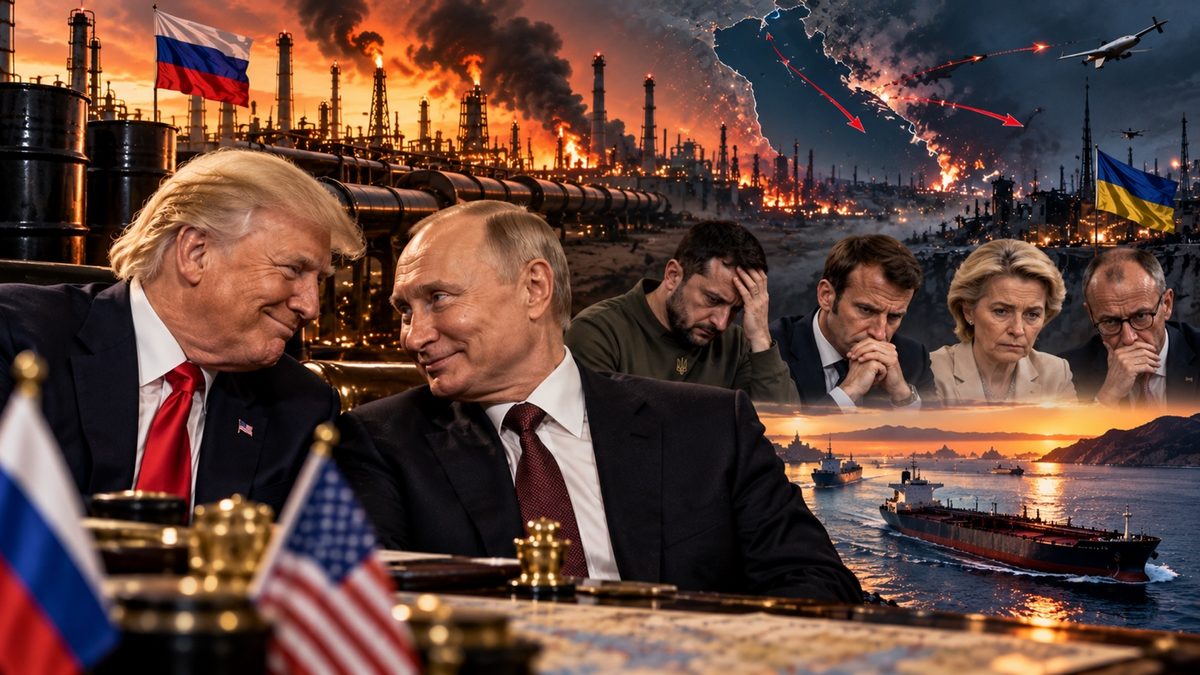
"It’s time for Ukraine to get a new president." On 10 October, Donald Trump crossed a line he had never crossed so openly. At issue: Ukraine’s strikes on Russian refineries, the day after a deal suspending American sanctions on Moscow’s diesel. Four weeks before the midterm elections, the price at the pump now weighs more heavily in Washington’s scales than Kyiv’s military leverage.
The scene unfolds on Saturday, 10 October, on the South Lawn of the White House, just before the American president flies off to a campaign rally in Clarksville, Tennessee. Asked about the criticism from Volodymyr Zelensky, who had just denounced the agreement struck the day before with Moscow, Donald Trump does not merely defend his initiative. He declares that it is "time for Ukraine to get a new president", accuses his counterpart of worsening the global fuel crisis by continuing to authorise strikes on Russian refineries, and adds, of those attacks: "He’d better d— well stop." The grievance is old; the tone is not. "We said, ‘You can do whatever you want to Russia. Don’t hit the refineries,’" he recalls, before adding that Zelensky "could have made many deals and, for some reason, he never does."
The phrase is not entirely new in Trump’s mouth. In February 2025, he had already called the Ukrainian president a "dictator without elections", a reference to the vote postponed under martial law, a few days before the explosive Oval Office clash. But the aim then was to force Kyiv to the negotiating table. This time, the demand bears on a specific aspect of how the war is being fought, and the sanction floated targets the very person of Ukraine’s head of state.
The pump price, the White House’s compass
To understand the brutality of the remark, one has to start at American filling stations. Last month, a gallon of diesel reached an average of $6.26 nationwide, a record, and several trucking and freight companies filed for bankruptcy. Farmers, ranchers, truckers: the constituency most exposed to the diesel surge is also one of the Republican Party’s electoral bedrocks, and its lawmakers are pressing the White House to deliver a price drop before the November vote. This very week, Donald Trump signed an executive order temporarily expanding the tax- and penalty-free use on highways of red-dyed diesel, normally reserved for farm and off-road machinery. The measure speaks volumes about the urgency: restricted-use stocks are being tapped for want of anything better.
The strain on the market stems from two wars at once. On one side, the conflict with Iran has reduced oil flows through the Strait of Hormuz. On the other, Ukraine’s long-range strikes on Russia’s oil industry have led to rationing in several Russian regions, scuffles at filling stations, an admission of shortages by Vladimir Putin himself and, in July, a Russian ban on diesel exports. Already deprived of part of the Gulf’s supply, the world market lost Russian diesel on top of it. It is this second source that Washington decided to tackle.
Hormuz and Moscow, the two taps
On 9 October, on Truth Social, Donald Trump announced that following a "highly successful discussion", Vladimir Putin had agreed to "immediately supply over 300,000 Tons of Diesel Fuel to the American and Global Marketplace", another 500,000 tons in November, then a million tons, and finally, "based on the condition of their Diesel Refineries", three million tons within a short period. In return, American restrictions on Russian diesel exports are suspended until 7 April. The presidential message explicitly ties the two fronts together: between Washington’s claimed "TOTAL CONTROL" of the Strait of Hormuz and this announcement, diesel prices will be "COMING DOWN, IN RECORD NUMBERS, AND FAST!", he promised in capital letters.
The same day, at the White House, he insisted that prices "will come tumbling" and that the war with Iran would soon be over "one way or the other". Tehran, he claimed, no longer has an army, a navy, an air force or anti-aircraft defences; the U.S. Navy has supposedly imposed a blockade on Hormuz where "nobody gets through". These assertions, unverifiable at this stage, shed light on a deeper contradiction. A strait under lock, even by the U.S. Navy, remains a strait through which oil flows poorly. As long as the Gulf crisis is unresolved, Russian diesel becomes the fastest adjustment variable, and the White House intends to make full use of it.
The reversal is spectacular. On 22 September, from the rostrum of the United Nations, Donald Trump was still threatening to use new tariff powers against buyers of Russian energy "if necessary" to end a war that, by his count, kills 25,000 people a month, "mostly soldiers". Less than three weeks later, Washington suspends its own sanctions on that very product. In the meantime, Steve Witkoff and Jared Kushner had met Vladimir Putin in Moscow, then travelled to Kyiv in early September. The logic of economic pressure on Russia is giving way to the logic of the pump price, and Ukraine finds itself asked to align its military strategy with this new trade-off.
For Kyiv, a one-way de-escalation
Volodymyr Zelensky immediately warned against the deal: the temporary lifting of sanctions, he argued, would give Moscow additional revenue to buy weapons and prolong the war. The argument goes to the heart of Ukraine’s strategy. The refinery strikes target precisely an industry that supplies both hard currency and fuel to the Russian war effort. Halting them at the very moment Russian diesel regains its international outlets would amount to letting Russia rebuild its energy revenues, with no assurance that it would spare Ukraine’s power grid in return.
Kyiv had, however, put forward its own offer. In late September, Zelensky arrived at the UN General Assembly with "concrete security proposals and de-escalation measures". His sequence was clear: Russia first stops its strikes on Ukraine’s energy sector, critical infrastructure and food exports, and Ukraine then takes matching steps. His government was also seeking additional air defences, more Patriot batteries, help protecting its grain exports through the Black Sea and support for local production of U.S.-designed interceptors. UN investigators warned, for their part, that renewed Russian attacks on the power grid could leave millions of Ukrainians without electricity or heat as winter approaches.
On 10 October, none of these requests received an answer. The sequence has been reversed: it is up to Kyiv to give way first, with no stated quid pro quo. Before his meeting with Zelensky in New York, Trump himself had summed up the ambivalence of his position, calling the Ukrainian campaign "a serious hit against the Russians", but also "a serious hit on the price of diesel". In three weeks, the second half of the equation has prevailed over the first.
From Doonbeg to the White House, a demand that escalates
The warning is not new. On 13 September, on the sidelines of the Irish Open played at his golf course in Doonbeg, Ireland, Donald Trump had already laid down the line: Zelensky "has to do one thing", stop knocking out diesel fuel in Russia. Ukraine could pursue other targets on Russian soil, he specified, but not diesel, "because he’s causing a shortage of diesel". And he insisted on the source of the problem: "This isn’t done by the Middle East." He said at the time that he had discussed it directly with the Ukrainian president. Two days earlier, the average price of American diesel had crossed the $6 mark for the first time.
Between Doonbeg and the White House lawn, the register changed in nature. In September, it was an instruction, accompanied by a list of substitute targets. In October, the injunction comes with a direct challenge to the Ukrainian leader’s legitimacy. On the ground, meanwhile, nothing is calming down: Moscow has intensified its air attacks, ballistic missiles and drones included, on Ukrainian cities from Kyiv to Dnipro and Sumy, while Ukrainian drones struck the Moscow refinery and facilities in the Samara region as recently as 20 September.
Trump’s gamble, Zelensky’s dilemma
The White House’s calculation is easy to read. An influx of Russian diesel, combined with a swift outcome in the Gulf, is meant to bring prices down before 3 November; Ukraine’s strikes, by threatening that supply, become a domestic obstacle as much as a diplomatic issue. That this trade-off amounts to loosening the grip on Russia’s war economy at the very moment Washington claims it can secure a peace deal "more quickly than people understand" does not, at this stage, seem to trouble the administration.
For Kyiv, the dilemma offers no comfortable way out. Complying means giving up one of the few instruments that have genuinely eroded the adversary’s financial and logistical capacity, at the onset of a winter in which Ukraine’s power grid is once again Moscow’s priority target. Refusing means exposing itself to the open distrust of an American president who now suggests, in front of the cameras, changing interlocutors. Between these two risks, Volodymyr Zelensky has little room for manoeuvre, beyond whatever the Europeans leave him, and the American electoral calendar grants him even less.
#Ukraine, #DonaldTrump, #VolodymyrZelensky, #Diesel, #Sanctions, #StraitOfHormuz, #Zelensky, #Trump