ANALYSIS – SCHOOL UNREST, ANTISEMITISM, THE 2027 ELECTION: In Paris, the Street Has Already Started the Campaign
By Angélique Bouchard
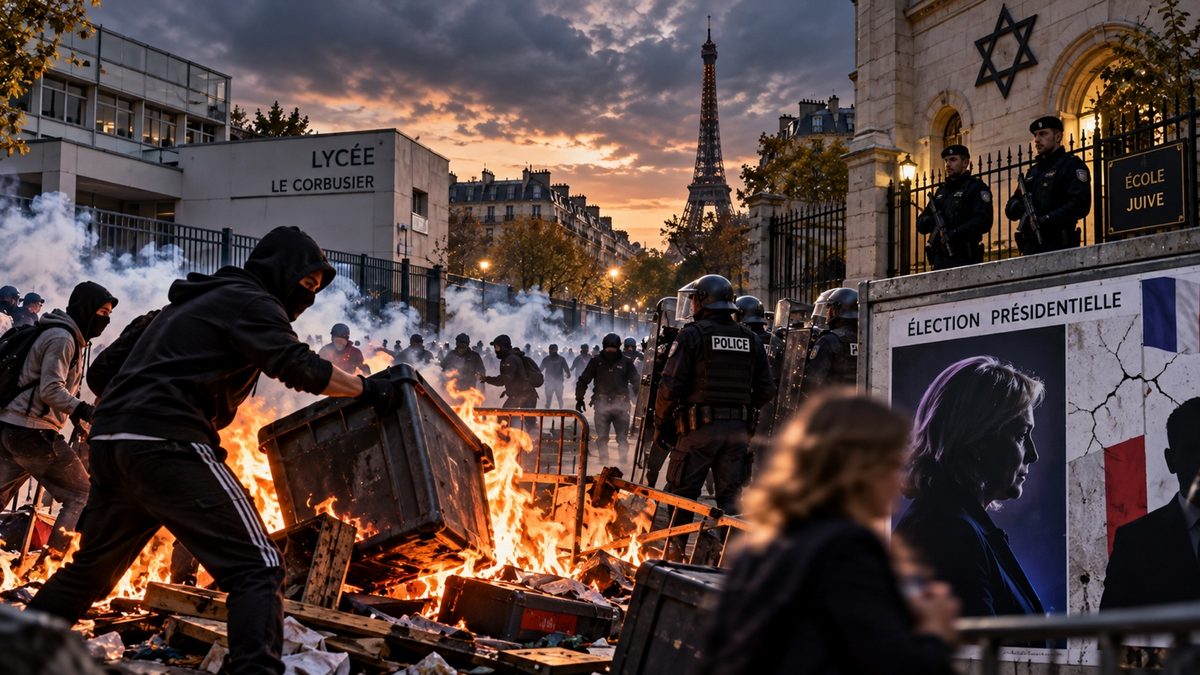
On the outskirts of Paris, outside the Le Corbusier high school in Aubervilliers, a teenager feeds a barricade that has already burned; in Pantin, outside the Marcelin-Berthelot high school, trash bins blaze and firecrackers answer tear gas. In Lens, a fifteen-year-old lost his hand after picking up a dispersal grenade. Across France, Jewish families are giving up displaying their mezuzahs. Elsewhere, the same drift is taking shape: in Brussels, Jewish schools operate under the protection of armed guards; in Erfurt, thirty thousand protesters tried to block a party congress; on American campuses, three students in ten consider violence acceptable to silence a speaker. These scenes are not interchangeable, but they reflect the same refusal, on both sides of the Atlantic, to name what is spilling over from the street into the school and the synagogue. In Paris, that refusal extends to those who exploit it, a few months before a presidential election in which the leading right-wing candidate is free to run only with an electronic tag on her ankle.
Rabbi Menachem Margolin lives in Brussels. Not the Brussels of postcards and summits, but the one where synagogues are built like fortresses and parents tell their children to tuck their Star of David inside their shirts before going out. The founder of the European Jewish Association writes in Fox News what European capitals prefer to treat as a mood. Antisemitism, he argues, did not return with a swastika. It returned as slogans, under the banner of justice, calling itself activism and daring anyone to object. And it did not come alone. It came with a violent extremism that European leaders spent twenty years describing as a fringe, a misunderstanding, a problem that would dissolve with enough patience and tolerance. "It was none of those things. It was a warning we refused to read, and we are paying for that refusal now."
He asks why a European who witnesses this every day should not be allowed to tell America what is already at its door, and why the warning should be addressed to Jewish leaders alone. He is speaking to mayors, governors, senators, police chiefs and university presidents: "Anyone with the power to act and the temptation to look away. Wake up."
In Antwerp, on March 23, 2026, Belgian soldiers stood guard outside a synagogue as part of heightened security around Jewish schools and places of worship. In Golders Green, in north London, on April 29, a man was arrested after being seen running with a knife and trying to stab Jewish passersby, according to the Shomrim neighborhood watch. In Manchester, on October 2, 2025 — Yom Kippur — the Heaton Park synagogue in Crumpsall was the target of what police described as a terrorist attack: two worshippers, Adrian Daulby and Melvin Cravitz, were killed, and the attacker was shot dead. In Manhattan, on May 5, 2026, anti-Israel protesters gathered outside Park East Synagogue. Near Tulane University in New Orleans stood a "from the river to the sea" sign, a slogan Jewish organizations regard as antisemitic.
Margolin is not asking America to be afraid. "Fear is what they want. I am asking it to be honest while honesty still costs almost nothing." Europe, he writes, has already seen this film. It knows how it ends. "Don’t wait until you need my experience to finally believe my warning."
From a Football Final to High School Blockades
The weekend he cites as evidence is no metaphor. On May 30, 2026, after the Champions League final between Paris Saint-Germain and Arsenal in Budapest, order broke down in the French capital: hundreds of arrests, a crowd trying to storm a police station, burned-out cars, the Eiffel Tower closing its doors because the authorities could no longer guarantee that the city center would hold. "The precise spark matters little. The lesson is always the same: a free, confident, modern city can lose command of its own streets faster than anyone in charge will admit. And when the streets are already lost, Jews are always the first to feel it." Americans, he adds, watch such scenes the way one watches a storm over a distant sea — terrible, tragic, foreign, impossible here. That is precisely what Europe told itself.
Four months later, the street has grown younger without changing its logic. Since late September, high school students have been blockading their schools over timetables, overcrowded classes, teacher shortages and classrooms that swelter during heat waves. The movement began in the Paris region, mainly in its poorer suburbs, before spreading nationwide, a few months before the election that will choose Emmanuel Macron’s successor. On Friday, October 2, there was tear gas in Strasbourg, fireworks fired at police in Marseille, garbage bins set ablaze in Rennes and clashes in Paris. Some four hundred high schools were shut. Gérald Darmanin, speaking on RTL, put the number of arrests at around two thousand, mostly teenagers, and said parents whose children cause damage should pay for the repairs. Édouard Geffray, on BFM: "In the street, children are in danger." Euronews counted at least sixty-five staff members injured, including forty principals, some one hundred seventy students, and more than one hundred high schools that suffered what the minister called "severe damage." In the government’s own words, protest had turned into ransacking.
In Lens, on the eve of a national day of action called by the high school students’ union against underfunding, overcrowding and crumbling buildings, a fifteen-year-old boy picked up a dispersal grenade. It exploded. He lost his hand and part of his forearm, authorities said, according to Reuters. François-Xavier Lauch, prefect of the Pas-de-Calais department, spoke of two hundred to two hundred fifty protesters hurling projectiles at police. Geffray judged that the wave was ebbing and announced an online platform where students could voice their grievances.
The Justice Ministry’s later tally told a different story: more than five thousand arrests since the start, 87% of them minors, and more than eighteen hundred prosecutions, 1,483 of them involving minors. The charges were not specified. Sami Karen, eighteen, outside the Charles-de-Foucauld high school in Paris: "We’ll keep blocking until the government hears us. As long as they don’t listen to us, we won’t stop this fight." Outside Marcelin-Berthelot as outside Le Corbusier, the same sign read: "Same studies, not the same rights." A platform does not give a boy back his hand. What it shows is an executive in its final months that would still rather open a complaints channel than give an answer on resources, staffing and order.
The 2027 budget, unveiled on Thursday, provides for a 1.7% increase in education funding, to €65.53 billion excluding teachers’ pensions — below inflation, according to Reuters. Years of underinvestment, the students say, explain the state of their classrooms. The original grievance was not invented. What followed can no longer be reduced to it.
La France Insoumise in the Dock
Intelligence services told a crisis unit on Thursday, October 1, that the movement had been launched by elected officials from La France Insoumise (LFI). Reuters reported it the next day. The party’s lawmakers rejected the accusation and spoke of politicization ahead of 2027. Le Monde reported that Geffray had initially accused LFI of fueling the first protests, before describing the movement as "taken hostage by ultra-left groups." Jean-Luc Mélenchon denies any responsibility for the violence.
Simone Rodan-Benzaquen, special envoy for Europe at the Foundation for Defense of Democracies, told Fox News Digital what the images show and the official statements smooth over. "The students’ grievances about missing teachers and deteriorating schools were real at the start. But dousing a principal with gasoline and attacking firefighters are acts of extreme violence. What makes this politically significant is the effort to turn frustration over schools into a much broader confrontation with the government." LFI, she adds, has "actively supported the mobilization": activists circulate footage of the clashes, party accounts amplify it, and elected officials cast themselves as the students’ defenders. "With an election next year, Mélenchon sees these mobilizations as a way to consolidate young voters and marginalize the moderate left. Amid deep political, geopolitical and economic challenges, this is a very dangerous situation for France."
Marine Le Pen, on X, took the step the government dares to take only halfway. "These are no longer high school protests. These are riots organized by professionals and supervised by La France Insoumise lawmakers." She is calling for an anti-rioter law that would make taking part in a riot a clearly defined offense. The Interior Ministry deployed specialized units and mobile gendarmes, according to Le Monde. Students and advocacy groups have denounced the use of batons, tear gas and less-lethal weapons against minors, and Amnesty International warned against excessive use of force. The ministry said on Friday that three investigations had been opened into allegations of police violence.
In Liège, on Thursday, Belgian high school students began protesting; schools there were closed the following day. The contagion did not wait for France to settle the question of who controls its streets.
From Lens to Utah, Violence Normalized
What Paris still treats as a local drift, American surveys are already measuring as a generational norm. A year after the assassination of Charlie Kirk on September 10, 2025, on the Utah Valley University campus during a Turning Point USA debate, the Foundation for Individual Rights and Expression (FIRE) surveyed 62,997 undergraduates at 262 institutions. Thirty percent consider violence acceptable to stop a controversial speaker from talking: 3% always, 12% sometimes, 16% rarely. Seventy percent say never. The figure has fallen four points since 2025, when it stood at 34%, but it has risen ten points in four years. Shouting down a speaker remains acceptable to 69% — three points fewer than in 2025, seven more than four years ago. A Gallup poll cited in the same run of articles finds that one American in seven considers political violence sometimes acceptable.
The boy in Lens has not read FIRE. The comparison is not a claim of causality. What it shows is that on both sides of the ocean, an already measurable share of young people has stopped treating physical confrontation as a line not to be crossed — and that the adults in charge of schools respond with a platform, a press release, or the word "peaceful."
Chapin Lenthall-Cleary, a FIRE analyst, says so without triumphalism. "We’re glad the percentage of students who find it acceptable to respond to speech with violence has declined. But as long as students and outside speakers believe that voicing disagreement or sharing controversial views could get them hurt, speech will remain chilled on campus." He offers a hypothesis, not proof: some of those who saw violence as a way to stop speech may have changed their minds after watching Kirk killed for speaking. In the early 2020s, left-leaning students were roughly twice as willing to accept violence as right-leaning ones. Since then, acceptance has risen sharply among conservatives and moderates, especially men. Liberals and conservatives are now roughly level. "Fortunately, overall support for violence dipped slightly this year, but more than 30% of students still say it is at least rarely acceptable to use violence to stop a speaker."
On the Utah Valley campus itself, the assassination left a mark that FIRE considers lasting, in both directions. The five top-ranked schools for free expression in the 2027 rankings are the University of Chicago, Claremont McKenna, Georgia Tech, Michigan Tech and Vanderbilt. The ranking does not say the country has held. It says where it still holds.
"Residual" Antisemitism Meets the Facts
The same name has been circulating for months in a dossier that the high school unrest neither covers nor contradicts. Joshua Zarka, Israel’s ambassador in Paris, told Fox that the way Mélenchon speaks before a crowd "reminds" him of Hitler, and that using Israel as an enemy to rally people against resembles the way Hitler spoke about the Jews. France recorded 1,320 antisemitic acts in 2025, triple the 436 of 2022. It is home to Europe’s largest Muslim community, and to its largest Jewish community as well. Zarka does not blame the government for the figure; in his view it is fighting the phenomenon and keeps the country "relatively safe." He attributes it instead to a base in which antisemitism is growing, fed, he says, from Iran, Russia, Turkey and Qatar, and exploited at home by vote-seeking actors, LFI foremost among them.
In February, Mélenchon mocked the pronunciation of Jewish names, including that of MEP Raphaël Glucksmann, drawing criticism from the Human Rights League. He had written on his blog that "antisemitism remains residual in France," a phrase his critics read as denial of the surge that followed October 7. Fox received no response from his communications adviser.
The facts that Zarka and community leaders list are not slogans. On January 12, in Lyon, a tree planted in memory of Ilan Halimi — kidnapped and murdered in an antisemitic attack in 2006 — was partially cut down. On February 9, a boy wearing a kippah was assaulted by five people, one of whom allegedly held a knife to his throat. Ten days later, acid was thrown into two dining rooms of a kosher restaurant in the 17th arrondissement. On April 15, racist and antisemitic graffiti appeared on three high schools in the Montpellier area — the very schools that October’s protests would say lack everything, and that April had already shown lacked no hatred. In March, two brothers were arrested over a plot authorities described as "deadly and antisemitic": a semi-automatic weapon, a bottle of hydrochloric acid and an Islamic State flag were found in their vehicle. El Al’s Paris offices were defaced.
Rabbi Elie Lemmel was punched in the stomach in Deauville in June, then attacked again on a café terrace in Neuilly-sur-Seine by a Palestinian from Gaza wielding a chair. He says he had almost never experienced such things before and sees the conflict since October 7 as an amplifier. "You have to be vigilant. Some people see a kippah and it bothers them. Those who want to do harm will always find reasons. If we start hiding, it’s the beginning of the end. I have always worn a kippah, and that is why I keep wearing it."
Yonathan Arfi, president of CRIF, the umbrella body of French Jewish institutions, describes the other side of the picture. Some families no longer put up a mezuzah, or change their names on apps to avoid being identified. "On one hand, a rise in antisemitism that leads to precautionary behavior. On the other, Jewish life more vibrant than ever, full synagogues, more kosher restaurants than ever. We must not hand antisemitic terrorists and those driven by hatred our fear and our withdrawal as a trophy. Wherever possible, Jewish life must go on, open and proud."
Aliyah reveals what pride cannot cover. After the Six-Day War, French emigration to Israel ran at 1,500 to 2,000 people a year. It peaked at around 8,000 between 2012 and 2015, fell to about 1,000 in 2023, climbed back above 2,000 in 2024 and reached 3,500 in 2025. The Jewish Agency expects some 4,000 departures in 2026. Arfi sees it as a warning sign: part of France’s Jewish community no longer sees a future here. Zarka, for his part, would sooner caution against Spain, Belgium and even the Netherlands, "where antisemitism is thriving."
At the ceremony for Ilan Halimi in February, Emmanuel Macron spoke of the "antisemitic hydra" that had slipped into "every crevice" of society. "In twenty years, and despite the resolute efforts of our police officers, gendarmes, judges, teachers and elected officials, the antisemitic hydra has never stopped advancing. Constantly taking on new faces, it has wormed its way into the heart of our societies, into every crack, too often accompanied by the same pact of cowardice: staying silent, refusing to see." He named the Islamist antisemitism of the October 7 massacre and far-left antisemitism, which he said "rivals that of the far right," as well as the mask of anti-Zionism, behind which hatred "advances in silence."
The same presidency refused, during the war against Iran, to let American weapons bound for Israel cross French airspace. Zarka points out that this was only the second such refusal since 1973, during the Yom Kippur War. February’s words and wartime’s closed skies do not describe the same policy.
From Erfurt to America’s Schools
On July 4, 2026, in Erfurt, Thuringia, more than thirty thousand people tried to block the congress of the Alternative für Deutschland (AfD), which was set to re-elect Alice Weidel and Tino Chrupalla as co-leaders. Signs read "Stop AfD Nazis" and "For diversity, against Nazis." Police described the protests as "largely peaceful" and reported around one hundred offenses, mostly graffiti, while pushing back groups with batons and deploying riot-control equipment. The vote was delayed.
Chrupalla, quoted by the Associated Press, rejected the language of courtesy. "There are no peaceful sit-in blockades. There are no democratic roadblocks. Nor are there gangs of thugs who deserve the harmless label of civil society. These troublemakers are the last resort of our political rivals." And to the protesters: "They think they have a monopoly on democracy. To these protesters I say: this democracy is as much ours as it is yours." Lena Raupach, spokeswoman for the widersetzen collective, openly owned the aim of blocking the congress. "The AfD pursues fascist policies: it wants mass deportations and terror in the streets. At the same time, it doesn’t solve a single real problem. It pursues policies that benefit the rich, not ordinary citizens."
The party, the second-largest group in the Bundestag, rejects the far-right label and says, according to the Associated Press, that it is being "used as a political instrument by the governing parties." It won more than 20% in the 2025 federal election, and some national polls now put it in first place. Chrupalla, on the Saturday: "We will win. Perhaps we will soon be able to govern alone. That would send the right message to the enemies of democracy who wanted to prevent our congress." In the hall, a "Make Germany Great Again" cap. The word "peaceful," in Erfurt as in French official statements, here describes a crowd that prevents a vote and a police force that counts graffiti. Margolin would recognize the test Europe has already failed: confronting hatred even when its source is fashionable, even when those spreading it claim the moral high ground.
Those accelerating America’s fracture, he writes, are not a masked fringe. They are winning arguments. They set what passes for acceptable on campuses, in city councils, in the feeds where children form their opinions. They teach a generation that some hatreds are sophisticated and forgivable, and that the oldest of them all is just one more political position. The America he believed to be this continent’s opposite — where a Jew could walk through Brooklyn or Boca Raton without calculating his safety, where a kippah did not tie your stomach in knots, where a synagogue did not have to look like a bunker, and where that assurance was a civic culture, not luck — is the very America the campus rankings are beginning to contradict.
Corey DeAngelis, a researcher at the Heritage Foundation, reads the same decline in test scores and spending. The latest PISA results show American fifteen-year-olds posting some of the lowest reading and math scores the country has recorded in a generation. Reading has fallen fourteen points since 2022, and math scores have sunk to their lowest level in more than two decades, the Washington Post reports. According to the Census Bureau, the United States now spends more than any other country: over $21,000 per student. Gallup measures record dissatisfaction with K–12 education, with 67% of adults dissatisfied. Since 2014, public schools have added some 620,000 employees while enrollment fell by about 775,000. The monopoly, he writes, has become a jobs program for adults more than a school for children.
In Chicago, Frederick Douglass Academy High School, built for more than a thousand students, has twenty-seven and employs twenty-eight adults. Nearly two-thirds of its students are chronically absent. More than $90,000 per head, better than one adult per child, and not a single student tested proficient in math or reading. In New York, 43% of public school children attend schools where more than half of students are below grade level in math, reading or both. The city spends more than $40,000 per child — over half a million dollars across thirteen years of schooling. Homeschooling in the state has grown by more than 200% in fifteen years, to 53,905 children, despite one of the most restrictive regimes in the country according to the Home School Legal Defense Association.
Eighteen states have adopted universal school choice in six years. In Texas, more than one hundred thousand children are on a waiting list because lawmakers put only $1 billion into the program, for scholarships of about $10,000, while public schools spend roughly twice that per student according to the Texas Education Agency. Comptroller Don Huffines has suggested doubling the funding. DeAngelis wants the cap removed altogether: fund students, not systems. A society that no longer learns to tolerate opposing speech, and spends fortunes for falling results, is preparing the street Margolin describes from Brussels.
The Ankle Tag and the 2027 Presidential Race
It is against this backdrop that France’s presidential election is taking shape, and criminal law now weighs on it as heavily as the campaign itself. On July 7, 2026, the Paris Court of Appeal upheld Marine Le Pen’s conviction for embezzling European public funds. On March 31, 2025, the criminal court had sentenced her to four years in prison, two of them suspended and two to be served under electronic monitoring, as well as a €100,000 fine and five years of ineligibility with immediate effect, which barred her from the 2027 race. According to Fox News, the Court of Appeal reduced the sentence to three years, two of them suspended, with the remainder converted into one year of home detention under an electronic tag, and cut the ineligibility period to forty-five months, thirty of them suspended. Since that period runs from the March 2025 judgment, she is eligible immediately.
The court found that a system had been set up to have the European Parliament pay assistants whose work, unrelated to their parliamentary mandate, in fact served the party — the Front National, since renamed the Rassemblement National. The damage, assessed at €2.8 million, must be repaid. Marine Le Pen and eleven other defendants were found guilty of embezzling public funds or of complicity. She acknowledges that some staff paid as European parliamentary assistants worked for the party in France, but calls it a mistake rather than a system. "We are considering the decision as a whole. We are partially satisfied," her lawyers said, according to Reuters. From the courthouse, she went straight to party headquarters.
Eligibility, however, does not guarantee a campaign. "If I am allowed to be a candidate but prevented in practice from campaigning freely, then you understand that it would not be possible," she told the French press. A year of home detention means being unable to crisscross the country, hold rallies or provide the physical presence on which a presidential campaign still feeds. Jordan Bardella — who traveled to Israel and, according to Joshua Zarka, made a solemn pledge at Yad Vashem to fight antisemitism "whether it comes from the right or the left" — remains the fallback should the tag hamper the campaign trail. The ambassador observes that in three years, part of the Jewish community has stopped seeing the Rassemblement National as the far right of old, and that this pledge is "sinking into people’s minds."
The 2027 landscape is reshaped as a result. Jean-Luc Mélenchon wears no tag: he has the high school protests, the images circulating online, and a young electorate that Simone Rodan-Benzaquen sees him consolidating against an already marginalized moderate left. Marine Le Pen has the right to run, but not the means to campaign like the others. Jordan Bardella enjoys freedom of movement, without yet carrying the name that has brought the party this far. Emmanuel Macron, for his part, must contend with an education budget that trails inflation, intelligence services pointing at LFI, a minister talking of a hostage-taking by the ultra-left, a "hydra" he named in February while antisemitic acts — three times as many in 2025 as in 2022 — have not receded, and airspace closed to American weapons bound for Israel.
*
* *
Lens, Erfurt, Golders Green, Aubervilliers, Montpellier and Utah do not overlap. The tragedy of a high school student maimed by a grenade he picked up is not an attack on a synagogue, nor the assassination of a campus speaker, nor graffiti on a school in the Hérault. To conflate them would be a lie. To separate them so completely that one no longer sees the same drift would be the other lie — the one Margolin says Europe has already paid for.
In early October, Paris brings together in a single sequence minors at school gates, a burning barricade, a sign about unequal rights, a principal doused with gasoline according to the account gathered by Fox and, further off, families taking down their mezuzahs because the "residual" antisemitism described on a blog does not match the ministry’s figures. The 2027 campaign has not yet begun, but its ingredients are already in place: the high school street, an ankle tag that permits a candidacy without permitting a campaign, and a hydra named but still not contained.
#France, #MarineLePen, #LaFranceInsoumise, #Éducation, #GéraldDarmanin, #JeanLucMélenchon, #JordanBardella, #RassemblementNational, #BudgetÉducation, #Justice