2026 MIDTERMS
ANALYSIS – 2026 Midterms – Michigan: The Muslim Brotherhood Question at the Heart of a Senate Race
By Angélique Bouchard
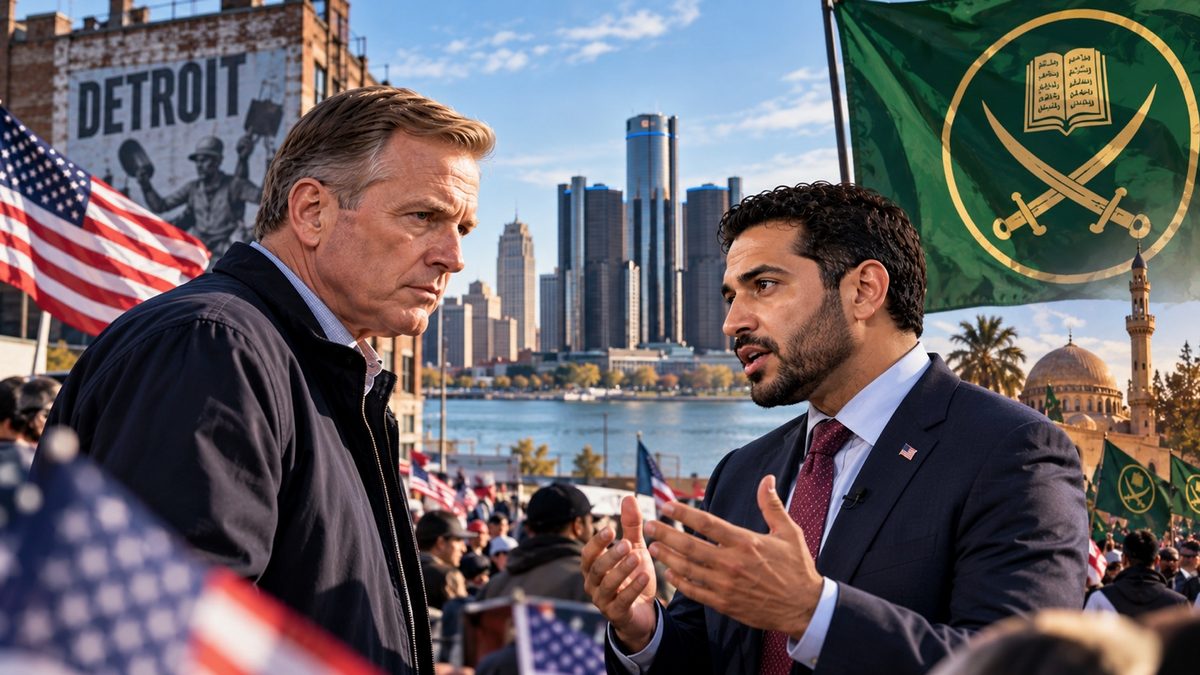
Ten days before the November 3 vote, Michigan’s Senate race pits Mike Rogers, a former FBI special agent and Republican congressman, against Abdul El-Sayed, a physician by training and the Democratic candidate backed by his party’s left wing. Two televised debates, a stormy town hall and two tense interviews with Bret Baier have set the terms of the contest: El-Sayed’s past positions on Muslim Brotherhood-era Egypt, a head-on disagreement over the war with Iran, and the cost of social promises in an industrial state that has lost 27,000 manufacturing jobs. Rogers describes an extreme candidate with concealed views; El-Sayed sees an attack on his faith. The argument itself turns on documented facts.
A "Manufactured" Candidate
At a town hall hosted by Sean Hannity on Fox News, Mike Rogers called his opponent a "manufactured candidate" and attributed to him a "pattern of deception." "He’s the most extreme candidate," he said. "He called for defunding the police. He called for letting criminals out of prison. He called for the Green New Deal, which is a killer for Michigan." The Republican touts a ground operation approaching, by his count, six million doors knocked, and says he hears the same answer from traditionally Democratic voters: "Yes, we’re voting. No, we’re not going to be a DSA state." He also relays the fears of Jewish voters, including a woman who says she is sometimes afraid to display her identity in public, and University of Michigan students who hide their religious symbols.
At the second and final debate on October 21, as reported by Fox News, Rogers accused El-Sayed of scrubbing his 2020 positions in favor of defunding the police: "Why would you go through and take all of that time to delete all of the material? X videos, comments, podcast. Why? Because he was passionate about defunding the police." El-Sayed rejects these characterizations and recenters his campaign on the cost of living, access to care and purchasing power, with a refrain: "put money in your pocket." On Medicare for All, he says he is fine with people keeping private insurance while wanting guaranteed public coverage for everyone. Rogers counters that this approach would eliminate private insurance in practice, raise costs for Michigan families and leaves unsaid the taxes required: "It’s a great slogan. There’s nothing behind it." Once policies aligned with democratic socialism are enacted, he added, voters will "be lucky to have a damn pair of pants."
On regulating artificial intelligence, El-Sayed floated "democratically appointed folks" on the boards of AI corporations, citing an existential threat to the workforce. Rogers took it as an admission of a desire for public control over private companies: "He said the quiet part out loud. That is the Democratic Socialists of America." Fox News notes that El-Sayed has received no official DSA endorsement and has not affirmed its platform, but that he has endorsed, and been endorsed by, several DSA-backed candidates, including New York Mayor Zohran Mamdani, a self-proclaimed socialist.
The Muslim Brotherhood: What Is Documented
The controversy rests not on insinuation but on public record. In 2011, while an assistant professor at Columbia University, El-Sayed published an op-ed in the Huffington Post urging the Obama administration to support Egyptian protesters associated with the Muslim Brotherhood. "It is in America’s interest to support Egyptian protesters’ efforts to achieve the ability to speak their mind and have a say in how they are governed," he wrote, adding that even if the Brotherhood overthrew the government, the resulting state would not necessarily resemble Iran. In 2012, according to the Washington Free Beacon, he signed a letter supporting decisions by Mohamed Morsi, the Egyptian president drawn from the Brotherhood, including calls to purge the police and the media. "He asked the Muslim Brotherhood head, Morsi, in Egypt to defund the police there, too," Rogers said at the debate. The Morsi government, which took power in 2012, was ousted by the military in 2013.
To this are added family and associational elements. Posts by his half-sister, Eman Abdelhadi, describe their mother’s involvement in Muslim Brotherhood activism in Egypt in the 1970s: "Had an amazing talk with my mom about her activism in the Muslim Brotherhood during the early 70s while she was in college," she wrote on X in 2012. His sister-in-law was a plaintiff in a lawsuit challenging her alleged placement on a terrorist watchlist; El-Sayed acknowledged this on October 17 while insisting she had done nothing wrong, the FBI declined to confirm or deny her status, and the lawsuit establishes no wrongdoing. Finally, in 2007, El-Sayed was vice president of the Muslim Students Association chapter at the University of Michigan, a group listed in a North American strategy memorandum written by a Brotherhood member, Mohamed Akram. Fox News Digital, which lays out these elements, states that it has found no direct link between El-Sayed and the Muslim Brotherhood.
El-Sayed denies any personal or family membership, says he was raised by his father and stepmother, and explicitly disavowed the organization on October 17 at a town hall in Caro, answering "Sure. Yeah, absolutely" to a voter who pressed him — though not before asking him, "Are you going after my mom?" That did not close the matter. Donald Trump describes him as "a Muslim Brotherhood guy, 100%" and has called him a "jihadist" at rallies; Rogers, for his part, says he has "never called him a terrorist" and does not "speak for the president." The Detroit Metro Times has announced it will no longer seek comment from the Rogers campaign, which it accuses of "lies and bigoted attacks" on El-Sayed’s faith. The stakes reach beyond the race: an executive order signed by Trump in November 2025 opened the way to designating certain Brotherhood chapters as foreign terrorist organizations.
Loyalty, the Uniform and the Foreign Relations Committee
On October 23 in Detroit, both candidates were interviewed separately by Bret Baier on Special Report. When the anchor moved to ask about the 2012 letter, El-Sayed cut him off: "No, no, no, let me just stop there. You are asking this question to raise a question about whether or not I have dual loyalties." He affirmed his exclusive loyalty to the Constitution of the United States, told Baier "Don’t be Rogers’ campaign" and then "Be a journalist," and called his opponent’s approach "sad" and "beneath him."
Rogers answered with his own record: "I wore the uniform of the United States. Many in my family, including our son, wore the uniform of the United States so he can pray any way he wants. It is not how he prays, it’s how he thinks." He accuses El-Sayed of having "adopted the ideology of the Muslim Brotherhood" and of casting himself as a victim. When Baier reminded him of the October 17 disavowal, Rogers replied with a question: "Does he disavow? Does he really say it?" The former FBI agent makes his experience the key to reading the controversy: not religious practice, but positions and associations.
The question has reached the Senate. According to Fox News, Jordan Domingue, El-Sayed’s security chief during his 2018 campaign for governor, says the candidate is angling for a seat on the Foreign Relations Committee "despite no foreign policy experience." Two Republican members of the committee are objecting in advance. Mike Lee: "A man with ties to the Muslim Brotherhood, who cheered their takeover of Egypt 15 years ago, and who campaigns with people saying America deserved 9/11, should not come anywhere near the U.S. Senate — and especially not the Foreign Relations Committee." Dave McCormick: "El-Sayed says he’s running on affordability, so why does he want a seat on Senate Foreign? Someone with El-Sayed’s radical views has no business on it." The 9/11 reference targets the streamer Hasan Piker, alongside whom El-Sayed has campaigned, not the candidate himself; it is this shortcut the local press holds against the Republican side.
Iran, Guns and the Economy
El-Sayed faults Rogers for backing the war with Iran, which he calls "illegal, unjustifiable" and "aimless," and demands a war powers resolution to end it. Voters, he says, are already paying for it at the pump and the grocery store: "Donald Trump is on the ballot through Mike Rogers. They are hip to hip on this war, and you are paying the cost." Rogers defends the original rationale for the operation while saying he has urged the president to end it: "I’ve called for him to wrap it up. That’s the right thing to do." Above all, he recalls that El-Sayed refused at the first debate to say whether Iran posed a greater threat than Israel: "My opponent can’t even condemn the Islamic Revolutionary Guard Corps, which is the terrorist enforcement arm of Iran. This is an absolute nonstarter."
On the Second Amendment, Rogers unearthed a 2023 video in which El-Sayed proposed to "tweak the Constitution, amend the amendment, and instead of the right to bear arms, change it to the right to have healthcare," suggesting that only designated community-based forces such as the police should carry firearms. The video has since been made private. El-Sayed, for his part, mocked Rogers’s inability to answer yes or no on universal background checks: "It’s not hard. Look at that. So dependable."
On the economy, Rogers lines up the figures: 27,000 manufacturing jobs lost, some of the highest auto insurance premiums in the country, and roughly two-thirds of fourth graders unable to read at grade level. All reasons, in his view, to distrust proposals that would raise taxes or narrow choices in insurance and energy. He credits Trump’s trade policy with bringing Silverado production back to General Motors, but parts ways on one point: "I’ve come out and said we shouldn’t be doing the Canadian tariffs the way we are doing them." He also calls for the return of vocational tracks in high schools, tied to the state’s industrial needs.
A Race With a Heavy Ideological Charge
Both camps have called in their national figures: Barack Obama and Bernie Sanders for El-Sayed, Donald Trump for Rogers, all expected in Michigan the same weekend. Jim Runestad, chairman of the state Republican Party, sums up his candidate’s line as "the commonsense, steady hand" against the "far-left, big-government policies" of an opponent "who campaigns with the likes of Hasan Piker and seemingly justified the horrific terrorist attack targeting children and the Jewish community in Bloomfield Hills." El-Sayed presents his campaign as centered on affordability and dismisses attacks on his identity as a diversion.
Two readings of the state’s future are thus in contention. One warns against past and present positions deemed extreme, against the cost of expanding public programs, and against a persistent ambiguity in foreign policy, from the Egypt of 2011 to the Iran of 2026. The other promises broader social protections and disputes the very legitimacy of the questions asked. On November 3, Michigan voters will have to judge the consistency between what the candidates have written, signed or filmed and what they promise today, and the real cost of those promises in a state whose industrial, fiscal and educational constraints are, for their part, thoroughly documented.
#Michigan, #MuslimBrotherhood, #MikeRogers, #AbdulElSayed, #FBI, #FoxNews, #Iran, #SecondAmendment, #Éducation, #DonaldTrump, #BarackObama, #BernieSanders, #JimRunestad, #HasanPiker, #BloomfieldHills, #Affordability, #ForeignRelationsCommittee, #Constitution, #IslamicRevolutionaryGuardCorps, #UniversalBackgroundChecks, #VocationalTracks, #GeneralMotors, #CanadianTariffs, #PublicPrograms, #SocialProtections, #IndustrialConstraints