BOOK – The Grand Interview with Olivia Roman – Epstein Files: “Crime Doesn’t Need to Be Hidden. It Needs to Be Classified.”
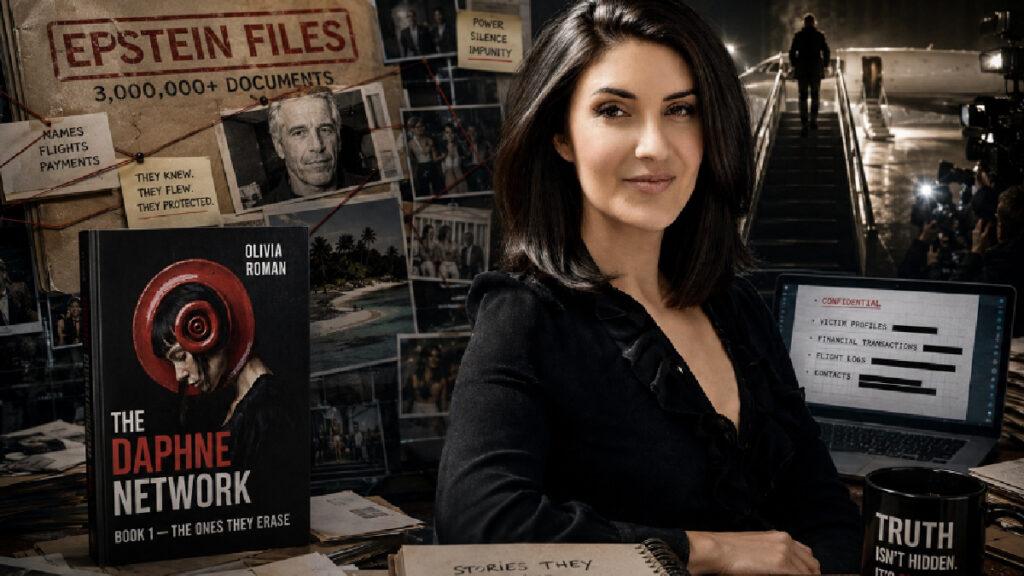
Novelist Olivia Roman confronts her Daphne Network (Those We Erase) with the three million documents contained in the Epstein Files.
Since January 30, 2026, and the release of the Epstein Files — three million documents, names, flight records and financial transfers — the most authoritative interpretations have largely come from criminologists. Alain Bauer sees a “system of systems.” Xavier Raufer sees the concealment of a “Third Culture,” in which money forgives everything. Olivia Roman has chosen a different path.
Intimately familiar with the language of institutions, which she has long observed, she does not document: she names. Her novel, Celles qu’on efface (Le Réseau Daphnée, Book One) proves nothing — and therein lies its freedom. There is no single mastermind, no roman à clef: instead, there is a grammar. Stamps, transfers, “supervised voluntary placements,” employees signing off without reading — and teenage girls selected because no one will come looking for them.
An interview with a novelist for whom fiction may be the only form still capable of confronting, as a whole, what the archives reveal only in disconnected fragments.
To order Olivia Roman’s novel: Celles qu’on efface (Le Réseau Daphnée, Book One)
Interview conducted by Roland Lombardi, Director of Le Diplomate média.
Le Diplomate: The Files have been online since January 30, 2026; your novel appears six months later. Coincidence, or did the times catch up with the book?
Olivia Roman: The timing means something, but it wasn’t calculated. I didn’t need three million documents to understand the structure: it had been legible for years in a single one, the 2008 non-prosecution agreement. What January 2026 changed is not what we know. It is what we can no longer pretend not to know. The novel didn’t chase the news; the news ended up resembling the novel. I would sincerely prefer the opposite.
You open on a civil servant validating a procedure in Bern on September 12, 2001, at 9:41 a.m. Why a man filing paperwork, rather than a crime?
Because crime, we think we know. Filing, we don’t. On September 12, 2001, the whole world was watching New York — the perfect day to validate a procedure; nobody reads the stamps while the towers are falling. Walter Frei is not a monster. He is a young man whose career is off to a good start, who never asked for this file and who processes it the way he was taught to process files. The evil I write about doesn’t need monsters. It needs employees.
Your author’s note walks a ridge line: « The historical facts cited are real. This novel is a work of fiction. » How do you hold it?
By refusing the two easy ways down. The first would be to let people believe it is all true — that is the regime of the roman à clé: unworthy of the real victims, legally reckless. The second would be to claim it is all invented, which would be a lie by omission: the mechanisms I describe — the agreement that immunizes, the file that sleeps, the jurisdiction that stops at the border — exist, documented, dated. So I hold the ridge this way: the facts are real, the names are fiction. I don’t fictionalize people. I fictionalize a grammar.
Your network has no arch-villain. How would you describe its architecture to someone who hasn’t read the book?
It isn’t a pyramid; it’s a procedure. There is a program, Hélios, then another that inherits from it, Daphnée. A code — ∆7-0 — that outlives the offices that use it. Foundations that finance, judges that seal, clerks’ windows that file. If you want an image: no one in an administration knows a file’s whole chain — each to his floor, each to his stamp. None of these people all know one another; they don’t need to. Each performs a legal gesture, or a nearly legal one, and it is the sum of the gestures that is criminal. Cutting off a head achieves nothing: the men pass, the procedure remains. That is what the reader must understand from the opening — and that is why the book begins with a case being filed, not with a murder.
À lire aussi : LIVRE – Le Grand Entretien avec Olivia Roman – Epstein Files : « Le crime n’a pas besoin d’être caché. Il a besoin d’être classé »
Alain Bauer, in these pages, described the Epstein system as a « system of systems »; Xavier Raufer speaks of camouflage by eminence. Your novel proposes a legal face that seals, and a hunger that signs nothing. What can fiction name that the investigation fragments?
Bauer and Raufer work under documentary oath: every sentence must rest on a piece of evidence. That is their strength, and it is their limit — an investigation proves fragments; it cannot prove a totality. The novelist proves nothing, and that is her freedom: she can name the totality without accusing anyone. My formula is that there are two layers. A legal face — agreements, immunities, signatures — with an address and letterhead. And beneath it, what that face sets in motion without ever signing it. The investigation will always reach the first layer. Only fiction can look the second in the eye, because fiction is the only one that owes it nothing. That is what makes it, in its way, more dangerous than a document: a document can be sealed. A grammar, once the reader has understood it, can never be taken back.
Raufer doesn’t stop at a criminological thesis: for him, Epstein is the servant of a « Third Culture » — the libertarian convergence of tech, finance and power, where money forgives everything. Your novel never utters the word ideology: nothing but procedure. Is the evil ideological or administrative?
The two theses aren’t looking at the same floor. Raufer describes the climate; I describe the plumbing. I will gladly follow him on one point: it takes a culture for the demand to exist and to feel forgiven in advance — a world where money absolves, where caste contempt makes certain lives negligible. But a culture is not enough to make a teenage girl disappear. For that you need a form, a validation chain, a statute of limitations. Ideology supplies the demand and the absolution; procedure supplies the execution and the forgetting. And of the two, procedure is the more disturbing, because it is the more durable: ideologies go out of fashion; forms are handed from office to office without losing a line. That is why my novel stands at the clerks’ windows rather than at Davos. If the Third Culture vanished tomorrow, another demand would come — and it would find the plumbing in perfect working order.
The network’s vocabulary — its lexicon — is « attributed to Lisa Carter, » a victim who died in January 2000. Why entrust the machine’s terminology to the girl it destroyed?
The machine already had all the words. Every term in that lexicon — erasure, voluntary placement, AVATAR-∆7 — was coined by people paid to make those words mean nothing. To render it in a dead girl’s voice is to reverse the burden: she defines the words that defined her. And I insisted that the document remain imperfect — it announces, itself, that it was never approved, that it must be read before correction. That is my definition of testimony: what escaped validation.
In your book, impunity works through the administrative gesture: an approved transfer, a « supervised voluntary placement. » Do the 2008 agreement and the Files confirm that intuition?
It is the most documented part of the real, and that is precisely the problem. The 2008 agreement is not a rumor: it is a document, with signatories, recitals, a date. A federal prosecutor, Alexander Acosta, uses it to turn a trafficking case into a lightened state proceeding; the immunity extends to potential co-conspirators the agreement doesn’t even bother to name; the victims, for their part, are not informed. A federal judge would recognize in 2019 that their rights had been violated — and the agreement held anyway. What the Files added is volume: proof that the exception was no exception, that there existed an ordinary regime of protection. Bauer is right to read it that way — not an anomaly, a regime. My novel says the same thing from the other end: crime doesn’t need to be hidden; it needs to be filed. The scandal is not in the shadows; it is in the stamp. One sentence in the book sums up everything I think about administrative vocabulary: « The word ‘transfer’ was lying. The girl had a destination. »
Your supporting characters carry the machine: Frei who validates, Tina Marlow who stays silent for twenty-eight years, Helen Morley who keeps the archives and says « I remember all of them » — and never speaks. Does impunity rest first on them?
Impunity is not a pact of silence; it is a division of labor. Frei validates without reading. Marlow keeps silent for twenty-eight years — not out of malice, but out of attrition and fear, because one more day of silence costs less than the first day of speech. Morley remembers all of them; in the book she says it as a verdict, not a point of pride. Bauer maps the protections from above — bankers, prosecutors, lawyers. The novel looks at the other side of the same coin: the ordinary employees without whom those protections would not hold. None of the three committed the crime. Without all three, the crime is impossible. That is why I give them as much room as the victims: the reader must ask which of the three he would have been.
Your victims have a precise sociology: Fall River and its dead textile mills; group homes, emergency placements, families who come asking for no one. The real victims of the Epstein system — teenagers from modest backgrounds recruited in Florida, poor girls promised modeling careers — fit the same profile. Does the crime begin in sociology?
It begins with a sorting, and the sorting is social. These girls are not chosen despite their poverty: they are chosen for it. Precarity serves two functions. A selection criterion, first — no one comes asking for a girl no one is expecting. A mechanism of impunity, second — the word of a teenager from a group home weighs less, before every institution, than a notable’s signature. The record documents it: the complaints gathered in Florida came from modest neighborhoods, and some of the victims had passed through social services; the Paris prosecutor’s office notes that Brunel offered modeling contracts to young girls from poor backgrounds. The Maxwell trial established the recruitment of vulnerable minors — the youngest was fourteen. One account, Christina Oxenberg’s, even reports Maxwell describing, as early as 1997, her scouting runs through the trailer parks of West Palm Beach; it is testimony, not a verdict, and I cite it as such. Raufer, for his part, situates that recruitment within the caste contempt of his « Third Culture »: girls perceived as unimportant, therefore consumable without risk. Class contempt is not this affair’s scenery; it is one of its gears — those who spoke of « white trash » were stating, without understanding it, the recruitment specifications. My novel is built on that. Fall River is not picturesque scenery; it is a condition of possibility: a town that closes its mills produces what the network consumes — teenage girls no one will come looking for. And my title says the rest: we erase those we have first classed as unimportant. Erasure is only the second operation. The first is the sorting — and that one, all of us do.
The French civil parties speak of a « troubling series of deaths. » Without speculating: what can a novel say about how an institution protects itself, where the investigation must stop at the facts?
I will not fictionalize real deaths, and I will hold to that in this interview: the official causes are established, and the framing « series of deaths » belongs to the civil parties — it is their right as litigants; it is not my material. What a novel can say is something else, and perhaps more disturbing: how an institution metabolizes its own faults. It does not deny them. It archives them. It turns a fault into a file, a file into a procedure, a procedure into a delay; at the end of the delay there is no fault left — there is a documentary holding. American law has even given this mechanism a name, in spite of itself: victims’ federal rights only fully take effect once charges are filed. Close the case without indicting, and their voice is neutralized before it even exists in law. The victims of the 2008 agreement were still receiving letters assuring them the investigation was ongoing when the agreement had already been signed — an administrative letter that lies: I know no more accurate description of what my network does. No conspiracy in any of it. Just management.
Your network crosses Switzerland, the United States, jurisdictions that don’t speak to one another. Where do you draw the line between criminal network, intelligence tool and pure predation?
I’m going to disappoint you: it moves. The line is usage, not nature. The same list of names is a victims’ file to a judge, an asset to a blackmailer, a risk to be covered for an administration. Predation produces information, and information always seeks its market. That is why my network thrives in the gaps between jurisdictions: every border is a place where a question stops being asked. Classic organized crime wants money. Mine wants worse — it wants to be unauditable.
Raufer rules out support from official services but does not exclude non-institutional structures; Bauer describes a formidable tool of blackmail and insider dealing. Where does your novel stand — and where do you refuse to tip into conspiracism?
I tip over at the precise moment the hypothesis becomes comfortable. So I stop just before. Conspiracism is a form of laziness: it replaces a hundred ordinary signatures with a single hand — and, at a stroke, it acquits the hundred signatories. That is a comfort I deny the reader and myself alike. Raufer’s caution is a criminologist’s: assert nothing the evidence does not establish. Mine is a novelist’s: I don’t need an intelligence service behind the door. The clerk’s window is enough. If my reader closes the book looking for a puppet-master, I have failed. If he closes it looking differently at a rubber stamp, I have succeeded.
The purely geopolitical question: can states knowingly tolerate such architectures because they are useful to them? Does your trilogy answer?
It leaves the question open, but it does not leave it neutral. The states in my book never sign anything. They abstain. They abstain from cross-checking two databases, from putting a question to a partner, from rereading an old agreement. Abstention is the diplomatic form of consent: it leaves no trace and produces the same effect. As for the real world, I keep to what the investigators say — and to the fact, troubling in itself, that the question of state use of such a network can be raised seriously by criminologists without anyone finding it absurd.
In February, the French executive stated that the affair « mainly concerns the United States. » The United States, for its part, ended up publishing three million documents under a transparency act. Does each country confess in its own way?
You will not hear me handing out good or bad marks to governments — that is neither my role nor my register. What I can say as a novelist is that every institution confesses in its own language, and that the confession is rarely what it seems. Publishing three million documents — is that transparency, or a way of making the essential unfindable in the mass? My network knows that gesture well: it doesn’t hide, it drowns. And conversely, delay — the time an institution takes to feel concerned — is the main character of my book: in my pages, a delay is never a lag; it is a tool. I say this of no country in particular. I say it of every architecture I describe: they almost never lie. They wait.
You are French, the affair now has a massive French chapter, and your novel keeps France entirely at a distance: not one French scene. A writer’s choice, or a cautious one?
Both, and I own them in that order. Writing first: proximity kills the scalpel. One scene on Avenue Foch and the book became a roman à clé — every reader would have hunted for the real names behind mine, and the mechanism, which is my true subject, would have vanished behind the guessing game. Bauer, as it happens, puts Paris as the first word of his subtitle: the French chapter is not secondary, and I don’t claim otherwise. We simply do inverse jobs — he must establish the addresses; I must make the mechanism recognizable. Caution second, and I don’t blush at it: investigations are open, real people are named without being guilty of anything, real victims are speaking now. That ground belongs to the courts and to journalists. I wanted the French reader to recognize the mechanism, not the addresses.
It is Switzerland you choose as the place of the sealing. What does neutrality allow that Paris or Washington would not?
Neutrality is a perfect narrative machine: a country whose historic function is to take no side is the ideal setting for a signature that commits no one. Bern, in my prologue, hides nothing — it files. That is not secrecy; it is procedure, and the difference is decisive: secrecy gets pierced; procedure gets respected. Washington would have given the book the color of a political thriller, Paris the color of an affair of state. Switzerland gives the color I was after: a beige wall, well maintained, behind which officially nothing happens.
The book’s only French trace is a phone number: the 119, France’s child-protection hotline, in your opening notice. A statement of intent?
Yes — the most important one in the book. It is the only sentence addressed not to the reader but to someone who might need it while reading. A novel about erasure had to begin with a number that cannot be erased. If a single person dials that number because of these pages, this book will have served a purpose literature doesn’t measure.
Seven years passed between the revelations of 2019 and the opening of a French judicial chapter. Does that long interval have an equivalent in the rest of your trilogy?
There are, in what follows, institutions that take a very long time to open their eyes again. And others that never close them — which is worse, because they are watching. I will say no more: the trilogy runs from 1977 to 2025, and what it owes to current events, it will pay in due course.
To speak the horror, you choose the coldest language there is: the lot, the profile, the filing. Why that register rather than pathos?
Because it is the language the crime chose for itself. These crimes were not committed in lyricism; they were committed in spreadsheets, calendars, dispatch slips. To take up that language is to turn it against itself: when the reader sees « lot » and understands what the word covers, he is the one doing the translation — and that translation belongs to him; it is irreversible. Pathos, by contrast, consoles. It tells the reader: you have wept, you are quits. I do not want my reader to be quits.
How do you write predation without ever making it desirable, without serving the system you denounce? What rules do you forbid yourself to cross?
My rules are written down, and they are absolute. The act is never shown: it exists only through its traces — files, codes, consequences. No victim’s body is ever described in the present tense of the crime. The network’s demand is quoted like an accounting entry, never staged: it must appear, because it is the accusation itself, but it appears cold, for the prosecution, from the point of view of those documenting it in order to destroy it. And one final test settles everything: if a sentence could serve the system it describes — aestheticize it, excuse it, make it imitable — it goes. I have cut entire pages on that test.
Your victims are never shown at the moment of the crime; they return through their files, their voices, their traces. A moral position or a literary one?
It is the same position, taken from two ends. Moral: to show the crime is to commit it a second time by literary means, and I hold that one has no right to. Literary: the trace is more powerful than the scene, because it makes the reader do the judge’s work, not the voyeur’s. When Lisa Carter returns through a never-approved lexicon rather than a flashback, she returns as the author of something — not the object of something. The whole difference of the book lies there.
If the three million documents say the « what, » what does your novel say that the archives never will?
The consent of the lukewarm. A document proves who signed, when, under what reference. It will never say what signing feels like — the ease of the gesture, the coffee going cold beside it, the career going on. The archives establish responsibility; the novel establishes banality. And of this whole affair, banality is the only thing reproducible everywhere.
Your first part opens with this sentence: « Twenty-five years separate these two cities. The network, for its part, still circulates. » Is that the book’s thesis?
It is its thesis and its anxiety. Cities change, men die, programs get renamed — and the circulation goes on, because it depends on none of them. The question twenty years of investigations leave open is exactly that one: was the system dismantled, or merely renamed? It stops only on the day someone, somewhere, decides not to sign. The whole novel is looking for that person. I won’t tell you whether it finds them.
Celles qu’on efface, 1977–2025, first volume of a trilogy. What would you want the reader to take away?
That erasure is a job. It has working hours, employees, forms, paid leave. We erase the ones we believe don’t matter. The title is a promise: what has been erased can be read again. A line in the novel says the system always found them. I want the reader to close the book with the opposite: someone, one day, always finds them again.
À lire aussi : ANALYSIS – Ceuta: Trump Denounces a “Catastrophe” and an “Invasion” – 50,000 to 60,000 Migrants, Madrid Under Fire
The Book :
Olivia Roman, The Daphne Network — Book 1: Those We Erase (Le Réseau Daphnée — Tome 1 : Celles qu’on efface), Librinova, published August 20, 2026 (EAN 9791043912931).
Currently available in French, as an e-book, on Librinova, Amazon, Fnac, Cultura, Kobo, Apple Books, Google Play and 200+ online retailers.
Order: https://www.librinova.com/librairie/olivia-roman/le-reseau-daphnee-4
Book 2, « Ceux qui orchestrent » (« Those Who Orchestrate »), forthcoming.
Works cited :
Alain Bauer, La vérité sur le système Epstein : Paris, Londres, New York… le réseau criminel mondial qu’ils ont voulu cacher (« The Truth About the Epstein System »), First, 2026.
Xavier Raufer, Jeffrey Epstein : l’âme damnée de la IIIe culture (« Jeffrey Epstein: Lost Soul of the Third Culture »), Éditions du Cerf, 2023.
See also: our in-depth interview with Alain Bauer (Le Diplomate Média, June 2026).
#EpsteinFiles, #OliviaRoman, #DaphneNetwork, #ThoseWeErase, #CellesQuonEfface, #JeffreyEpstein, #EpsteinDocuments, #EpsteinInvestigation, #EpsteinCase, #EpsteinNetwork, #GhislaineMaxwell, #InstitutionalCorruption, #InstitutionalFailure, #SystemicCorruption, #OrganizedCrime, #CriminalNetworks, #CrimeAndPower, #PowerAndImpunity, #EliteImpunity, #BureaucraticViolence, #AdministrativePower, #PoliticalCorruption, #FinancialCrime, #SexTrafficking, #HumanTrafficking, #VictimsRights, #CrimeLiterature, #PoliticalThriller, #GeopoliticalThriller, #CrimeFiction, #PoliticalFiction, #InvestigativeFiction, #LiteraryThriller, #FrenchLiterature, #ContemporaryLiterature, #AlainBauer, #XavierRaufer, #EpsteinTransparencyAct, #LeDiplomate, #GrandInterview