ANALYSIS – REMIGRATION: Facing the “Migrant Invasion”, the EU Finally Emerges from Denial Under Pressure from Trump and Vance
By Angélique Bouchard
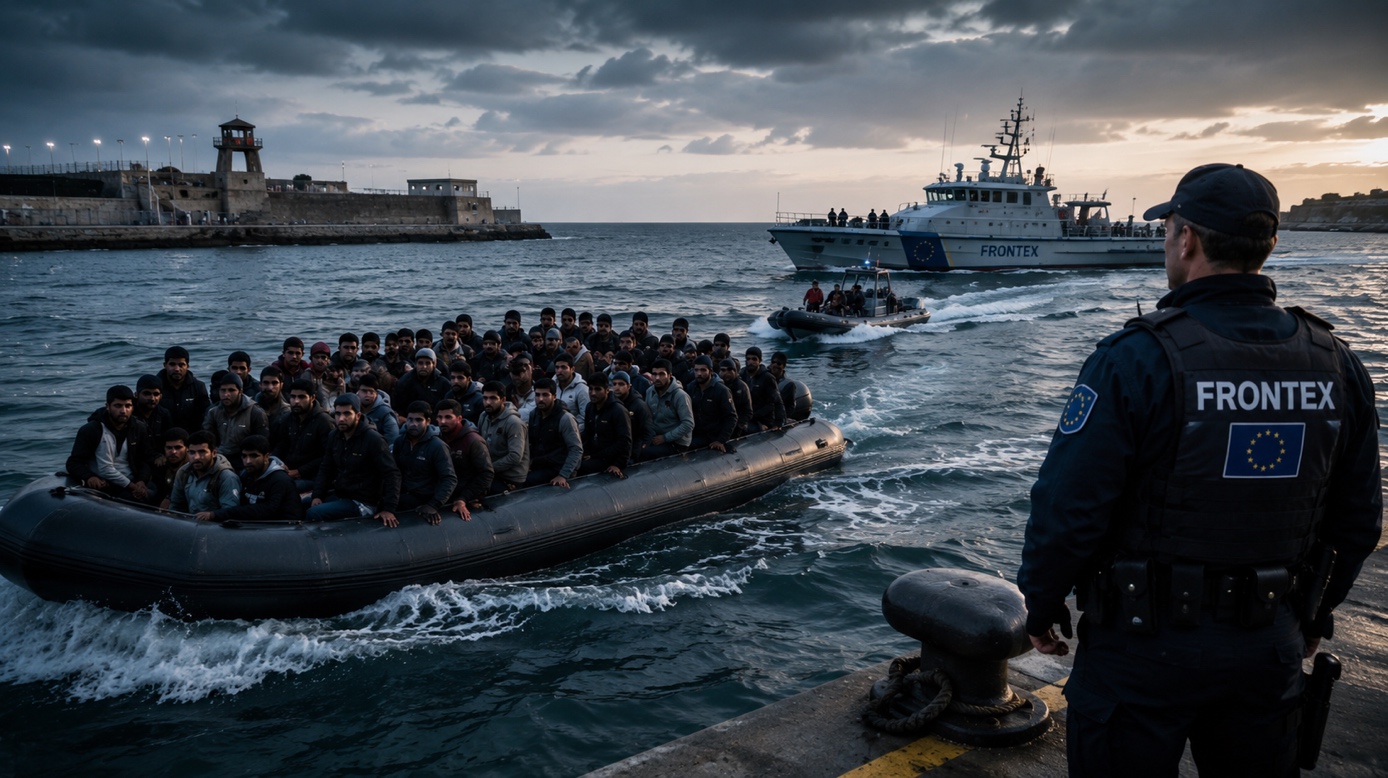
For a long time deaf to the repeated warnings of Donald Trump and his administration, the European Union has finally validated, in early June 2026, a significant tightening of its migration policy.
For the first time, European institutions have adopted a set of measures providing for systematic screening of asylum seekers, the widespread use of biometric data, and the possibility of creating deportation centers located outside the territory of the Union.
This shift comes as several American political figures believe that Europe has waited too long to respond to what they describe as a “migrant invasion” with profound consequences for the security, culture, and cohesion of European societies.
À lire aussi : ANALYSIS – International Competition Governance,
Warnings Long Ignored, Now Impossible to Dismiss
As early as September 2025, during his speech to the United Nations General Assembly, Donald Trump issued an unequivocal warning to European leaders: “You’re destroying your countries. Europe is in serious trouble; it has been invaded by a force of illegal aliens like nobody has ever seen before.”
Vice President JD Vance went even further following the murder of British student Henry Nowak, who was stabbed to death in Southampton in December 2025. In a scathing statement, Vance accused European elites of having “[abandoned](D:\\ww.foxnews.com\\world\\jd-vances-warning-europes-future-shines-spotlight-continents-growing-list-problems)” their civilization:
“Henry Nowak died the same way a civilization dies: abandoned, handcuffed by authorities who neither trusted nor cared for him, and accused of hate crimes he did not commit. His murder is as tragic as it is enraging. He should still be alive today, and he would be if the last few generations of European elites had stood their ground against the politics of self-hatred and the mass invasion of migrants, many of whom despise the West and the people who love it.”
Secretary of Defense Pete Hegseth also sounded the alarm during the D-Day commemorations in France:
“Sadly, today, different European beaches are being stormed by different dangerous ideologies. Boats and men are arriving on the beaches of Spain, Italy, Greece, and Bulgaria. When will European capitals finally do something about that invasion? Or is it too late?”
These statements, long dismissed as exaggerated by parts of the European elite, are now finding growing resonance in several European capitals.
À lire aussi : ANALYSIS – Competition, Development and the
A Still Timid and Uneven European Tightening
The new European agreement stipulates that asylum seekers will be subjected to prior screening regarding their identity, security, and health status before even entering the asylum procedure. Member States will be required to share information on entries and exits of third-country nationals and to use biometric data (fingerprints and facial recognition). The text also provides for the possibility of creating deportation centers located outside the territory of the Union.
While this package marks a real change in tone, its effectiveness remains uncertain. Divergences between member states remain deep, and implementation will largely depend on the goodwill of national governments. Moreover, the text does not fundamentally challenge the right to asylum itself, which limits its scope in the face of the massive flows observed in recent years.
À lire aussi : ANALYSIS – Trump Warns China of ‘Big Problems’ Over Iran as X
Radically Opposed National Positions
Italy under Giorgia Meloni has chosen a firm policy that has already produced concrete results: irregular arrivals have dropped sharply thanks to an agreement with Albania and enhanced cooperation with transit countries. This policy is part of a broader line of defending national sovereignty, which contrasts with the trend observed in other European countries in recent years.
By contrast, Spain has taken a diametrically opposed approach by regularizing nearly 500,000 undocumented migrants. Javier Negre, director of the newspaper La Derecha Diario, sees this as an incentive for illegal immigration encouraged by certain NGOs: “When undocumented migrants arrive, they get papers and social security. NGOs have made a big business out of promoting illegal immigration.”
Denmark, which will assume the EU presidency in July 2026, has led a coalition of nine countries (Austria, Italy, Poland, the Baltic states, among others) demanding greater leeway to deport migrants who have committed crimes. In a letter addressed to the European Court of Human Rights, these states argue that the current interpretation of the European Convention on Human Rights undermines their sovereignty and prevents them from effectively protecting their citizens. They notably call for the ability to “take effective steps to counter hostile states seeking to use our values and rights against us, for example by instrumentalizing migrants at our borders.”
À lire aussi : ANALYSIS – Marco Rubio: The Cuban-American Pivot of
Remigration: From a Marginal Concept to a Structured Political Proposal
The concept of remigration — understood as the organized, voluntary or forced return of non-integrated immigrants to their countries of origin — represents one of the most notable developments in the current European migration debate. Long confined to the fringes of the far right, it is gradually emerging into the public debate, particularly in Italy.
On June 5, 2026, in Busto Arsizio near Milan, the Remigrazione e Riconquista committee publicly presented a ten-point legislative proposal explicitly addressing this issue. The text notably provides for:
- The introduction of financial incentives to encourage foreigners to voluntarily return to their country of origin;
- The systematic expulsion of individuals in an irregular situation;
- The expulsion of naturalized Italians convicted by the courts.
This legislative proposal, supported by nationalist-revolutionary movements such as CasaPound Italia and other far-right organizations (Rete dei Patrioti, Veneto Fronte Skinheads), is part of a strategy aimed at the gradual normalization of the remigration concept. The organizers notably observed a minute of silence in tribute to Henry Nowak, the British student stabbed to death in Southampton, presented as an emblematic victim of the consequences of uncontrolled immigration.
The radical nature of this proposal and its inclusion on the Italian political agenda illustrate a shift: what was once considered an extreme position is now becoming the subject of concrete legislative proposals, with militant structuring and an attempt to scale it up nationally (a nationwide tour was organized, with a rally planned in Rome on June 13, 2026).
This phenomenon reveals a dual dynamic. On the one hand, a radicalization of part of public opinion in response to the persistent failure of integration policies and the perception of a loss of border control. On the other hand, an attempt to normalize the concept of remigration by translating it into precise legislative proposals rather than mere slogans. While this movement is still driven by far-right organizations, its ability to mobilize and structure a coherent political discourse around the return of non-integrated immigrants makes it a phenomenon worth closely monitoring in the coming months and years.
À lire aussi : ANALYSIS – State Aids, Energy Sovereignty and the Nuclear
A Structural Failure of Integration and Sovereignty
Beyond immediate security concerns, several observers point to a deeper problem: the failure to integrate part of the populations that have arrived in recent years. Alan Mendoza of the Henry Jackson Society estimates that “the EU’s demographics are changing Europe’s culture. We now have to deal with populations that are not integrating into local customs.”
In Spain, Javier Negre denounces a rise in petty crime committed by some of the new arrivals who, in his view, “do not share the same values.” He adds: “We are importing a lot of people, and some realize they can steal iPhones and wallets.”
These observations align with concerns expressed by several European countries regarding the emergence of “parallel societies” and the rejection of the fundamental values of host countries.
The Economic Impacts of Mass Immigration
Mass illegal immigration also has significant economic consequences, often underestimated in public debate. The direct costs associated with reception, housing, healthcare, and education of new arrivals weigh heavily on the public finances of several member states. In many countries, these expenditures far exceed the tax contributions of the individuals concerned, at least in the first years following their arrival.
Furthermore, the massive influx of low-skilled labor exerts downward pressure on wages in certain sectors (construction, agriculture, personal services). While this may benefit some employers in the short term, it weakens the least qualified workers in host countries. Finally, money transfers to countries of origin (remittances) represent significant capital outflows for European economies.
In the Italian case, the firm policy pursued by the Meloni government has led to a significant reduction in irregular arrivals. This decline has mechanically reduced expenditures linked to emergency reception and detention centers. Italy, which already has a very high level of public debt, sees this control over migration flows as a way to limit additional budgetary pressure. By contrast, countries that have opted for mass regularizations or a more open reception policy bear structurally higher costs in the long term, both in terms of social spending and pressure on public services.
*
* *
The European Union finally appears to be emerging from a long period of denial regarding the consequences of mass illegal immigration. The new rules on biometric screening and offshore deportation centers mark a real change in tone. However, national divergences remain deep, and the implementation of these measures is likely to be complex and partial.
Between Italy’s firm approach, Spain’s opposing choices, the radicalization of part of public opinion around “remigration,” and calls for greater sovereignty led by Denmark and its allies, Europe is entering a phase of more direct confrontation with a reality it has long refused to name. The warnings from Trump, Vance, and Hegseth were not provocations, but diagnoses. Europe is beginning to hear them. But the accumulated delay is such that demographic, cultural, security, and economic fractures risk worsening before sustainable solutions can be implemented. The continent may no longer be at the stage of prevention, but rather at the stage of managing a crisis that is already well advanced — and whose political and social consequences could intensify further in the years to come.